
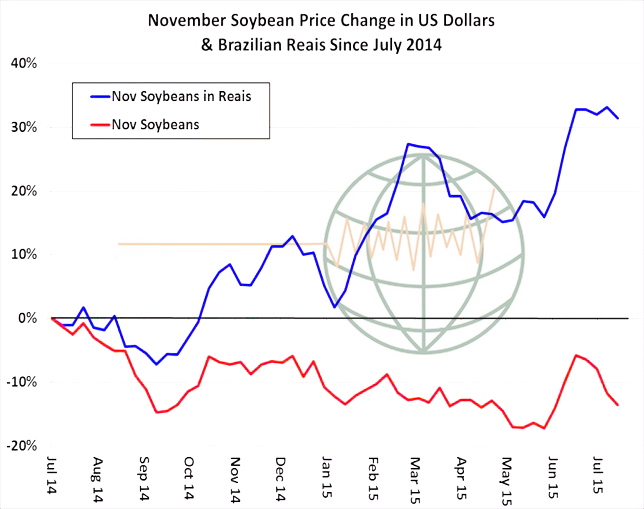
- The chart below illustrates the advantage that the declining value of the Real is offering to Brazilian farmers – and why their 2015/16 soybean acres are likely to rise another 3-5% to a new record high. Although CBOT soybean futures are off 6% since the start of 2015, the Brazilian Real has declined MORE than 30%, which at $10.00 soybean futures has added an equivalent of $3/bu to Brazilian farm income. Brazilian farmers will start soybean seeding in about six weeks and they are cheering (equivalent) $13 soybeans! This is an economic saga for the US farmer since he/she is struggling with at or below breakeven prices and he hopes that others cut their production. The rising US$ is enhancing foreign grain and soybean production to the chagrin of the US producer. He/she is the one that will have to either cut inputs or seeded acres.
- Yesterday saw soybeans rally (as anticipated) from Monday’s price onslaught! Since the July 14th price high, a mere two weeks ago, November futures have fallen $1.13/bu, or roughly 11%. The market is within 35 cents of the contract lows and the debate remains as to how many, or how few, soybean acres were not seeded in 2015, and the inevitable impact upon overall output. Recall that NASS has resurveyed planted acreage in some states, albeit too late for the July WASDE report, but this should percolate through into their August release and potentially produce a positive report! With mostly adequate soil moisture levels it will be Central US temperatures that will be most important to US soybean yields this year. Current forecasts call far near to below normal temperatures from late this week, and this will favour podding and pod filling. Forecasts into mid-August again lean favourable for yield and trendline levels should not (yet) be written off. Farmer selling has declined in the recent price fall but cash basis has firmed accordingly. Further rallies will likely see improved farmer selling, which will cap upside. Additionally, we should not forget that Chinese demand for US soybeans is, at best lacklustre, through to November and even December. Accordingly we are more wedded to our view that season highs are in place.
- In corn we also saw a “Turnaround Tuesday” following the market’s two day price lashing, although a three cent turnaround does not appear to be too convincing! Fresh market news is sadly lacking! Argentine fob premiums remain some 40 cents below US Gulf and Brazilian export commitments are growing, both adversely impacting US opportunity. US weather is favourable, and some 25-30% of the crop is in dough stage by the end of this week. Forecasts are consistent with a good mix of light to moderate precipitation and sunshine – all conducive to crop development. Modest crop rating improvements are anticipated in the next few weeks. China is experiencing huge difficulty in selling off its sizeable state reserves into its domestic market with a suggestion that only 3.4 million mt have been successfully auctioned out of an estimated 150 million mt stockpile. Chinese prices have declined around 20% since late May. We suspect that there could well be further liquidation into the week and month end, and if US national yield reaches 164-167 bushels/acre ten “fair value” would appear to be in the $3.60-$4.00 (basis December futures) range. Rallies look a fair bet to sell into right now.
- Chicago wheat markets gained 3-9 cents with Chicago outpacing the premium Minneapolis contract. The Wheat Quality Council, who have been conducting a crop tour in the N Plains, have placed some ND yields at or above last year. In Russia the Rouble has fallen to a 20 week low with planting decisions to be made in a few short weeks. The Rouble vs. US$ has fallen 20% since early May and is hovering just above the January lows. The impact is that the July 2016 contract price in Roubles stands at 11,800/mt compared with 7,000/mt exactly 12 months ago! Clearly the likelihood of reduced planted acres is looking remote! This perhaps exemplifies just how critical currencies are to non-US exports and non-US seeding intentions. Aussie weather forecasts are calling for heavy showers across W Australia, which will go a long way to replenish soil moisture ahead of the critical growth phase that starts in August. Overall, wheat has seen a bounce from its technically oversold condition and as downside targets have been met (for now) we would continue to look at further rallies as a selling opportunity.