
- The USDA has today released its weekly export figures as detailed below:
Wheat: 344,700 mt, which is within estimates of 300,000-700,000 mt.
Corn: 1,627,300 mt, which is within estimates of 1,250,000-1,750,000 mt.
Soybeans: 606.900 mt, which is within estimates of 600,000-1,000,000 mt.
Soybean Meal: 187,200 mt, which is within estimates of 100,000-275,000 mt.
Soybean Oil: 34,600 mt, which is within estimates of 50,000- mt.
- Brussels has issued weekly wheat export certificates totalling 755,414 mt, which brings the season total to 29,879,121 mt. This is 1,92 million mt (3.0%) behind last year.
- Favorable weather, and vegetation health at or above last year, has been well documented across Europe and the Black Sea. Warmer weather is desired across W Europe as the crop begins the grain fill stage, but damaging cold is not projected. Weather across the Black Sea regions will be nearly perfect through the first week of June. We project a moderate hike in combined EU and Black Sea wheat yield in the next one to three USDA WASDE releases, and amid lacking demand growth, surpluses will continue to build. Already the USDA projects combined EU, Ukrainian and Russian production to exceed domestic use by 67 million mt, vs. a surplus of 70 million in 2015/16. It looks like the EU/Black Sea wheat surplus could reach a record 71 million mt in 2016/17 with normal early summer weather.
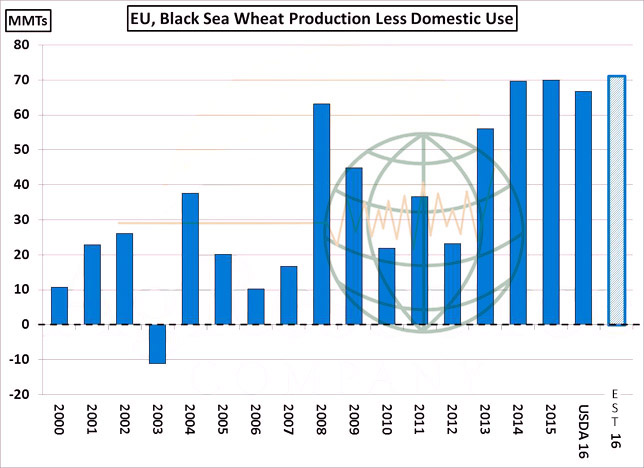
- The full combined balance sheet is below. Notice that despite an 1.3% drop in area, total EU & Black Sea supplies will be a record large 283.7 million mt, up 4 million from the USDA’s estimate amid a 1 million mt production gain in Russia, a 1 million mt gain in Ukraine and a 2 million mt boost in Europe. Domestic use is projected slightly below the USDA, as EU feed consumption will likely be cut amid larger available corn supplies. End stocks are projected higher by a like amount. Combined exports (if achieved) at 71.5 million mt are the largest on record, which amid steady/weaker global trade will leave little room for US export demand growth. New crop cash prices are already weakening, and it’s left to the US Gulf market to follow if the US’s share of world wheat trade is to be increased.

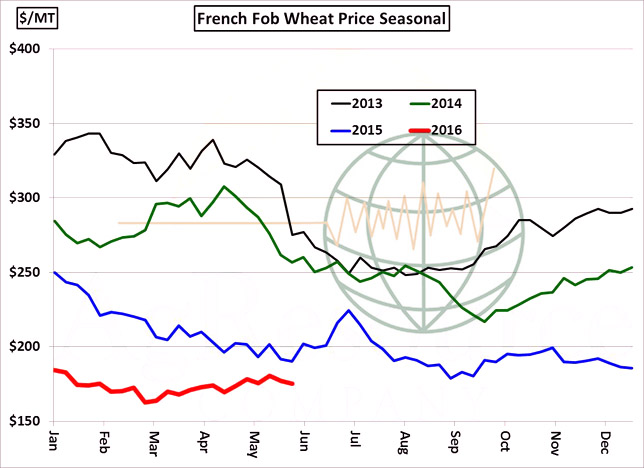
- World cash wheat prices have turned lower this week, but additional downside risk remains into the N Hemisphere’s spring wheat harvest. The attached graphic shows French fob prices for the last three years, and a fairly strong seasonal trend appears. World wheat markets typically bottom in Aug/Sep, with June to August losses since 2013 ranging from 8-10%, which in 2016/17 projects a seasonal bottom at $157/mt. Interestingly, this also aligns with major exporters’ stocks/use analysis. At this price global wheat will also better compete with corn for feed consumption. The next leg down in US futures will be led by world cash markets. A weaker trend is expected over the next two to three months, and US futures should find a more lasting bottom at $4.00-4.20, basis spot Chicago.
- The International Grains Council (IGC) has released its most recent crop estimates which forecast 2016/17 global wheat output at 722 million mt, a 5 million month on month increase, down from 736 million mt last year. Global corn output was forecast at 1,003 million mt, an increase from 998 million mt last month and also a year on year increase from 971 million mt. Clearly grain supply appears to not be lacking according to the IGC!
- Today has seen a suggestion that Chinese soybean meal is actually very close to calculating into the west coast of the US and this has sparked something of a profit taking move in Chicago in advance of the long weekend holiday break. The $160/ton rally in spot Chicago futures is historic in a non-drought year and from a technical perspective the market is severely overbought and in dire need of correction, but a top is not evident at this time.
- Brazilian and Argentine farmers are smiling! The price of soybeans in Reals or Pesos reached record highs this morning. As we have previously reported, interior and port prices for soybeans and corn have never been higher in local currency in S America. The high corn price is causing domestic livestock producers to ration feed demand, but in the case of looking forward to 2017, producers would seem likely to expand. Importantly, Brazilian farmers are selling ahead. We have heard reports of record forward Brazilian soybean sales for the new crop growing year with a crop that ranges from 102-110 million mt. Its appears to be good times for S American agriculture.