
Happy New Year to all our readers and we wish everyone a successful and prosperous 2013.
The start to the year has reflected pretty much “more of the same”, fund selling particularly in soybeans, which has left the bean market firmly in a downtrend. The technical picture is bearish but looks very oversold right now and due for a correction but we would caution against stepping in right now, as the trend is still intact. The old adage about “catching a falling fridge” should not be forgotten at present.
The on-going fund selling in soybeans has largely been brought about by S American crop prospects. Argentina’s Buenos Aires Grain Exchange (BAGE) reports their crop at 85% planted, which is up nearly 5% week on week and the USDA attaché sees the 2012/13 Brazilian soybean crop at 83 million mt, which is 2 million mt above the last USDA estimate.
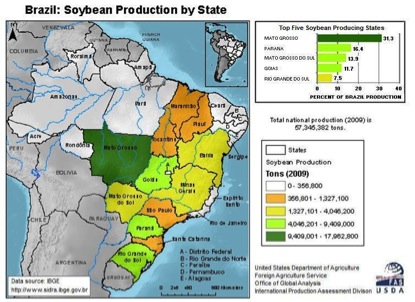 Weather conditions in Brazil are mixed, with Matto Grosso (the largest soybean producing state) showing early moisture stresses and deficit. December’s rainfall in the region has only amounted to 35 to 50% of normal and the deficit has grown to 100 to 150 millimeters in the key central region. However, the prospects in other states look better; Parana and Rio Grande do Sul both received good rains during last month. Matto Grosso do Sul needs further rainfall to achieve its potential. All in all, January and February will be key months for rainfall and its effect on the soybean crops.
Wheat markets have fared slightly better than soybeans, in other words they have not fallen as much! Globally we still see tightness in traditional sources of supply; Black Sea, Argentina and the EU. The US currently represents the cheapest source of wheat in the world and we are seeing an increase in the size of fund net short positions. We find this somewhat incongruous from a trade perspective and would not wish to be short of the cheapest global source of anything, let alone wheat!
The latest USDA crop condition report, issued on 2nd January, showed that wheat condition had deteriorated in December in both Kansas and Oklahoma. The expectation was for improved crop condition following increased precipitation.
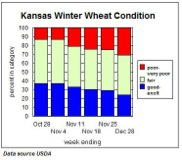 Kansas’s wheat rated as good to excellent fell to 24% from 46% a month ago, whilst the crop rated poor to very poor increased to 31% from 25%.
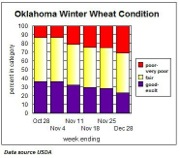 The figures for Oklahoma over the same time frame were 11% good to excellent, down from 14% whilst poor to very poor increased to 61% from 44%.
The graphics show a clear trend of declining condition resulting from dry early conditions leaving the crop poorly developed, late going into dormancy thereby adding to stress levels by prolonging the very poor growing season, then being hit by cold winter conditions and freezing temperatures. The next USDA crop condition report is a month away and we will be looking closely to see if there is any sign of a reversal of the current trend.
In conclusion, we acknowledge the sizeable price declines but continue to view fundamentals as projecting a potentially bullish picture. However, until we see some clear sign of a change in the current downward trend, we have to sideline for now. The picture looks to be set for a potential “bear trap” hence our sideline rather than short stance.