
- HEADLINES: Chicago rallies on the lack of bearish surprises.; US corn, soybean and wheat stocks are historically tight; Largest 2021/22 corn stocks of the year?
- Chicago futures are holding their morning gains based on a neutral to slightly positive July USSA crop report The report confirmed the USDA’s conservative nature in adjusting US/Canada and Brazilian crop estimates. We believe that the USDA will further cut its Canadian crop and Brazilian corn crop estimates in August and September based on adverse weather. Brazil will suffer another freeze late this week.
- US 2021 /22 corn end stocks at 1,432 million bu is likely to be the high of the crop year based on a record US corn yield of 179.5 bushels/acre. Remember that the record US corn yield is 176.6 bushels/acre set back in 2018. We, and private analysts, gauge the 2021 US corn yield between 172.5-177.5 bushels/acre due to N Plains drought. US soybean yields depend on August weather. NASS made a sharp downward adjustment on US spring wheat/oat and barley yields based on the worsening drought across the N Plains. The loss of wheat, oats, canola, and other small grain crops is going to have a bullish tailwind that lasts well into 2022 based on Canada’s importance with world exporter corn, soy and oilseed stock/use ratios at record lows.
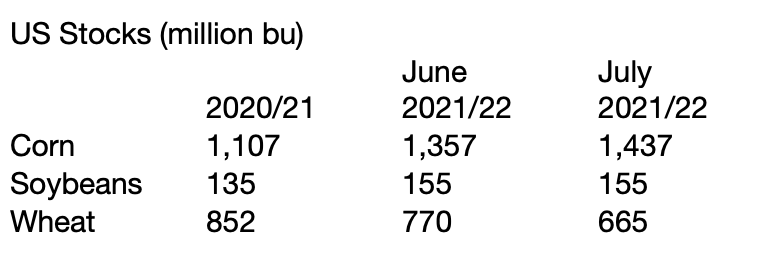
- The USDA raised their estimate of 2020/21 corn feed/ residual use by 25 million bu to 5,725 million and cut end stocks to 1,082 million bu. We would argue for another 25-50 million bu increase in feed/residual based on the June stocks data. However, following the recent erratic quarterly changes in US corn stocks estimates, the USDA decided to be conservative. No change was made to the US ethanol grind even with the US gasoline demand running hot in the post pandemic economy. We maintain that US ethanol use should rise another 50-75 million bu which will drag 2020/21 US corn stocks to well under 1,000 million bu.
- US 2021 /22 corn production was raised 180 million bu based on an additional 1.0 million harvested acres found in the June Seeding Report. The USDA held yield at trend at 179.5 bushels/acre citing that there was crop stress across the N Plains and NW Midwest, but that the index was not low enough to justify a July yield cut. US 2021/22 corn end stocks rose 75 million bu to 1,432 million with an average farmgate price at $5.60 (down $0.10/bu).
- The US soybean 2020/21 and 2021/22 balance sheets were completely unchanged from June with stocks of 135 and 155 million bu, respectively. Such stocks are historically tight and reflect zero room for adverse weather. A 1.8 bushels/acre drop the 2021 US soy yield would eliminate projected 2021/22 soybean end stocks. Really a 2021 US soy yield less than 49.5 bushels/acre is unacceptable. China’s 2021 /22 soybean imports were adjusted down by 1 million mt to 102 million. The risk in Chicago soy futures is to the upside.
- NASS pegged US all wheat production 1,746 million bu, vs. 1,898 million in June amid major cuts to spring and durum yields. Combined spring/durum production is estimated at 382 million bu, down 207 million from USDA’s implied forecast in June and down 273 million (42%) from last year. US wheat stocks were placed at 665 million bu, vs. 770 million in June. The loss of spring production will accelerate US stocks contractions, which persists into 2022/23 unless sizeable acreage expansion of 1.0-1.5 million is encouraged (via price?). 2021/22 HRS stocks are forecast to drop to 119 million bu, vs. 235 million in 2020/21, which assumes demand rationing of 131 million bu. Such spring wheat demand rationing only occurs at much higher prices.
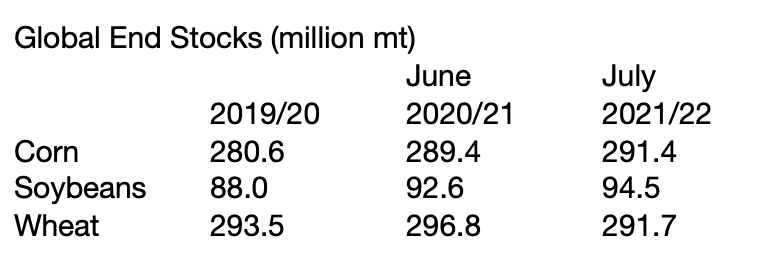
- Major exporter wheat production is pegged at 409 million mt, down 2.7 million from June and up just 2.4 million from last year. Russian production was down 1 million mt at 85. This along with a cut to N American production worth 4.6 million mt more than offset modest hikes in Europe and Ukraine. Exporter wheat stocks in 2021/22 fall to 60 million mt, a new 8-year low. Exporter stocks/use is calculated at 14.2%, a new 14-year low. The long-term bull trend in world wheat markets will be extended into the winter months. We also note that further downgrades to production in Canada and Russia are anticipated in August.
- Chicago futures will go back to counting raindrops, but midday model guidance maintains the return of dryness across the Central and Northern Plains into July 25. Temperatures warm with time. US/exporter stocks are historically tight even assuming trend US corn/soy yields. Demand-led bull markets is in the market’s future. The 2021 Canadian drought is a big deal with a canola/wheat crops that could easily be 5-7 million mt smaller that WASDE is forecasting.