21 December 2012

  • As anticipated we have had something of a rebound today after yesterday’s sharp decline in prices.
  • Profit taking on short term positions ahead of the extended break are likely to be the culprit. We will be watching very closely to see if it is the proverbial “dead cat bounce” or a return to normality when we come back in 2013.
  • Fresh news is thin on the ground, other than surviving the “end of the world” which is now a bit of a weary topic!
  • We close this evening wishing one and all a very safe and happy festive season and look forward to picking up the baton once again in the New Year.
  • We will be available over the holiday period if necessary.
  • Thank you to all our friends and supporters without you we would not be where we are today!

20 December 2012

  • Tomorrow may well be the winter solstice (shortest day) and the world may well be ending as predicted by the ancient Mayan civilisation but today’s price action across key commodities certainly had a feeling of Armageddon about it.
  • We have seen a further day of plunging prices as China cancelled a further 540,000 mt US soybeans. We even heard tell of major banks advising clients to exit from commodities. Little wonder that it feels like the world and his wife want to leave this world clutching what little is left of their cash, if the Mayans are correct of course!
  • The continued decline strengthens the bearish technical picture adding to the pressure of the moment. However, we do not see a change in fundamentals, despite being fearful of sounding like a record stuck in its groove. The trend is set strong at present and shows little sign of change right now. Year end profit taking and cash withdrawals may provide a short term dent in a strong market but what we are currently witnessing has a different feeling to it.
  • In fundamental terms we saw US weekly exports published as follows:

Wheat: 671,200 mt which was above the estimate of 450-650,000 mt.
Corn: 120,200 mt which was below the estimate of 250-550,000 mt.
Soybeans: 629,900 mt which was below the estimate of 650-850,000 mt.
Soybean meal: 395,900 mt which was above the estimate of 200-300,000 mt.
Beanoil: negative 5,800 mt which was below the estimate of 20-40,000 mt.

  • EU wheat export licences were granted for a further 600,000 mt bringing the season to date total to 10.133 million mt, which compares with 8.568 million mt at the same time last year.
  • To make full sense of the last few days is difficult when faced with the fundamentals as we see them. We would not advise short positions at this time, the potential for a correction in the New Year is, in our opinion, significant.

19 December 2012

  • Today Egyptian tender held little in the way of surprise with the US collecting all the prizes! 180,000 mt SRW (soft red wheat) and 110,000 mt HRW (hard red wheat) with no Black Sea offers made. Syria picked up 100,000 mt Black Sea wheat which was assumed to be of Romanian origin. Activity ahead of the forthcoming Christmas and New Year holiday period is brisk, particularly at these prices, and many, ourselves included, believe we could well be facing different circumstances when we return.
  • The shine was taken off the tender news when Informa Economics (private analysts) reported their 2013 acreage forecasts as follows:

Corn 99.026 million acres, up from 97.7 million acres previously.
Soybeans 78.962 million acres, down from 80.1 million acres previously.
Wheat 42.198 million acres, down from 42.5 million acres previously.

  • The market reacted in particular to the enlarged corn acreage which left CBOT corn futures trading at a five month low and wheat prices tagged along for the ride having earlier gained on the Egyptian tender. The corn acreage, if sown, will be the largest in over 76 years and, weather permitting, would produce significant gains in output over this years out-turn. If “trend line” yields are reached on the enlarged acreage we could well be looking at output rising to somewhere in the region of 14.5 billion bu, which is around 30% above this year.
  • The decline in corn price on the news triggered technical selling as chart support gave way and funds pitched in to fuel the decline, in the final 15 minutes before Wednesday’s close front month soybeans are down $0.28, corn $0.13 and wheat $0.05.
  • The hopes for a 30% plus recovery in Russian grain output may well prove misplaced according to their AgMin today. They estimated their winter grain output at 36.8 million mt on a slightly reduced acreage. However, SovEcon (consultants) suggested that the estimate might prove optimistic and indicated that cold conditions were already beginning to kill some crops, the regions affected included the Volga Valley, southern Rostov and Voronezh. Ukraine’s Agritel added that despite reasonable snow cover in some areas there was cause for concern due to poor early crop development caused by dry conditions.
  • Russia is in need of a good season and harvest following the poor out-turn in 2012. SovEcon put Russian wheat stocks 40% down yoy at 15.2 million mt (compared to 25.4 million mt).
  • Once again we see a fundamental situation developing which is at odds with price development. The return to markets after the holiday period will be most interesting!

18 December 2012

  • Today seems to be largely about the CBOT soy complex as China reportedly cancelled up to 300,000 mt of US soybeans which dragged the market some $0.20 lower in early trade. Later in the session we saw front month Jan ’13 at $0.18 down and forward months also down but not to the same extent.
  • We had planned to write tonight along the lines of, “the Chinese market having remained firm yesterday means that the decline in CBOT prices was overdone and we expect a recovery, and quickly!” We are sure readers will empathise and understand how pleased we are not to have written that!
  • However, wheat prices were sucked into the decline and, of course, both London and Paris followed suit. The Paris/US spread has maintained its differential with the US retaining its competitive edge. We picked up on small European “longs” exiting their positions as the market continues to display little sign of finding support. Presumably the prospect of growing margin calls in a cash strapped  business environment has forced their hand.
  • Following on from our Argentine comments yesterday, we heard that a two million mt cap has been placed on Jan/Feb exports. If we add this to the “all but empty” Black Sea and seemingly growing fund short in wheat we could well be heading into a massive bear trap.
  • In summary, whilst we can only accept that, as always, the market is “right”, the fundamental position that we observe in global terms points towards prices moving upwards rather than, as currently, down. We need a trigger to reverse the decline, and at this time it is difficult to envisage what, or when, this will emerge.
  • Back to the subject of soybeans, Hamburg based Oil World today reduced its outlook for Argentine soybean output to 53 million mt; this is the second 1 million mt reduction by Oil World having been at 54 million mt in November and 55 million mt in October. The decline is as a result of ongoing adverse weather conditions which are delaying and disrupting sowing. Whilst planting can continue into January in some regions, it is at the expense of yield. In the same report, the analyst left Brazil’s output unchanged at 81 million mt.

17 December 2012

  •  The start of the new week saw a degree of confidence returning but it was short lived. CBOT wheat futures declined as technical levels on charts were breached to the downside; this added to the break of the technical downtrend last week giving the chart traders a further selling opportunity, which they took with both hands. To add to the CBOT wheat woes we also received a forecast of rainfall in the drought stricken Plains. The cumulative effect was to see the contract close below its 200 day moving average for the first time since late June.
  • London and Paris markets followed Chicago lower assisted by a higher Euro vs US$, the US$ being troubled by budgetary deficit and “fiscal cliff” issues. US wheat, in FOB terms, looks to be about the most competitive in export markets (even accounting for freight differentials) and we would expect to see the next Egyptian tender focus very strongly on US origin material.
  • A statement from Ukraine’s State Statistics Service that their domestic wheat stocks are at 6.5 million mt, just enough to cover the rest of the season, left the government urging traders to cease further exports. They did not go so far as to formally ban exports at this time. Export pace has been brisk so far this season in a year which saw the wheat harvest decline from 56.7 million mt in 2011 to an estimated 46 million mt this year.
  • The prospects for Ukraine wheat crops this winter were questioned recently as severe frosts reportedly hit key growing regions. However, insulating snow cover would appear to have done its job and provided adequate protection against temperatures which have reached below minus 22℃. Regions not yet covered with snow have not experienced temperatures low enough to cause damage according to the the state weather forecasting centre.
  • One area of concern is the potential “cap” on Argentine wheat exports. Last week we reported that export licences would be limited to 4.5 million mt, down from 6.0 million previously. Seemingly exports have already hit 4.8 million mt and loaded vessels are being delayed, awaiting licences! There is talk that output could be further reduced leaving stocks tighter still. The S&D for the S Americas is becoming interesting with the potential for significant volumes to be imported (from where) to meet domestic needs. With Black Sea and EU well sold at present it would point to the US and possibly Canada as the likely sources.
  • CBOT Soybeans touched the $15/bu mark yesterday before easing lower, strong exports and crush pace were cited as the key reason. As global soybean demand continues to grow we hear that the proportion Brazil’s GM acreage is to increase to nearly 90% of the total planted, a 14% increase. Conditions appear more favourable as reasonable rains have fallen across the main growing regions leading to forecaster AgRural raising its crop forecast to just over 82 million mt
  • Argentine weather continues to plague their farming industry. Continued rains have significantly delayed their wheat harvest and left both yield and quality below hoped for levels. The prospects for soybean and corn sowings have suffered similarly as ground conditions in many regions remain waterlogged and unworkable. Precipitation over the coming two weeks is likely to determine to fortunes of soybean and corn output, which global consumers are reliant upon in the prevailing tight supply conditions.

14 December 2012

  • Markets have recovered somewhat today with London and Paris closing with some gains and just avoiding double digit losses across the week. In Chicago too it appears as if the markets are heading towards the highs of the week as fund buyers have emerged from the sidelines and value buyers in corn and wheat have decided that some value is now evident!
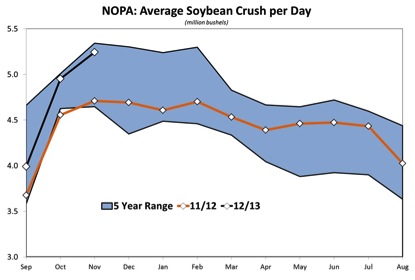
  • The latest US soybean crush figures were released today by NOPA (National Oilseed Processors Association), the November figure was 157.3 million bu which, if extrapolated, reaches an annual total around 1,600 million bu. Crushers appear happy with margins and continue to source soybeans at relatively strong basis levels.


Courtesy International Agribusiness Group LLC

  • Additionally, China continues to buy more soybeans from the US and next week’s export sales figures are expected to show a third consecutive million mt figure. The combination of strong crush and exports continues to drive our belief in tighter end stocks than currently forecast by the USDA.
  • In the southern hemisphere Argentina’s BAGE has issued a warning that its wheat output will drop by as much as 30%, to 9.8 million mt, due to adverse wet weather conditions. They added that corn and soybean plantings were behind last year and that “yield expectations were reduced.” Interestingly BAGE’s wheat figure is below that of the USDA which, at 11.5 million mt, was only released this week!
  • One point to watch going forward is the strong cooling which has recently developed in the equatorial Pacific Ocean over the last month. The La Niña phenomenon is known to be a drought maker in the central USA and typically affects hard red winter wheat regions more strongly than the western corn belt. If these cooling ocean conditions persist and develop further, hot on the heels of the current drought, we could well be facing an extremely dramatic season next year. The situation will warrant a close eye and further evidence of La Niña could well be the trigger to take some defensive action particularly in wheat, but also corn.

13 December 2012

  • Key data today included another big week of wheat export licences with 610,000 mt issued by Brussels bringing the year to date total to 9.533 million mt, 1.228 million mt above last year, which is a 15% increase. To put this into perspective, the USDA’s report issued earlier this week forecast EU exports for the season at 9% up on previous. Given the lack of availability in the Black Sea region, it is unlikely that the current export pace will reduce sufficiently to hit the USDA forecast. Additionally we hear that Indian supplies are being questioned on quality grounds and we know Argentine supplies are tight, so demand will remain for EU supplies.
  • US weekly export figures were issued as follows:

Wheat: 573,400 mt, above estimates of 300-550,000 mt.
Corn: 272,600 mt, within estimates of 100-300,000 mt.
Soybeans: 1,319,500 mt, above estimates of 600-850,000 mt.
Soymeal: 271,800 mt, within estimates of 200-350 mt.
Beanoil: 30,500 mt, within estimates of 15-40,000 mt.

  • The key number again lies in soybeans, which are running at over 30% ahead of this time last year and at 81% of the USDA’s full year estimated export level. Either the estimate is too low or export sales have to collapse in volume, and soon, which will likely only be as a result of sharply higher price levels. Meal export levels are also running ahead of USDA numbers, and again we would expect to see either a revised USDA forecast (higher) or a slowdown caused by higher prices.
  • The EU wheat markets took a tumble towards the close, seemingly on news that Rotterdam based Abengoa, a bio-ethanol producer with a wheat capacity of 1.2 million mt and a bio-ethanol output of 127 million gallons, is to close for a period of three months (or if rumours are true, possibly longer). This news was swiftly followed up by further (unconfirmed) rumours of additional plant closures.
  • Prices dropped despite the continuing strong export demand, which shows just how fragile these elevated price levels really are!


12 December 2012

  • Markets have continued to decline as long liquidation following yesterday’s USDA report persisted throughout the day. Early trade offered some respite as there was evidence of value being picked off by consumers as well as some shorts taking cover, however the fund sellers have had the upper hand and prices decline although at a lower rate than previously.
  • A glimmer of hope lies in an anticipated strong soybean export figure to be announced Thursday. China continue to actively source soybeans to feed their now profitable crush albeit at the expense of end stocks in the USA. The potential for the USA having to import soybeans later this season to meet domestic crush requirements is looking a real possibility, unless prices rise sufficiently to ration demand as we have mentioned more than once.
  • One respected commentator has raised a significant question, “How can Brazil be expected to supply corn, soybeans, soybean meal and sugar all at the same time?” The export capacity of the country is not sufficient to meet these simultaneous demands and shippers could well be faced with significant shipping delays and associated demurrage costs. Clearly the answer to tight global supplies will not be found if we expect Brazil to provide ALL the answers.
  • We expect to see further consumer buying on this price break, US wheat is at a five month low and competitive in the global marketplace, and with the fundamentals continuing to look tight much better value exists in prices today than has been the case for some time.

11 December 2012

  • Today’s USDA report was initially viewed as “something and nothing” with first glance commentary suggesting it was slightly supportive to soybeans and products and possibly a touch bearish for wheat. Corn export figures were left unchanged to the surprise of many, with the January report now expected to carry the “big news”.
  • The aftershock came as speculative wheat long holders liquidated positions, particularly in the March ’13 contract, which has caused the wheat market to plummet dramatically (3.2%) to a five month low. The slight increase in 2012/13 US and world wheat end stocks as a consequence of reduced US export demand has been the trigger.
  • The strength of selling has been enough to drag corn and soybean markets along for the ride. However, we understand that consumer interest has been reasonably strong, particularly in soy products, partially saving the day.
  • From a technical perspective, specifically in CBOT wheat, the market looks set for further significant falls with some predicting close to $6.00/bu as the ultimate target. Prices fell below what was viewed as key technical support levels ($8.35 basis March ’13) as defined by Fibonacci retracement of the late summer price increases. Technical traders will be keen to sell such price breaks and protect prices from rising higher in a bear move. We find such lowly price levels extremely difficult to digest tonight given such a dramatic reaction to today’s figures, but remain vigilant to market developments.
  • Clearly, the effect on both London and Paris is likely to mirror the “big brother” in Chicago and little trend digression is expected in the short term.
  • The interesting sidelines sit with such detail as the wheat/corn spread which is now below $1.00 premium for wheat. The key issue being that major wheat exporters are struggling for stocks at this time and the season still has a long time to go. However, we must always be mindful of the old adage, “the market is always right” and “the market can remain irrational far longer than you or I can remain solvent”.
  • As a passing note, China added to their already considerable soybean stockpile with a further 115,000 mt purchase at the expense of a further reduction in already low US end stocks.
  • As always, markets continue to keep us on our toes, but this one could potentially cause us to pirouette (and even consider a “U turn”) unless we see consumer support emerging to bolster, slow and reverse this price decline in short order. We watch with extreme interest in the coming days.