28 March 2018

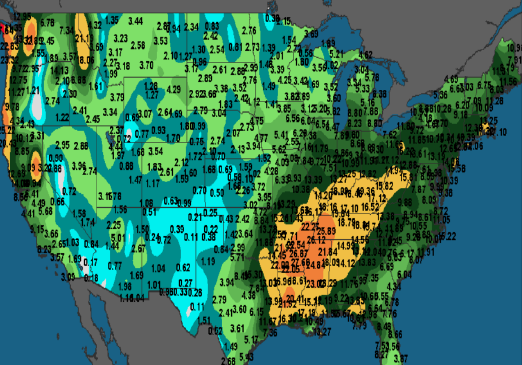
  • It has been a “Tale of Two Cities” in regards of Central US weather during the 1st quarter of 2018. Heavy rain, often more than 18”, has dropped across the Delta and Southern Midwest while extreme drought persists across the Plains. The disparity is striking and based on the extended range forecast, this trend is unlikely to change. It will be important to see if the dryness in the Plains shifts north and east into June as forecast.

  • Soybean futures traded quietly at midweek and settled slightly lower. Trading interest has been limited ahead of the USDA March report and rallies have been capped by funds looking to book profits ahead of the NASS Acreage and Stocks data. While soybeans and meal are trading well off the early month highs, soybean crush spreads are holding just under the highs traded five weeks ago. The May spread on Wednesday was at $1.47/bu, and on a seasonal basis is holding at a record level for late March. The July spread is also holding at a similar level at $1.44, with August at $1.37/bu. We estimate March 1 soybean stocks at a record large 2,055 million bu; however, strong crush margins are expected to keep processing rates record large into 2019. Our view stays neutral ahead of the US growing season, with spot soybeans to find support against $10.00 while a weather problem is needed to support a lasting rally over $11.00.
  •  Corn settled flat again, and there was little for the market to accomplish ahead of tomorrow’s flood of USDA data. There’s little doubt March 1 stocks will be record large, but more important will be whether farmers intend to plant at least 90 million acres in 2018. The USDA’s Outlook Forum guess (90 million this year) is rarely too far off, but there is a risk that intentions range between 88-89 million, which will provide strong support on breaks into mid/late summer. Also note US corn export sales Thursday should be a hefty 50-60 million bu. This week’s EIA data was mildly supportive in that ethanol production through March 23 was near unchanged on the week, and stocks fell 41 million gallons. They are now down 2% from this week in 2017. US crude production is record large, but crude exports continue to rise, and stocks remain some 20% less than a year ago. Overall, the incentive to produce/blend ethanol will stay intact throughout 2018. Volatility is expected on Thursday. It is too wet/cold in the Midwest, too dry in the Plains, and Gulf corn is competitively priced.
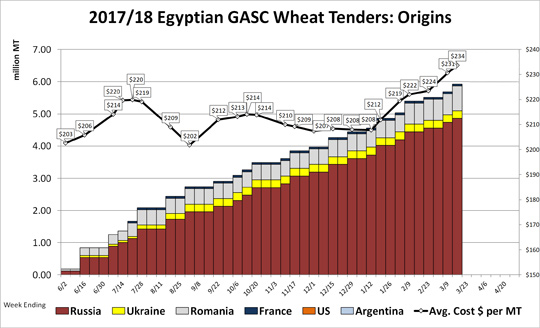
  • May Chicago wheat has now retraced 85% of its Feb/Mar rally, and with the US Gulf market below other world fob prices, downside risk moving forward is limited. The next potential bear move requires confirmation of large Black Sea and EU crops, which won’t be known until July. Also, the US cash market is not showing evidence that current US wheat stock levels are burdensome. New crop cash basis is relatively strong. Funds are short an estimated 60,000 contracts in Chicago. The dry Plains weather pattern shows little sign of change in the next 30 days. Soil moisture in the far eastern section of the HRW belt will be improving, but a vast majority of HRW crop will be stressed under worsening drought conditions. Even SRW crop ratings need close watching amid a series of heavy rain events offered to the Midwest/Delta into mid-March. Egypt’s GASC is seeking optional origin (Black Sea) wheat for early May arrival. It is fully expected that Russian wheat will account for a bulk of the purchase, but the price paid is expected to be another seasonal high. NASS data won’t be overly insightful for wheat, but the spring wheat market does require a boost in acreage

27 March 2018

  • The month of March will end in a few days and the CRB Index is breaking out to the upside (likely to finish above a downtrend line that extends back to 2011). This is an important signal the CRB bear market has likely ended. Inflationary concern is growing as the US budget deficit is likely to annually grow at $1 trillion in the years ahead. This produces a more bullish macro background. The CRB rally has been led by energies, but the metal markets have started to follow. Key will be whether the ag markets get involved in the macro recovery this summer, and add to momentum.
  • Soybean and meal prices eased through Tuesday’s trading, with reduced volume totals noted. Market news so far this week has been limited, though traders are anxious to see the USDA’s quarterly stocks and new crop acreage data. US and S American soybean meal prices have rallied since the start of the year, but so far spot and forward offers are not suggesting a significant shift in world demand. Note that US soybean meal is almost always priced higher than Brazil and Argentina, and that prices spreads on quoted offers this week are not significantly different from a year ago. So far Argentina continues to export meal at a good pace, with the latest vessel lineup showing March exports unchanged from a year ago at 2.5 million mt. Jan-Mar exports are estimated at 6.7 million mt, or slightly better than last year. Quieter trading is expected to continue into the USDA reports on Thursday. Record large March 1 stocks and new crop acreage is expected, and an acreage number below 91 million acres would likely be seen as bullish.
  • Chicago corn futures traded mixed and in mediocre volume ahead of Thursday’s highly anticipated USDA data. The spec community is likely to square positions up ahead of the reports, but large new positions are unlikely. Ethanol blend margins are again at the levels caused by Hurricane Harvey last summer, which is noteworthy, and Wednesday’s EIA report is expected to feature steady production and a modest decline in ethanol stocks. Also key will be whether US crude stocks rebound following last week’s surprising correction. Estimates on Brazil’s safrinha crop have centered at 62-63 million mt, implying a total Brazilian corn crop of 87-88, vs. the USDA’s 94.5. Weather in C Brazil looks to be non-threatening into mid-April, but it is acreage that is capping crop forecasts. Recent dryness in Goias and Mato Grosso do Sul needs watching, but overall there is still no indication that Brazil’s wet season will end prematurely. Corn looks to be most supported in the weeks ahead amid ongoing US export demand, coming excessive rainfall in the Delta, and what looks to be another round of snow across the Dakotas, MN, IA and WI next week.
  • US wheat futures fell another 3-5 cents amid a lack of fresh news, and as the trade debates Plains weather potential during the first half of April. The evening’s model guidance suggests that perhaps light precipitation will be more widespread moving forward, but drought improvement is unlikely without a more pronounced, and sustained, pattern shift. Long term moisture deficits remain. We caution against turning bearish below $4.60, basis May Kansas futures, and $4.50, May Chicago, as US cash prices are now much better in line with values elsewhere. The world cash market continues to inch higher, albeit very slowly, and Gulf HRW’s premium for June arrival rests at just $1-7/mt over comparable EU/Black Sea origin. It is our belief that the February rally was unsustainable but at current prices downside is limited. Argentina’s crippling drought does not look likely to end in the next 30 days, when wheat is typically planted, and a close eye will be kept on soil moisture in eastern Australia, where longer term dryness also lingers.

26 March 2018

  • Soybeans were on both sides of unchanged at the start of the week, before ending near the lows of the day. Markets rallied overnight on hopes that US/China trade dispute could be avoided, but May beans struggled above last week’s highs, on profit taking ahead of this week’s key USDA reports. Weekly export inspections were at the top end of expectations last week, and totaled 21.5 million bu. The cumulative inspection total for the year remains 12% behind last year; though, the previous four week total has been similar to a year ago and near the five year average. Brazil is now exporting more than 2 million mt/week, which will keep US exports seasonally slow into the summer. The Brazilian export program should begin to wind down in July, when we expect the US program to pick up. Key USDA reports are now three days out, and we look for choppy trading to unfold into the report release. Ahead of the US growing season we expect spot soybean prices to hold above $10.00.
  • Chicago corn futures erased overnight gains amid a lack of any new export sales and as producers in the Delta/Southeast did well to maximize planting progress over the weekend. The crop in Louisiana is 63% planted, vs. 74% last year and 46% on average. However, fieldwork in the south will halt completely over the next ten days as excessive rain triggers regional flooding in LA, AR, MS, MO and parts of TN/KY. .Much of the moisture forecast in the latest NOAA five day forecast falls within a 72-hour window. Otherwise, stocks, new crop acreage, and the end of the month and quarter align on Thursday. We place managed funds’ position this evening at 208,000 contracts, large enough to give the bulls pause but also a position that is likely to be defended through the early part of summer. It is unlikely that planting intentions exceed 89.5 million acres, vs. final area of 90.2 million in 2017/18. As such trend/above yield is required to maintain 2018/19 end stocks above 1.9- 2.0 billion. Clarity over N Hemisphere weather is needed.
  • US wheat futures settled 5-11 cents lower, led by Kansas, as radar maps showed light rains working across Western OK and Central KS. Crop conditions, however, are little changed, rapid deterioration has occurred since late autumn. Dry weather continues across the Western HRW Belt into the first full week of April. Funds sold an estimated 4,000 contracts in Chicago. Good/excellent ratings in KS this week are pegged at 13%, vs. 11% last week. Good/excellent in OK rests at 9%, vs. 5% last week, but both remain historically low for mid/late March. Nationwide crop conditions will be reported next Monday, and US winter wheat ratings are expected at 35-38% good/excellent, vs. 51% in early April a year ago. A rail worker’s strike in France and bottlenecks at Russian ports have sent world cash offers higher with French/ German prices finding new seasonal highs at $209-213/mt. Comparable Gulf HRW this evening is offered at $219-221, still lofty but its premium is narrowing. Work suggests that 5-6”of precipitation is needed in Mar-Apr to maintain trend HRW yield, a number that looks nearly impossible this year. Strong support is pegged at $4.60, basis May Kansas futures, at which point the US competes on paper for world market share.

23 March 2018

  • The weekly Commitment of Traders report showed that in the primaryChicago ag markets, funds held a net long position worth 353k this week versus 406k last week, and -137k year ago. Fund sold 19,800 corn, 20,500 wheat, and 12,700 soybean contracts. Also of note, was liquidation of close to 12,000 soybean meal contracts and 14,303 contracts in the cattle market.
  • Overnight selling in Chicago soybean markets uncovered strong end user demand in the meal market, that lifted old crop contracts $8-9/ton. Soybeans finished just below unchanged, but found technical support at the 100 day moving average and finished more than 18 cents above the early morning low. Funds were sellers early and buyers late. The weekly US export sales report was mildly disappointing within the context of a week’s data, and was the lowest in four weeks. However, slowly, the pace of shipments/sales and the USDA’s export forecast have started to come in alignment. The shipment pace is 11% behind last year, though total commitments are now within 4 million mt of last year’s record. Outstanding sales at 9.8 million mt are the largest mid-March total ever, and nearly 2 million above a year ago. The USDA’s March forecast now looks to be reasonable. Argentine exports are expected to fall to fall under 1 million mt as crop estimates are now under 40 million mt, and US export shipments are expected to pick up mid summer, as the Brazilian export program winds down. We look for narrowing ranges next week ahead of the March NASS report, but breaks under $10 should find good support ahead of the US growing season.
  • Heavy selling overnight and in the morning faded into end user pricing as, US-China relations aside, fundamental remains mildly bullish. Plains drought will deepen over the next two weeks, the USDA looks to raise old crop exports further, and cattle on feed continues to expand to multi-year highs. Anxiety over global trade barriers will persist for some time, but otherwise the risk of tightening old and new crop balance sheets remains intact. Export sales through the week ending March 15th totaled 58 million bu, vs. 99 million a week ago but still sizeable. Another two weeks of similar demand, and the USDA will be forced to raise its export forecast 25-50 million bu. Amid unchanged production in Mexico, and a final Argentine crop between 30-32 million mt, it is unlikely that new crop exports fall below 2.0 billion bu. However, fund length is still very large, with managed funds on Tuesday long a net 213,000 contracts, down only 30,000 on the week. Funds will very likely defend this position into early summer, until crop conditions are known, but we maintain that rally efforts will be more laboured in the weeks ahead. We also maintain that above-trend N Hemisphere yields are now needed to turn bearish.
  • Wheat extended its recovery today, and Kansas’s premium to Chicago is back to $.22/bu, basis July. It has become apparent that early-week rain in parts of the HRW Belt did little to alter soil moisture there, and near complete dryness will resume across W KS, E CO and the TX/OK panhandles in the next ten days. KS crop ratings are published on Monday afternoon are likely to be only marginally improved. Otherwise, fresh wheat-specific new is lacking. Russian interior prices this week are unchanged, and amid ongoign weakness in Russia’s Ruble replacement costs in S Russia in US$ terms are rather weak. However, contacts hint that supplies are nearing exhaustion in areas near ports, and exporters are now having to search farther inland to meet current loading contracts and commitments. US weekly export sales totalled an uneventful 10 million bu, still slightly below the average needed to meet the USDA’s forecast with just ten weeks remaining in the 2017/18 crop year. Surprisingly, managed funds are long a net 30,000 contracts in KS, up 600 on the week and the most since 2014. An outright bull trend requires adverse weather in the EU/Black Sea, particularly amid fund length in HRW futures, long term forecasts are dry across the Plains.

To download our weekly update as a PDF file please click on the link below:

Weekend summary 23 March 2018

Our weekly fund position charts can be downloaded by clicking on the link below:

Fund positions disaggregated data

22 March 2018

  • 2018/19 will see a tighter global outlook according to the International Grains Council (IGC) in their latest update. They forecast a 46 million mt year on year , the lowest level in four years decline in stocks to 560 million leaving stocks to use ratios similarly lower. Stock levels in  major exporting countries is also forecast to reduce some 29 million mt from last year to 145 million mt. Global wheat output in 2017/18 was forecast to drop 17 million mt year on year to 741 million whilst corn consumption was seen to grow 20 million mt to 1,094 million leaving corn stock levels 43 million mt lower at 265 million, the lowest figure in four years.
  • Kansas wheat has maintained strength this morning amid drier Plains forecast, and as US drought conditions are unchanged despite early week rainfall in Kansas. Otherwise, markets are mixed and near unchanged. Details surrounding some $50-60 worth of tariffs targeting China are imminent, but are not yet available. Technology/intellectual property will be the focus. There is a debate ongoing between concern over future Chinese interest in agricultural products and China’s needs for soybeans in the near/medium term, which cannot be supplied by S America alone. We doubt much clarity will emerge on Chinese trade for some time. Note that tariffs will take affect only after a period of public comment.
  • Informa Econonics’ monthly update today features a modest downward revision in new crop US corn seeding, and a boost to soy acreage. Corn acres this spring are estimated at 88.9 million, vs. 89.2 in Feb and the USDA Outlook’s 90. US soybean acres are pegged at a record 91.5 million, vs. 91.2 a month ago and the USDA’s 90. A slight shift from corn to beans makes financial sense. Assuming trend yields, bean stocks stay elevated in 2018/19, but there is a path to putting new crop US corn end stocks at 1.7-1.8 billion, vs. old crop stocks of 2.1-2.2. This is not overly bullish corn, but does suggest strong support will be available on breaks until July weather is better defined. New wheat acres are pegged at 46.1 million, vs. USDA Outlook Conference’s 46.5, which suggests a much smaller than expected expansion in spring acres. Also of note, a USDA attaché report on Wednesday pegged Mexican corn production in 2018/19 at 26.6 million mt, unchanged on the year. Carryover stocks will be down slightly, and assuming normal growth in Mexican feed consumption record imports of 17.0-17.5 million mt are required to keep stock levels steady. Mexico will be largest importer of corn. Another round of heavy snow will impact Central Russia over the next 5-7 days, and will also impact the Eastern European corn belt on the weekend. It remains unlikely that the N Hemisphere corn crop will be planted earlier than normal.
  • The US$ at midday is up slightly. Spot crude is down $.60/barrel. EU milling futures settled unchanged, and the DOW is down 380 points. US corn and soy stocks as of March 1 will no doubt be record large, and as such we expect rallies to be capped at $3.85, May corn, and $10.40, May beans. Measuring new crop supply and demand is a bit more difficult, and whether soybean acreage really does expand above 90.0-90.5 million in the face of higher cotton and minor feedgrain prices will be key next Thursday.

21 March 2018

  • Row crops, corn and soybeans, are steady today, while wheat has extended its weekly losses as Russian and European fob offers retreat very modestly and as the market debates the potential for rainfall across the W Plains during the final days of March. We would mention that managed funds in Kansas are approaching a net flat position, and the US market’s premium to other origins is narrowing rather quickly.. Exporters this morning sold two cargoes of corn to S Korea for old crop delivery.
  • Spot soy oil futures up nearly $.50/lb as the market suspects Trump is less willing to cap RIN values, thus leaving the RFS mandate unchanged. Soy oil stocks have risen sharply in recent months, but as the mandate in 2018 calls for incrementally higher biodiesel blending, some pressure will persist with respect to keeping US biodiesel production elevated. Crude is also up another $1.50/barrel, basis spot, and at midday sits at new six-week highs. Gasoline future have found new 32-month highs when casting aside Hurricane Harvey’s brief influence on energy prices late last summer.
  • The EIA’s weekly energy report is also viewed as supportive. Crude stocks (less reserves) fell 2.6 million barrels, which is counter-seasonal as energy stocks in the US tend to increase noticeably into the middle part of April. US crude stocks on Friday totalled 428.3 million barrels, down 2% from a year ago. Motor gas stocks totalled 243 million barrels, down 1.7 million on the prior week and unchanged from last year. Tension between Iran and the US is noted, and new sanctions are possible in early May. US ethanol production through the week ending March 16 totalled 308 million gallons, up 7 Mmillionil on the week. Ethanol stocks fell 22 million gallons despite the boost in production, and it is likely some measure of export demand has returned. Futures-based ethanol blend and production margins have rallied further.
  • The S American weather forecast includes just a few light/scattered showers in Cordoba and Santa Fe over the next ten days, and should the forecast verify, precipitation there during the second half of March will rest at just 8-60% of normal, with a large swath of Argentina’s crop belt seeing just 8-15% of normal. The USDA is not yet done lowering Argentine production and exports. There is also some attention being paid to ongoing snowfall in Russia, and abnormally cold temperatures across the whole of Europe and the Black Sea. Early N Hemisphere corn planting would now seem unlikely in 2018.
  • The midday GFS weather forecast is wetter in the Western Plains March 30-31, and features widespread rainfall of 0.50-1.25” across OK, KS and CO in the 8-10 day period. This will be a blessing if the forecast verifies, but we await this evening’s run of the EU model before placing much confidence in the GFS solution. All models include some kind of westward expansion in Central US precipitation in late March/early April, but exact locations and amounts will be important with respect to adjusting HRW yield potential. Notice that heavy showers will remain a feature across the S Corn Belt, and there is potential for heavy snowfall in IA, IL, IN and OH on the weekend.
  • Wheat futures continue to extract weather premium, and the move has been exacerbated by the lack of US wheat export demand. Otherwise, we caution against turning bearish ahead of a growing season, and as some 65,000 contracts of corn length has been shed since last Tuesday.

20 March 2018

  • Chicago is slightly higher at midday with corn/soy/wheat futures trading either side of unchanged. The morning volume of trade has been reduced from Monday’s strong activity as funds appear to be less willing sellers. Funds are still sitting on a sizeable net long position heading into the end of the quarter, but they are taking a pause. Monday’s Chicago Open Interest data did not suggest that funds had liquidated enough length to consider the market clean and ready to restart upwards. Moreover, cash traders report that world farmers have slammed shut their barn doors heading into a new N Hemisphere growing season. The farmers are willing to bet that someone/somewhere is going to endure adverse weather. This could produce another supply driven rally during the coming growing season, but with the USDA March Stocks/Seeding report due out on March 29, few want to take any new large net positions.
  • Chicago brokers report that funds have sold 3,800 contracts of corn, while buying 2,900 contracts of soybeans and 3,200 contracts of wheat. In soy products, funds have sold 2,400 contracts of soyoil and bought 1,200 meal. There continues to be meetings/talks that the Trump Administration could cap RIN prices on biofuel production. Yet, if President Trump or the EPA enacted such a cap, it would run awry of the 2007 US Energy Bill and likely be quickly challenged in court. The court ruled in 2016 that EPA did not have the discretion to peg US ethanol production mandates due to the blend wall. There is little doubt the court would find a cap on RINS in violation of the 2007 law. The point being that the road to capping or changing RINS is long and arduous without the affirmative vote from US Congress. The midday GFS weather forecast offers limited rain for the drought stricken W Plains in the next ten days. However, the weather models offer rain chances from W Kansas and W Oklahoma through the Delta/S Midwest with heavy totals. Some rain totals across the Gulf States could reach 7-10.00”, which would add to flooding woes. The corn crop is slowly being planted across southern third of the US and the forecast offers additional heavy rains into April.
  • The midday weather forecast is similar to the overnight runs with limited rains for C and S Argentine crops for the next ten days. A few showers greater than .50” may fall across 10% of the crop area, but most of Argentina see 0.1-0.6” on the weekend. This is far too light to alter the deepening drought. Warm temperatures will also persist across Argentina with highs in the 80’s to the lower 90’s. Moderate to heavy rain will persist across N Brazil with ten day totals of 6-9”. The rains will slow harvest, but produce favourable growing conditions for corn. The odds of a smaller Argentine corn and soybean crop is rising amid the deepening drought. Cash connected traders in Argentina now argue for a soy crop below 40 million mt.
  • Everyone is catching their collective breath with just seven trading days remaining before the key March Stocks/Seeding Report. The US FED is expected to raise their lending rate by 0.25% on Wednesday and worry persists with the Trump Administration will impose trade tariffs on China before the end of the month. Funds need to liquidate additional net long Chicago positions and world cash markets need to tighten before a rally can be sustained.

19 March 2018

  • Managed funds are holding their largest net long combined ag position in nearly two years. This large net long fund position along with Trump trade tensions pounded ag futures on Monday. The US Central Bank is expected to raise interest rates on Wednesday, but key to late week ag price action will be US and S American weather. Outside of US trade flow uncertainty, it is supply (weather) that will determine Chicago prices action into midsummer. We doubt that the sharp break lower in Chicago futures will persist as Argentine crops decline and the Plains drought is far from over.
  • Rains amounting to 0.10-1.80” fell across Buenos Aires and Cordoba in Argentina over the weekend and some rain looks to fall in Northern Argentine crop belt this weekend. Some 30-35% of corn/soy will have reached maturity this week with the remainder of the crop having passed the critical growth stage. The coming moisture will not materially affect yield potential. However, normal rainfall will be ongoing across much of Brazil, and threats to safrinha corn yields are currently absent. Assuming the 10-day forecast verifies Feb-Mar precipitation in Mato Grosso (which grows 40% of Brazil’s second corn crop), will be near average, and well above prior drought years. Already, worst-case scenarios are being avoided. Steady shower activity will persist in Central Brazil into the very end of March, and longer-term climate guidance is void of any premature end of the wet season through April 7.
  • Heavy fund selling along with weekend concerns over US/Chinese trade relations sent soy futures sharply lower to start the week. The US weekly export inspection data offered no inspiration as last week inspections total fell to the lowest level of the year to just 18 million bu. Funds sold an estimated 12-15,000 soybean futures. Soybean option volatility held at multi year lows through harvest, and then spiked in late January, which continued through February. Note that even at the peak, the option volatility index was just barely over the five year average. Monday’s break has sent the option vol rates back to multi year lows, with the entire US growing season ahead. As such, we will be watching for opportunities to buy calls against existing sales, in the upcoming weeks. With record large Chinese demand and an already short Argentine crop, any type of US weather problem could send Chicago futures higher. In the near term, we expect that the soy market is close to forging a low ahead of the acreage report. The 50 day moving average in May is just below $10.20, followed by the 100 day average near $10.10.
  • Corn fell sharply along with the rest of Chicago. Corn-specific news today centred on the European Union potentially targeting US corn (the EU imports 20-30 million bu from the US) as retaliation to recent US tariffs, and also on fund length that has exploded in recent weeks. Profit taking is noted, but we urge caution against turning bearish. US acres are expected to contract in 2018, and the US Gulf market is very well positioned to capture a sizeable share of world feedgrain trade between now and late summer. Argentine origin has been following the US, but note that other competing feedgrains have been unmoved on the US break. Funds sold an estimated 27,000 contracts on Monday. We also mention that corn seeding in LA is just 8% finished, vs. 31% on this week a year ago. Progress in MS is 4% complete, near average, but above normal rainfall is projected across the Southern US over the next two weeks, which could exacerbate a shift in acreage to soybeans. Chart-based support is pegged at $3.70-3.74 basis May.
  • Kansas wheat futures led the way down as rainfall in the last 24 hours exceeded prior expectation (both quantity and coverage) and as the US market is still priced at a premium to competing supplies in Europe and the Black Sea. However, we do note that crop ratings as of Sunday are the lowest on record for mid-March, and work suggests that a more significant pattern change is needed to meaningfully alter US yield potential. Good/excellent crop ratings in KS is pegged at 11%, vs. 12% last week and 38% a year ago. Ratings in OK and TX also fell on the week. Low yields are feared. Russian fob wheat offers are slightly lower, but at $210/mt for May delivery are just $8/mt below comparable US origin (vs. $42 two weeks ago). US Gulf fob wheat is much more aligned with world markets, and the US competes with Black Sea origin below $4.50/bu. Some downside remains, but we caution against turning bearish following the emotional $.75/bu collapse. We remain concerned about an expanding Plains drought.

15 March 2018

  • Egypt’s General Authority for Supply Commodities (GASC) purchased 240,000 mt of wheat at average price of $233.71/mt basis C&F. Russia and Romania sold 120,000 mt each. Prices continue to reach new highs for this season. The origins are by no means surprising, but the price of execution is the highest in three years. The US market is no doubt overvalued, but downside risk in EU/Black Sea offers appears limited into the new N Hemisphere harvest. Fundamental support is pegged in May Chicago wheat at $4.65-4.70.

  • It has been another mixed morning in Chicago, seemingly driven by US weekly export sales. Corn and bean sales were at or above expectations, while wheat demand continues to suffer from lofty prices (relative to other origins), and it is possible that the USDA will hike old crop HRW stocks further in its April WASDE, thus further buffering against new crop yield loss. Corn is down a shade, beans are up 8-12, and wheat futures at all US exchanges are down 3- 8 cents at midday. Through the week ending March 8, the US sold a net 99 million bu of corn, a new marketing year high and the largest amount since late 1994. Total US corn sales since Jan 1 rest at 688 million bu, vs. 379 million in the same period a year ago, and additional demand lies in the offing through late spring. Soybean sales totaled 47 million bu, down from the prior week but up 29 million from the same week in 2016, and some interest is being funnelled back to the US following this year’s crippling drought. Wheat sales were a meagre 6 million bu, including just 0.3 million of HRW, and without improvement in the final throes of the market year, it is possible the USDA’s US wheat export forecast is still 10-15 million bu too high.
  • NOAA’s updated spring and summer climate forecasts are slightly improved across the eastern and northern Plains through June, but unchanged elsewhere. Heat and dryness (and thus ongoing drought) will be featured across the S Plains over the next 90 days. Normal/above normal precipitation is offered to the N Plains and Midwest, and as expected much of NOAA’s update centres on a transition from La Niña to neutral ENSO conditions this spring. The summer forecast is of course much too far off to place any confidence in, but amid warming N Pacific and Atlantic Oceans, bouts of heat are likely across much of the Central US Jul-Sep.
  • The Rosario Grain Exchange in Argentina has lowered its corn production estimate to 32 million mt, vs. 35 million in Feb and vs. the USDA’s 36. With the extended range outlook trending drier, worst-case scenarios are becoming increasingly likely, and a final harvest number of 30-31 million mt is possible. As such, we expect breaks in corn prices to be shallow/short lived until early US crop conditions are confirmed to be at/above average. The big change in recent weeks has been in the US corn balance sheet, and a sizeable crop is now needed for the bears to find leverage.
  • The Argentine forecast is unchanged over the next 10 days, and so is still nearly completely dry across 80% of the primary crop belt. The midday GFS weather forecastis much wetter in 11-15 day period, advertising totals of 2-4” across Cordoba, Santa Fe and Entre Rios. The models in recent days have flirted with a pattern change there by late March, but confidence in this is low, especially given drier trends in overnight EU and Canadian weather model outlooks.
  • The markets are consolidating ahead of NASS’s planting intentions reports, and new trends won’t likely be established until afterwards. Corn’s story is most compelling, longer term, via a lack of acreage expansion and rising export demand. 

14 March 2018

  • Chicago trade has been mixed  at midday as traders await large US weekly export sales on Thursday morning. FAS daily sales totals along with rumours that China has booked a sizeable number of US soybean cargoes this week has supported the expectation that US bean sales could near or exceed 1.5 million mt with US corn sales at 1.5-2.0 million. US wheat sales continue to plod, but the theme of improving US export demand shows no signs of abating in the summer row crops. The combination of large US sales and new fund money inflows has been the supportive fundamentals for Chicago prices this morning. However, this is the third day of fund buying and following Thursday’s USDA export sales report, we anticipate that Chicago values will sink into the weekend as needed rains are slated to drop across Argentina. Although it ss late in the growing season, trade sensitivity persists for Argentine weather. Moreover, traders understand that if China were to respond to actual and threatened US trade tariffs, those announcements are usually made on the weekend. The bulls will want to pull in their horns heading home on Friday. Research argues that Chicago futures are range bound awaiting the USDA Stocks and Seeding Reports and the new N Hemisphere planting season. US old crop corn, soybean and wheat end stocks remain historically sizeable.
  • Chicago brokers estimate that funds have bought 3,200 contracts of corn, 1,600 contracts of soybeans, and 900 contracts of wheat. In soy products, funds have bought 2,400 contracts of soymeal and sold 2,100 contracts of soyoil. The US$ is in recovery with strong economic data and an expected rise in US interest rates helping to support the greenback. Until there is clarity on the timing of the passage of a new US infrastructure package (deeper US deficit), we look for the US$ to be rangebound.
  • Some early harvest data is starting to emerge from Argentina and initially, crop yields are running better than expected. Corn yields are down 2-5% from trend with soybean harvest just starting in the far north. There is not enough data to make a trend, but early harvest yields are better than expected which is producing caution about a further drop in private crop forecasts. Many traders remember the dire 2012 Midwest droughts and that corn/soybean yields did not fall nearly as much as feared late in the season. Some traders wonder if that same trend could be evolving in Argentina.
  • French fob wheat prices have been sagging on their large old crop supply as world wheat export demand starts to fade seasonally. This is the first time during the 2017/18 wheat crop year that French fob wheat offers compare with Russian. The competition will likely produce a seasonal top in Russian wheat with warming temperatures helping to source supply from the farmer. N African demand is largely filled into May, and the new winter crop is starting to green.
  • The weekly US ethanol report posted record large US ethanol stocks at 1,020 million gallons. This the first time that US ethanol stocks have risen above 1,000 million gallons. The US weekly ethanol corn grind was down to 301 million bu from 311 million in the week prior. The weekly data was deemed slightly bearish for corn prices.
  • The midday S American GFS weather model is similar to its overnight with showers/storms possible across much of Argentina on the weekend with totals of .5-2.00”. A few days of dry weather follow with some light showers late next week. The extended range 11-15 day forecast offers another chance of showers/storms. Near to above normal rains persist across the northern half of Brazil which favours their winter corn crop.
  • The Trump Administration is threatening new tariffs against China, while most of the Argentine crop loss is known. US corn and soybean export demand has stepped up, but amid surplus old crop US stocks, one wonders quite how much additional upside market risk exists. This is not a place to be overly bullish or bearish of Chicago grains. Our bet remains one of sideways trade awaiting N American planting weather.