28 March 2024

  • HEADLINES: NASS seeding report rallies corn/wheat; Soybeans lag on expected jump in US seedings; Total US 2024 intended seeded acres falls 6.6 million.
  • The USDA March Stocks finals held few surprises compared to estimates. NASS forecast March 1 US corn stocks at 8,347 million bu, 7 million less than some forecast, but 85 million bu less than the average trade estimate. We calculate a Q2 corn feed/residual use rate of 1,559 million bu, 129 million bu more than last year. Total US Q2 use was 3,830 million bu, the second largest on record. The prior quarterly use rate was set back in December-February of 2021/22 at 3,880 million bu. US March 1 corn stocks at 8,347 million bu are 951 million bu greater than last year, but the strong usage trajectory should drop 2023/24 corn stocks below 2,000 million bu by the final count.
  • US March 1 soybean stocks were 1,845 million bu with the quarterly residual being a negative 24 million bu. This compares to -23 million bu for the same quarter last year. US March 1 soybean stocks are up 158 million bu from last year or 4.3 million mt. This stocks gain highlights the importance of the final size of the 2024 Brazilian and Argentine soy crops. USDA is unlikely to raise its old crop end stocks forecast at 315 million bu in April.
  • The NASS March Seeding report was bullish of corn and neutral for wheat and soybeans relative to expectations. US farmers responded to low price and profit forecasts and cut US corn seeding back to 90 million acres. Spread unwinding of long soybeans vs grains is pressuring the soybean market at midday, but the grains are sharply higher on fund short covering.
  • Total US farmed acres fell to 313.3 million acres, down 6.6 million acres from last year. Iowa farmers are forecast to plant 24.1 million acres, Illinois farmers 22.7 million (each equal with last year), Kansas 23.7 million acres (down 5%), Texas at 20.9 million acres (down 5.4%) with North Dakota planting 23.5 million acres (down 2.2%). Total US farmed acres rarely rise more than 500,000 acres from intentions and the final June forecast. We have confidence that US producers reported the cropped acres they intend to farm in 2024.
  • NASS forecast total US corn acres at 90.0 million acres, down 4.6 million from last year. Assuming a record 181 bushels/acre yield, the total US corn crop would be just over 15 billion bu. This would be down 180 million bu from the Outlook Forum estimate of February. US soybean seedings at 86.5 million bu were at trade expectations with a yield of 52 bushels/acre producing a 2024 US soy crop of 4,453 million bu. This is down 50 million bu from the Outlook Forum which drops 2024/25 US soy end stocks to 385 million bu. Such stocks do not argue for November to fall too far below $11.75 this spring.
  • March US Wheat stocks and seedings data leans mixed, fundamentally, but it is weather that matters most beginning in April. March 1 wheat stocks were 1.087 billion bu, 30 million above the market’s expectation and which implies Dec-Feb feed/residual disappearance at -48 million bu, vs. -11 Mil a year ago.
  • However, cumulative Jun-Feb feed/residual is calculated at 139 million bu, vs. 95 million. USDA will lower their annual wheat feed number by only 5-10 million bu in the April WASDE. End stocks will be lifted a similar amount.
  • All wheat seedings are pegged at 47.5 million acres, 500,000 above expectations and down 2.1 million year on year. Assuming normal abandonment and trend yield, new crop US wheat stocks reach 720-750 million bu. Yet, SRW seedings were trimmed 600,000. HRW seedings were increased a modest 300,000. HRS seedings are projected at 10.7 million acres, up only 200,000 year on year. It is the US durum balance sheet that loosens significantly as 2024 acres expanded by 350,000 (22%) from last year.
  • The long awaited March stocks and seedings report has come and gone, and bearish surprises were lacking. Producers are unwilling to expand total acres amid deflated prices and as CRP acres increase. Old and new crop corn end stocks are in retreat, and it remains that favourable N Hemisphere/trend yields are needed to be bearish of ag markets at current prices. Any new bearish trend has been pushed back to Jul/August. Acute focus on weather patterns develops in the next 90-120 days.
27 March 2024

  • HEADLINES: Chicago grain trade turns slower and lower ahead of USDA reports.
  • Chicago grain markets were weaker overnight and were under early pressure at the morning open but have moved off the lows after an early burst of fund selling. Market news has been limited at midweek, and trading has largely developed around the upcoming USDA reports. Wheat has led the morning recovery and traded in the green for much of the morning, soybeans have clawed back some of the overnight losses, and corn has, at times, tried to work back to unchanged.
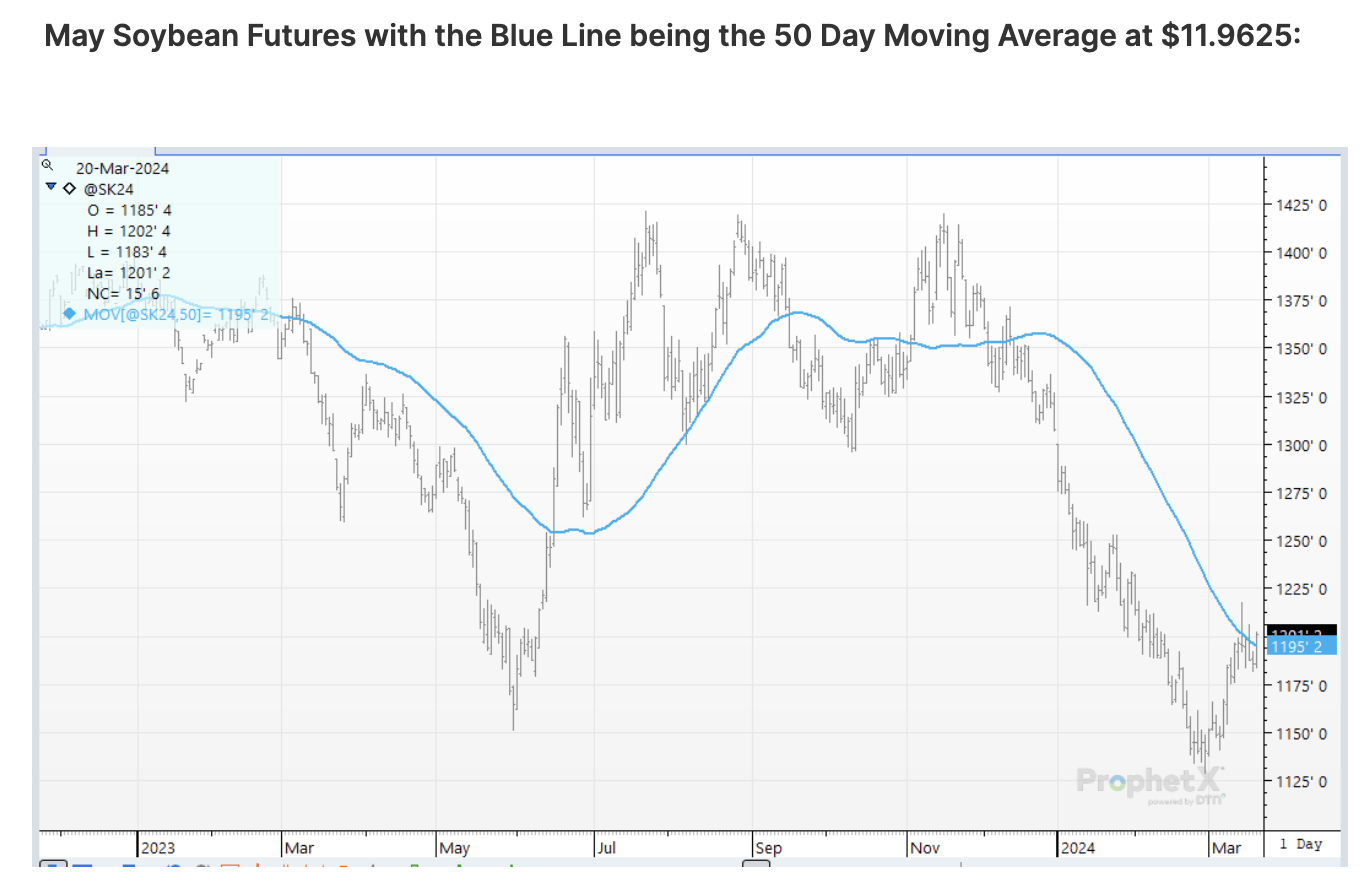
  • May corn has been under technical pressure this week after stalling against the 50-day moving average last week, which weighed on May Chicago wheat in the first half of the week. May soybeans found support on a test of the 50-day moving average this morning.
  • Chicago brokers estimate that funds have been light sellers of 2,000-3,000 contracts in the corn market, sellers of 1,000-2,000 contracts in soybeans, and have bought 2,000-3,000 contracts of wheat. In the soy product markets, funds have sold 2,000-3,000 in soybean oil and bought 1,000-2,000 contracts of soybean meal.
  • The EIA’s weekly Petroleum Status report showed that ethanol production last week rose 1% from the previous week and reached a 3-week high of 1,054 thousand barrels/day. This was the most in 3 weeks and marked the eighth consecutive week that ethanol production was above a year ago. Cumulative ethanol production from the start of the corn crop marketing year is up 4.4% from last year, and cumulative production for the 2024 calendar year is up 3%.
  • Other market news has been limited this morning, with the trade awaiting key USDA reports on Thursday. The average trade estimate calls for 2024/25 corn acres at 92 million acres (94.6 last year), 86.3 million soybean acres (83.6 last year), and 47.7 million wheat acres (46.9 last year). Combined corn, soybean, wheat, and cotton acres are projected to fall by 734,000 acres from 2023.
  • The midday GFS weather forecast update shows rains falling across the upper Delta and Eastern Corn Belt states over the next 10 days, with snow projected across the Western Plains and upper Midwest regions. Below normal temperatures continue across the northern Plains and Midwest this week, with a widespread warming trend to get underway at the end of next week.
  • Limited rains are projected for the driest parts of southern Brazil in the next five days, where they are most needed for the recently planted Safrinha corn crop. The forecast adds better rains in the 6-10 outlook but leaves several dry pockets in South Brazil and west Paraguay.
  • Summer row crop prices have corrected in technical trade and limited demand ahead of the USDA’s Prospective Planting and March Grain Stocks report. Funds still hold sizeable net short positions in all Chicago markets, with the trade prepared for bearish stocks numbers. In tight stocks years, the stocks figure drives the Chicago price response. In ample stocks years, it is the planting intentions figures. Nearly 1 million acres were added to CRP in the last year, and the key question to be answered on Thursday is the extent of the decline in total crop acres.

26 March 2024

  • HEADLINES: Chicago sags as corn, wheat bump against chart resistance ahead of USDA reports.
  • World grain futures are mostly lower at midday as spot corn, and KC and European wheat bump against chart-based resistance, which is unlikely to be breached until NASS stocks and seedings data is published. Wheat markets have been the bearish leader on Tuesday as nearby Russian fob prices stabilise at $205-206/mt, up $8/mt from mid-March’s low but still somewhat aggressive when measured against comparable EU, US and Australian origin. We estimate existing Russian wheat stocks today at 34-35 million mt, and key is whether tension between RIF and Moscow pulls weekly Russian exports below 1 million mt. We note RIF was not awarded any of Russia’s remaining 2.4 million mt worth of Apr-Jun export quotas. Overall, the spark for large new positioning is absent today. The next 48 hours will be defined by the lack of a clear trend.
  • China’s latest auction of reserve soybean stocks featured purchases in the domestic market of just 82,000 tons, half the auction’s total, which follows a retreat in spot crush margins amid weakness in Dalian meal and oil values this week. China in late spring isn’t yet willing to chase rallies, with soy cargoes in S Brazil quoted $0.20-0.30 under spot Chicago, which compares to briefly positive premiums in early March.
  • Otherwise, there is just not much for the trade to sink its teeth into two days before USDA publishes benchmark US planted area estimates and fine tunes corn, wheat and soy disappearance via March 1 stocks data. Residual disappearance is always uncertain, and key on Thursday is the sum of US acreage intentions. Previous years of deflated prices have triggered corrections in total area. Combined corn, wheat, soy, and cotton acres at/above 240 million, like in 2022 and 2023, is unlikely.
  • The European/Black Sea climate pattern attracts more attention beyond early April. It is far too early to adjust yield from longer term trends, but over the next two weeks a rather stark split between heavy/excessive rainfall in W Europe and lingering warmth/dryness in Ukraine and Southern Russia remains projected. 10-day precipitation accumulation in France and the UK is projected in a range of 2-5”. 11–15-day guidance stays wet in France, and it has been too much water that has been the issue in W Europe since autumn. A correction in EU wheat production worth 5-7 million mt is anticipated. Meanwhile, little/no precipitation is advertised in key areas of Romania, Ukraine and Russia.
  • We would maintain that large Northern Hemisphere crops are needed to sustain bearish trends into late 2024, and weather in late winter/early spring has been far from normal in a host of areas.
  • Spot WTI crude has extended Monday’s recovery as EIA data Wednesday is expected to show a third consecutive week of lower stocks. Ethanol swap prices, RINS and California carbon credits have followed US/world crude prices higher since early March.
  • The midday GFS weather forecast is drier in Argentina and a bit drier in Mato Grosso do Sul in centre-west Brazil but is otherwise consistent with morning output. The coming lengthy period of warmth/dryness in Argentina boosts the speed of harvest into early April. The Brazilian monsoon continues normally in Mato Grosso and Goias, 60% of safrinha corn area, into April 10, but net soil moisture loss persists in Mato Grosso do Sul and Parana, which account for a third of safrinha production. It is not a bullish S American forecast, but assuming CONAB’s safrinha corn acreage numbers, continued dryness in MGDS/Parana keep total 2024 Brazilian production at/below 115 million mt, vs. 137 last year.
  • There is no reason for either the bulls or bears to gain meaningful leverage until stocks/seedings data has passed and more is known about N Hemisphere soil moisture on June 1.

25 March 2024

  • HEADLINES: Chicago steady/higher at midday; Press release surrounding dairy cow disease expected; GFS weather forecast wetter in N Brazil.
  • Chicago grain futures are steady/higher at midday in a reversal of Friday the volume of trade has been active with short covering being featured.
  • Wheat and soy futures have been the bullish leaders on the Russian political battle between the Kremlin and a private exporter, RIF. 4 cargoes of RIF wheat are said to be held at ports awaiting phytosanitary certificates. Russian wheat is offered at $210/mt and most recently traded on Friday at $206/mt. The next level of resistance is the 50-day moving average which crosses at $5.775 basis May Chicago futures.
  • For the fourth day in a row, soybean futures have pushed either side of the 50-day moving average with soyoil futures forming a reversal. There is no big news for Chicago soybeans other than Brazilian soybean exports for March are forecast to be the second or third largest on record. Brazilian soybean export commitments are the third largest on record which is offering the cash market support.
  • Corn futures have been unable to gain any upside traction with active wheat/corn and soybean/corn spreading. Traders find it difficult for Thursday’s report to be overly bullish with the US holding 2.0 billion bu of corn supplies and stocks being over 1.0 billion bu larger than last year.
  • Chicago brokers estimate that the managed money has bought 5,300 contracts of soybeans, 4,700 contracts of soyoil, and 1,200 contracts of soymeal. In the grains funds are flat in corn while buying 5,600 contracts of wheat.
  • US weekly export inspections for the week ending March 21 were 48.3 million bu of corn, 28.2 million bu of soybeans and 11.6 million bu of wheat. For their respective crop years to date, the US has exported 961 million bu of corn (up 242 million or 25%), 1,342 million bu of soybeans (down 309 million or 19%), and 520 million bu of wheat (down 93 million or 15%). We look for WASDE to raise their 2023/24 corn export forecast by 25-50 million bu and cut soybean exports by 15-25 million bu in April.
  • The US dairy industry is awaiting a USDA press release that is rumoured to tie HPAI (avian flu) to dairy cattle in several Southern Plains operations that have had cows go off feed and nearly dry up due to illness. The mortality rate of the illness has been low, but milk production declines and fails to recover in some older animals. The disease has been a mystery and previously blamed on bad feed and the smoke from recent prairie fires. The US dairy industry has been aware of the mystery illness for 10 days, but only now USDA will be having a comment. We have no knowledge of what the USDA will say or what is the remedy. Also, a Minnesota goat has also been infected with an avian flu type of disease which was reported last weekend. We currently doubt that the mystery illness will have a significant impact on grain or feed consumption, but additional information is required. This is something new to monitor.
  • The midday GFS weather forecast is again wetter in Mato Grosso and far Northern Brazil, with accumulation there into April 4 raised to 3-5”. Scattered showers will persist across N Brazil into April 5-6, and so the GFS forecast has extended the duration of this wet pattern. The GFS and EU models are at odds over early April rainfall in N Brazil, but safrinha corn crop threats nearby remain confined to Mato Grosso do Sul and Parana, where 30-day rain has been recorded in a range of just 30-50% of normal, and where a pattern of below normal rain is forecast to continue. Mostly dry and warmer than normal temperatures in Argentina facilitate active harvesting.
  • Recall there remains an 8.1 million mt spread between CONAB and USDA’s estimate, which matches nearly exactly projected US end stocks. Key is whether new weekly soy sales of 10-15 million bu/week continue into the latter part of April. Yet, be prepared for additional choppiness into Thursday. USDA’s first pass at the 2024 US acreage matrix is important. Snow/cold in the north and unrelenting/unwanted rainfall in the Delta/Southeast will be more closely monitored beyond April 1.

23 March 2024

  • HEADLINES: Wheat recovers on soaring European market; Row crops struggle.
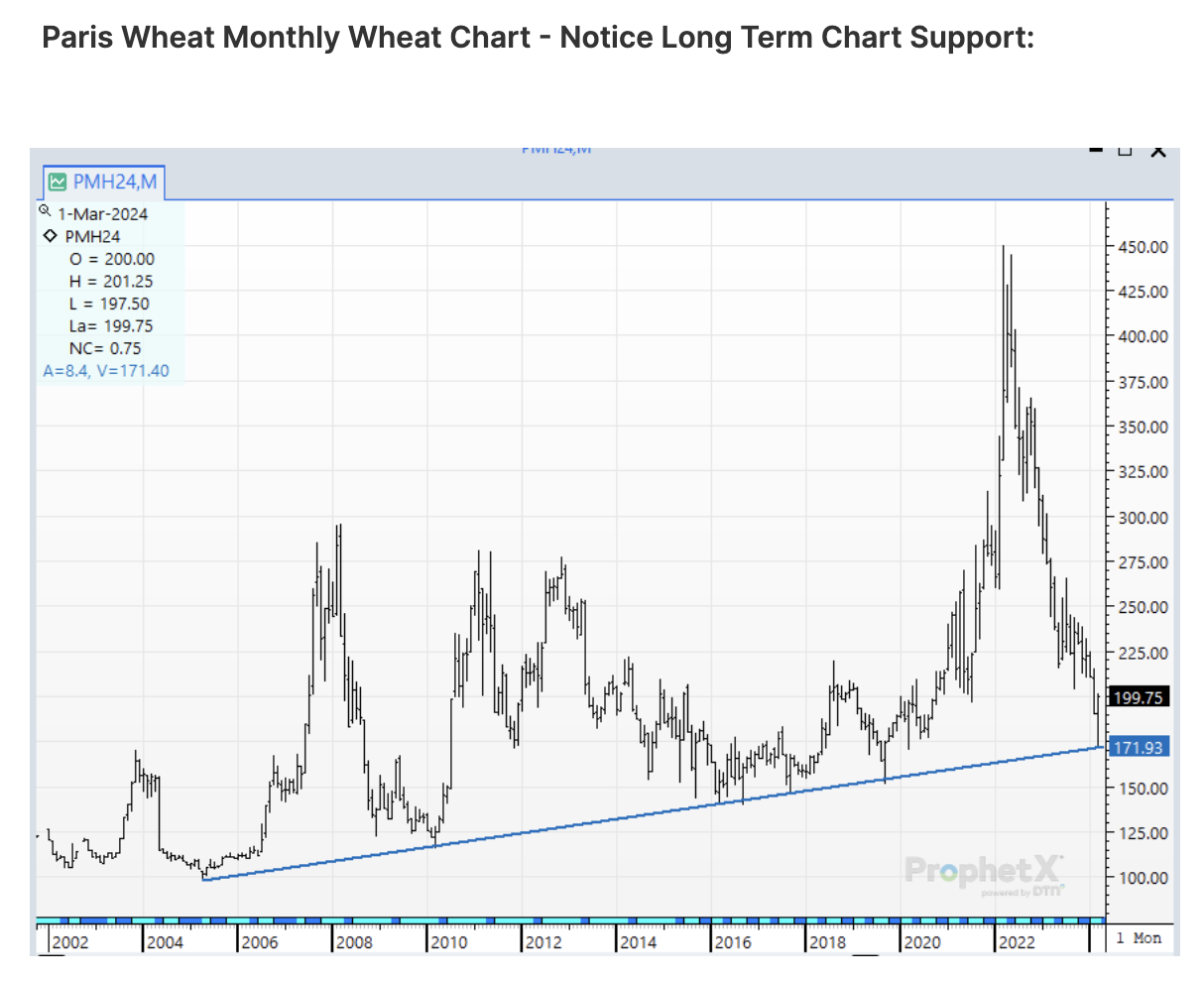
  • Wax on/Wax off! Chicago grain futures are mixed at midday with corn and soybean in the red and wheat futures following the EU market higher. Based on midday Chicago values, March corn prices are virtually flat for the week at $4.395, May soybeans are down 3 cents (last week’s close at $11.9825) with May Chicago wheat up 23 cents at $5.51. Chicago wheat has traded within last week’s range, which makes a break above or below this week’s high or low important. We note that long term monthly wheat charts in Paris and Chicago reflect strong support below current values, and it appears that wheat is trying to forge a seasonal low. The choppiness of Chicago trade has been fully expected as a key NASS Crop Report is due next week Thursday. US farmers will tell NASS that their total seeded acres will be down 2-3 million acres from last year due to a lack of profitability, it is just how much of a rotation out of corn into soybeans/cotton will be uncovered.

  • Traders are also expecting a sharp fall in net short managed money positions in corn, soybeans, wheat, and soy products. Whether this fall occurs will be key to next week’s trading. The managed money crowd will bank profits heading into the end of the month and quarter. Brazilian farmers were active sellers of recently harvested soybeans and corn which was hedged on the early week Chicago rally. It is still the case that neither rallies nor breaks are able to be sustained.
  • The USDA announced that 263,000 mt of US corn was sold to Mexico. 173,000 mt was for the 2023/24 and 90,000 mt for the 2024/25 crop year.  Mexico is the largest US corn importer and has secured more than 18 million mt of US corn to date. Mexico is forecast to import 20.6 million mt of US corn in the 2023/24 crop year. Pace analysis suggests that Mexico could import 22 million mt of US corn.
  • Chicago brokers estimate that the managed money has sold 6,300 contracts of soybeans, 4,700 contracts of soyoil, and 4,100 contracts of soymeal. In the grains, funds have sold 5,100 contracts of corn and 3,600 contracts of wheat.
  • Low grain prices are straining farmers across the world including Brazilian farmers where bankruptcies are up 534% and Russian farmers that will cut back in spring grain seeding due to negative margins. And Ukraine farmers are facing new crop corn bids that are near $100/mt or $2.60/bu off the farm. Even with the Ukraine government trying to provide free seed, the margin for its farmers is exceptionally low due to rising fixed and variable costs. The extended war is finally starting to take its toll. The first crop that will endure the smaller seedings due to its high input cost is corn followed by wheat. Soybeans and other oilseeds will be favoured along with fallow acres. Northern Plains and Delta farmers are shunning corn, while Midwest farmers are adding 5-10% more soybeans to save cost and reduce risk. The market is doing its chore in reducing new crop supplies through profit and price. Total US and world cropped acres will be curtailed this spring, which will elevate the importance of weather/yield.
  • The midday GFS weather forecast is wetter in Mato Grosso, with 10-day accumulation there raised from 3-6” to 4-9”. Regional flooding is a concern in western Mato Grosso, but otherwise coming soaking rain across the northern half of Brazil’s safrinha corn belt is viewed as a positive. Longer term issues remain present, namely the probable return of warmth/dryness in April, but there will be no shortage of soil moisture in Mato Grosso, Goias and Minas Gerais nearby.
  • We do note that rains into April 1 miss key areas of Mato Grosso do Sul and Parana, which combine for 30% of Brazilian safrinha output. Drought worsens there, and the need for rain becomes immediate beyond April 1. A major difference in corn crop health between northern and southern areas lies ahead.
  • Late winter/early spring is typically a strong time of year, seasonally, for ag markets. This is due to the erosion on physical N Hemisphere supplies and the looming nature of the new crop growing season. Ongoing climate chaos is noted this year following incredible warmth in the Central US in Feb, only to be followed by massive snowfall in northern areas. The transition to La Niña leaves forward weather/supply less predictable. Choppiness continues into NASS stocks/seedings data next Thursday.
To download our weekly update as a PDF file please click on the link below:

21 March 2024

  • HEADLINES: Chicago mixed with volume in retreat on the break; Key is the close and whether May corn can settle above $4.42, the 50-day moving average.
  • Chicago values are mixed at midday. May corn futures failed to accelerate through the 50-day moving average while selling in soyoil futures pulled soybean prices lower. A close above the 50-day moving average in May corn ($5.42) is needed to confirm a new leg up. Otherwise, Chicago is holding in a sideways trading pattern with neither the bulls nor the bears able to gain more than a day or two of traction. The Chicago close is important today with the bears nervous as chart patterns continue to improve.
  • Chicago brokers estimate that managed money has sold 3,200 contracts of soyoil and a net 900 contracts of soybeans. The funds have purchased a net 2,600 contracts of corn, 300 contracts of wheat, and 1,300 contracts of soymeal. Managed money trade is slowing at midday.
  • US weekly export sales were better than expected in the summer row crops. The US sold 46.7 million bu of corn, 18.2 million bu of soybeans with net wheat sales cancellations of 4.0 million bu. China purchased 11.2 million bu of US soybeans last week and shipped out 22.3 million bu. China has now secured 812 million bu of US soybeans with just 838,000 mt of open purchases remaining to be shipped.  There are 55 million bu of US soybeans sold to unknown destinations, but the risk of sales cancellation or switching in the coming months is far less than in recent years. Based on the sales and shipping pace, we estimate that USDA’s soybean sales pace is too high by 25-40 million bu. US soybean sales through March 14 are down 340 million bu or 19% from last year due to the long Brazilian export tail from last year’s record harvest that cut into early season US sales.
  • US corn sales at 1,641 million bu are up 266 million from last year or 19%. There is 691 million bu of open US corn sales that has yet to ship with Mexico holding nearly 300 million bu of that total. Mexico is unlikely to switch US corn purchases to S America on logistical costs. China made no new US corn purchases, but China’s US sorghum purchases are record large at 181 million bu.
  • Chinese wheat cancellations were included in this week’s data which produced net sales cancellations of 4.0 million bu. US SRW wheat sales were cut by 8.7 million bu while HRW/HRS sales increased by 4.2 million bu. The US has now sold 676 million bu of wheat for the crop year, up 20 million bu from last year or 3%. China shipped out 1 cargo of US SRW wheat last week and another vessel is expected to load this week. China has 21.5 million bu of US SRW wheat sales on the books that is expected to ship prior to the end of the crop year.
  • Indonesia’s biodiesel consumption in the first 2 months of 2024 rose by 16% to 2.17 million mt. It is now mandatory that 35% of Indonesian biodiesel supply is blended with palmoil. 4.5 million mt of palmoil will be used in 2024.
  • Season US weather forecasts were released by NOAA today. They reflect summer Plains dryness and Western and Southern US heat. It is far too early to be accurate in the forecast as El Niño rapidly transitions to La Niña.  Our bet is that the Central US will endure extreme heat, just like the winter.
  • Dry weather holds across S Brazil and Argentina for the next week with limited rainfall. We note that Parana is in that dry trend which could cause new stress on winter corn production. Otherwise, near to above normal rain falls across N Brazil with totals 3.00-8.00” and locally heavier amounts. The rains across Northern Brazil will help replace soil moisture for the winter corn crop. The drier weather is needed for NE Argentina and Southern Brazil due to recent heavy rainfall and regionalised flooding. The dryness across Parana must be monitored as the monsoon starts its seasonal retreat in April.
  • Two steps forward and one back best explains Chicago price action in recent weeks. Gold and the US stock market are pushing to new record highs. As a host of asset prices rise, Wall Street types are looking at grains and trying to measure the opportunity with a new Northern Hemisphere growing season ahead. In fact, several macro funds have been dipping their toes in the grain markets, but a real investor story requires a few supply shocks via adverse weather. A late day Chicago rally will encourage the bulls that additional short covering could evolve heading into the weekend.

20 March 2024

  • HEADLINES: May Chicago soybean futures push above 50-day moving average; Brazilian Dec-February weather; Future Mexican corn import demand.
  • Chicago values are mixed at midday with the grains weaker and soybeans firmer. There was solid volume on the morning reopening, but activity following the first 30 minutes dried up. Grains have a mixed tone while soybeans feel supported at midday with the charts providing clues for the close.
  • Traders are watching to see if May soybean futures can close above their 50-day moving average at $11.9625. Soybeans have been flirting with the 50-day with rallies above and breaks below over the past 5 trading sessions. However, May soybean futures have been unable to close above this resistance. The last time that May soybean futures were able to close above the 50-day moving average was back on December 11. The chart pattern that is forming is a bull flag with breaks to support at $11.70-11.80 uncovering fund short covering. Key for Chicago going home is whether May soybeans can finish above $11.96.

  • World wheat futures are under pressure from the sizeable amount of wheat offered to Egypt’s GASC in today’s tender. We counted 34 separate offers for the May 5-15 shipment period which reflects the abundance of Russia/European old crop supply. The cheapest fob wheat offer was Bulgarian wheat at $232.50/mt. US/Paris wheat futures are in decline on the remainder of large old crop wheat availability. World wheat futures declined based on this availability. However, new crop supplies are becoming more important with each passing day. The ongoing wet weather pattern for W Europe and dryness across the Black Sea is gaining attention, but it is far too early in the growing season to cut yield or planted acres. That becomes possible in April/May with a static pattern.
  • Chicago brokers estimate that managed money has sold 5,100 contracts of wheat and 3,100 contracts of corn, while buying 3,600 contacts of soybeans. In the soy products, funds have bought 3,000 contracts of soymeal and 1,200 contracts of soyoil. Funds are holding sizeable net short positions in soybeans/soymeal.
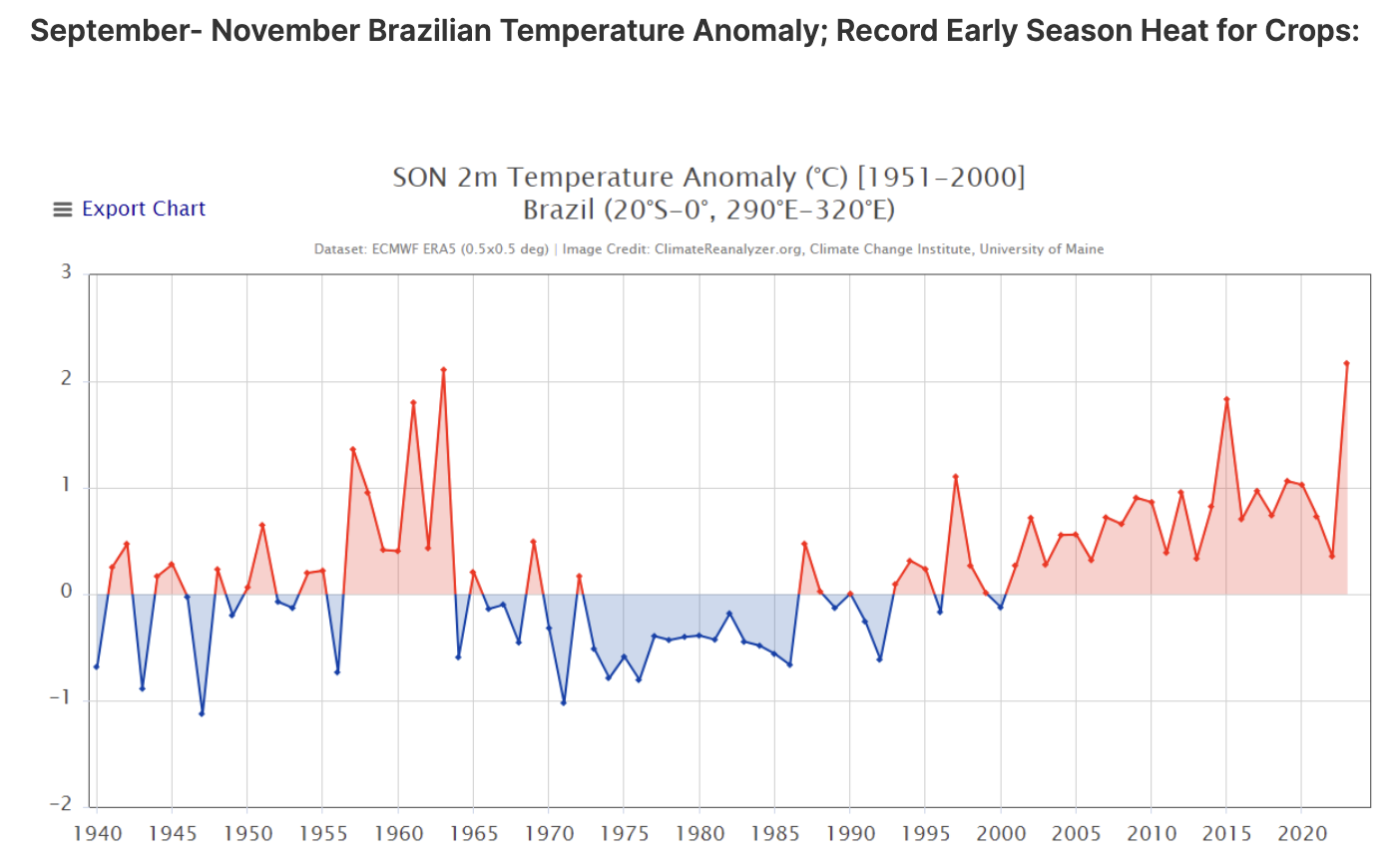
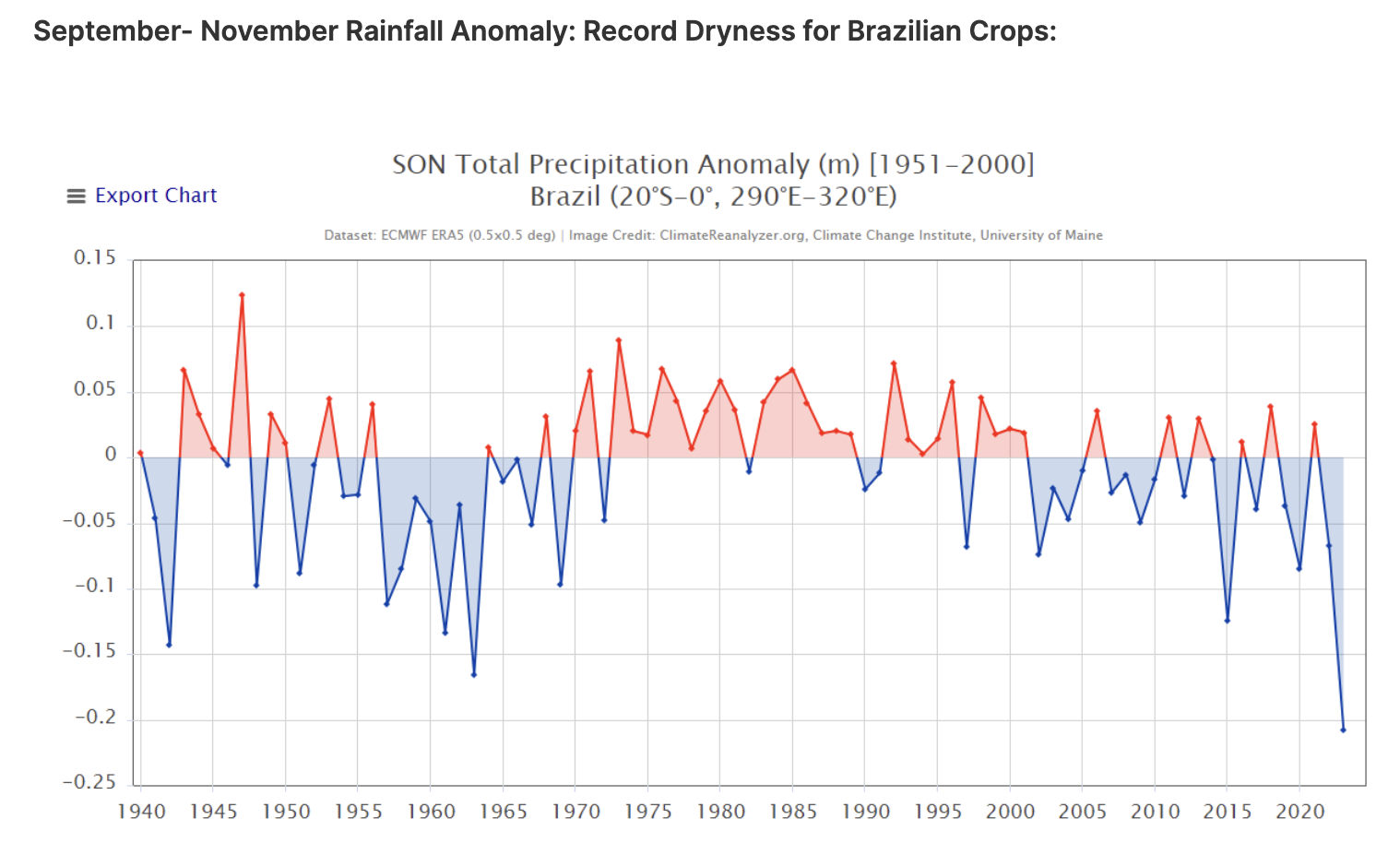
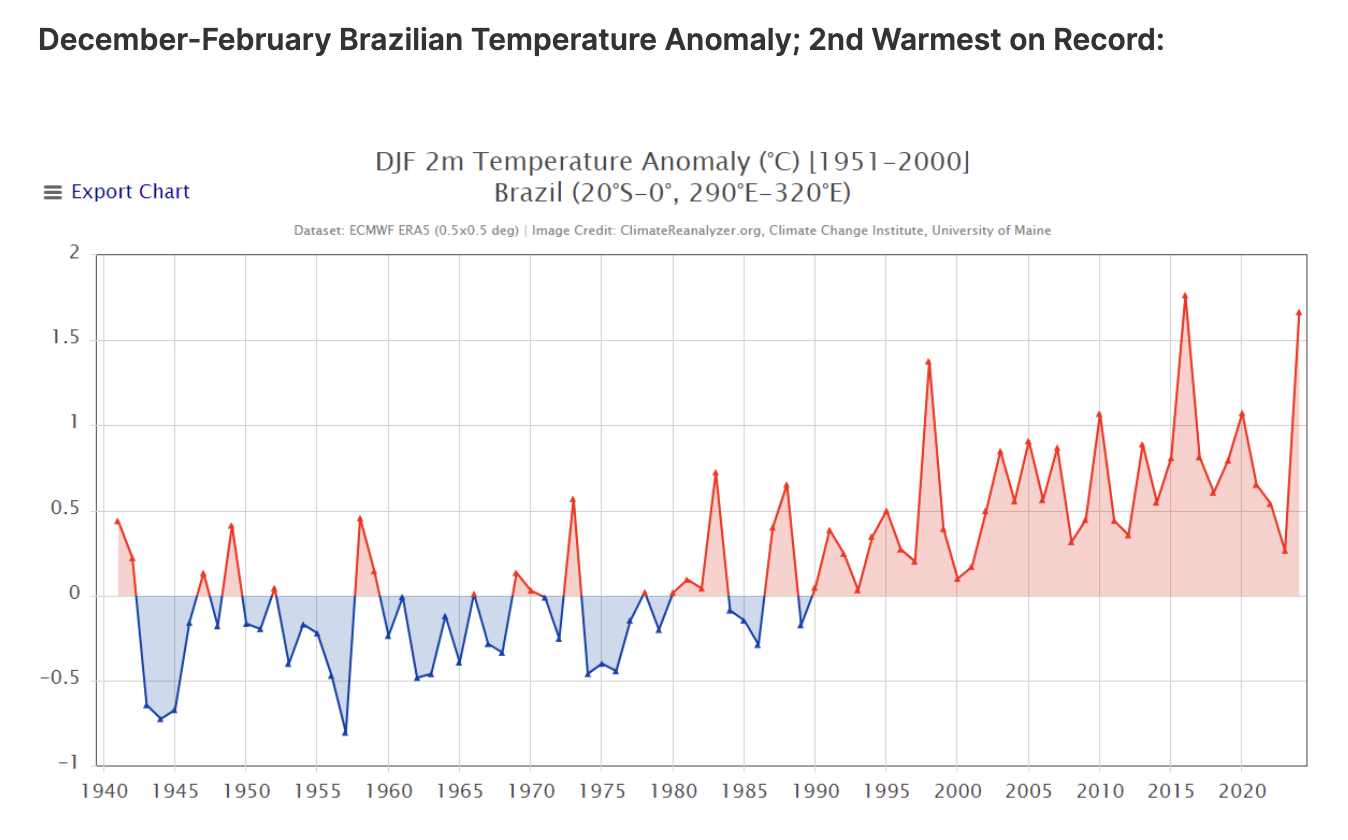
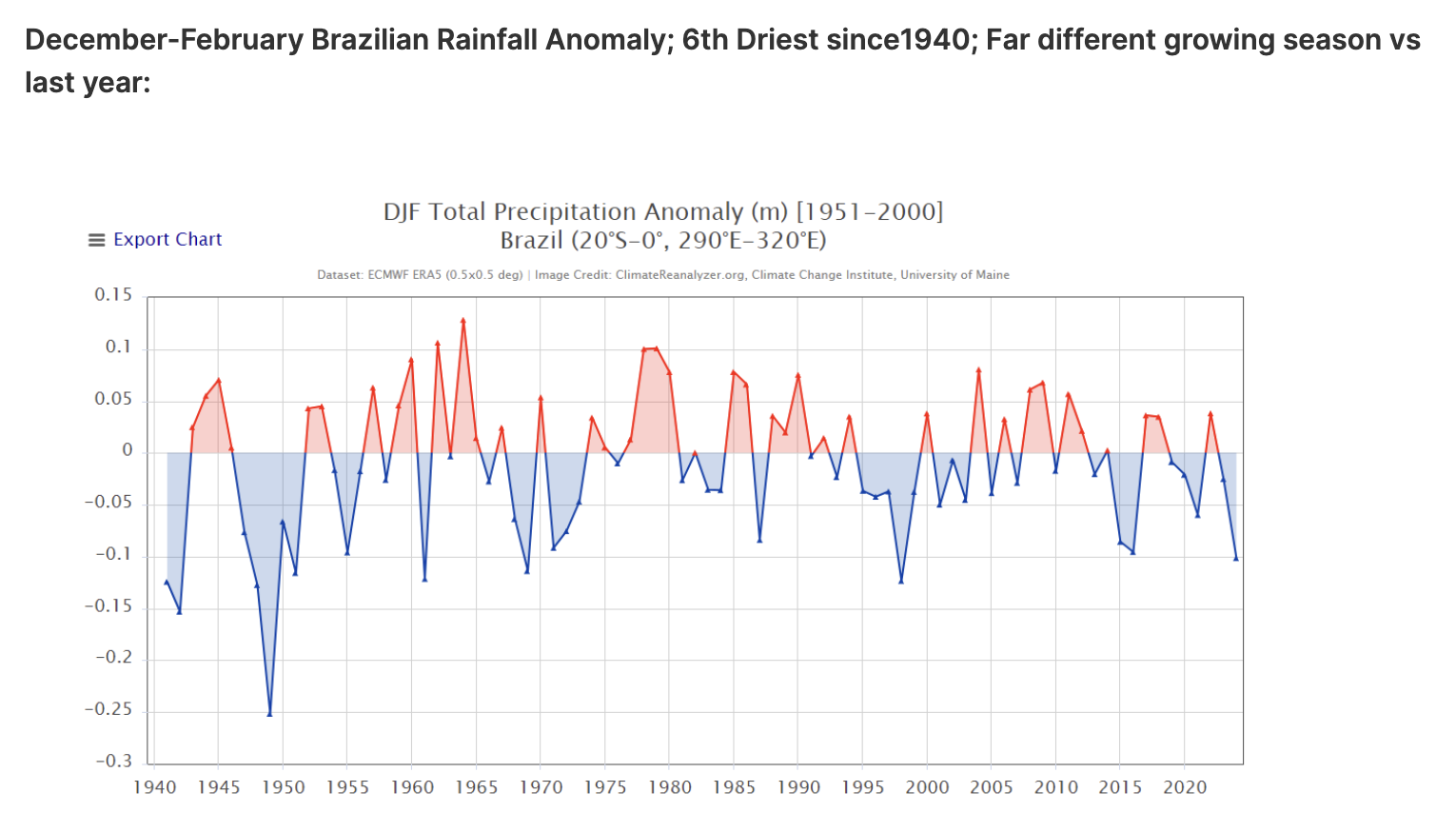
  • We have been reflecting on the record large 8.2 million mt disparity of public crop estimates between CONAB and USDA on the 2024 Brazilian soybean crop. We have no way of knowing which is correct, but we are attaching seasonal temperature and rainfall anomalies for the growing season broken down into 2 quarters, Sept-November and December-February. All that can be said is that this year’s 2023/24 Brazilian growing season was the warmest on record and one of the driest. Under this growing weather, USDA is forecasting Brazilian soy yield to (50.2 bushels/acre) be down just 3.7% vs trend and down 6.9% from last year’s record.

  • US weekly ethanol production totaled 308 million gallons, up 5% from last year and on pace for WASDE to raise their 2023/24 US corn grind to 5,400 million bu. Amid the inclusion of E15 year round across the Midwest, the 2024/25 US corn grind could reach a record 5,475 million bu. Seasonally, ethanol prices rise into June.
  • The US ag attaché in Mexico released their balance sheet on Mexican corn demand, imports, and usage for the 2024/25 crop year. The report expects that Mexico will import a record 22 million mt of corn in 2024/25 on surging feed demand. This would be a record 865 million bu of corn that would come mostly from the US. In coming years, Mexico could become the world’s largest corn importer.
  • The US Central Bank will update their interest rate policy near the Chicago close. We expect that they will keep rates higher for longer based on stubborn inflation and the difficulty of the last mile to getting inflation beat down to their 2.0% target. Watch the US dollar and how it reacts to the US Central Bank policy. We look for US weekly export sales to be poor for wheat on the already announced daily Chinese cancellations. Soybean sales will be poor on competition. US corn and soymeal sales should be solid. Note that US soymeal continues to be shipped with limited switching to Argentina with a record 3.4 million mt of open US meal sales on the books.  March corn futures have now traded at $4.39 for the past 10 trading days. We look for additional short covering into the USDA March 28 Stocks/Seeding Intentions report.

19 March 2024

  • HEADLINES: Chicago markets are slow and mixed at midday; Wheat rallies on Black Sea dryness and fund short covering; Brazilian Real weakens.
  • Chicago values are mixed at midday with corn/wheat higher while soybeans sag on the rise in Brazilian cash soybean sales due to the faltering Real. The Brazilian Real has been recently edging lower vs the US dollar with the rate being 5.035:1$ which has helped boost Brazilian cash soybean harvest sales. The Real had risen to 4.9:1$ in early March. The Real vs USD weekly chart reflects a building triangle formation with resistance at 5.08:1 USD. Brazilian farmers are sensitive not only to Chicago prices, but the value of their currency since world soybeans are traded in dollar terms.
  • Corn and wheat futures are higher on managed money short covering and the rally in Paris wheat futures. Traders argue that old crop fundamentals are largely known and digested below €195/mt May Paris and $5.25 May Chicago. Chicago futures held a key monthly chart uptrend line late last week when China announced that it was cancelling US SRW wheat purchases. The new Northern Hemisphere growing season ahead and developing soil moisture shortages across the Black Sea are gaining attention. Moreover, Russian wheat exports are forecast to rise to a record 3.1-3.2 million mt in March. A new Northern Hemisphere growing season will bring supply uncertainty.
  • Chicago brokers estimate that managed money bought 2,600 contracts of wheat and 4,200 contracts of corn, while being flat of soybeans. In the soy products, funds have sold 1,400 contracts of soymeal and bought a net 900 contracts of soyoil. Fund managers are trying to reduce their net short position heading into the NASS/USDA crop report on March 28.
  • Egypt continues to honour wheat purchase contracts despite the IMF imposed currency float on its currency, the Pound. There had been rumours that Egypt may want to renegotiate existing Russian wheat sales, but that does not appear to be the case. The expanded $8 billion dollar loan to Egypt should allow their budget to run effectively into mid-2025. And a deal with the Emirati Sovereign Wealth Fund suggests new Egyptian investments of $35 billion could be made by the end of April. It appears that Egypt is in a vastly improved financial condition with a war raging across Gaza amid new loans/investments.
  • One debate that will not die is the 8.2 million mt supply difference between the March CONAB and USDA soybean crop reports. Such a March supply difference is record large and the bulls and the bears keep looking for whom to trust. The 8 million mt difference has a sizeable impact on 2023/24 US soybean exports as the CONAB crop forecast would shorten the tail on the 2023/24 Brazilian export season. One fundamental that appears to be missed is that Brazil’s expanded diesel blend of 14% soyoil will require additional Brazilian soybean crush. We believe the Brazilian 2023/24 soybean crush rate at 58 million mt due to the need to produce soyoil to blend with diesel.
  • The forecast is wetter across Northern and Central Brazil than the overnight GFS run with some areas seeing 10-day accumulations of more than 5.00”. The near to above normal Northern Brazilian rainfall will help restore soil moisture ahead of the April pollination. The Argentine forecast is drier with any heavy rainfall pushed southward into Uruguay. Extreme heat will be lacking outside of Paraguay and MGDS in SW Brazil. As a sidenote, the GFS weather forecast followed the EU model’s lead and curtailed Plains and W Midwest precipitation totals and shifted heavy snows to MN/WI and N MI.
  • It is another quiet Chicago trading session with few traders wanting to enter fresh risk ahead of the March 28 Stocks/Seedings report. We see the late March NASS report as providing price fireworks amid the wide range of estimates of US corn/soy and spring wheat seeding. And quarterly stocks reports are always fraught with risk. The 20-day moving average crosses at $5.55 basis May Chicago wheat futures, a level that would also produce a double bottom on the charts. Arctic cold across the Canadian Prairies keeps wheat traders alert to determine the southward push of sub-20-degree readings that could damage S Plains jointing wheat. Otherwise, Chicago is about short covering that occurs on breaks.

18 March 2024

  • HEADLINES: Wheat bounces from early session selling on rising Russian fob offers; Soybeans sag on weak Brazilian premiums; GFS midday weather forecast is wet for N and C Brazil.
  • Chicago values are mixed at midday with wheat futures rising while the soy complex sags. Soyoil has been the downside price leader as Friday’s rally stopped just short of $0.50/pound basis May and selling returned. Chicago traders are awaiting the EPA update on their GREET model and how it will impact corn and soyoil demand to produce green fuels. The EPA has not provided any timetable of when a GREET model announcement will be made, but several sources suggest that it could be released prior to the middle of April. Oil share pushed out to 42.5% last Friday, its best level since mid-September. Key support now rests at 50-50.5% on any correction.
  • The Russian/Ukraine war is broadening amid the weekend drone/missile attacks on Odessa and interior Russian oil refineries. World grain traders fear that the expansion of the war could involve key Russian ag export ports like Novorossiysk which could cause disruptions to Russian grain trade at some point. No attacks on Novorossiysk have occurred to date, but the shorts are taking a more cautious approach in positioning heading into the end of the quarter/month and coming key USDA reports on March 28. Wheat bears are fearful of waking up to a Ukraine drone attack on Novorossiysk, and world grain markets that are in a panic short covering mode.
  • The Russian/Ukraine war has held a bearish influence on world grain values as Ukraine established an export corridor through the Western Black Sea into Istanbul. However, Russia’s constant bombardment of Odessa is causing worry as to Ukraine’s grain export capabilities.
  • Chicago brokers estimate that managed money bought 3,100 contracts of wheat and 500 contracts of corn, while selling 2,800 contracts of soybeans. In the soy products, funds have sold 2,500 contracts of soyoil and bought a net 600 contracts of soymeal. The fund related trade is in decline at midday.
  • US export inspections for the week ending March 14 were 48.8 million bu of corn, 25.2 million bu of soybeans, and 11.1 million bu of wheat. The US has shipped out 909 million bu of corn for its crop year to date (up 217 million or 31%), 1,314 million bu of soybeans (down 305 million or 19%), and 504 million bu of wheat (down 94 million or 16%). We maintain that WASDE needs to raise its US 2023/24 corn export estimate by 25-50 million bu and cut soybeans 15-25 million bu in March. US wheat exports appear to be correct following recent week cancellations by China.
  • China will auction off 226,000 mt of 2019/20 soybeans with no origin being specified on Tuesday. It is rumoured that the state (Sinograin) decided to go ahead and crush 1.0 million mt of recently imported soybeans, rather than place them in the reserve. This could diminish future import demand by a like amount. China appears to be cautious in the purchase/placement of new crop Argentine soybeans into their state reserve.
  • China’s corn import pace is record large and WASDE will have to raise Chinese corn imports in their April WASDE report. We hve China importing 16.5 million mt in the crop year through February. Pace analysis would argue for China corn import pace of 31-33 million mt which seems too large. All that is known today is that China’s import pace will exceed 19.0 million through March, with China an active buyer/importer of Ukraine corn in recent weeks.
  • Stabilising Russian wheat export prices and a new growing season is spurring short covering from long time wheat bears. Dryness across the Black Soils area of Russia is interesting but non-threatening today.  Close attention must be paid to future Black Sea weather including Eastern Ukraine where dryness has lingered since January. Wheat appears to have the best world fundamentals heading into a new growing cycle, but soybeans will struggle on rallies until 85% of the Brazilian soybean harvest is completed. Brazilian rain in the next few weeks will boost winter corn and replenish soil moisture. We doubt that corn/soy breaks or rallies can be sustained until after the March 28 USDA report.

15 March 2024

  • HEADLINES: Soybeans recover and close firm on Friday: Chicago corn ends firm on strength in cash markets; Brazilian rainfall unlikely to be lasting: US wheat ends lower for third day; Russian/EU markets stable.
  • Soybean futures were under follow-through technical pressure in early trade on Friday, but the early selling was countered by a larger than expected NOPA crush that supported higher prices. Soyoil paced Friday’s rally despite larger than expected NOPA stocks.
  • The February crush reached a new record high of 6.42 million bu/day. US capacity has expanded, and the February data suggests that the US could theoretically crush nearly 2,500 million bu/year if needed. This total will dramatically expand by the end of 2025.
  • May soybeans marked the third consecutive higher weekly close and finished just below the 50-day moving average. A close above $12.00 will likely trigger another round of fund buying, with the next targets near $12.80 and $13.00. Key support is offered at $11.70-11.80 May.
  • Brazil’s market shed premium on Friday as rain blankets a majority of the safrinha Corn Belt Mar 23-28. Confidence is high with respect to this brief pattern change, but newly released long range guidance allows warmth/dryness to return in April. Brazilian crop risks stay elevated. We would also note Argentine fob basis rallied $0.08/bu overnight. US Gulf and Argentine origin are offered into the world market near parity for early spring. Chicago at $4.30-4.50 is not overvalued.
  • Managed funds have pared their record net short position in the last three weeks. Funds’ short on Tuesday at 252,000 contracts remains historically large, and only stays in place amid normal Brazilian weather. Our best bet is that Brazilian production falls below 115 million mt, which leans bullish of corn until Midwest summer growing weather is known. Upside is pegged at $4.70-4.75. Spot EU corn settled at an equivalent above $5.00/bu for the first time since early February as feed markets seasonally bottom.
  • May Chicago wheat ended slightly lower amid a lack of breaking news and as the US dollar index again bounces from key chart support. Importantly, Russia’s market is stable after rallying $5/mt on Thursday. The EU market ended slightly higher. Spot Chicago is fundamentally undervalued below $5.30, and downside risk between now and harvest is limited. The weather forecast is paramount from April 1 onwards. Regular April rainfall is needed across the US Plains, W Canada and across most of Ukraine and Russia.
  • Managed funds on Tuesday were short a net 79,000 contracts of Chicago wheat vs. 66,000 the previous week. But it is the fund short of 36,000 contracts in KC that is in danger of being covered ahead of the US growing season. Plains crop ratings are improved year on year as of mid-March, but downgrades will be rapid if soil moisture loss is extended into April. This week’s Russian low in fob wheat could be important longer term.
To download our weekly update as a PDF file please click on the link below: