
To download our weekly update as a PDF file please click on the link below:
Monthly Archives: December 2017
21 December 2017
- Chicago prices are mixed at midday with the grains firmer while the soy complex is weaker. The soy complex is still suffering from fund long liquidation in soymeal while funds enter a larger net short position on soybeans and soyoil. It has been a largely technical week with traders squaring positions ahead of the coming Christmas Holiday. Normally, like Thanksgiving, there tends to be some sort of bounce into the long holiday weekend with the shorts always more nervous about their positioning. Chicago brokers estimate that funds have bought; 4,100 contracts of corn and 1,900 contracts of wheat, while selling 3,800 contracts of soybeans. In soy products, funds have sold 3,100 contracts of soyoil and 1,200 contracts of meal. Fund traders have come out of long soybean vs short grain spreads, and are now entering a net short soybeans position.
- US sorghum sales are soaring with another 17.2 million bu sold last week. For the crop year to date, the US has sold 158.4 million bu of sorghum, which accounts for 61% of the projected annual exports. China remains on a purchase pace that they could easily run the US short of sorghum. USDA has already sharply curtailed US sorghum feed and industrial use, making any future monthly reductions difficult. US corn will be left to find larger tonnages of US feed and industrial demand based on the void that stronger sorghum prices are now leaving. US elevators/banks report that US farmers have been larger sellers of cash corn/soybeans as their need for cash increases, and bankers force sales before the New Year. This could account for a portion of the open interest increase in Chicago corn futures in the past two weeks. A “give up” mentality prevails in the country as farmers give up on the prospect of a Chicago rally.
- It is all about the technicals with soybeans lower and the grains firmer. Fund managers want to see if March corn can close above its 20 day moving average at $3.5125 and if better rains can fall across the parched areas of Argentina The holidays and the end of the year loom with many traders loath to take on new positions. The grains should bounce.
20 December 2017
- According to the Kansas City Federal Reserve Bank, there is one thing that we can count on in the year ahead; higher fixed and variable lending rates. Whether it is an operating, machinery, or farm land loan, the cost of capital is rising as the US Central Bank raises interest rates and banks foresee greater risk in farm loans after several tough years. Whether this will start to cut into US ag productivity is uncertain, but something to monitor closely in the year ahead.
- Thin demand ahead of the holidays/end of year, and scattered storms across Argentina left Chicago soybean prices drifting lower into midweek. Preliminary volume data showed just over 233,000 contracts traded on Wednesday, which is the thinnest day of trade for the month. Commodity funds were estimated sellers of 5,000 soybean and 4,500 soyoil contracts, and bought 500 in soymeal. In the December WASDE, as the USDA raised their estimate for biodiesel use, they took from export and domestic use, to leave the year end soyoil stocks forecast unchanged. The change in biofuel demand was a nod towards changes in EPA mandates and the Commerce Department’s barricade to Argentine biodiesel imports. Lower domestic food consumption is a trend that has been in place since the late 1990’s. Per capita soyoil food consumption peaked in 1999, and has declined by an average of 2% per year. The USDA’s December forecast implies 2017/18 per capita consumption will decline by the average rate of 2%, and would be the lowest since 1983. S American weather is mixed, but should the EU model be correct, one has to be careful being bearish into yearend.
- March corn rallied another 2 cents, driven by another week of enlarged US ethanol production, competitive offers at the Gulf and an otherwise lack of fresh news. The weather models are coming into agreement on Argentina’s weather pattern, and while regional showers of .25-.75” are probable in Cordoba, the remainder of the country looks to face another 10-day period of dryness and warming temperatures. March’s futures 20-day moving average rests at $3.51, a level to be closely watched ahead of the holidays. US ethanol production through the week ending Dec 15th totalled 317 million gallons, down from the previous two weeks, but still some 4% above the same week in 2016. Ethanol stocks are at a lofty 937 million gallons, but ongoing export demand is noted, and has accelerated a bit since late November. Production margins have collapsed amid weakness in ethanol prices, but ethanol’s discount to gasoline is perched at the levels triggered by Texas Hurricane Harvey. Overall, US corn appears to be finding new incremental domestic use, and we expect export sales to be solid in the weeks ahead as Brazilian offers cease and Argentina fob offers are rising. We remain neutral, but need to keep an eye on threatening Argentine weather.
- US wheat continues its slow but steady rally on the backdrop of US weather concern and a weaker US$. It is impossible to quantify winterkill and frost/freeze losses, but conditions in the next 10 days will be ripe for talk of damage. Low temperatures this morning fell into the upper 20s across the Plains, and the forecast has trended cooler in all US wheat production areas in the 8-15 day period, and snow cover will be particularly lacking across the S Midwest and S Plains. The EU and GFS weather models are in general agreement that lows in MO, IL and KY will reach the teens and lower beyond December 28. Otherwise, take note that US Gulf SRW has fallen to parity with Argentine wheat, previously the world’s cheapest origin, and there is becoming a noticeable difference between lo-pro and hi-pro world cash offers as supplies in N Europe dwindle. US export sales on Thursday are estimated between 425-550,000 mt. Fund short covering is likely to be a theme heading into year end, and longer term trend/above trend N Hemisphere yields are needed to sustain world end stocks above 260 million mt vs. 268 in 2017/18.
19 December 2017
- Corn cash and futures prices continue to do very little, but at the same time other grain markets are inching higher. Corn has solidified itself as the cheapest feedgrain, in both the US domestic and world export markets. The question ahead is whether abundant corn supplies act as a weight on rallies in other markets, or whether rising wheat, sorghum and world barley prices act as a boost for corn. At the least, 2018 planting intentions, in the Plains especially, are much less certain than they were 45 days ago.
- Tuesday was a slower, but lower day of trade in the soybean and meal markets, that left January soybeans 5.5 cents lower at the close. Funds sold 7,000 contracts in soybeans and 4,500 in meal, and were buyers of 2,500 contracts in the soyoil market. While soybeans and meal have been down this week on fund liquidation, soyoil has traded firm on spreads. Uncertainty over upcoming biofuel demand continues to frustrate the soyoil trade. The USDA’s balance sheet shows that if their soybean crush rate is met, that the soyoil balance sheet will be fine, while a number of analysts contend that the USDA’s biodiesel forecast is still too low. While the USDA has done a good job forecasting biodiesel demand in recent years, the cancellation of soyoil receipts in Chicago has become concerning. Quieter Chicago trade is expected to unfold in the rest of the week, with attention to S American weather forecast.
- March corn traded in just a 2-cent range, unable to rally or break amid competing fundamentals. The trade is also debating the accuracy of even the near term forecast in Argentina, and as of this evening the EU and GFS models are still very much at odds regarding rainfall there in the next 5 days. The midday GFS was very wet; the afternoon run of the EU model is nearly completely dry in Buenos Aires, La Pampa and Cordoba. We have detailed in recent reports how soil moisture deficits persist in Argentina, and follow up rain is needed. Otherwise, in spite of weather, S American cash corn continues to rally. Fob basis in Argentina in just a matter of weeks has doubled from $.25/bu in early Oct to $.52/bu currently. Without renewed weakness in S American markets, which isn’t expected until February, we doubt much downside risk exists in Chicago futures. A close above $3.51, March, is mildly supportive.
- Spot Chicago wheat nearly touched its 20-day moving average at $4.26 but ended just short and settled the day a bit weaker. Kansas futures ended higher, and very modest premium to Chicago is noted there. Wheat-specific news is lacking, and like corn S American weather will be the market’s primary driver, but a close eye wil be kept on US temperatures next week. Snowfall expected prior to next week’s cold event. Trace amounts are possible in E CO, W KS and NE, but otherwise complete dryness will continue across the Plains into early Jan. The EU and GFS models are in general agreement that overnight lows in OK, KS, NE and CO will fall into the single digits in the period December 24-26, with another round of possibly colder readings due December 29. It is impossible to quantify winter damage, but such temperatures amid lacking snow cover is far from ideal. However, abnormally warm temperatures will persist in the Black Sea, exports will be ongoing and Russian fob offers are unchanged for an 6th consecutive week at $191-192/mt, vs. comparable Gulf HRW at $198.
18 December 2017
- Managed funds as of last Tuesday were short a combined 355,000 contracts of corn and wheat, which is by far a record. In our view there are more than enough questions over 2018 US and global grain surpluses to trigger periodic short covering rallies and, really, not until late spring will S America’s corn export potential be solidified.
- Following a higher start to the morning, soybeans quickly turned down, shrugging off the morning’s export sales announcement and inspections data. Soymeal is where funds still hold the largest position, and it was the meal market that lead prices lower. Commodity fund traders were estimated sellers of; 8,000 soybean, 3,500 soymeal, and 2,000 soyoil contracts. Ahead of the morning open, the USDA announced export sales totaling 14.6 million bu to China. Other trade news for the morning included the weekly inspections data that showed that soybean export inspections were well above expectations and totalled 65 million bu last week. Cumulative inspections for the year are now at 950 million bu, or 141 million (13%) behind last year’s export pace. Funds started the week cutting back their meal position and selling out the rest of the soybean position ahead of the end of year holiday season. The near term Argentine weather forecast are favourable, while the extended outlook turns hot and dry. Key chart support sits just under the market.
- Corn futures ended steady again, and unlike beans are not extracting weather premium from price. As we have mentioned in recent days recent and upcoming rainfall in Argentina is incredibly important, but so too is the US Gulf market’s position in the world market. Real weakness in cash prices in Argentina isn’t expected until the first crop is harvested in early February. In the meantime we fully expect the US to be world’s go-to origin. US exporters also sold another 168,000 mt of sorghum to China this morning, and China’s appetite for US sorghum will not be slowed at current prices. There is still a sizeable margin for sorghum imports, and room for an additional rally in sorghum prices worth $20-30/mt, basis US Gulf offers. Sorghum basis across the interior US is atouch stronger this week, and the goal of that market is to secure additional acres in 2018. Note, too, that excessive heat in E Australia may trim sorghum yields there. Funds maintain a sizeable net short position (still near-record large), and there are enough questions over S American surpluses and US acreage to keep downside risk limited at current prices.
- US and European wheat futures ended slightly higher, mostly amid a noticeable lack of new selling. As of last Tuesday managed funds were short a near-record 158,000 contracts in Chicago, and were short a record 32,000 contracts in Kansas. Meanwhile, HRW basis levels continue to strengthen and there are hints that a much colder (or seasonal) temperature pattern lies in the offing in Ukraine and S Russia in late December. Without near perfect weather next spring, the US balance sheet will be tightening further, perhaps substantially. Meaningful rainfall remains absent from the Plains forecast into the opening days of January, and close attention needs to be paid to overnight low temperatures next week, and longer term, and an unstable Polar Vortex is likely to trigger additional rounds of frigid temperatures through the winter. A demand spark is so far absent, but funds’ short positions in mid-December suggest a vast majority of bearish news has been accounted for. New selling must be led by the cash market, which unlike recent years is firming.
15 December 2017
To download our weekly update as a PDF file please click on the link below:
Weekend summary 15 December 2017
Our weekly fund position charts can be downloaded by clicking on the link below:
14 December 2017
- Next week’s Argentine rains are extremely important for their corn/soy yields. Weather modeling argues that some damage has already occurred to the Argentine first corn crop that will pollinate in the next 21 days. Also the delay in soybean seeding is also producing a modest yield drag. The maps below reflect Argentine soil moisture as of December 11. In particular, subsoil moisture has been in fast retreat in the past two weeks, thereby raising the importance for a soaking, not just passing rainfall event.
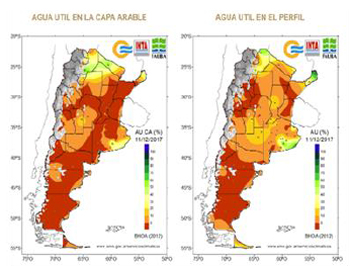
- It has been a morning of grain vs. soy spreads as hedge fund managers start to come out of long held positions. Funds have spread long soybeans against grains going back to late summer, which has generated profits. Funds desire to close a modest portion of the position which has pressured the complex and produced a bid under the grains. The volume of Chicago trade has been low and most are not looking for any excitement into the holiday’s unless S American weather forecasts change. Chicago brokers estimate that funds have bought 2,300 contracts of corn and 2,100 contracts of wheat, while selling 4,800 contracts of soybeans. In soy products, funds have sold 3,100 contracts of soymeal and bought 800 soyoil. Chicago meal and soybean prices are also being pressured by chart based considerations with soybeans under an uptrend line and January meal testing the November 30 low at $322.50. A drop below this support would potentially confirm a top.
- Rumors of a potential reinstatement of the $1.00/gallon US Biodiesel tax are being heard this morning. This is due to several ag state senators fighting hard for its return in early 2018. Senator Grassley from IA has been a strong proponent of the biodiesel credit and congressional staffers are raising their odds that the tax credit could return and be retroactive. It is something to watch heading into the Christmas break.
- The Rosario Commodity Exchange raised their wheat crop estimate to 17.3 million mt from 16.3 million, left their corn crop estimate unchanged at 41.5 million mt, and slightly adjusted their soybean crop estimate up to 54.5 million mt from 54.4 million due to larger seeding. USDA Argentine crop estimates are all higher.
13 December 2017
- The lack of any truly fundamentally-supportive developments in the USDA numbers allowed the grain/oilseed markets to slip lower yet again. While the USDA failed to lower their U.S. corn export projection, the expected increase in ethanol demand was not nearly enough to excite the market, while the lowering of the U.S. soybean and wheat export projections simply brought further highlight to the weak export picture. Without a dramatic change to S American weather prospects, the latest reports may set the stage for continued defensive price action into the USDA’s January 12 all-important set of reports.
- On the sharp break in Kansas and Chicago wheat futures, cash basis levels have soared amid tightening supplies of quality wheat. We do notice that Kansas cash wheat basis is now at its best levels in three years amid the recent $.50/bu basis advance. The basis rally has caused Kansas wheat to trade at a premium to Chicago wheat for the first time in a month. Funds appear to be willing to build on their net short in Chicago more than in Kansas. The cash basis rally is the first sign that one needs to be careful about being too bearish wheat with key support noted in Kansas futures basis March around $4.00.
- It has been a low volume and slightly higher trade in Chicago corn, soybeans and wheat this morning. Surprising soymeal vs. soyoil spread trade is occurring as soyoil futures retreat back to last week’s low. Wheat has been the morning upside leader on short covering and reduced precipitation chances for the parched Plains next week. Chicago volume has been modest and a mixed to slightly higher close is expected. December Chicago futures contracts go off the board today with either January or March taking their place on the spot continuation charts.
- The US Central Bank will likely announce an interest rate hike this afternoon, just before the Chicago close at 1:15 PM CST. Chicago brokers estimate that funds have bought 2,600 contracts of corn and 1,900 contracts of wheat, while selling 1,200 contracts of soybeans. In soy products, funds have sold 3,500 contracts of soyoil and bought 1,100 meal.
- Brazil will allow Russian wheat imports via decree, which Brazil hopes will help normalise meat trade with Moscow. The US is the loser of the decision with US HRW wheat unlikely to be sold to Brazil in future crop years when there is a shortage of Argentine HRW wheat. The move further helps Russia solidify its position as being the world’s wheat exporter.
- Goldman Sachs Inc is reaffirming its bullish call on commodities and raw material prices for 2018. Goldman is forecasting returns on commodities at 10% and expects a bullish landscape based on the GDP expansion of emerging nations. In particular, Goldman is forecasting that energy prices will rise 15%, which should be favourable to the US biofuel industry. We feel that hedge funds will position long in key commodity markets in late 2017 and early 2018.
- Argentina will place an 8% tax on biodiesel exports starting in 2018. Over the years, the Argentine Government has moved back and forth with taxes that range from 0-12%. The latest hike should not be a surprise; in fact, we do not expect the tax to have any impact on US duties on Argentine biodiesel that will be officially ratified into US law for the next five years in February.
- There is something of a demand bull story developing for soyoil amid limited biodiesel imports (duties) and a US mandate of 2.1 billion gallons. Cash US soyoil stocks are tightening amid the enlarged domestic demand. Chicago corn and wheat futures are higher as open interest surged on Tuesday and funds are holding a large net short position. US corn exports are showing new life amid higher S American fob offers. Next week’s Argentine rains will be important in terms of amounts and locations.
12 December 2017
- The USDA December Crop Report was seen as mixed to slightly bearish with WASDE deciding to cut US wheat and soybean exports in the 2017/18 crop year, while raising ethanol demand in corn by 50 million bu. In aggregate, the December WASDE report is unlikely to alter prevailing Chicago sideways price trends, with the only real winner being US biodiesel which saw a noticeable rise in use while exports were trimmed. The WASDE report will fuel oil/meal spreading and potentially, some exodus from long soybean/short corn spreads. We look for a mixed Chicago close with all eyes focused on Argentine and S Brazilian rainfall totals next week. WASDE lowered the 2017/18 US corn end stocks by 50 million bu amid the record pace of US corn ethanol demand in recent weeks. WASDE raised the US corn ethanol demand estimate to a record large 5,525 million bu. The increase in US corn ethanol demand reduced US corn 2017/18 corn end stocks to 2,437 million bu. The US average farm-gate price range narrowed 5 cents on either end of the forecast to a net average of $3.20. This is $.16/bu lower than last year.
- World 2017/18 corn end stocks were raised slightly by 500,000 mt to 204.1 million mt. We note that based on strong Chinese demand, WASDE did raise US sorghum exports by 50 million bu to 260 million. US sorghum food/seed/ industrial use was cut by a similar amount leaving US sorghum end stocks at 21 million bu, a slight 2 million rise from November. Research maintains a trading range of $3.35-3.75 for March Chicago corn futures. US wheat end stocks were increased by 25 million bu to 960 million bu amid a like reduction in US wheat exports to 950 million bu. Russia’s wheat exports were raised by 500,000 mt to 33.50 million mt, which is still 1.5-2.0 million too low in our opinion. The US wheat export prospects going forward depend upon European wheat sales/exports and future Russian weather patterns to determine if record loadings can continue. US wheat has regained export competitiveness, but its opportunities going forward are all tied to the future Russian and European export pace. We see March Chicago wheat trading a range of $4.10-4.50. 2017/18 world wheat end stocks were forecast to rise 1 million to a record large 268.4 million mt. The 2017 Canadian wheat crop was raised 3.0 million to 30 million mt with the Australian crop holding at 21.5 million mt. We also note that European wheat production was raised 1 million to 152.5 million mt with exports holding steady at 28.50 million mt. World wheat prices look to trade in a $175-205 range into Q2 2018. US 2017/18 soybean end stocks were raised 20 million to 445 million bu.
- WASDE cut US 2017/18 soybean exports by 25 million to 2,225 million bu with a 5 million bu increase in the residual. Such US soybean end stocks argue for a trading range of $9.65-10.10 for spot Chicago soybean futures with normal S. American weather. However, soyoil should gain on soymeal with WASDE raising their estimate of US 2017/18 biodiesel use by huge 500 million lbs to 7,500 million lbs. WASDE cut US soyoil exports by 300 million lbss and domestic use by 200 million leaving end stocks at 1,616 million lbs. We argue for tightening supplies of US soyoil going forward with the marketplace making sure that US soyoil exports are tepid at best. The 50 day moving average crosses at $.3414 basis January soyoil futures. This is the next upside price target. 2017/18 world soybean end stocks were raised to a record large 98.3 million mt, up 400,000 mt largely due to the US export cuts. WASDE left their Brazilian soybean crop estimate at 108.0 million mt and the Argentine crop at 57.0 million mt. Most would argue for a 1-3 million gain in the Brazilian forecast and a like cut in Argentina, leaving the overall S American soy crop unchanged.
- The USDA December report is producing a modest recovery as the market was unable to garner any downside momentum. However, at the end of the session, traders will be left with the same oversupply with diminished US export demand. Only adverse S American weather can spur enough fear to engender a lasting recovery. Our mindset remains one of selling Chicago rallies with one eye on the upcoming rains across Argentina and S Brazil next week. These rains are very important that they actually materialise.
11 December 2017
- Chicago prices are weaker at midday with wheat sagging to new contract lows on continued technical selling amid large world supplies. Favorable weather in the Black Sea is allowing Russia to export record tonnages of wheat, which is stealing “sales thunder” from the rest of the world’s exporters. The drop in wheat is pressuring corn, with wetter forecasts for Argentina and S Brazil producing liquidation in soybeans. The market expects that WASDE will raise their end stock forecasts for soybeans and corn due to sagging US export forecasts. The mentality of the markets is bearish, with most pointing to world weather as offering the only hope for a lasting recovery. Our research and belief continues to suggest that at these price levels there is minimal benefit or profit potential in taking short positions. Patience is advised with uncertainty surrounding S American weather forecasts. Cash basis levels are again starting to gain as farmers shut their barn doors.
- Brazil’s CONAB will be out in the morning with their updated corn and soybean crop estimates for Brazil. The data will be ahead of the USDA report. The trade is looking for a modest increase in crop size to 109-110 million mt of soybeans. The corn crop is expected to change little based on the importance of safrinha production. Limited progress was achieved between the Argentine Government and the US Commerce Department last week. The Argentines are trying to negotiate a lower duty or a complete end of the duty on their soyoil based biodiesel imports into the US. A final 5 year ruling is expected from the US Dept of Commerce in early February.
- The bearishness in Chicago is thick this morning as wheat values push to new contract lows. Almost everyone expects a bearish report from USDA on Tuesday. It is the market’s reaction to the report that will be the most interesting. This is not a place to join the bears in our opinion, and we await additional weather rallies with La Niña forecast to persist.