16 April 2013

  • In good old tradition the markets have been trading in “turnaround Tuesday” mode so far with Monday’s declines being reversed, and sharply so in Chicago. London & Paris markets, having now closed, may need to play some degree of catchup in the morning if CBOT levels remain where they are right now. Front month, May ’13, in London made better gains (£3.15 in reduced volume trade) than its Paris counterpart, which only managed to put on €0.25; this has left the Paris premium over London at £13.60 having been around the £15.00 level over the last couple of days. Some degree of concern is being expressed at the inability of mainland Europe to trade a futures position before Nov ’13 when the May contract expires on 10th. The six month gap presents a degree of problem as the new crop position approaches; the London July is an alternative but not a preferred one and the same can be said for the CBOT contract as price correlations are poor.
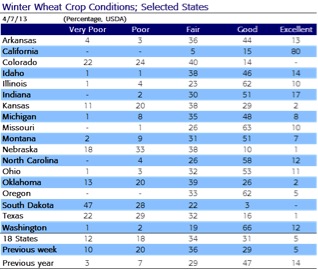
  • Slower than anticipated plantings of spring wheat and corn in the US as a consequence of current cold weather patterns have assisted the more positive market tone today. Spring wheat is only 6% planted, compared to 33% last year and the five year average of 13%. Corn is at 2%, behind both last year and the five year average of 16% and 7% respectively. Winter wheat condition is all but unchanged on last week, the slight change being poor to very poor, which has risen a point to 31%.
  • Looking back at the history on this year’s US wheat crop does not make for encouraging reading; dry planting conditions in top and sub soils following the summer long drought, slow germination and emergence leading to poor plant populations, a late entry into dormancy as winter temperatures were slow to arrive, which left the crop to try and develop for longer in adverse moisture conditions. More recently the sharp freezing temperatures that have been experienced are doing little to aid the crop and boost its potential. Reduced plant numbers and the current high “poor to very poor” crop rating do not bode well for a bumper US wheat crop.

15 April 2013

  • Tonight the market is displaying a wall of red as lower levels prevail across both European and US markets. The “rot” set in as soon as Chinese GDPO figures were published, these showed what some might consider enviable growth, but the market construed as a potential slowdown. Expectation was for 8% growth, but 7.7% was the reported level. The lower level is perceived as a possible precursor to further global slowdown with all that will follow. It has not only been agri commodities which have borne the brunt of today’s declines, metals and energies have also suffered sharp losses. Gold markets have shed over $130/oz and crude fell over $3.00/barrel as markets sold off on the news.
  • Following on from our recent commentary on Egypt’s absence from the market in recent weeks, it was reported today that their central bank sold (to the banking sector) what amounts to five times the normal weekly foreign exchange volume in its weekly auction. The weekly sales are made to allow foreign trade to continue in basic commodities, including wheat. The $600 million sale could well be a signal that Egypt is about to return to the international wheat market after an absence of some weeks, we will watch with interest. Interestingly, GASC have stated that they expect to import more than half a million mt more wheat in 2013/14 than in the current year.
  • In Brazil’s congested ports there is an additional problem looming with the threat of a one day strike by port workers. Proposed reforms have been delayed and the workers have threatened a stoppage which would do nothing to aid the congested soybean export programme.
  • China is reported to have purchased close to half a million mt of US soft red wheat for the 2013/14 marketing year, the secant such sale in under a week. Some question whether this is an indication of less than anticipated production in China, or simply further growth in domestic consumption by the increasingly urbanised and wealthy population who demand more westernised and processed foodstuffs. Reports suggest that China is seeking as much as a further 1 to 1.5 million mt, which may add some credence to the latter if it is proved correct.

12 April 2013

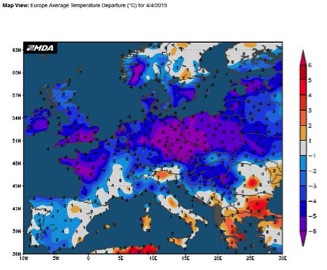
  • We close the week in a slightly more upbeat mood as the last few weeks of sub-zero (in ℃ terms) temperatures give way to warmer conditions and the extremely late signs of spring arrive at long last. Evidence of increasing levels of fieldwork in dryer soils is growing, and we would expect a fairly rapid rise in soil temperatures to aid crop development.
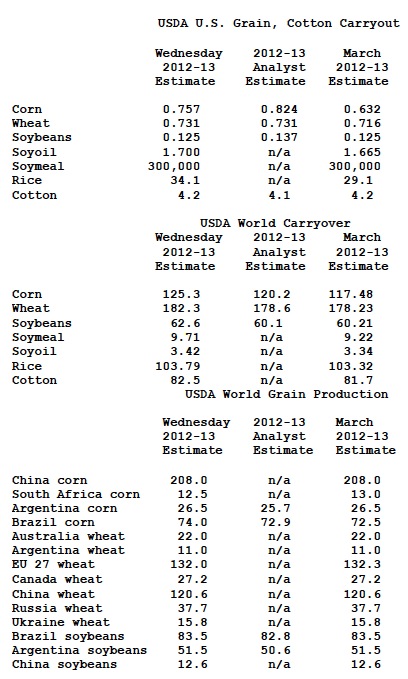
  • This week’s WASDE figures, released Wednesday, were not bearish as expected by some. However, the prevailing post report mood is very much one of “hand to mouth buying” and despite the potential warning signs, few are prepared to get bullish on old crop positions at present. The potential offered by large, and possibly record, crops in coming months appear to be offering comfort to consumers. We are aware that many European feed businesses are in a position of low levels of old crop cover and given the signs of tight supply, could well face some surprises before the next harvest is under way.


  • The Chinese bird flu outbreak continues to rumble on with headlines this week reading “nine dead out of 33 confirmed cases” of the human variant. Further cases have been discovered in birds in a number of live bird markets in Eastern China although the details are scant as is often the case in China. Precautionary culls of birds have taken place in at least one of the markets affected although subsequent discoveries do not appear to have attracted the same measures, at least according to reports received so far. This has resulted in a degree of nervousness in the soybean complex as uncertainty over Chinese consumption levels has caused many to retreat from the market.
  • Wheat and corn markets have found some support as the freezing conditions continue to delay corn plantings and potentially damage wheat crops. Disappointingly, this week’s US wheat export numbers did not match up to the upper end of expectations which could have reached the 1 million mt mark if the ideas that China purchased 14 to 16 cargoes actually materialised. Corn prices have received a degree of support from WASDE’s lower than anticipated ending stock figure. All of the USDA’s weekly export figures were all within the range of trade estimates so no surprises there.
  • We pick up on news that growers in the US are reluctant to sell given the on-going low temperatures, which are potentially delaying and damaging crops, as well as a degree of belief that the recently released stock numbers are “plain wrong”. Whilst we sympathise with their view, it must be remembered that “the market is never wrong”, buyers and sellers agree a price and trade, and therefore it MUST be right. Many a trader has lost money believing he is right and the market is wrong!
  • Whilst the US cold weather remains in the headlines, the forecasts show that there is a change towards warmer conditions towards the end of the month. This is already evident across Northern Europe as night-time temperatures remain above 0℃ (32℉), and daytime levels approach double digits (10℃/50℉). This will prove a blessing to growers who are waiting for warmer soil temperatures to boost germination and crop development in what can only be described as a late season so far.
  • Brussels granted wheat export licences totalling 377,254 mt this week (the lowest weekly total since 1st January 2013), which brings the season total to 17.579 million mt, 4.824 million mt ahead of this time last year (plus 37.8%). If the season’s remaining weekly exports were to be exactly the same as last season, it would bring the annual export level up to 19.578 million mt, and interestingly we have only had one smaller week of exports compared with last year since the beginning of December 2012 (which was the week of 26 February 2013, and that was 2,542 mt less than the prior year). Whatever happens in the remaining weeks we are heading for a big number; Wednesday’s WASDE estimate for EU wheat exports was increased by 1 million mt to 20.5 million mt, so at least they seem on the ball with that number!
  • On the subject of WASDE numbers, Wednesday’s April EU end stocks figure was estimated at 0.5 million mt greater than a month ago at 10.04 million mt; principle reasons are due to 1.25 million mt greater beginning stocks, a reduction of 200,000 mt in production, a 0.5 million mt reduction in overall consumption together with the addition 1 million mt of exports. By way of comparison, Stratégie Grains wheat carryout figure was reduced in mid-March from their February estimate by 200,000 mt to 10.7 million mt.

11 April 2013

  • The USDA has today released its weekly export figures as detailed below:
    Wheat; 339,500 mt, which is within estimates of 225,000 – 650,000 mt.
    Corn; 475,900 mt, which is within estimates of 225,000 – 900,000 mt.
    Soybeans; 383,700 mt, which is within estimates of 375,000 – 1 million mt.
    Soybean meal; 234,600 mt, which is within estimates of 50,000 – 250,000 mt.
    Soybean oil; 7,700 mt, which is within estimates of zero to 15,000 mt.
  • The Chinese bird flu outbreak continues to rumble on with today’s headline reading nine dead out of 33 confirmed cases of the human variant. Further cases have been discovered in birds in a number of live bird markets in Eastern China although the details are scant as is often the case in China. Precautionary culls of birds have taken place in at least one of the markets affected although subsequent discoveries do not appear to have attracted the same measures, at least according to reports received so far.
  • Wheat and corn markets have found some support in early trade as the freezing conditions, which we commented upon yesterday, continue to delay corn plantings and potentially damage wheat crops. Disappointingly, today’s US wheat export numbers did not match up to the upper end of expectations, and which could have reached the 1 million mt mark if the ideas that China purchased 14 to 16 cargoes actually materialised. Corn prices received a degree of support from the lower than anticipated stock figure reported yesterday.
  • We pick upon news that growers are reluctant to sell given the ongoing low temperatures, potentially delaying and damaging crops, as well as a degree of belief that the numbers are “plain wrong”. Whilst we sympathise with their view, it must be remembered that “the market is never wrong”, buyers and sellers agree a price and trade, therefore it MUST be right. Many a trader has lost money believing he is right and the market is wrong!
  • Whilst the US cold weather is currently in the headlines, the forecasts show that there is a change towards warmer conditions towards the end of the month. This is already evident across Northern Europe as night time temperatures remain above 0℃ (32℉) and daytime levels approach double digits (10℃/50℉). This will prove a blessing to growers who are waiting for warmer soil temperatures to boost germination and crop development in what can only be described as a late season so far.
  • Brussels granted wheat export licences totalling 377,254 mt this week (the lowest weekly total since 1st January 2013), which brings the season total to 17.579 million mt, 4.824 million mt ahead of this time last year (plus 37.8%). If the season’s remaining weekly exports were to be exactly the same as last season, it would bring the annual export level up to 19.578 million mt, and interestingly we have only had one smaller week of exports, compared with last, since the beginning of December 2012 (which was the week of 26 February 2013, and that was 2,542 mt less than the prior year). Whatever happens in the remaining weeks we are heading for a big number; yesterday’s WASDE estimate for EU wheat exports was increased by 1 million mt to 20.5 million mt, so at least they seem on the ball with that number!
  • On the subject of WASDE numbers, yesterday’s April EU end stocks figure was estimated at 0.5 million mt greater than a month ago at 10.04 million mt; principle reasons are due to 1.25 million mt greater beginning stocks, a reduction of 200,000 mt in production, a 0.5 million mt reduction in overall consumption together with the addition 1 million mt of exports. By way of comparison, Stratégie Grains wheat carryout figure was reduced in mid March from their February estimate by 200,000 mt to 10.7 million mt.

10 April 2013

  • A summary of today’s USDA’s April WASDE report for each of the three key agri products is available to download; please click on the link below:

USDA Apr 13 Corn

USDA Apr 13 Soybeans

USDA Apr 13 Wheat

  • The report’s authors did mostly as expected by not responding in their final balance sheet with the residual change which was indicated in the March 1st stocks report. We expect greater exports and ethanol grind over the next 90 days (compared with current estimate). The level of soybean exports and crush has to reduce immediately to meet the WASDE numbers.
  • Bottom line – this report is not bearish, however the majority are not prepared to get bullish right now. Cash basis should, on the back of this, continue to strengthen.
  • In other news, Brazil has agreed to double its wheat import quota for purchases outside the MERCOSUR free trade bloc (Argentina, Brazil, Paraguay, Uruguay and Venezuela) from 1 to 2 million mt. The measure is in response to below average production in the region and fears for increasingly tight stock levels.
  • In the US last night’s hard freeze affecting key hard red winter wheat regions of W Kansas Oklahoma and W Texas is feared to have caused severe crop damage. The crop, as it starts to flower, is especially sensitive to freezing temperatures which can cause irreversible damage. One saving grace is that the crop is delayed as a result of unseasonal low temperatures and has not yet reached the flowering stage, currently it is still jointing. Clearly the ongoing cold period is a potential threat to an already pressed crop.
  • As always, we will continue to study today’s release and comment further if appropriate.

9 April 2013

  • Seemingly we have an improving situation in US winter wheat condition with 36% rated good/excellent, which is a 2% improvement wow, but significantly behind last year’s 61%. Poor/very poor ratings stand unchanged wow at 30%, again a significant variation from last year’s 10%. Further detail is listed in the attached table.


  • Brazil’s Conab has released its latest output estimates with the 2012/13 soybean crop at 81.9 million mt (down 0.24% mom), and corn is estimated at 77.45 million mt, which is an increase from 76.1 million mt mom. Both numbers, if realised, would be record harvests!
  • Closer to home, AgroConsult report lower Ukraine output forecasts as a consequence of the extended winter period. 2013 wheat output is seen at 20.23 million mt, down from 21.07 million mt mom; barley is seen at 7.75 million mt, again a reduction from last month’s estimated 8.3 million mt. The estimate for corn is a 600,000 mt improvement mom to 21.8 million mt.
  • In France, their AgMin sees an increased wheat area for 2013 at 4.97 million ha (up 2.2% yoy), barley area is down 5.5% yoy at 1.59 million ha.
  • The recent outbreak of bird flu in China is reported to have claimed additional lives with the total reported at eight. According to Reuters, a total of 28 cases are being reported from the latest variant of the disease. The outbreak does appear to be having an impact upon poultry consumption, albeit one we can not quantify at this time, and we would expect ingredients (soybean meal) to be similarly impacted with the appropriate knock on effect on prices. This is only likely to become significant if the outbreak becomes widespread, although some are questioning what the substitute for poultry meat is in China and whether the consumption pattern will resume its more traditional course as time moves on.
  • Tomorrow’s April WASDE report was expected to have something of a limiting effect on CBOT markets today, soybeans currently stand in positive territory as does corn, the cold conditions which are delaying plantings will no doubt add to the positive sentiment, as does the prospect of Chinese corn imports resulting from their cold and wet weather delayed plantings. Wheat is trading a touch lower, presumably as a result of the slight condition improvement.

8 April 2013

  • Markets started the week on a firmer note as discussion abounded on the subject of freezing conditions causing crop damage in the US; additional support was derived from reports that China has purchased multiple cargoes of US wheat, actual numbers are to be confirmed but some 14 to 16 are suggested but confirmation is awaited. The final supportive note came from drier conditions in the western Plains region.
  • With the USDA scheduled to release its April WASDE report on Wednesday we expect rallies to be capped before too much upside is seen. The level of confidence exhibited in the NASS quarterly corn stocks will be extremely interesting and watched by everyone.
  • Paris wheat prices reached two month highs whilst the UK made better gains with new crop UK prices making premium gains over Paris; perhaps based upon the concerns which exist over declining UK output potential as unseasonal cold conditions continue to delay crop development and ultimate output.

5 April 2013

  • This week has seen a post USDA report and Easter break return to work in something of a mood of acceptance of the inevitable. Bigger stocks and a “nothing to worry about” attitude seem to prevail with the markets all at lower levels than they have been in recent weeks. Perhaps wheat has shown the most resilience with London and Paris markets virtually unchanged on pre report levels as opposed to the US corn market, which has fallen a full $1.00 per bushel and has shown little in the way of returning to former levels. The US soybean market took less of a hit, falling about $0.60 per bushel on Thursday but working another $0.30 per bushel lower over the course of this week.
  • Going forward it would seem that the key influencing issue is that of weather. In Europe we are looking at the potential for a later, rather than earlier, harvest due to the prolonged period of cold weather. This has left soils colder than normal, which delays germination and emergence of spring sown crops as well as delaying crops coming out of winter dormancy. Anecdotal evidence within the UK this week is that growers and merchants are pricing wheat for August delivery in the north as a full old crop month. This is leaving new crop barley looking particularly attractive for August at substantial discounts. September barley also looks attractive but not quite the same “bargain” as August.
  • Still on the subject of weather, the US is reported to remain cold throughout the first half of April with freezing temperatures remaining in place across the northern Plains and into Canada. As with Europe, the potential for planting delays exists, and many growers will be more than fully aware that any significant delay in corn planting will increase the possibility of any number of weather related issues down the line. Pollination at times of high temperature and peak crop moisture demand in high summer could well conspire to persuade some to switch acres away from corn to soybeans. We will be watching for tell-tale signs as plantings progress in coming weeks.
  • Reports of a new strain of avian influenza in China (H7N9), transmissible to humans and possibly responsible for a number of deaths have hit the headlines this week. The World Health Organisation has played down fears of a global pandemic, similar to the H5N1 swine flu outbreak in 2009. However, this has not prevented Chinese traders from selling out soybean meal positions “just in case”, and creating a mood of lower pricing, particularly on the Dalian Exchange.
  • Brussels have once again issued wheat export licences in excess of half a million mt, this week’s volume hitting 533,289 mt, which brings the season total to 17,201,767 mt. This is 4.556 million mt ahead of last year, a greater than 36% increase. Our “usual comments” apply!
  • We continue to watch the balance of the old crop season unfold, specifically in relation to EU feed grains and how tight they may become. In addition, Russia and Ukraine’s attitudes and government policies as far as early season exports are concerned. This is in the light of last year’s large early season sales amid the context of poor harvests leaving tight ending stocks. No doubt this will be of keen interest to Egypt who seem to be holding back from further tenders amid statements to the effect that they have 80 or so days of stocks; cynically (as ever) we believe they may well be hard pressed for government foreign exchange reserves to back up tenders, as well a reluctance to accept IMF assistance for fear of austerity implications.
  • No doubt the onset of milder spring weather conditions across the northern hemisphere will alleviate some of the concerns, but there is a long way to go before we see the potentially bumper harvests hit the barn floor and market pressures relieved.

4 April 2013

  • The USA has released its weekly export figures as detailed below:

Wheat, 316,000 mt, which is below estimates of 350-800,000 mt
Corn, 387,300 mt, which is within estimates of 175-600,000 mt
Soybeans, 747,800 mt, which is above estimates of 200-700,000 mt
Soybean meal, 105,300 mt, which is within estimates of zero to 170,000 mt
Soybean oil, minus 4,600 mt, which is below estimates of zero to 15,000 mt

  • A steadier US$ on account of heightened tensions over North Korean “warmongering” and “sabre rattling” has provided sufficient impetus to provide commodities with a slightly weaker tone during today. Added to some profit taking after yesterday’s wheat rally we are unsurprised at today’s price action.
  • Brussels has granted another big week of exports licences, 538,000 mt bringing the season total to nearly 17.5 million mt. We remain 35% higher than this time last season amid prospects of delayed and possibly reduced harvest. Little wonder that wheat prices in both London and Paris are now all but unchanged on pre USDA report levels.
  • It has been the soybean complex which has led downward momentum, perhaps with the “bird flu”  talk still prevalent in China as reports of another death from the new strain of virus leaves traders keen to exit long positions and pressure markets. Our view is that the “new” virus is likely to go the way of the last significant outbreak, and is unlikely to create a global flu pandemic, massive poultry cutbacks and the consequent fall in protein demand.
  • Within the USA it appears that corn growers in the MidWest still have concerns over frozen ground and drought, whilst hard red wheat continues to be plagued by high plains drought. Temperatures are rising, as would be expected at this time of year, but it is possible that sowings could be delayed and output compromised as a result – early days!

3 April 2013

  • Today sees a plethora of data releases, key items are listed below:
  • Russia’s AgMin reports their 2013 grain crop at 90-92 million mt, which is a downgrade from their last estimated level of 90-95 million mt although an increase from last year’s 71 million mt.
  • Argentina’s Rosario Grain Exchange (RGE) estimates the 2012/13 soybean crop at 48 million mt, which is unchanged from a month ago; their forecast for the corn crop is 25.3 million mt, which is a 200,000 mt reduction from last month’s estimate.
  • Informa Economics released estimates as follows; the 2012/13 Argentine corn crop at 25.3 million mt, a 300,000 mt reduction mom, Brazil’s 2012/13 corn crop is estimated to be 71.95 million mt, a 350,000 mt increase mom, China’s 2013/14 corn crop is forecast at 213 million mt, an 8 million mt  increase mom.
  • Informa’s soybean estimates are for the 2012/13 Argentine crop to come in at 52 million mt, a 1 million mt increase mom; Brazil’s crop is seen at 83.25 million mt, a 1.25 million mt decrease mom.
  • In the news today we read a number of reports of “bird flu” in China, to which a number of deaths (human) are attributed. In 2009 a global flu pandemic was predicted, based upon a similar bird flu strain, albeit the prediction did not materialise into reality. As a consequence we have seen a decline in soybean prices, initially on the Dalian exchange, on fears of reduced soybean meal consumption.
  • EU grains have made gains and are now not too far below pre-Thursday report levels. News that EU crops (specifically UK, France and Germany) are three to four weeks behind normal, when placed into the context that EU wide stocks that are at just over three weeks consumption, makes for a fascinating potential market development. Add to the EU situation a potentially very tight Russian wheat supply, by which we understand potentially running out, the picture becomes doubly interesting and we will look with interest to see how this unfolds in coming weeks.
  • The latest Russian wheat outlook looks to be challenging to say the least. Poor autumn establishment in dry conditions, followed by Oct-Dec sub normal precipitation led to the crop entering dormancy in poor condition. Improved winter rains have improved matters but possibly too late to see a full recovery and crop potential. Spring weather, specifically rainfall will be absolutely key in determining output for the region.