
16 May 2013

  • Brussels has granted another week of ¼ million mt plus wheat export certificates with the actual season total hitting 19,176,587 mt. This brings exports to 5.329 million mt more than this time last year (38.5%).
  • The USDA has today released its weekly export figures as detailed below:

Wheat; 540,700 mt which is within estimates of 250,000-600,000 mt.
Corn; 258,500 mt which is below estimates of 300,000-500,000 mt.
Soybeans; 361,900 mt which is below estimates of 400,000-600,000 mt.
Soybean meal; 192,500 mt which is above estimates of zero to 180,000 mt.
Soybean oil; minus 5,200 mt which is below estimates of 5,000-15,000 mt.

  • CBOT markets show diversity with the soybean complex trading in positive territory whilst the grains (wheat and corn) trade lower. Support for the bean complex may have come from the meal export data. Corn prices dipped on the potential for plantings to increase in the current weather window, albeit the window is expected to close as rains move in again further delaying sowings.
  • Agritel have forecast 2013/14 Russian wheat exports lower at 10.4 million mt, which compares with the USDA’s latest figure of 18 million mt. Whilst they see the crop up from last season at 51.4 million mt, this number is some way short of the USDA’s 56 million mt. As we have previously reported, exports will be pressured by domestic restocking; additionally the final crop outturn is far from certain right now with the dry conditions in the key southern growing region.
15 May 2013

  • Our weekend roundup commentary seems appropriate today; the morning news today reported that the UK, which is less than six weeks away from mid-summer, was due to receive snowfall. We felt that this was fanciful and typical scaremongering, however it has proved correct as a number of regions across the UK have indeed received snow today. Little wonder that harvest dates are being viewed at the later end of the spectrum with little prospect of early crops. August wheat is very much, at present, an old crop commodity rather that a 50:50 split between old and new.
  • News that France has once again (actually the third time) gone back into recession has done little to bolster confidence in Euroland, seemingly Germany has only just missed the recessionary trigger. On the news the Euro has hit its lowest level in around six weeks.
  • In the US, the strong US$ has had the inevitable consequence of adding a weaker tone to commodities which are already pressured following the latest USDA report.
  • It feels very much as if we are shaping up for a long season of weather issues from which markets will take their direction. Ukraine and southern Russia have been dry and temperatures have risen sharply in recent days helping to progress spring plantings. However, the recent dry conditions have accelerated soil moisture evaporation; if it had not been for heavy snow melt following the winter soil moisture deficits would be causing concerns right now. That said, estimates of Ukraine wheat output have been cut to a range of 19.9-20.23 million mt from original ideas of 22 million mt. Last year’s dry conditions left output below 16 million mt and rain is needed if we are not to see a repetition this season.
  • Similar conditions appear to be stressing wheat crops in southern Russia. Temperatures are well above normal and rainfall has been limited, and insufficient to offset the evaporation caused by the elevated temperatures. Extremely dry conditions are apparent in the four key wheat districts of Stavropol, Krasnodar, Rostov and Volgograd. The difference between Ukraine and these regions is that the ground water reserves are more limited and unlikely to be adequate to support crop development going forward unless rain, and plenty of it, falls very soon. The last six to eight weeks have been dry and whilst spring planting has progressed well, it is at the expense of germination and development.
  • In other news today rapeseed crops in Europe have mixed prospects; the UK crop is poor at best having suffered from late planting, excessive winter wetness, pigeon predation in early spring leaving overall production prospects very much in question. Conditions in France are mixed with the northeast looking poor whilst German conditions appear to be improving. The warm and dry conditions which are hitting wheat in Ukraine and Russia are also potentially impacting their rapeseed potential. To cap it all, Australian output may well reach a three year low on dry conditions according to Oil World.

13 May 2013

  • Today has proved interesting on the first day back after Friday’s WASDE report with what can only be described as a bullish session amid what we originally interpreted as a bearish report. There is a distinct lack of fresh information and the US old crop fundamentals of cold and wet as well as tight supplies appear to be the drivers today.
  • US corn planting weather would seem to have a good three day window as temperatures rise and a dry conditions prevail, for now. We know that the serious corn growers can hit some big acres when necessary, and now would seem to be “necessary”. Whether or not this small window is enough to get the necessary acres into the ground or not remains to be seen.
  • We note with interest the especially dry and hotter conditions in Texas where the condition of wheat rated poor/very poor is at 70%. Cattle growers may well use wheat fields as grazing and consider planting an alternative, sorghum or cotton, which may leave as much as two thirds of the state crop unharvested.
  • According to China’s CNGOIC (China National Grain & Oils Information Centre) the country, which is the world’s second largest consumer of corn, may well increase its corn output by nearly 3% and wheat by just over 1% this year. The corn harvest, if realised, would reach 214 million mt and leave imports for 2013/14 at around 5 million mt, nearly double the  current year’s estimated import volume. This figure, whilst large, is less than that forecast by the USDA on Friday, which stands at 7 million mt. Their wheat harvest, as the world’s largest producer, would stand at 121.8 million mt, mostly a winter sown crop.
  • Last week Brussels issued wheat export certificates totalling 284,484 mt bringing the season total to 18.926 million mt with eight weeks to go. The season is 5.217 million mt ahead of the same time last year (38%).
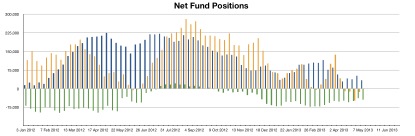
  • Fund net positions in CBOT corn returned to a positive figure (just) after a four week sojourn in “short” territory. Soybean net longs reduced slightly and wheat net short positions increased to a slightly larger net short. The cumulative position reveals a relatively small position from an historic perspective.
  • Finally, Oil World today estimated the EU rapeseed output at a three year peak of 20.2 million mt as winter crops (UK excepted) appear to be performing reasonably well. Crop conditions in Australia, due to dry conditions, as well as S Russian and Ukraine crop concerns continue to be a factor to watch.

10 May 2013

  • We reported a week or two ago that the markets were all about the weather; how prophetic that has proved to be! In the UK we took the two day opportunity to parade in shorts and T-shirts and enjoy our summer, if you missed it we are now back to rainstorms, gale force winds and temperatures well below normal. Happily, we are not alone in our abnormal conditions; the US and Canada continue to struggle with cold and wet conditions which are delaying spring plantings and hampering winter wheat progress.
  • Latest USDA crop condition figures show the proportion of winter wheat rated poor/very poor to have risen to 39% from 35% a week ago whilst the good /excellent crop has fallen one point to 32%. Crop progress is also slow with only 20% headed (compared to 14% a week ago), which is behind the five-year average of 39% and 64% last year.
  • Spring wheat fares no better with 23% planted, which is an improvement week on week, but behind the five year average of 50% and last year’s 82%. Unsurprisingly the emerged crop only stands at 5%, which compares with last year’s 43% and a five-year figure of 19%.
  • Canada has also struggled with plantings as late snow cover, lingering cold and wet soils continue to delay fieldwork. Elsewhere we see on-going dry patterns emerging in Southern Russia and Ukraine where the continental climatic pattern moves into its summer season with rapidly rising temperatures, which threaten to further dry out topsoils and leave crops open to moisture and heat stress. As we have previously reported, the region is fast approaching a time when rainfall is becoming a necessity if crop potential is to be fully reached. Europe, as a whole, continues to receive cooler and wetter weather but wheat crops appear to be progressing in reasonable condition.
  • It will be interesting to view the USDA’s figures issued today (as European markets are closing) where, no doubt, most will be focussing on corn and soybean numbers rather than wheat.
  • Moving away from wheat, possibly the most notable news this week has been that at least three cargoes (reported to each be 30,000 mt) have been traded to the US from Brazil and Paraguay. The reports carry a strong degree of credibility insofar as load ports and vessels have been nominated. This volume (90,000 mt or 3.3 million bu) will hardly scratch the surface of the addition 70 million bu that we estimate is required to be found to meet the minimum “pipeline” requirements of the US soybean balance sheet. Supplies are tight following last year’s drought conditions coupled with strong export trade, particularly to China, and a strong domestic crush leaving end of season stocks in a historically tight position.
  • The tightness is soybeans is clearly illustrated by cash basis levels which continue to be strong; additionally the front month CBOT contract (May ’13) stands at a premium of over $0.80/bu to July ’13. The May ’13 contract is also trading at a very strong premium in excess of $2.70/bu over new crop Nov ’13 indicating continued buying support for the old crop positions. Clearly consumption interest has not yet been curtailed by prices!
  • Figures released this week by Brazil’s CONAB, which lowered forecast soybean output by 400,000 mt to 81.5 million mt (month on month) have done little, if anything, to markets. Supplies appear to be flowing from Brazilian ports as the season moves into top gear and it would seem fair to assume that pressure will now come off the US from an export perspective.
  • In conclusion, whilst there may be continued tightness in old crop supplies there need to be buyers to sustain high and higher prices. As buyers keep their cards close to their chest and run stocks as tight as practical, given the large new crop discounts, we would appear to be facing limited price upside unless mother nature springs a surprise. From a new crop perspective it appears that large acreages and (until proven otherwise) trend line yields will provide some relief to globally tight stock positions. Under these circumstances price rallies would look likely to be capped by selling pressure. One caveat has to be made, and that is the current net fund position; funds (as at 30 April) had relatively small net long positions in soybeans and were net short corn as well as wheat. Should they decide to change their stance and scramble to cover short positions we could face sharp upward price moves.

9 May 2013

  • The USDA has today released its weekly export figures as detailed below:

Wheat 465,500 mt which is within estimates of 300,000-800,000 mt.
Corn 285,800 mt which is below estimates of 400,000-800,000 mt.
Soybeans 585,500 mt which is within estimates of 400,000-700,000 mt.
Soybean meal 71,900 mt which is within estimates of50,000-230,000 mt.
Soybean oil 900 mt which is within estimates of zero –10,000 mt.

  • Markets are trading into tomorrow’s USDA report and today has seen higher levels across all three key agri commodities. Once again the report will be published as Europe is going home for the night (and weekend) so this side of the pond will have the weekend to digest the data and reflect upon US reaction prior to markets opening on Monday.
  • Of note today are the reports that at least three cargoes (of 30,000 mt) of Brazilian and Paraguayan soybeans have been traded into the US as the latter’s stocks continue to be tight and cash bids rise to elicit farmer selling with limited success. In addition to trade reports we have first hand knowledge from Brazil that trades have actually taken place (confirmed today) and our confidence remains high that the US is now an importer of S American soybeans.
  • Continuing the S American theme, CONAB reported the 2012/13 soybean crop slightly lower than a month ago at 81.5 million mt (vs. 81.9 million mt) and the corn crop slightly higher at 78 million mt (vs. 77.45 million mt).

7 May 2013

  • The European markets have seen little in the way of excitement as holidays get in front of day to day activities, the Paris May ’13 contract approaches expiry and buyers retreat hoping that their purchases will see them throughout to the new crop and its inevitable price reductions.
  • We therefore look, as ever, to the US for news and information upon which prices will take direction; the weekly crop progress report did little to add comfort as the winter wheat data continues to present a gloomy picture. Poor/very poor rating accounts for 39%, a rise from 35% a week ago, whilst good/excellent stands at 32%, down from 33% last week. Spring wheat plantings stand at 23%, up from 12% last week but behind the 5 year average of 50%. Corn plantings, whilst better than last week at 12% (last week 5%) are behind the 5 year average of 47%. Soybean plantings are just scratching the surface with 2% in the ground compared with the five year average of 12%. All in all, the US weather has conspired to give us an unattractive overview of the coming season; however we MUST remember that nature has an impressive ability to compensate and it seems markets are taking this into account right now.
  • Ukraine’s soil moisture levels are starting to raise concern as the dry conditions have left topsoils drier than desirable. Planting of spring wheat is reported to be significantly behind last year and winter planted crops are showing signs of a decline in condition. The latest crop estimates from ArgroConsult and ProAgro are around 2 million mt behind the USDA’s latest forecast. To add to the concern it is also reported that temperatures are rising creating additional drying to topsoils; the forecast for the next week shows little immediate relief.
  • Canadian wheat output may well come under pressure as their planned record acreage of spring wheat is delayed as a result of frozen soils and heavy snow melt.
  • In Australia the lack of spring rains in NSW, described as ether “below average” or “very much below average” has delayed sowings of wheat.
  • Despite what might feel like bullish news, the general feeling we have is that (new crop) price rallies are being viewed as opportunities to sell, and therefore gains are being limited. The key to exploiting this to full advantage from a consumer perspective is to anticipate the arrival of plentiful new crop supplies and have little in the way of expensive old crop stocks. Maybe this is a statement of the obvious, but sometimes it is worth making such statements particularly when the old vs. new crop price differentials are wide.

3 May 2013

  • The week’s news has largely revolved around the US weather scene, which continues to present an unfavourable picture with continued cold and wet conditions associated with a closed low that is positioning itself over the US Corn Belt. As a result, corn plantings are delayed with no widespread relief from this pattern in the near-term forecast. Meanwhile, some of the winter wheat crops have been subjected to a series of freezes, which could impact yield also. Spring wheat plantings are also being delayed. Overall the “top picture” does not look fantastic right now, but we must bear in mind that there is a long way to go before harvest is even considered and nature has a wonderful way of compensating for the inevitable difficulties it encounters in a season.
  • In terms of market impact, we have seen new crop corn (Dec ’13) move from last Friday’s close $5.23⅞ to finish Thursday at $5.58⅜, a rise of nearly $0.35/bu. In terms of old crop corn we are seeing the front month premiums growing with May ’13 over $0.35 ahead of Jul ’13, reflecting the tightness of supplies and reluctance of sellers to part with stocks. Cash premiums remain solid as buyers attempt to persuade sellers to come forward.
  • The soybean market displays similar notes with the May ’13 premium reaching record levels over the Jul ’13 contract. In the first two days of the week we saw old crop beans gain over $0.50/bu only to give much of that back on Wednesday before beginning to climb once again.
  • In terms of driving forces it is probably fair to say that Chinese demand for old crop US soybeans is drying up fast as the flow of Brazilian supplies picks up. Latest trade data would lead us to believe that over 7 million mt of soybeans were shipped in April, maybe a touch lower than originally estimated but more than double the volume moved in March. This is clearly moving the focus away from US tonnage.
  • In addition there is the impact of bird flu in China, the BBC has reported that all provinces in the country are affected and, with 120 people affected and 26 dead, clearly this does not appear to be a “one minute wonder”. The WHO continues to warn of the seriousness of the threat to human health and whilst not transmissible from human to human (yet), the virus has displayed two of the five mutations required to make this happen. Should such an event occur, the WHO further warns of the potential for a pandemic of greater proportion than has been previously exhibited by any other flu variant.
  • Many stories follow on this theme with varying reports on the decline in chicken meat consumption, as much as 80% reduction being cited by some. There are also bizarre reports of rat and small mammal meats being passed off as mutton in the country which is searching for an alternative to poultry protein – we will leave readers to decide for themselves as to the attractiveness or otherwise of such a culinary delight!
  • More seriously, the impact on soybean meal consumption must be an issue going forward. Unless the virus is stopped in its tracks by the imposition of some fairly draconian measures, culls and exclusion zones around infected areas, the spread will continue to grow. How this plays out in coming weeks will be key in determining the requirement for soybean meal. We are watching with growing interest.
  • Finally, Brussels granted EU wheat export certificates for 338,588 mt, which is ahead of last week and brings the cumulative volume up to 18.641 million mt, 5.15 million mt ahead of last season (38.1%).

2 May 2013

  • The USDA has today released its weekly export figures as detailed below:
    Wheat 716,600 mt; which is above estimates of 450,000-650,000 mt
    Corn 985,200 mt; which is within estimates of 750,000-1,050,000 mt
    Soybeans 1,231,300 mt; which is above estimates of 400,000-800,000 mt
    Soybean meal 148,900 mt; which is within estimates of 120,000-280,000 mt
    Soybean Oil 1,100 mt; which is below estimates of 5,000-10,000 mt
    The soybean figure represents new crop sales, mostly to China who also accounted for old crop cancellations.
  • CBOT markets have shown gains today with corn showing the way in the light of sowing delays caused by the much discussed cold and wet weather. Wheat has followed and soybeans have also made gains. The front month contracts in both soybeans and corn are illustrating the strong cash demand, which has pushed basis levels higher. The May ’13 soybean premium has stretched to over $0.70/bu, whilst the corn premium has reached close to $0.40/bu. The tightness in old crop supplies is likely to reflect a similar position in the July contract as May reaches expiry later this month.
  • Brussels issued a further 342,000 mt of wheat export certificates, which brings the season to date total up to 18.905 million mt, 5.1 million mt ahead of the same time last season. Given concerns that the Ukraine export route was once again “open for business” has not materialised into serious EU export competition so far. We reported earlier that domestic prices were at a sufficiently high level to discourage traders from opting for export markets ahead of domestic; so far this seems to be holding true.

1 May 2013

  • With Paris markets closed for the Mayday celebrations we will be brief tonight. Weather issues dominate with cold and wet conditions pressuring the US, however today has seen a classic case of “what goes up, must come down.” Pricing boards are a sea of red at the close despite these weather threats.
  • The potential for switching of US corn acres into soybeans should not be underestimated as optimal corn planting dates loom close and weather windows appear limited if the forecasters are correct. Only time will tell, and this point should be watched very closely.