16 September 2013

  • The week has started lower with some evidence of spread trades being unwound which has given support to the grains. Tomorrow’s FSA report and the attached concern that it may show significant acreage reduction, particularly in corn is also lending a degree of support. Weekend rainfall and more in the forecast, albeit probably too late to have a significant impact, has given the bears some comfort.
  • Today has seen news that Indian monsoon conditions look set to support their soybean output and help to achieve the highest soybean meal exports in six years. India is the largest supplier in Asia, and looks to have the potential to reaching excess of 4 million mt in the year starting October. Whilst far removed from CBOT markets, this tonnage is sufficient to have some impact on futures prices in coming months. The export potential is also assisted by the weakening Rupee, which has lost 13% vs. US$ this year.
  • We await tomorrow’s report and would not be surprised to see “fireworks” in immediate post publication trading.

12 September 2013

  • Still digesting USDA numbers, grains currently down and soybean complex higher, and will update later but meanwhile today’s headline data is as follows:

World 13/14 wheat ending stocks: 176.28 million mt, above  estimate of 172.76, and 172.99 month on month.
US 13/14 wheat ending stocks: 561 million bu, above estimates of 551 and 551 month on month.
World 12/13 corn ending stocks: 122.59 million mt, below estimates of 122.798, and 123.11 month on month.
World 13/14 corn ending stocks: 151.42 million mt, above estimates of 146.927and 150.17 month on month.
US 12/13 corn ending stocks: 661 million bu, below estimates of 718 and 719 month on month.
US 13/14 corn ending stocks: 1.855 billion bu, above estimates of 1.732, and 1.837 month on month.
US 13/14 corn production: 13.843 billion bu, with 155.3 bu/acre, on 89.1 million harvested acres, above estimates of 13.62/153.69/88.559 and above 13.763/154.4/89.1 month on month and up from 10.78/123.4/87.4 year on year.
World 12/13 soy ending stocks: 61.55 million mt, below estimates of 61.73, and 62.22 month on month.
World 13/14 soy ending stocks: 71.54 million mt, above estimates of 71.167 and below 72.27 month on month.
US 12/13 soy ending stocks: 125 million bu, above estimates of 123 and unchanged month on month.
US 13/14 soy ending stocks: 150 million bu, below estimates of 165 and 220 month on month.
US 13/14 soy production: 3.149 billion bu, with 41.2 bu/acre, on 76.378 million harvested acres, above estimates of 3.14/41.172/76.248 and below 3.255/42.6/76.4 month on month and up from 3.015/39.6/76.1 year on year.

  • The USDA has today released its weekly export figures as detailed below:

Wheat: 551,900 mt, which is within estimates of 450,000-650,000 mt.
Corn: 332,600 mt, which is below estimates of 400,000-500,000 mt.
Soybeans: 478,100 mt, which is below estimates of 650,000-800,000 mt.
Soybean Meal: 128,700 mt, which is within estimates of 70,000-230,000 mt.
Soybean Oil: 6,200 mt, which is below estimates of 10,000-20,000 mt.

  • Brussels this week has granted wheat export licences totalling 724,008 mt, which brings the season total up to 5,409,530 mt. This is nearly 2.6 million mt ahead of this time last season (92% ahead).
  • One last news item from Reuters suggests that the EU will cap fuels from food crops (wheat and rapeseed) as fears for rising food prices and climate damage continue to grow. The suggested 6% ceiling on inclusions fall some way short of the 10% target set in 2009. EU biofuel producers will no doubt feel hard done by with any expansion prospects effectively curtailed. From a personal perspective it is pleasing to see the EU agreeing with our long held view on the folly of bio-fuels; we have long held the opinion that they are not energy neutral! In 2007 EU ethanol production was around 2.7 billion gallons, today around twice that. According to latest estimates, the EU wastes around 5 billion gallons of car fuel each year due to ……….. (would you believe) ……. Incorrect tyre pressures. Maybe they should legislate on that instead!

11 September 2013

  • As expected, today has seen little action in the run unto tomorrow’s USDA crop report. Nervous traders have probably reduce position size ahead of the report in a “risk off” mood. We have reported in recent days our view that global crops show a stock rebuild potential and despite some reduction in predicted northern hemisphere output we continue to stare at increased total supplies of both grains and oilseeds, which will impact S&D and in turn prices. Our S American contacts advise us directly that oilseed planting intentions are for increased acres assuming weather permits, and hot on the heels of increased northern hemisphere output it would seem likely that our high school economics lessons will prove correct and drive prices in a downward direction, unless of course we can see demand escalation of some magnitude (from where, we know not).
  • Lanworth, the Reuters crop forecasting arm, today increased global corn output to 942 million mt (from 940 million mt) due to improved prospects for crops in both the US and Ukraine. Ukraine output was increased 3% to 26.4 million mt as a consequence of “moderately wet and unexpectedly cool” late August weather. The US output was put at 13.396 billion bu based upon a yield of 152.2 bu/acre. The latest figure is an increase from their last estimate of 13.330 billion bu and 151.6 bu/acre. Their outlook for soybean output was less optimistic with US production trimmed marginally to 3.113 billion bu (from 3.114 billion bu). Global wheat and soybean output were left unchanged in their latest deliberations (at 702 million mt and 278 million mt respectively).
  • Tomorrow looms large although historically it is the next, October, report which has produced market upsets. However, the USDA has in recent times had sufficient lack of predictability to see an apple cart or two being upset and tears shed as their reports are read.

10 September 2013

  • Today has seen another Egyptian purchase of wheat, unsurprisingly from the Black Sea! This time, the fifth since late August, 115,000 mt went to Ukraine and 60,000 mt each to Russia and Romania. French offers were some $3/mt higher on an FOB basis, but the additional $6 or $7 on freight meant they were close to $10 out basis C&F.
  • In France, cash premiums for wheat declined as their estimated output was increased by 900,000 mt to 37 million mt, which compares with 35.5 million mt last year. (This figure is still lower than a number of private estimates.) Th bigger picture suggests that a larger EU crop will result in a lower need for French imports and the increased French crop has left the trade talking of a 12 million mt exportable surplus, an increase of 2 million mt over last year.
  • Whilst EU exports are running over 2 million mt ahead of last year the French share is only 400,000 mt of this. The lack of competitiveness in Egyptian tenders will leave the S&D heavy on the supply side!
  • Other news includes the increased forecast by Brazil’s Conab (government crop supply agency) in 2012/13 corn output to even higher record territory, their latest estimate has reached 81.3 million mt, an increase of 1 million mt from their August estimate. At the same time they reduced the 2013 wheat crop estimate to 4.95 million mt from 5.62 million mt.
  • Brazil has expanded a duty-free wheat import quota through to end November by 400,000 mt after severe frosts blanketed the country’s main wheat belt in the past two months and as its main supplier Argentina is struggling with its own shortages. The expansion takes the quota to 2.7 millions mt. Brazilian flour mills have already purchased 2.3 million mt of US and Canadian wheat for import under the quota, which exempts the wheat from a common import tariff of 10 percent. Brazil is often among the top two or three wheat importers in the world. As members of the Mercosur customs union, grain trade between Brazil and Argentina is tariff free.
  • We, like the rest of the trade await the USDA report which is scheduled to be published at 5pm (UK time) on Thursday.

9 September 2013

  • We start the week in a quiet manner in what is almost guaranteed to be a quiet run up to the USDA’s next, and much anticipated, report on Thursday.
  • Front month contracts in Chicago are soon to expire, and with cash premiums evaporating fast as newly harvested crops reach eager customers, the futures have faded fast. Buyers are reluctant to purchase more than immediate requirements and the old crop premium will now be very short lived.
  • We can see a scenario building where season highs have been scored, grains (corn and wheat), as we have reported previously, would appear to struggle to make significant gains in the light of global supply rebuild and soybeans have a similar uphill battle in an enlarged world supply situation.
  • There appears slightly more rain in US forecasts and, encouragingly, there is little in the way of a damaging frost forecast through to the last week of the month.
  • We continue to look forward to Thursday’s figures with interest.

5 September 2013

  • What goes up must come down, or so it seemed this morning! Tuesday’s gains in soybean meal were retraced yesterday and again this morning, although late trade has seen the soybean complex back into positive territory; the grains have continued weak, and this has spilled over into European grain markets.
  • Of interest is the level at which yesterday’s Egyptian purchase was made, the Black Sea seller’s level basis C&F was $7 below the US soft red wheat FOB level. This illustrated the disparity between origin offer at the present time, which will surely be rectified in time. The question will no doubt be, “Will Black Sea offers rise as availability is reduced, or will US prices fall to become more competitive?”
  • Brussels has issued wheat export licences this week for 558,695 mt bringing the season total to 4.686 million mt, 2.3 million mt ahead of last seasons figure.
  • The market remains nervous as weather forecasts vacillate between dry and wet and the USDA/WASE report looms ever closer next week with all it may bring with it. Within days we will see the FSA acreage report updating figures and shortly after we will see actual harvest results. It is only then that we will be able to judge what effect the weather conditions have actually had upon yields.
  • Commodity broker, F C Stone, has released its latest crop estimate with a corn yield of 156.4 bu/acre giving an output of 13.942 billion bu, this compares with the USDA’s latest 154.4 bu/acre and 13.763 billion bu. Their soybean numbers came in at 41.2 bu/acre with output at 3.146 billion bu vs. USDA figures of 42.6 bu/acre and 3.255 billion bu. Bear in mind the USDA will update its numbers on 12th September. For comparison Allendale forecast corn at 153.4 bu/acre and soybeans at 39 bu/acre whilst a Reuters survey saw corn yield at 153.985 bu/acre.

4 September 2013

  • The markets have today all traded lower with funds being noted sellers in the soybean complex as well as in grains. The inability of the Nov ’13 soybean contract to push into new highs has been cited as the trigger for selling of a technical nature. As ever, the grains tagged along with the decline.
  • Egypt’s GASC once again secured wheat in their most recent tender, this time for October 21-31 shipment. Russia secured 120,000 mt and Romania the balance of 60,000 mt. This brings Egypt’s 2013-14 procurement to just over 1.9 million mt, and is the third such tender within eight days. Perhaps of interest is the growth in tonnage secured by Russia who were noticeable by their failure to secure early tonnage in Egypt’s tenders. France, once again, was too expensive and failed to secure a sale.
  • The Reuters crop forecasting arm, Lanworth, once again cut its forecast for US corn and soybean output as a consequence of hot and dry conditions. Corn was forecast at 13.33 billion bu with yield at 151.6 bu/acre, which is a reduction from 13.406 billion bu and 152.4 bu/acre. Soybeans were predicted to yield 40.4 bu/acre with a total output of 3.114 billion bu, which compares with 40.8 bu/acre and 3.14 billion bu last estimated. In the same report they increased global wheat output to 701.84 million mt (3 million mt increase month on month) based upon improved prospects for crops in Russia, Canada, Kazakhstan and Argentina, which are expected to offset the poorer outlook in Australia.
  • Much has been talked of the US weather conditions of late. The season started late with unusually wet conditions delaying seeding in sodden fields, although some heroic efforts were made by farmers to catch up when conditions allowed. Crops (corn and soybeans) became tested as conditions moved towards the now all too familiar dry state. We are all familiar with the adage that corn crops are made in July, and soybeans in August; helpfully for corn, the dry spell only really kicked in in late July, which means that the corn crop has escaped the worst yield influencing impact of the dry weather. More concerning is the August dryness which is impacting soybean crops.
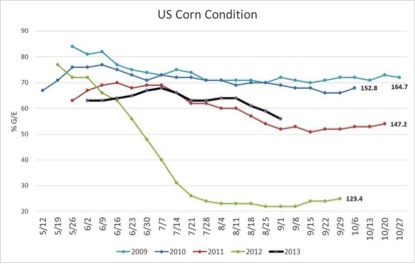
  • Yesterday’s (Tuesday) crop condition report showed corn good/excellent rating on 56% of the crop, much as expected, down from 59% the previous week and way ahead of last year’s drought hit 22%.


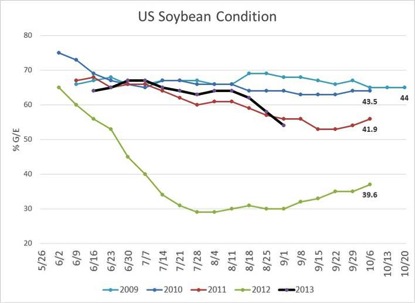
  • The condition of the soybean crop was reported as 54% good/excellent, again this was as expected, down from 58% week on week but an improvement on last year’s 30%.


  • It must be remembered that last year’s drought hit much earlier and the corn crop suffered in the key pollination stage of growth, and that late rainfall (in August) boosted soybean output – see old adage above! Regardless, the outlook for both soybean and corn output remains above that of last year.
  • S America soybean stocks are reducing swiftly as the strong pace of world demand (China) boosts exports. August soybean exports from S America rose by nearly 4 million mt year on year, with Brazil accounting for 3 million mt and Argentina 0.9 million mt. September export volumes are also expected to be higher than last year, largely as a result of low availability of US stocks and late availability of new crop due to the likely lateness of harvest. The key question will be, “Can the US deliver sufficient volume of soybeans to export locations to satisfy global import requirements from October?”