23 April 2015

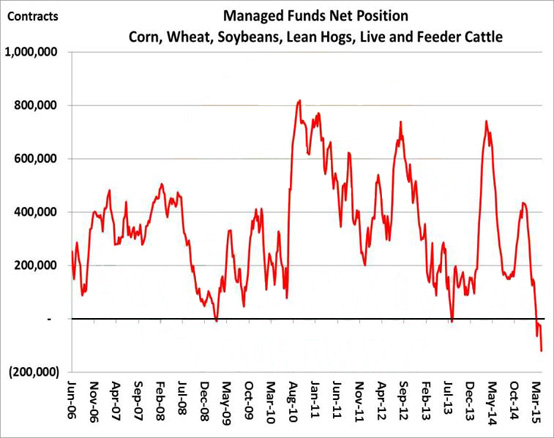
  • Traders have expressed concerns that fund managers are holding a record short position in combined agri commodity positions heading into a new growing season. If there was a weather spark – a supply dislocation – grain and oilseed prices would likely rally, potentially sharply. The problem is that today such a weather spark is lacking and may not develop until late May or June when the reproductive period for summer row crops comes into focus. Funds have held record large short positions in other markets such as the €uro in recent months, and this produced accelerations in downtrends – not reversals. The key is watching weather for any sign of threat that would force funds to rethink their bearish stance.


22 April 2015

  • We have seen another day without bullish input or fresh news of significance, consequently prices have wavered and eventually settled a touch lower in Chicago.
  • Avian flu dominates discussions and the lack of US export demand follows a close second. The desperate bulls continue to talk of the potential Brazilian truckers strike but their voice is not being heard in the markets right now.
  • EU and Russian weather patterns and forecasts are improved and corn is being seeded into favourable soil moisture with forecasts suggesting further rain. Observers are suggesting that early spring weather is almost ideal and crops are responding accordingly. Forecasts as far out as 5th May remain favourable and (as we have previously mentioned) Russian crop forecasts are rising.
  • Global grain markets are stable with fresh news lacking and end users are reluctant to extend cover forward whilst spring sowing is under way. As plantings progress it will likely raise pressure on farmers to sell remaining stored stocks.
  • StatsCan is scheduled to release their April planting survey tomorrow, and the expectation is that we will see expanded wheat, canola (rapeseed) and soybean areas.
  • If things continue “as is” it adds up to no lack of grains and likely much lower harvest time prices.

21 April 2015

  • The latest US crop condition and progress report showed winter wheat condition as 42% good/excellent, which is unchanged week on week, and compares with 34% last year and the ten year average of 49%. Perhaps more surprising was the percentage of corn planted, which was reported to be 9% compared with 2% last week and below expectations of 10% and the ten year average of 12%. More encouragingly was the spring wheat planting update at 36% planted compared with 17% last week, 9% last year and the ten year average of 17%.
  • In a more esoteric comment it is noted that El Niño conditions are reported to be developing rapidly in the equatorial Pacific whilst cooling is impacting the Atlantic. The combination of these two conditions suggests, quite strongly, against a dire 2015 US Midwest drought, and points towards a second year of trend or above trend yields in corn and soybeans. Consequently any weather related price rallies in the spring planting period should provide a selling opportunity and should not be chased by buyers.
  • The spread of bird flu through the US poultry flock is reported to be accelerating at an alarming rate! This is adding concern for US domestic soybean meal demand. On Monday, Wisconsin declared a state of emergency and called up the National Guard to help clean infected farms in order to contain the disease. Iowa reported that 5.3 million chickens are infected. Migratory birds appear to be spreading the virulent flu through US poultry flocks at a rapid pace and the fear is that nearly every US state could be infected by the end of spring. By way of note, the US poultry industry is the largest consuming species of US soymeal.
  • Argentina has authorised the export of an additional 3.5 million mt of the 2014/15 corn crop, which is in addition to the 8 million mt already authorised late last year. Argentina has always restricted corn and wheat exports to ensure sufficient stocks are available for domestic consumption, however (maybe cynically) it appears that export tax revenues are more important at this time for the cash starved government!
  • Russian domestic wheat prices are falling due to increased farmer selling, which has been driven by the farmer’s requirement for cash to allow spring planting as well as generally high stocks. FOB Black Sea 12.5% protein wheat was reported to be offered at $193, which is some $14 lower than a week ago. Spring plantings have been delayed by recent cold conditions, with some 2.6 million ha planted, 8.5% of the planned area and below last year’s 2.9 million ha. Offsetting the spring delay is the good condition of winter grains and good soil moisture levels, particularly in Siberia.
  • Stratégie Grains have raised their estimate of 2014/15 EU wheat exports to 32.1 million mt following recent weeks high export volumes. This is slightly behind the USDA’s most recent figure but still points towards ongoing high volume weekly exports.
  • Chicago corn and soybeans ended lower whilst wheat saw a bid on the back of short covering following the crop condition update which did not improve. Corn in particular and soybean markets feel bearish not least on the back of the US bird flu situation. The overall impact is difficult to gauge but the trade is not liking reports of huge slaughter numbers and the US’ apparent loss of export share. Bird flu is now a bearish market fundamental. The longer term view for wheat’s latest rally looks limited given favourable US and world weather.

20 April 2015

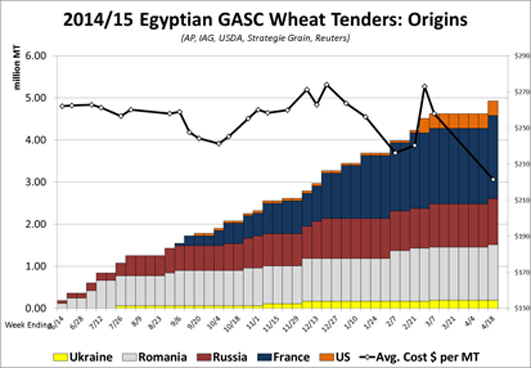
  • Over the weekend we saw Egypt return to the wheat tender market for the first time since February 3rd, and they picked up 300,000 mt with 180,000 mt from France and 60,000 mt each from Russia and Romania.

  • As can be seen from the graphic above, the price paid was the lowest this season, and surprised many by actually how low it was, the consensus view is that it was below replacement pointing (once again) at the  desire to move old crop stocks before the new crop harvest. It may well be that wheat prices are low but crops are looking pretty good everywhere, cash markets have little consumer business on the books, apart maybe from some feed wheat, and if rain continues to fall across the US Plains there will be little incentive for the funds to exit their short positions.
  • Staying with wheat, Russia’s IKAR raised their 2015 crop estimate to 54-59 million mt from their previous estimate of 52-57 million mt. With improving FSU and European weather many of the previous pessimists are edging their forecasts ever closer to 60 million mt from the previously sub-50 million mt levels that sent a shiver through many traders. A 60 million mt harvest would likely equate to exports of 25 million mt and possibly as high as 30 million mt.
  • Talk today has included further rumblings from Brazilian truckers and there is a suggestion that another strike could develop later in the week. With around 90% of the soybean crop harvested the impact of industrial action is certainly not creating a panic by exporters or processors at this time. In addition cheaper Argentine supplies are offered but Chinese buyers have been active in securing supplies prompting some short covering and higher prices as a consequence.
  • It has been reported that despite the above, Chinese buyers have overbought nearby soybeans and are looking to roll April shipments forward, which is likely to cap nearby price rallies somewhat. Out of the estimated 9 million mt that Brazil will export in April, 7 million mt will go to China. With their domestic soybean meal prices in decline the last thing they need right now is record import volumes in April and May. Higher prices may well suit China and help them roll May into Jun-Aug positions.

16 April 2015

  • At the time of writing this 15:20, Thursday, CBOT markets are running a touch lower in a market that is impressive in its lack of fresh news.
  • The USDA has today released its weekly export figures as detailed below:

Wheat: 160,400 mt, which is within estimates of 100,000-300,000 mt.
Corn: 616,700 mt, which is above estimates of 400,000-600,000 mt.
Soybeans: 538,800 mt, which is above estimates of minus 50,000-plus 150,000 mt.
Soybean Meal: 143,500 mt, which is within estimates of 50,000-150,000 mt.
Soybean Oil: 4,500 mt which is within estimates of zereo-20,000 mt.

  • Brussels resumed its pattern of large weekly figures with this week’s wheat export certificates totalling791,515 mt, which brings the season total to 27,935,875 mt. This is 2.27 million mt (8.83%) ahead of last year’s record pace.

15 April 2015

  • It has been a dull day today with somewhat rangebound prices and the trade attempting to decide what the weather is going to do. Soybeans were subjected to further short covering whilst farmers in the US Plains await soaking rains over the weekend. There remains nothing fundamental to suggest that the bearish trend is changing but with the funds already short, and substantially so in some cases, it remains for crops to be seeded to encourage fresh selling.
  • There was no news from Russia on the lifting of their export tariff, and it was suggested that the decision will come in May or June when more is known about their crop size. That said, the Russian weather has been close to ideal over the last couple of weeks and talk is of increasing rather than decreasing crops right now with a general consensus that their wheat crop will be in the range of 54-58 million mt.
  • With little else to report we will leave tonight’s update mercifully brief!

14 April 2015

  • We have seen a typical Tuesday with corn, soybeans and wheat enjoying something of a recovery, a reversal of the trend seen in recent days. Fund covering of shorts in corn, soybeans and meal has been reported to be active. It seems that there is a problem insofar as that as the US and global weather pattern comes into better focus the bulls lack a credible story to prop up and support their positions. Consequently, the market enjoys a period of short covering (such as we have seen today) but as crops are sown, and at a speedy pace, and end users the world over have extended their forward cover in corn, soybeans and wheat, markets are hit by farmer selling which caps gains.
  • In a move which might just generate a market move in coming weeks and months, it has been announced that the EU will not cut a deal to expand the use of vegoils or grains in the production of biofuels. EU politicians backed a deal to limit the use of crop based biofuel to 7%, well below the initially legislated 10%. EU politicians claim that biofuels cause damage to the environment and push up food costs. It is expected that the announcement will receive the full parliament’s backing in coming weeks and bring to an end the two year long debate on the importance of biofuels in the EU’s fuel supply.
  • It is apparent that the market is changing its focus towards new crop fundamentals, getting seed into the ground, which may well see some negatives later in the week. To counter this, it should be noted that many are picking up on the significance of US and most world farmers sitting on a large volume of old crop grains and oilseeds, which will weigh heavy as new crop availability becomes nearer. As US corn and soybean crops approach something like 70% planted we are likely to see cash basis levels become vulnerable as elevator operators start to stress over storage levels (which remain at least partially full of unsold old crop supplies).
  • Cash wheat markets are stagnating ahead of a possible announcement from Russia as to whether they will or will not lift their export tariff. Traders are unwilling to take fresh positions that may look “silly” in the wake of an announcement, which may come swiftly after a meeting scheduled (in theory) tomorrow. Meanwhile many are contemplating near perfect weather and trying to come to terms with the burden of raising their yield predictions – with all that brings!
  • The US weekly crop rating report released yesterday showed 42% of the winter wheat crop to be rated as good/excellent, down 2% week on week and compares with 34% a year ago. The ten year average is 49% with the highest rating of 78% in 1998 and the worst of 28% was in 1996. Im corn, it seems that planting is active in northern Illinois and parts of Iowa so the report next week should show good progress. This week’s data showed  2% completed, last week’s figure was “unknown”  and compares with last year’s 3%. The ten year average is 5%, with the highest at 13% in 2012 and the lowest was 2% in 2009. Soybean plantings follow corn so it is too early for data to be reported. It appears that soil moisture levels should benefit early crop development in both corn and soybeans – as a very general statement.

13 April 2015

  • Monday has seen a down day as markets return to trading after the weekend. The dominant news has been rainfall across the US Plains over the weekend, which allowed CBOT wheat to decline some 4.5%, which led corn lower albeit to a lesser extent and grain/soybean spread unwinding left some support in the soybean complex. Today’s decline in Chicago wheat has left US prices closer to Black Sea and EU levels paving the way for potential competitiveness going forward.
  • There is also news (as yet unconfirmed) that Russia will confirm later this week that it is to end the wheat export tariff on 30 June this year. There is no widespread panic selling on the news, and it remains to be seen whether the rumour becomes fact. The potential for the market to go lower, and potentially much lower, given normal weather and an end to the export tax is real. However, it must be borne in mind that if we see another ten days of unchanged weather in W Europe we will hear cries of “too hot and too dry”, which will offer price support – whether justified or not.
  • Reuters report that the USDA has confirmed an outbreak of the lethal strain of H5N2 bird flu in a commercial chicken flock, which widens the impact of the virus that has already killed hundreds of thousands of turkeys this year. A flock of some 200,000 chickens in Wisconsin is infected according to the USDA.
  • It is rumoured (strongly) that Argentina is about to release 2 million mt of corn and up to 100,000 mt of wheat export licences in coming days. The news comes as global prices appear to be in retreat and Argentina would appear to be keen to get fresh sales on the books before it is too late. Additional pressure comes from Brazil about to harvest a large corn crop and offer cheap exports well into the early US harvest period of October and November.
  • All in all, this is certainly an interesting start to the week!