27 August 2015

  • Last evening saw Egypt’s GASC, once again, tender for wheat, on this occasion the shipment period was 1-10 October and the 13% moisture cap remained in place. Russia was successful in securing the whole of the business, one 60,000 mt cargo at a reported price of $190.07/mt
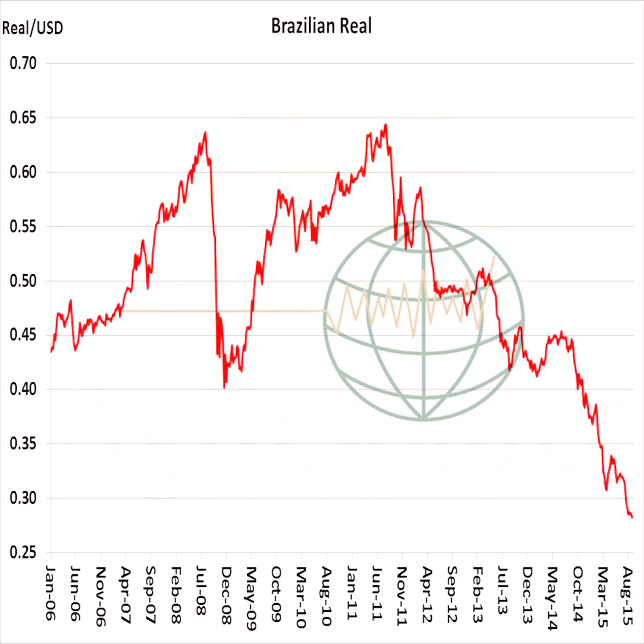
  • We last night referred to the ongoing weakness in the Brazilian Real and the chart below illustrates the point. The Brazilian currency has shed 27% this year and seems to be targeting the prior record of 4.1 vs. US$. The implication is that the Brazilian farmer is enjoying extraordinary profitability despite Chicago soybeans at six year lows. Consequently we would expect Brazilian farmers to expand 2016 soybean acreage, maybe as much as 3-5%, which could see the crop grow as high as 103 million mt given favourable growing conditions. If this proves to be the case we will likely see further growth in global soybean stock, which are already high!

  • It seems that Russian wheat output is still understated as current yield data starts to flow from the spring crop harvest. A crop north of 61 million mt, which is above the latest USDA number, looks entirely possible. Indeed, today SovEcon put the Russian total grain crop at 101 million mt with wheat accounting for 61.3 million mt. Exports are likely to also be high and potentially revised even higher as it seems that exporters are not yet hitting either desired or required volumes. The export tariff continues to ensure that Russian export trade remains a “spot” affair, and as the Russian winter approaches it is likely that exporters will want to maximise volumes before logistics become difficult.
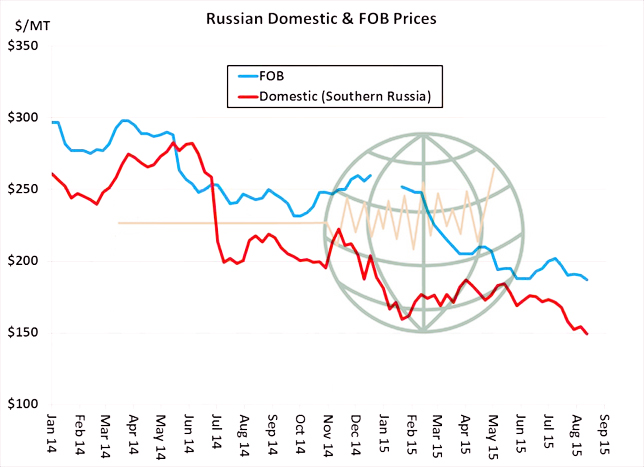
  • Russia’s total wheat supplies in 2015/16 appear to be heading for the second largest on record, and Russian wheat priced in US$ is incredibly cheap. The graphic below displays domestic prices across the Southern Region (the region that accounts for a majority of Russia’s exportable surplus) vs. quoted fob offers. As of early this week, wheat in Southern Russia is buyable at $149/mt ($4.05/bu), and exporters can sell this wheat into the world market at $181-185/mt for Sep/Oct delivery. This $30-35mtT spread is not uncommon and will allow exporters to remain aggressive with sales into North Africa and the Middle East in the foreseeable future.

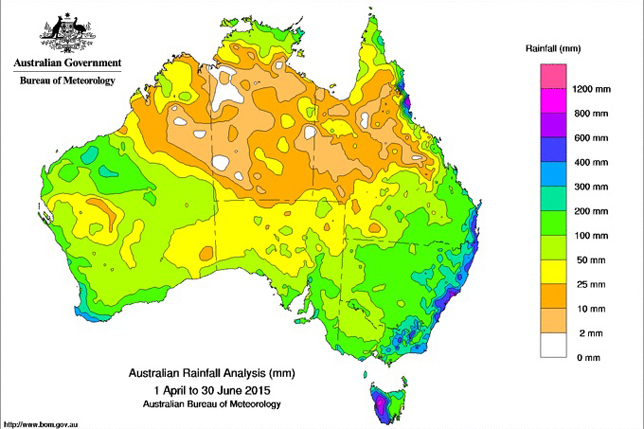
  • Despite the looming threat of El Niño, the arrival of beneficial rainfall has helped prospects for the Australian wheat crop. The USDA’s current forecast for the 2015 Australian wheat crop stands at 26mt, 10% higher year on year. The rains arrived at a crucial point in the crop’s development with some parts of Western Australia, the major grain producing state, seeing the most rainfall in the past three months. Usually, El Niño brings drought-like conditions to Australia. So far, severe weather has not arrived but forecasters have warned that El Niño could strengthen towards the end of the year. There could also be wetter weather in Western Australia during harvest in November/December, which could potentially downgrade more of the wheat crop to feed grades.

  • The International Grains Council (IGC) has today increased its monthly forecast for 2015/16 global corn output by 2 million mt to 968 million mt, which is behind last year’s 1.003 billion mt crop. Global wheat output was also increased by a massive 10 million mt to 720 million mt. Doubtless the information above (Russia and Australia) as well as the improved EU and Ukraine crop prospects (corn excepted) have contributed to their findings.
  • Today’s market action has seen some recovery in Chicago corn and soybeans with wheat lagging behind largely as a result of aggressive Russian and E European offers to Egypt. The rally in corn and soybeans is based upon hot/dry E and S Midwest weather forecasts together with an improvement in nearby export demand prospects (at last!).
  • The USDA has today released its weekly export figures as detailed below:

Wheat: 529,600 mt, which is above estimates of 225,000-400,000 mt.
Corn: 854,800 mt, which is within estimates of 500,000-900,000 mt.
Soybeans: 1,325,800 mt, which is above estimates of 600,000-1,050,000 mt.
Soybean Meal: 149,900 mt, which is within estimates of 50,000-275,000 mt.
Soybean Oil: 35,100 mt, which is above estimates of zero-30,000 mt.
  • New crop corn and soybean sales were better than expected and have been seen as supportive, as the market has reflected. There is also a sign that China is starting to look at the US as an origin for soybean supplies as S American prices start to become less competitive when compared to US levels.
  • Brussels has issued weekly wheat export certificates amounting to  319,410 mt, which brings the season total to 3,399,289 mt. The season to date total is 94,131 mt (2.85%) ahead of last year.

26 August 2015

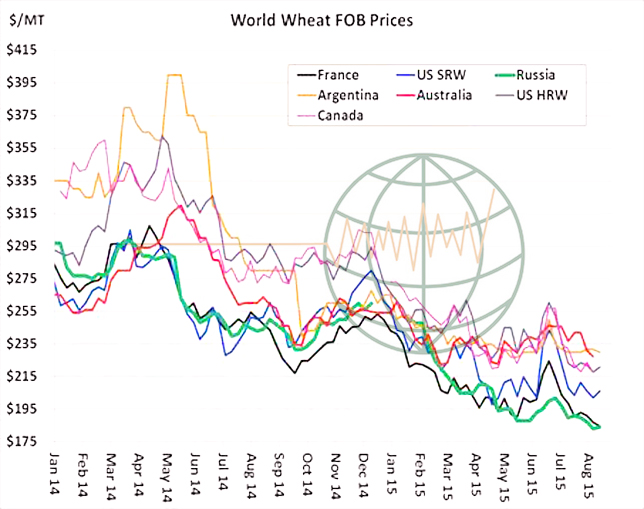
  • Russian and French fob wheat prices continue to pace the decline. Both markets have eased to new lows in recent days as evidenced by the chart below. Notice that US wheat remains noncompetitive and that export sales are likely to remain tepid into autumn. Australia is expected to become a more aggressive exporter on currency and supply with a few more rains. US wheat futures are trying to rally, but are unable to carry through amid sagging world wheat values that are looking for fresh demand.

  • General market comments:
  • The value of the US$ has been directing Chicago grain prices this week amid a lack of other fresh fundamental news or information. EU wheat yields continue to be better than expected which will help the community deal with its corn shortage.
  • While the soybean market remains oversold, traders see the good weather of the past week as a reason to suspect better production while global currency developments spark weaker demand concerns.
  • In corn, the weak technical picture opens the door for a test of Monday’s lows and perhaps a test of the August 12th lows.
  • In wheat the market action is bearish as even the technical correction off of the lows Monday showed a lack of commitment from the bulls. Fundamentals are weak and shallow corrections may continue until the bulls have something more than “oversold” as a reason to buy.
  • Despite something of a recovery in global financial markets the Chicago grain room has found selling pressure as world cash markets in wheat, corn and soybeans all ease lower. Tunisia was a wheat buyer today, cheaply, and this has had traders pondering quite how poor global demand truly is right now, and this includes China who are still not pitching in for US soybeans. Ongoing cash market weakness is undoubtedly pressuring futures prices in a spate of fresh export business.
  • The weak Brazilian Real (3.6:1 vs. US$) is not helping Chicago markets either. The weak Real is down to political as well as economic drivers with growing numbers calling for the impeachment of President Dilma on account of her knowledge of “backhanders” from Petrobas. As we have stated previously, the weak Real, Ruble and other emerging nation currencies reduces the purchasing power of the consumer but at the same time stimulates agricultural production within each of the nations. This creates a longer term bearish paradox for the now long suffering (???) US farmer.
  • China imported record tonnages of grain during July with combined wheat, corn, barley, DDG and rice imports at over 4 million mt. The rising imports are about to collide with another sizeable Chinese grain harvest that will start in September. Amid China’s growing stocks of grain (highest level since China entered the WTO in 2001), the Government continues to look for ways to slow imports through regulation. US DDG and sorghum cash basis has declined in recent days amid concern about a slower Chinese grain import profile this autumn.
  • CBOT grain futures will continue to follow macro market developments and how the Chinese equity market reacts to their monetary easing stance overnight. Any actual or perceived weakness in the Chinese equity markets will not bode well for commodity valuations. All eyes will remain on China amid the fear that their economic slowdown is worse than being reported by Beijing.
  • It is expected that the Chicago market will hold at $8.50 November soybeans, $3.60 December corn and $4.80 September wheat heading into the Labor Day weekend (5-7 September). However, we remain extremely concerned about the lackluster world grain demand and that EU, Russian and Canadian crops continue to get larger. Even Aussie wheat looks to be all of 25 million mt amid the recent rains across NSW. Aussie fob wheat prices have fallen $20/mt in the past few days as the market shifts from old to new crop bids. The Aussie wheat harvest will start across Queensland in October. Our generally bearish view is maintained, but we would be reluctant (or cautious) to make sales here and anticipate some sort of recovery into early September.

25 August 2015

  • Chicago saw a bounce this morning following macro market activity, which included a broad rally of US and European stock markets. Commodities tried to follow although volumes have not been huge!. There has been a US$ rally which weakened grains and the soybean complex has found some short covering support. As the DOW rallied 300-400 points today’s grain market reaction does not inspire confidence for a long lasting bullish run.
  • China imported record tonnages of grain during July with combined wheat, corn, barley, DDG’s and rice imports at over 4 million mt. The rising imports are about to collide with another sizeable Chinese grain harvest that will start in September. Amid China’s growing stocks of grain (highest level since  China entered the WTO in 2001), the Government continues to look for ways to slow imports through regulation. US DDG and sorghum basis have declined in recent days amid concern about a slower Chinese grain import profile this autumn.
  • CBOT grain futures will likely continue to follow macro market developments and how the Chinese equity market reacts to their monetary easing stance overnight. Any actual or perceived weakness in the Chinese equity markets will not bode well for commodity valuations. All eyes will remain on China amid the fear that their economic slowdown is worse than being reported by Beijing.

25 August 2015

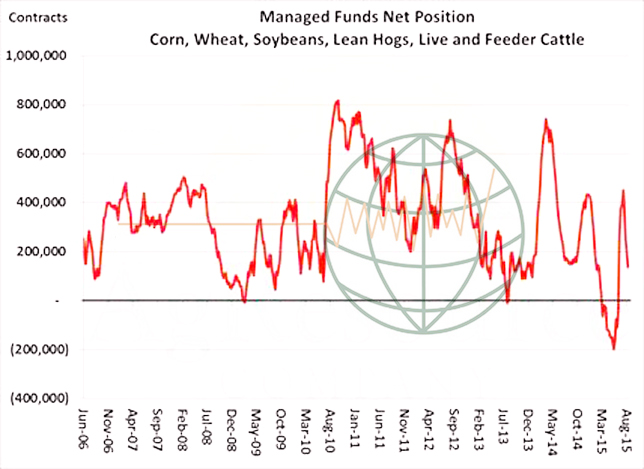
  • Despite the recent liquidation, funds are still holding a net long position in US ag futures markets which is illustrated in the chart below. This is one reason why ag commodities are so closely following the developments in US and world equity markets as they (funds) push to shed any market exposure until the emerging market meltdown bottoms. It is our expectation that some sort of trading bottom should be formed in ag markets by mid-week. However, there will likely be a retest of that bottom by late September. Our view remains that commodities will not forge their final bottom until the 4th quarter 2015.

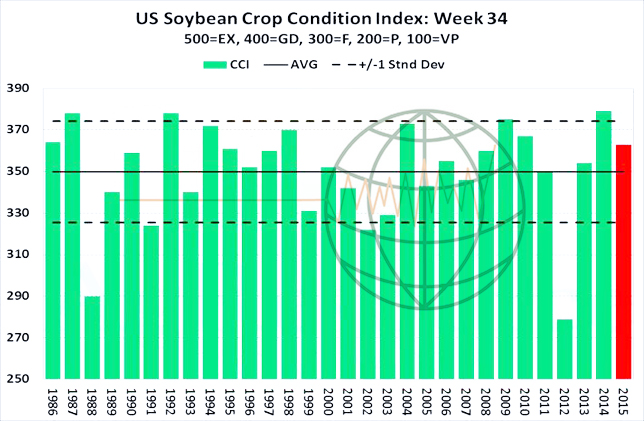
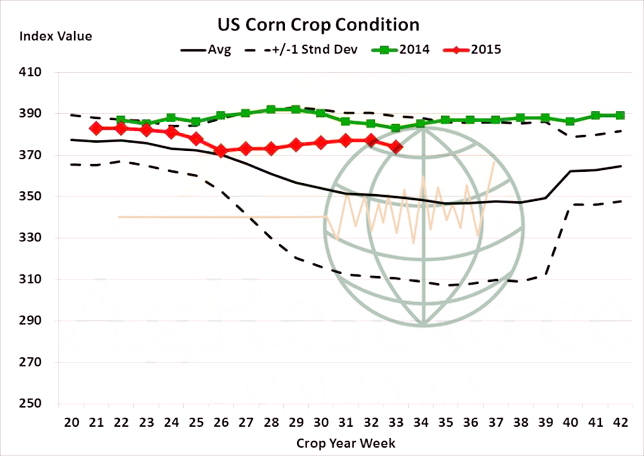
  • Soybean futures fell to sharp losses at the start of the week on liquidation triggered by steep losses in global equity markets. Funds were estimated as net sellers through the day of 15,000 contracts in soybeans, 6,000 contracts in soybean oil, and buyers of 3,000 contracts in the soymeal market. The USDA’s daily export reporting system showed soybean sales of 120,000 mt made to an unknown destination, but total new crop sales remain well behind last year. S American basis has turned higher in recent weeks, but it will be quite difficult for the US to catch up on lost business. Crop ratings were unchanged for the 4th consecutive week with good/excellent holding at 63%. The chart below shows the 2015 crop as being rated well above average for late August. Harvest progress was reported at 15% in LA, just ahead of the 5 year average of 11%. Soybean futures this week are now deeply oversold and traded to our initial downside target, though our view of the market remains bearish. Large global supplies and the lack of demand growth look to cap rallies in the year ahead and the market looks to be targeting the 2008 low, under $8.

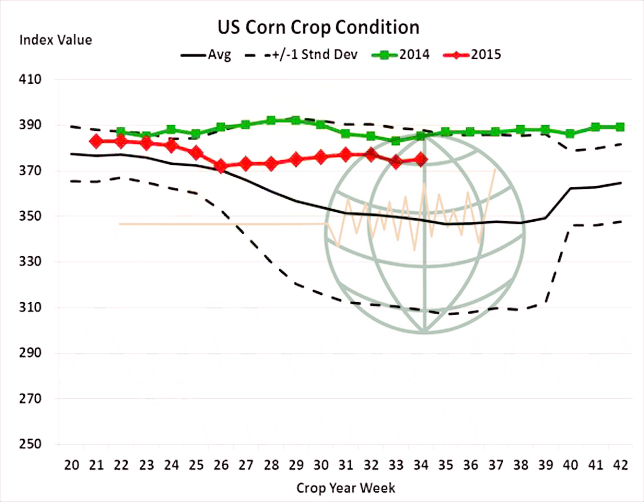
  • Corn rallied 4-5 cents amid corn-bean spreading and a sharply lower US$. Crop conditions this week were unchanged at 69% good/excellent, with a 1 point improvement noted in the crop condition index amid a shuffling of the good and excellent categories (good was down 1; excellent was up 1; the excellent category has more weight in the index value). A more neutral pattern is likely into NASS’s September crop report, and as China’s absence from the US market has more of an impact on soybeans than grain markets. However, focus has to remain on demand, with Argentina still the world’s low cost supplier and with Brazilian export commitments having surged 2 million mt in just the last week. Crop condition models maintains a range of 166-170 bushels/acre relative to national yield in the September report, and China now requires importers to report who the final end user of bought supplies will be, which is just another hurdle to large scale foreign imports. Harvest progress is 87% complete in LA, 47% complete in TX and 31% in AR. We continue to favour a policy of selling into short covering rallies.

  • Wheat futures ended 3-6 cents higher, as a plunging US$ offset steep losses in energy and equity markets. There’s little new fundamental news to report, with Black Sea cash prices a bit weaker and with rainfall to linger across Eastern Australia over the next 2-3 days. But contrary to corn and soybeans, funds as of last week were short and a modest short covering effort was noted yesterday. Russian wheat is buyable for spot delivery at $181/mt, which is comparable to $4.50 basis September Chicago. French wheat for Sep/Oct is quoted at $190-195, with US Gulf SRW at $204 and HRW at $218. The Russian ruble today hit a new all-time low, which has pushed domestic prices in US$ terms down to $3.25-4.00. Russian wheat priced in rubles has been rallying, but not to the degree that export controls are needed. Currencies will keep non-US wheat competitively priced into early winter. US weekly export shipments through last Thursday totaled 10.2 million bu, roughly half of the previous week’s total and well below the average pace needed to hit the USDA’s forecast. We calculate that some 16-17 million bu per week are needed, so far, this level has been achieved just three times. More weekly sales and shipment data is needed, but the USDA’s forecast appears overstated without a Northern Hemisphere crop threat this autumn/winter – and note that widespread rainfall is offered to Europe and Central Russia in the first week of September. Short covering rallies will likely be a periodic feature of the market. We continue to believe that fundamental advances will struggle above $5.30, basis December futures, and rallies above this are opportunities!

24 August 2015

  • Today has seen “meltdown: in Asian stock markets, which has spread with contagion around the globe. The Dow opened 1,000 points lower although the “black box” trades seem to have had enough by midday and something of a recovery followed with the Dow (only!) 250 lower at midday. Some support may well translate into Asian markets tomorrow but we are not holding our breath. Commodities followed with prices sharply lower in early trade but recoveries were also clear with Chicago markets almost back to Friday’s closing levels with under an hour to go.
  • The drop in global equity markets is based upon fears over slowing market growth in emerging markets. However, unlike in 2008, there is not a systemic risk to US or other developed nation’s banking systems based upon depreciating assets (house prices) but in the absence of global economic growth there is a real risk to future commodity demand (and growth). This is the underlying concern that markets are considering, and will likely plague any market rallies, particularly in the short term.
  • The US$ has fallen in value against the €uro (or has the €uro gained?) and this added some support to Chicago grains, wheat in particular, with corn following behind. With all that we have seen in the last week or so, and particularly today, it feels extremely difficult for major rallies to succeed particularly with the US harvest staring at us in a few short weeks.
  • The EU crop monitoring unit, MARS, has increased EU soft wheat yield marginally to 5.81 mt/ha compared with last month, this is above the five year average (by 2.5%) but still below last year. Corn yields were forecast lower at 6.4 mt/ha down from 6.71 mt/ha last month and below both last year’s figure and the five year average.
  • US crop conditions, which will be reported later tonight, are expected to see an unchanged to slightly better figure based upon last week’s favourable weather conditions. We will update on this tomorrow.

20 August 2015

  • The USDA has today released its weekly export figures as detailed below:

Wheat: 314,400 mt, which is within estimates of 300,000-500,000 mt. (Old crop 314,400 mt – New crop nil)
Corn: 859,100 mt, which is above estimates of 350,000-800,000 mt. (Old crop 282,700 mt – New crop 576,400 mt)
Soybeans: 830,800 mt, which is within estimates of 500,000-1,050,000 mt. (Old crop 46,400 mt – New crop 784,400 mt)
Soybean Meal: 232,800 mt, which is above estimates of 25,000-225,000 mt. (Old crop 62,800 mt New crop 170,000 mt)
Soybean Oil: 7,100 mt, which is within estimates of zero-15,000 mt. (Old crop 7,100 mt New crop nil)

  • New crop corn and soybean sales were pretty good, but the export data was otherwise uneventful. Cumulative new crop corn sales are 40% behind last year, new crop soybean commitments are 46% down, wheat is 15% down and soybean meal commitments are 50% behind last year. Significantly improved export demand is essential, and soon, if USDA forecasts are to be reached.
  • Brussels has issued weekly wheat export certificates amounting to  591,624 mt, which brings the season total to 3,079,879 mt. The season to date total is 388,932 mt (14.45%) ahead of last year.
  • A couple of general comments:
  • In soybeans the Pro Farmer crop tour is still confirming reasonably high yield potential, and as a consequence it could be that we have still not seen the market lows yet.
  • In corn we seem to have a situation where yield concerns are limiting selling and demand concerns are limiting buying! Where can a market like this go?
  • In wheat there is still no definite sign of a low but the oversold market condition and slight reversal may provide some support and additional buying.
  • The market is seeing some spread trading of grains against the soybean complex due to the persistence of favourable Central US weather. The industry well understands that this week’s rain and now the upcoming cool temperatures are ideal for yield potential, but its soybeans that will benefit more as this crop is still in its reproductive stage, whilst corn is increasingly pushing closer to full maturity.
  • The Pro Farmer tour is pushing out state by state data on corn that suggests NASS is too high in its corn yield estimates. The Tour numbers are coming in well below the August NASS figures, which is not in itself unusual, however the deviation is greater than would be normally expected – maybe a warning sign! To counter this, we would again suggest that global export demand for both grains and oilseeds remains slow and this point should not be overlooked. World wheat and corn trade for August is some 20% behind last year, and China appears very slow in stepping forward and buying new crop US soybeans in the second half of October and November. Worryingly (for the US) it is reported that an estimated 6 million mt of S American soybeans have been sold to China in the September to November shipment period, the latter part of which is the key “gut slot” for the US soybean export programme. Replacing these “lost” sales will prove difficult for the US – if not impossible – and the impact upon end stocks should be borne in mind.

18 August 2015

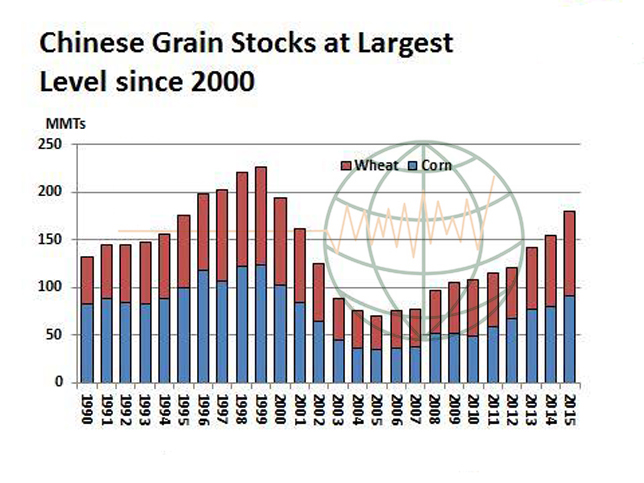
  • China is swimming in grain! The chart below reflects Chinese grain stocks since 1990 – and today’s estimated levels are at their largest levels since 2000. Most Chinese grain users suggest that these grain stocks are being undercounted by USDA. China has guaranteed its farmers $9.70/bu corn in recent years which has spurred production and imports of other non GMO grain. The sheer supply of Chinese corn/wheat stocks has the Government planning for a policy change that could slow/end grain imports of nearly 20 million mt annually. Chinese ag policy needs to be closely watched as another record harvest approaches.

  • After the close, NASS reported that national soybean crop ratings were unchanged through the week with good/excellent holding at 63%. Crop ratings declined in 7 states, increased in 9, and were unchanged in 2 states. The absence of a decrease in ratings is adding confidence to USDA estimates. We hold to a bearish outlook with resistance in November ’15 futures expected above $9.30, while our initial downside target rests at $8.50-8.60 by harvest.

  • Corn crop conditions fell 1 point to 69% good/excellent vs. 74% a year ago, following last week’s warmth and near complete dryness. Conditions also tend to seasonally erode beginning in late July/early August. However, steady to higher ratings are expected next week amid this week’s cool frontal pass, with the latest models still offering widespread totals of .50-3.00” to all but the far E Corn Belt into Friday/Saturday. As for acreage, assuming some 1-2 million acres are added to the FSA data series – which has been the case in recent years – we can find no reason that NASS will adjust their estimate until the final report in January. The goal of the market is now to find higher domestic and export consumption rates, which suggests a slow but steady bearish trend into harvest. We continue to remain willing sellers of 15-20 cent rallies.

  • Spring wheat conditions are 70% good/excellent, above estimates of 69%, up from 69% week on week and up from 68% year on year, and the crop is now 53% harvested vs. 15% a year ago, and the winter wheat harvest is complete. Combines are actively rolling across the Northern Hemisphere and consumptive interest remains lacking. We would anticipate another Egyptian tender early this week on any additional price break. The Australian weather forecast maintains widespread shower activity across New South Wales on the weekend, with totals pegged as high as .75- 1.00”. El Niño continues to strengthen, and will likely continue to do so into the autumn months, but this so far has had little effect on the Aussie climate. US wheat futures are left following world cash prices, and to some extent US corn futures. There’s simply no shortage of food or feedgrain, and without a shift to lasting heat and dryness in Australia in late August and September, a range of $4.80-5.20 will be sustained through the months ahead.
  • With less than an hour to go in Chicago soybeans and wheat are trading lower with corn just in positive territory. Widespread rains in the last 24 hours and a favourable forecast into next week appears to be showing the greatest benefit to the bean crop, hence price downside. The overnight drop in the Chinese stock market (some 6%) may also be contributing to weakness in the soybean complex. Many will question the correlation between Chinese equities and Chicago soybeans, and the link is somewhat convoluted, however the market is clearly uncomfortable with economic contraction in the world’s largest end user of soybeans and products – simple as that!