8 August 2015

Weekly CCI Analysis:

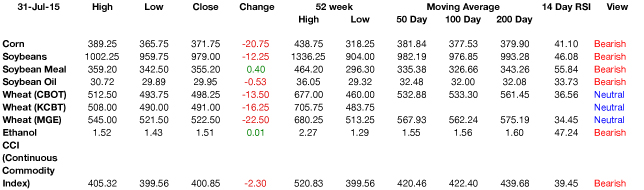
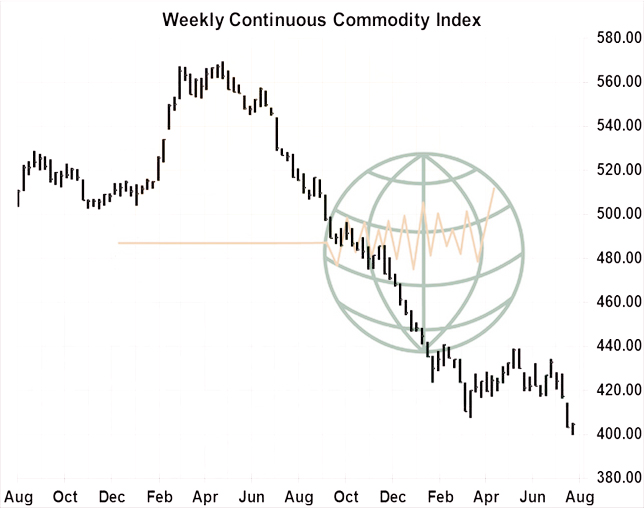
The CCI/CRB bounced on Friday but settled the week at new multi-year lows. The plunge continues to be driven by weak energy and metal prices, with only limited rallies in ag markets offsetting this. We maintain a longer term bearish outlook as the US$ has not yet peaked. The July US employment report featured the addition of 215,000 new jobs, which was close to expectations but which also validates a rate hike from the Feb sometime in early autumn. The US$ consolidated late in the week, but near rally highs and concern over China and South American economies persists. Crop production, specifically, will likely expand outside of the US amid renewed weakness in currencies in the Black Sea and Brazil, and crude’s decline has not triggered the necessary improvement in consumption.

Longer-term soybean analysis:

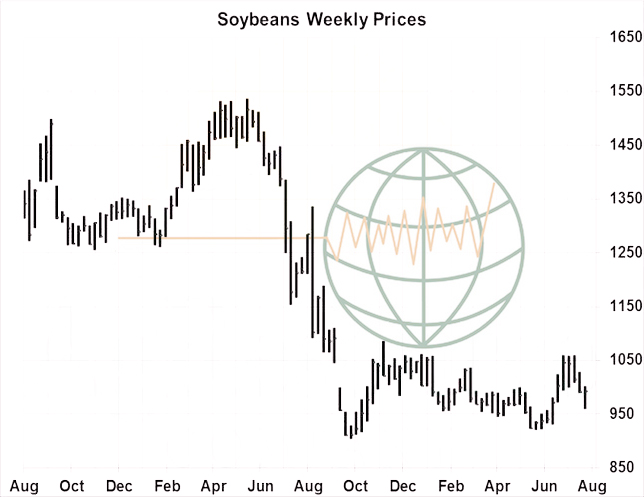
Soybean futures held in a narrow range for much of the week, but were higher at Friday’s close on short covering ahead of the August crop report, and drier than desired weather forecasts across the Eastern Midwest. New crop export sales were the largest of the year at just over 1 million mt, and there were also announcements of several more cargos sold to China through the week. However, new crop sales remain well behind last year, and indicate that the USDA could be overestimating soybean exports by 150-200 million bu. Market focus in the week ahead will be on the August crop report. Ahead of the report, the average trade estimate calls for a soybean crop of 3.7 billion bu, barely under last year’s record crop. Our view is that once the crop report has passed, market focus will turn towards slow export sales and building US stocks. We continue to remain bearish on any strong rallies ahead of harvest.

Longer-term corn analysis:

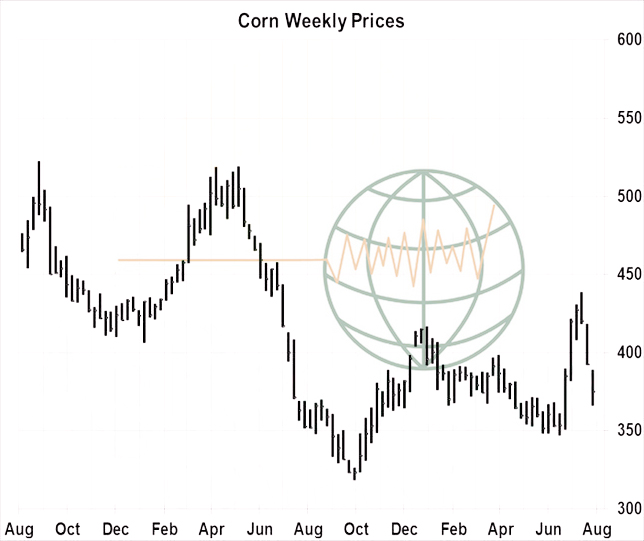
Corn futures this week ended up 3 cents. Critical USDA supply updates lie in the offing, and ahead of next week’s Crop Report, and FSA acreage data the following week, speculative funds have defended what is still a very large net long position. Bullish numbers in the comings weeks are needed to prevent additional long liquidation, but the theme is that US supply (and associated risks) have returned to the forefront of trading strategies. We maintain a longer term bearish outlook amid recent crop condition rating improvements, and as demand shows little sign of improving. S American corn is still offered below US Gulf values into late autumn, and there’s increasing market talk of aggressive Brazilian ethanol exports following a further drop in their currency and very cheap sugar prices. End user demand underpins prices on breaks, but 2015/16 stocks/use forecasts of 14% implies harvest lows of $3.50-3.60, basis December. Supply-driven into early September offer selling opportunities.

Longer-term wheat analysis:

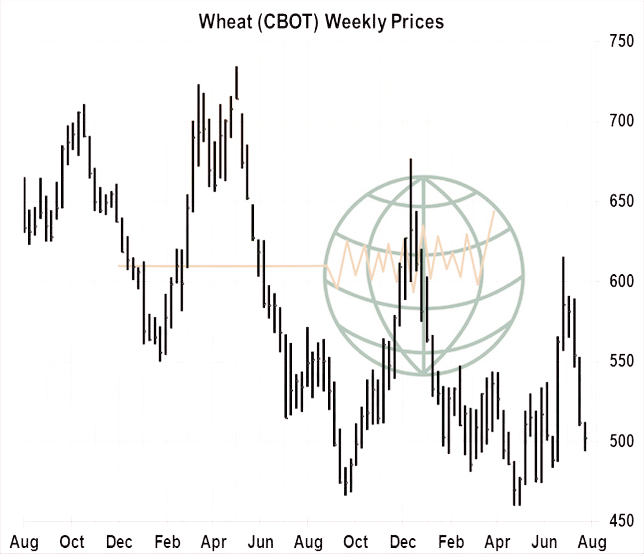
US wheat futures settled the week mixed, with Dec Chicago up 11, KC up 2 and MGE down 1. HRW’s discount to SRW continues to expand amid burdensome supplies and as Gulf fob prices are some $30-40/mt amid competing origins. This HRW discount will be a feature in spot months in the foreseeable future. Otherwise, there’s little change. Egypt’s latest tender again confirmed that major world exporters are searching hard for demand, and Black Sea and EU cash prices have fallen to seasonal lows. Russian domestic prices are in decline amid winter harvest and favourable spring wheat conditions – and the Ruble posted a new multi-month low this week, which makes Russian wheat that much more competitive. The overreaching theme remains too much supply chasing too little demand, and US end stocks of 925- 950 million bu argue against any sustained rally in the months ahead. Better export and feed consumption is needed. A range of $4.80-5.30, spot, is projected into autumn.

6 August 2015

  • The USDA has today released its weekly export figures as detailed below:

Wheat: 840,800 mt, which is above estimates of 400,000-600,000 mt.
Corn: 274,300 mt, which is below estimates of 350,000-950,000 mt.
Soybeans: 576,900 mt, which is within estimates of 350,000-900,000 mt.
Soybean Meal: 59,900 mt, which is within estimates of 50,000-225,000 mt.
Soybean Oil: 10,200 mt, which is within estimates of 5,000-40,000 mt.

  • Brussels has issued weekly wheat export certificates amounting to  442,598 mt, which brings the season total to 2,097,860 mt. The season to date total is 695,076 mt (49.55%) ahead of last year.
  • The hot and dry conditions in Europe, particularly France (but also Romania), are adversely impacting non-irrigated corn acres as we have previously reported. Analyst ODA (Offre & Demande Agricole) puts the EU crop at 63.9 million mt, below the EU Commission’s latest estimate of 65.5 million mt, and significantly below last year’s 77.8 million mt figure.
  • Some trade estimates have come in as low as 61-62 million mt.
  • Chicago markets have been mixed with soybean and corn lower whilst wheat closed a touch higher on the back of better than expected US export sales. Interestingly it seems there were large net cancellations in old crop soybeans and old crop corn whilst new crop soybean sales hit 1 million mt for the first time this season despite the fact thay we would expect this to be a routine number at this time of year. New crop corn sales at 11 million bu can only be described as disappointing and in a nutshell US 2015/16 export commitments for corn, soybeans, soybean meal and wheat remain substantially behind last year.
  • Crude oil and gasoline futures prices extended their losses down $0.90/barrel and $0.04/gallon respectively with spot ethanol following behind.
  • In Europe, Paris wheat rallied as Socomac followed Senalia in halting grain intake into the Rouen silo (export and futures) quite what the link is is something of a mystery but it is happening and we are not too proud to admit it. Hopefully we will reach some conclusions before long!

5 August 2015

  • Last night saw analyst, FC Stone issue its latest US crop estimates, which showed US corn yield at 165 bushels/acre and soybean yield at 45 bushels/acre. Both numbers were viewed as bearish upon release as they translated into the 3rd largest US corn and 2nd largest US soybean crops on record, and bullish inspiration was difficult to find. However, historically, FC Stone has overstated the US corn yield 59% of the time and in soybeans 64% of the time. Thus, there is a slight bias to overstate yield and production in their estimates compared to the upcoming NASS report.
  • Further detail into the release shows that FC Stone as of August 1st estimated the US corn crop at 13,381 million bu based upon a yield of 165 bushels/acre. This yield is above what the trade was expecting and is considered slightly bearish. Stone pegged the IA corn yield at 187 bushels/acre, IL at 174 and MN at 184 bushels/acre. The IN corn yield was estimated at 149 bushels/acre and OH at 160 bushels/acre. The MO corn yield was estimated at 130 bushels/acre. FC Stone estimated August 1st US soybean yield at 45 bushels/acre with US production at 3,797 million bu. Stone estimated the IL soybean yield at 48 bushels/acre, IA at 52 bushels/acre, and MN at 47 bushels/acre. The IN soybean yield was pegged at 45 bushels/acre with OH at 47 bushels/acre. The Missouri soybean production as estimated at 200 million bu with a yield of 35 bushels/acre. It’s interesting to note that the ND soybean yield at 36 bushels/acre was above MO yield of 35 bushels/acre. The FC Stone soybean yield was seen as slightly bearish and some slight pressure was expected in the overnight trade.
  • Having said that, today has seen additional risk premium being added into corn, wheat and soybean futures ahead of next weeks critical USDA releases including the August crop report and the FSA acreage data due on 17th. Talk of drier than desired conditions across much of the eastern corn belt in the coming week, although heat is absent, has also added some premium today.
  • Informa Economics added to the data party with their latest estimates, which pegged US corn yield at 165.4 bushels/acre and output at 13,412 million bu and soybean yield at 45.4 bushels/acre with output at 3,789 million bu. Both numbers were a touch above trade estimates and again are deemed slightly bearish. Worthy of additional note is their adjustment to Ukrainian corn output, an additional ½ million mt to 26.5 and an additional ½ million mt to Russian wheat output to 57.5 million mt.
  • Egypt’s GASC issued a further wheat tender, this time for 11-20 September shipment, which saw what can only be described as a stunning range of offers with Russian, Ukraine, Romanian and French offers all undercutting recent paper market prices, and that despite the removal of the 13.5% moisture allowance on French. Russia secured 120,000 mt from Russia around $7 below the last tender price despite Ukraine being cheapest on an FOB basis. (Maybe there was a disagreement on the price of cotton in exchange!) Paris wheat on the Matif exchange traded lower initially but, despite Egypt, it reversed when Chicago rallied.

4 August 2015

  • Crude oil prices fell to sharp losses in recent weeks on oversupply and waning demand. The chart below reflects our expectation that spot crude should bottom between $42-44.00. US rig counts are up and OPEC members are still pushing for world market share. If the $42.00 level is taken out, the next downside price target would be the 2008 lows at $32.50. We have previously suggested that fracking and the new advances in oil extraction argue for spot crude oil to trade between $35-80.00 for many years to come as the market adjusts to the US becoming a net exporter.

  • US soybean good/excellent ratings rose 1% to 63%. The sunshine, warmer temperatures and rain across the W Midwest has helped US soybean yield potential. Note that seasonally US soybean ratings tend to decline from early July into August. Such a decline in ratings has not occurred this season, which argues for US soybean yields rising to near or above trend levels. If the ratings keep rising into mid-September due to favourable weather, the US can still produce a 2015 US soybean yield above 46 bushels/acre. Such production with a fall in US soy exports could lift 2015/16 soybean end stocks to 500 million bu or more.

  • US good/excellent corn ratings as of Sunday were 70%, unchanged on the week. However, the crop condition index, which accounts for all rating categories improved 1 point to 376 (down just 2% from last year). The ratings have rallied steadily since early July, against the seasonal trends. As such, we believe that it is justifiable to raise projected final US corn yield by 0.5 bushels/acre to 166 bushels/acre. Coming rainfall and a lack of heat will likely maintain high ratings into the middle of August.

  • US spring wheat condition ratings were unchanged as of Sunday, with 70% of the crop pegged as good/excellent, and conditions across the Dakotas are the upper end of the historical range. Spring wheat harvesting has reached 8% complete, vs. 3% a year ago. A seasonal bottom is slowly being formed in non-US fob prices which should offer support to US markets on breaks. The Australian forecast is dry into mid-August, which should be watched, but without lasting heat/dryness, CBOT spot futures are fairly priced in a range of $4.80-5.30.
  • Chicago has seen light volume trade today in a feeble attempt at a “Turnaround Tuesday” which saw wheat ending lower with corn and soybean just in positive territory. Buying from consumers is limited and it is traders looking to either bank profits or reduce risk ahead of the raft of private forecasters data in coming days.
  • There are strong rumours in Asia that China is about to change its minimum price policy on grains. China has supported corn and wheat at prices that are relatively high in relation to world levels and this has promoted additional domestic soybean meal consumption. The Chinese authorities appear to be looking for ways in which to reduce the cost of storage and waste, and is expected to move towards a target price system with direct payments to farmers. If implemented this would lead to plummeting Chinese feed prices and very likely significantly reduced volumes of imported feed grains.

3 August 2015

  • Markets are lower today, CBOT with 15 mins to go is all in the red and European grains and rapeseed also closed down.
  • Chicago’s lower opening uncovered short covering and consumer buying, which preempted some clawback of early losses. Funds were seen as moderate sellers as they eased back their net long summer corn and soybean positions. Favourable US weather and slow exports continue to hang over the markets and still look as if they will cap any rally efforts. Crude oil fell with sharp losses touching $44/barrel, a price last seen late last year. Volumes have been uninspiring and the market is looking for a decline into the close.
  • US forecasts continue to offer a cooler and wetter outlook for the Midwest into the latter part of the week with adequate to surplus rainfall and near to above normal temperatures. Evidence of extreme heat or dryness is markedly absent and the forward outlook suggests that corn and soybean ratings could well increase into August month end.
  • The Ruble is at 5½ month lows.
  • The EU Commission has reduced the EU corn crop to 65.5 million mt with a yield of 7.1 mt/ha, recall last week MARS (the Brussels crop unit) put the crop at 62 million mt with a yield of 6.7 mt/ha basis official area – as MARS does not issue forecasts! ??????? What is the point of having and paying for a crop unit if the data it provides is ignored????? And – what is more – who provides Commission data if MARS does not? Apologies, evening rant now over – for now!

1 August 2015

Weekly CCI Analysis:

The CCI/CRB index fell to fresh six year lows, but was able to modestly recover into the end of the month. Weaker energy, grain and metal prices were partially offset by a rally in meats and tropical ag markets. Friday’s sharp decline in the US$ offered the bears a reason to bank some profits. We doubt that any US$ rally can be sustained as the value of the Brazilian Real slid to new eight year lows which is making their sales of agricultural goods more attractive across a host of international buyers. Also, China’s August 1st PMI reading fell to 50%, a tick below the July reading as there is no evidence of a strong bullish turn in China’s manufacturing sector. We maintain concern that China’s engine of world economic commodity growth is slowing which will have profound implications for raw material valuations in the years to come. We have (publicly and in print) been bearish commodities since 2013 and we see no reason to alter our view of selling rallies amid excessive supplies and demand growth that is less robust.

Longer-term soybean analysis:

Old crop CBOT soybean futures closed down 10 cents while new crop November lost nearly 25 cents amid favorable Central US weather and continued slow US export demand. The USDA August crop report is just seven trading days away and trader anxiety will be rising in the days leading into the numbers. NASS will use the five year average pod weight which should produce a yield of around 45 bushels/acre. Its late July and August weather than determine US soybean yield, not June rainfall. We also expect that traders may be disappointed that 2015 US soybean seeding/harvested acres only falls 800,000-1.2 million acres compared to trader calls for losses of more than 2.0 million acres. MO farmers were able to seed during early July and did not place as many acres in the Prevent Plant programme. The problem facing the US soybean market is export demand. Research argues for a 2015/16 US soybean export total of 1,550 million bu or less, which makes yield/acre losses meaningless and if acres or yield ends up being larger than expected, the sluggish US soybean export sales pace opens the downside potential in November soybeans to $8.00. Our view remains bearish and we would see November rallies to $9.60-9.75 as a sale.

Longer-term corn analysis:

CBOT corn futures fell another 20 cents on fresh fund liquidation. The highlight was last Friday’s CFTC revelation that funds added to their net long position last week, despite a 40 cent drop in price. These losing positions were steadily washed out. Even today, we estimate that speculative funds are long a net 150,000 contracts of corn vs. last July’s net short position, which amid rising US crop potential and stale US export demand suggests additional downside risk. The only issue of note is yield loss in Europe amid lengthy hot/dry weather during July and how this will impact EU wheat exports and corn imports. S America should fill much of Europe’s additional feed need, and generally Brazilian and Argentine offers for Sep/Oct remain some $.20-.40/bu below US Gulf origin. Research maintains a US yield range of 165-168 bushels/acre which in turn suggests 2015/16 stocks/ use of 13-15% and an autumn price range of $3.30-3.90. Rallies based on US production moving forward will be fleeting, as the market is required to boost US exports and industrial use.
We fear that if the two-week Central US forecast is verified, additional liquidation will persist into the August crop report.

Longer-term wheat analysis:

US wheat futures ended the week down 15-18 cents with futures contracts in Minneapolis pacing the decline on record spring wheat yield potential. Futures in Europe fell €4/mt. The primary feature of the market remains too much supply chasing too little demand, as Russian fob offers into October trade in a range of $191-197/mt, or just a few dollars above the seasonal lows posted in May. Wheat production estimates are rising across the Black Sea and just this week the Wheat Quality Council’s tour of ND pegged the US spring wheat yield at a record 49.9 bushels/acre. Even Canadian crops have improved amid favourable July weather, and welcomed widespread rain fell across W Australia. 2015/16 world wheat production is rising and could reach a record 730 million mt with stocks at a record large 215 million mt. There is currently no shortage or story for world wheat prices. Meanwhile, importers continue to cover only short term needs and are unwilling to chase rallies. Without a threat to Aussie production – work indicates that spot Chicago futures must trade in a range of $4.60-5.30 into autumn to encourage consumption. Wheat’s premium to corn should also erode to attract feed use.