
To download our weekend summary as a PDF file please click on the link below:
Monthly Archives: September 2015
4 September 2015
To download our weekly update as a PDF file please click on the link below:
Weekly Update 4 September 2015
Our weekly fund position charts can be downloaded by clicking on the link below:
3 September 2015
- The USDA has today released its weekly export figures as detailed below:
Wheat: 277,900 mt, which is within estimates of 250,000-500,000 mt.
This year 277,500mt; Next year 400mt.
Corn: 441,000 mt, which is below estimates of 500,000-900,000 mt.
This year 112,700mt; Next year 328,300mt.
Soybeans: 1,472,300 mt, which is above estimates of 550,000-950,000 mt.
This year minus 60,500mt; Next year 1,532,800mt.
Soybean Meal: 204,500 mt, which is above estimates of 50,000-200,000 mt.
This year minus 13,900mt; Next year 218,400mt.
Soybean Oil: 6,100 mt, which is within estimates of 5,000-40,000 mt.
This year 4,000mt; Next year 2,100mt.
- Brussels has issued weekly wheat export certificates amounting to 272,705 mt, the lowest weekly figure this year. This brings the season total to 3,617,994 mt, which is 318,084 mt (nearly 8%) behind last year.
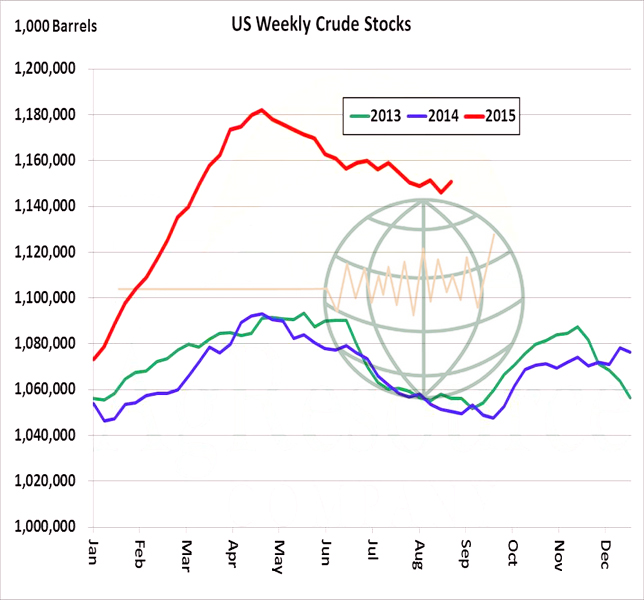
- Sticking with the macro picture we see large US crude oil stocks capping rallies as the seasonally slow period for demand arrives. The summer driving season ends with the Labor Day weekend. Research sees the crude oil market in a bottoming pattern with support noted under $42 and rallies to be capped inn the range of $53-55.00. Shale producers have break evens around $50, and there is talk that OPEC may vote to trim production by year end to prevent an even deeper correction. The point is to come away from bearish crude bets and expect a swinging market profile within a general $40-55 range into 2016.
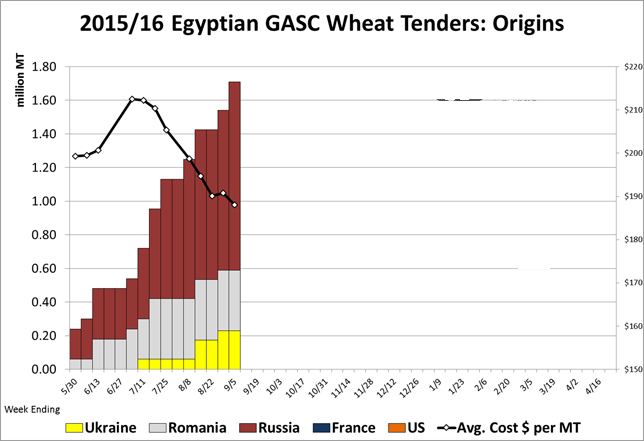
- Egypt has tendered for wheat once again, this time for 11-20 October shipment, and in the million plus mt offers it was Russia who once again secured the entire 170,000 mt business at a price almost £3.00/mt below last week, reported to be $188.02 basis C&F. France offered the cheapest FOB price $174.74/mt in a 400,000 mt plus offer whilst Russia was a bigger seller and more than $4.00.mt basis FOB more expensive – but freight costs pushed the business away from France. Romania and Ukraine were unsuccessful offerors and nothing was on offer from the US.
- StatsCan today released its latest data which showed end July wheat stocks 32% down year on year (20 year highs) at 7.11 million mt, which was above trade expectations that stood at 6.5 million mt. Canola (rapeseed) stocks were put at 2.32 million mt, again above the 1.4 million mt trade estimate but below last year’s 3.01 million mt figure (a four year high).
- Staying with stats, AgroConsult put the Ukraine 2015 grain crop at 57 million mt, a 600,000 month on month increase with wheat accounting for 24.2 million mt (1.7 million mt up month on month). Corn output was less optimistic with the latest update 1 million mt lower month on month at 23 million mt.
- Informa Economics has estimated 2015 US corn output at 13.688 billion bu vs. their previous estimate of 13.412 with yield increased to 168.8 bushels/acre from 165.4 previously. Soybean output was estimated higher at 3.924 bushels/acre compared with 3,789 previously with yield at 47.0 bushels/acre vs. 45.4 previously.
- In other news, China is closed today and tomorrow to celebrate the 70th anniversary of the ending of World War 2, maybe some market respite will follow, maybe not! However, despite closure, the IMF warned that the impact of Chinese lower growth on the rest of the world would be worse than previously thought. They said, “China’s transition to lower growth, while broadly in line with forecasts, appears to have larger than previously envisaged cross-border repercussions, reflected in weakening commodity prices and stock prices. Near-term downside risks for emerging economies have increased.”
- To counter Chinese news, Europe is growing as demonstrated by the Eurozone composite purchasing manager’s index (PMI), which improved to 54.3 in August from 53.9 in July, which signals accelerating growth. Whilst global economic worries have grown recently, the reduced fears of a Grexit have led to an improved European business environment, pushing the pace of growth to its best in just over four years. However, as always the news is not entirely as it may seem on the surface. Growth across Europe is not uniform, on the one hand we saw German PMI jump to a five month high of 55.0 and both Spain and Italy also saw improvement. On the other hand France saw PMI fall to a seven month low of 50.2 and that is a worrying sign of stagnation.
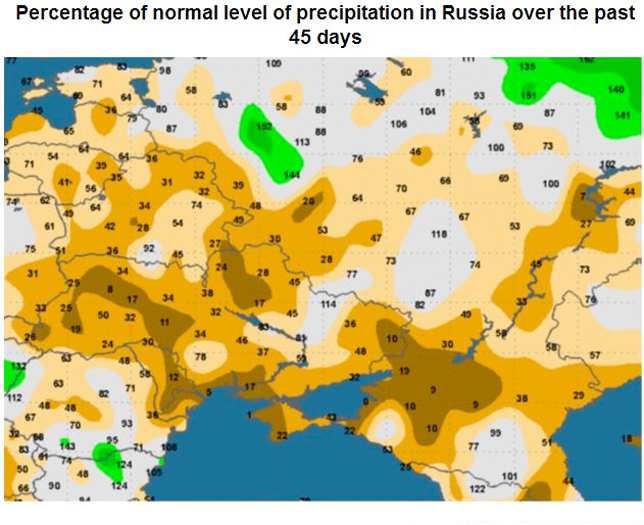
- We have previously mentioned that Russia fears another dry sowing period for winter wheat as dry weather over the past few weeks and soil moisture levels are lower than average for this time of year, according to analysts at SovEcon. There are concerns that the lack of rainfall will delay the planting of winter wheat, which already has a tight planting window. However not all is lost, as spring wheat is yet to be sown for which there is still time for the weather (winter rains in particular) to improve. Despite the dryness, SovEcon have reported that 3.2 million ha of land has been planted to winter grains, which is ahead of last year’s pace. The South, which is suffering the most from low soil moisture still has some time left before the planting window closes, with 10-25mm of rain forecast over the coming two weeks. However, more rain will still be needed in many areas.
2 September 2015
- Late yesterday Int’l FC Stone released their latest production forecasts which showed US 2015 corn production higher at 13.457 billion bu (from 13.381 previously) with yield at 165.9 bushels/acre, up from 165.0 last month. For comparison current USDA numbers are 13.686 and 168.8. They trimmed US 2015 soybean output to 3.791 billion bu (from 3.797 billion previously) with yield increased to 45.4 bushels/acre from 45.0 a month ago. Current USDA numbers are 3.916 and 46.9. Their figures are based on customer (grower) surveys and are based upon final US output not the September USDA report.
- Early trade in Chicago today saw Stone’s figures as mildly supportive, particularly on the opening but focus soon returned to slumping global grain prices as well as further crude losses. Buyers have been noticeable by their absence today. There is a lack of expectation over tomorrow’s weekly US export numbers despite an increasing seasonal pace. Cheaper FOB prices from S American corn and Black Sea/French wheat remain a limiting factor for US exports.
- Global wheat and corn FOB levels continue to slide as evidenced by Ethiopia being offered very cheap wheat in their tender, below yesterday’s reported (cheap) Algerian levels. S Korea has secured S American corn $0.21/bu below US levels for early new year shipment. French export silos are fully stocked and look as if they need to make space for new crop corn and sunflower seed supplies. Consumers the world over see little reason to commit too far forward in the face of such a volume of supply in corn, wheat and soybeans.
- There is a strong argument to take levels of cover higher into the winter, prices are at season lows and in some cases levels not seen for some years. UK farmer selling is likely to slow if prices slip much further, and the potential for a starved market does exist although global supply pressure is likely to ensure prices do not make massive gains.
- Data supportive to our last paragraph does lie in the wings although it is early days. There are reports of dry conditions across key Russian and Ukraine grain production areas and winter planting is taking place in conditions less than ideal for germination. As we say, it is early days and our view is that spring weather is more likely to impact output than dry conditions at planting. Additionally, India’s monsoon rains are seen as falling short of the forecast, which was at only 88% of long-term average. This could make the season the driest since 2009 and restrict crop outputs. Current Indian stocks should be sufficient in key agri commodities such as wheat, rice and sugar but restricted rains could leave a big hole in cooking oil supplies leaving a big import requirement.
- Position risk management is now becoming a more significant issue.
1 September 2015
- As the UK returned to work after a holiday extended weekend we witness Chicago markets following the macro signals, the principal one being the falloff in crude prices (down $3.50/barrel back to $45.50 basis Oct WTI) added to which the US DOW was sharply lower, by some 400 points. As corn, wheat and soybeans lacked fresh market news the macros took over as this week heads into an extended US weekend break for Labor Day.
- Currencies continue to play their bit as the Ruble has fallen to 66.4 vs. US$ and the Brazilian Real hit 3.664. As we have reported previously (more than once) the incentive for farmers to extend acres in those regions displaying weaker currencies continues to exist and we see no reason for this to change right now. This will doubtless add to burgeoning global stocks if mother nature plays her part. Russia is about to start winter wheat planting in earnest whilst Brazil will be sowing soybeans in a few short weeks and the incentive to increase acres must seem attractive.
- Algeria’s latest wheat tender is arguably sharply discounted as France (in particular) looks to secure demand ahead of the corn and sunflower harvest and global wheat markets continue to sink in the face of limited demand and the exporter’s full silos. It is simply a case of too much wheat chasing limited demand.
- Funds appear to be shedding length in corn as concerns continue to exist over US demand (domestic and export). Look for the funds having a square position before markets show any major resilience would be our take on things right now.