30 November 2015

  • Chicago corn and soybeans are seeing some gains as we start the week whilst wheat is still the weak commodity of the trio. As Chicago prices remain at or near multi-year lows and equity markets close to historic highs it would not be out of place to question if money is flowing out of equities and in to ag commodities. If this is the case it could explain the increase in open interest that was seen on Friday. Tonight’s Thanksgiving delayed COT report will clarify fund activity as well and we will update charts tomorrow.
  • US weekly export inspections for the week ending 26 November were; 67.4 million bu of soybeans, 11.8 million bu of corn, and 10.1 million bu of wheat. For their respective crop years to date the US has shipped out; 375 million bu of wheat (down 71 million or 16%), 263 million bu of corn (down 95 million or 26%), and 733 million bu of soybeans (down 58 million or 7%). In late October US soybeans were above last year, and are now falling behind on a slowing shipping pace.
  • Russian wheat is not flowing to Turkish millers, but it was reported that a cargo of sunflowerseed oil did set sail over the US holiday weekend. Turkish flour millers are not in a hurry to seek supply from other exporters, but Ukraine is offering high protein wheat to make up any Russian shortfall. Turkey has not apologised to Russian officials which has hardened their political relationship and has many Russians asking for stiffer economic sanctions. We have heard that Russia will not ask for an official banning of wheat or vegoil trade with Turkey, but instead will focus on fruits and vegetables. (Seems they know which side their bread is buttered – excuse the irony!)
  • The calculators are grinding out estimates as to what future Argentine corn and wheat production is likely to be following their expected tax cut on December 10th – once President Macri is installed. Doubtless we will get updates as to totalled crop areas, but one has to consider that Argentina could easily produce 30 million mt corn crops with their exports rising to 20-24 million mt or more. The extra corn exports will compete directly against Brazil, Ukraine, Russia and the US in future crop years. One result will likely be that US baseline corn exports need to be revised downwards by 100-200 million bu in the years ahead. The US has tremendous competition lurking in world corn trade.
  • At this time we see the S American weather forecast as “OK” and therefore see no reason for concern at this time.
  • Summary:
  • Soybeans – can not rule out more a of a “recovery” bounce as Argentine export tax to drop (only) 5% to 30%.
  • Corn – the market is very oversold but with Argentine export restrictions gone and the 20% export tax reduced to zero (effective 10 December)  it is hard to become bullish.
  • Wheat – the market remains oversold but very large Chicago deliveries and the strong US$  keeps sellers active.

25 November 2015

  • Egypt’s GASC has taken advantage of recent price drops to once again tender for wheat for late December shipment, and as expected France has won the lion’s share with 50% of the tender awarded in their direction. A total of 240,000 mt was awarded with the balance equally split between Russia and Romania, and France picking up 120,000 mt, the average price of $205.94 basis C&F is just over $5/mt below their last tender.
  • There is a suggestion that Russian authorities are trying to set up as many roadblocks as possible to slow/end the flow of Russian wheat to Turkey. It is premature to call it a full tilt embargo, but Moscow is said to have told custom agents to do all that they can to prevent Russian wheat from sailing. Clearly Russia well understands that Turkish millers rely on Russian wheat and they currently appear to want to cause some difficulty in loading/sailing.
  • Ukraine has stated that it has closed its airspace to Russian planes and that it has stopped buying Russian natural gas. Ukraine has been working hard to secure EU natural gas that is often sold at price below Ukraine offers. The point is that political anxiety is dramatically on the rise in the Black Sea. As we intimated yesterday, this has worried grain exporters/importers from the area.
  • Finally, we will be “off grid” for the remainder of the week due to personal reasons. Reports will resume on Monday and we apologise for any inconvenience this may cause.

24 November 2015

  • By our calculation the funds nest short position, updated to last night (and it can not be totally accurate) suggests that they are back at, or close to, last June’s 200,000 net short position. Such a large position, as we head into the crucial S American growing season is a recipe for volatility. Any adverse conditions that develop in December of January would doubtless encourage a sharp short-covering rally. There is no suggestion right now that this would happen, however we would express surprise if we did not see at least one weather scare in the run up to late January’s harvest. We continue to advise a cautionary approach.

  • Last night’s close in Chicago saw a price “key reversal” is soybeans, which is often associated with the formation of a bottoming pattern. Both soybeans and meal made fresh contract lows before short covering saw prices close higher.
  • Today has seen Chicago grains easier with soybeans just in positive territory as we approach the close. The weekly price chart in soybeans is also displaying a reversal pattern, which appears to be gaining the interest of funds, particularly as we see crude oil, gold and CRB Index all bouncing off recent lows. More optimistic global economic growth and inflation outlooks are also prompting a “bottom picking” mentality, and we all know the old trader’s joke about “bottom picking” etc. etc! The grains are easier on lack of fund follow through although any soybean strength could possibly spill over into grains.
  • Black Sea and EU fob wheat prices showed continued weakness on lacking demand and Jordan has for the second time in two weeks cancelled a 100,000 mt wheat tender.
  • The downing of the Russian jet by the Turks overnight has fueled widespread speculation as to what will be response from the Russians. Russia and Turkey have battled for decades, so this skirmish is not something new. However, Russia does provide 57% of Turkey’s natural gas supply and if it is shut down prior to winter this would severely impact Turkey’s economy. Moreover, Turkey is Russia’s 2nd largest wheat importer and there is talk of a partial embargo. It seems as if everyone is trying to gauge the Russian response to Turkey’s military downing.
  • Finally, one has to remember that most Black Sea trade moves through the Bosporus Straits (ag, energy and even military) at Istanbul so this shipping lane is vital. The Bosporus Strait is hugely important from an ag logistical standpoint and any slowing/blockage is something being discussed by importers and end users this morning.
  • Clearly there are some geo-political issues emerging, and these will bear watching.

23 November 2015

  • Top of the weekend news has to be that Conservative opposition challenger Mauricio Macri won Argentina’s presidential election on Sunday, bringing to an end more than a decade of free-spending leftist populism with a promise to open up the ailing economy to investors. Outgoing President Fernandez’s style and policies appear to have worn thin with the electorate who have backed Macri’s pledges to liberalise and stamp out corruption. How this pans out will be interesting to watch in coming weeks and months.
  • Chicago markets started the day somewhat lower on the Argentine news as well as beneficial rain and snow across parts of the US, which is improving soil moisture levels as crop dormancy approaches. Funds were once again sellers, but have this afternoon come back to take cover amid a lack of concrete news from S America. There are suggestions that there may be a one month period of zero percent soybean export taxes with month two at 15% followed by a return to 33%. This would suggest an avalanche of supplies hitting the market in an extremely short period of time with all that comes with such a move – lower prices! The time frame for large volumes to hit the market is realistically governed by such issues as freight availability and internal logistics, but the suggestion of significant stock movement was enough to move the market in early trade.
  • Tension is once again growing between Russia and Ukraine as power lines to Crimea were blown up over the weekend and it is not beyond comprehension to believe that further retaliation could include ports and grain shipments. With markets already nervous it would not take much to prompt additional risk premium to be injected into current low prices.

19 November 2015

  • Brussels has issued weekly wheat export certificates totalling 655,676 mt. This brings the season total to 9,064,414 mt, which is 2,482,607 mt (21.5%) behind last year. To reach the USDA’s latest EU wheat export total of 33.5 million mt it will be necessary for exports to hit an average of just over 740,000 mt for each of the remaining 33 weeks in the season.
  • The USDA has today released its weekly export figures as detailed below:

Wheat: 721,900 mt, which is above estimates of 200,000-400,000 mt.
Corn: 779,800 mt, which is above estimates of 500,000-700,000 mt.
Soybeans: 1,798,100 mt, which is above estimates of 700,000-1,100,000 mt.
Soybean Meal: 247,300 mt, which is within estimates of 150,000-300,000 mt.
Soybean Oil: 37,700 mt, which is within estimates of 10,000-40,000 mt.

  • In their latest update Stratégie Grains have raised their estimate for 2015 EU soft wheat exports to 26.8 million mt, an increase of 300,000 mt. At the same time wheat output is also increased by the same amount to 149.8 million mt, maize output is forecast 200,000 mt higher at 57.3 million mt whilst barley output remains unchanged at 60.5 million mt. Stratégie Grains views the pace of EU wheat exports as rising, particularly to N Africa in the light of a weaker €uro, which is improving competitiveness. At the same time domestic wheat consumption in livestock diets is reduced to 54.5 million mt vs. last month’s estimate of 56 million mt due to reduced competitiveness against other grains. Consumption by flour millers was also reduced by ½ million mt.
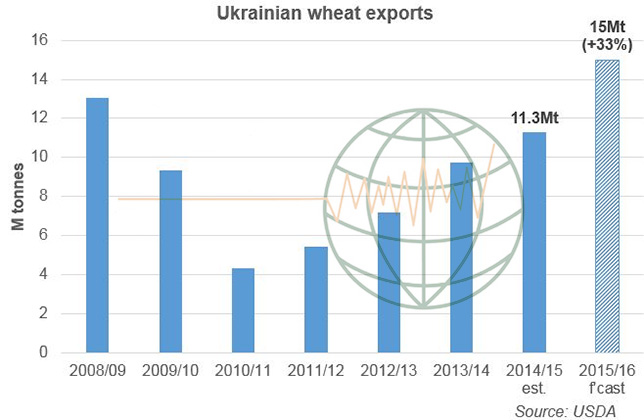
  • Traders and the Ukrainian AgMin have agreed to limit wheat exports from the country to 16.6 million mt this season, according to reports by Reuters. However, the current size of the cap is unlikely to cause major concern as it is above both total season exports in recent years and current forecasts for 2015/16 exports (see chart below). This year, Ukraine has endured a difficult autumn planting campaign and concerns have been raised over the condition of crops for harvest 2016. As a result, the cap is expected to be reviewed in spring 2016 following an assessment of crop conditions. Current season exports from Ukraine have got off to a good start with 5.5 million mt of wheat shipped in the first three months of the 2015/16 season (Jul-Sep), according to data from UkrAgroConsult. This is 22% higher than the same period in 2014/15, while the USDA forecasts total season exports to be 33% higher year on year. Exports from Ukraine are usually weighted towards the front end of the season. On average, over the past five seasons, more than a third of the full season total was shipped by end-September, with an average of nearly 70% of the total exported by end-December.
  • It has been a mixed day in Chicago with a noticeably reduced appetite for selling in anticipation of Friday’s COT report showing an even larger net fund short position, which is offering some support (on the back of what would happen if funds cover their short). Added to this, larger than expected wheat, corn and soybean export sales bolstered further support as traders start to believe that current (low) prices are beginning to build and develop demand (we are not too sure on this one).
  • S American corn fob premiums are starting to rise placing US Gulf offers at a slight advantage and interest is beginning to switch back to the US crop.
  • Ultimately it is hard to remain overly bearish, despite the fundamentals, in the light of the sizeable fund short and multi-year low prices. That said, there is little on the horizon to suggest that there is anything of a lasting rally in the offing.

18 November 2015

  • We are looking at another “down” day in Chicago as the soybean complex leads prices lower. The market is bracing itself for Sunday’s Argentinian presidential election and all that might come with the ultimate outcome, with many expecting a win for opposition leader Macri. If he is elected there is an expectation of a rapid cut in soybean export taxes and a Peso devaluation. The polls appear to favour Macri but there is an uncertain history of accuracy over Argentinian presidential election polls and there will be an indeterminate period of time before any changes are enacted.
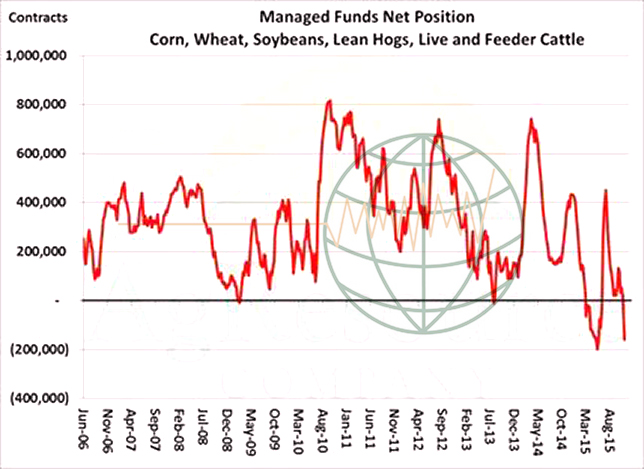
  • The funds have never held a larger short ag position than as of today! The chart below reflects non-commercial net ag positions in livestock, grains and oilseeds. Notice that as of last Tuesday, non-commercials held a net short of just over 300,000 contracts, larger than the low going back to June. Funds have been aggressive sellers of a host of commodity markets following the recent strong rally of the US$. Fund shorts by themselves are not a reason to be bullish. What is lacking is a fundamental catalyst to spark any short exodus. The heady fund position argues that sellers should be cautious entering new short positions as we have advised previously.
  • Stratégie Grains have reduced their estimate of EU wheat imports in the 2015/16 year by 400,000 mt to 3.1 million mt. Improved competitiveness of EU wheat, particularly in the south when compared with Ukraine. At the same time an increase of 300,000 mt is seen in EU 3rd country exports to 26.8 million mt, mostly featuring N Africa as the destination. Note that this compares with the latest USDA estimate of 33.5 million mt, a somewhat large difference!

17 November 2015

  • Chicago wheat has fallen below last week’s low in trade today whilst soybeans tested last week’s high. The fall in wheat has seen funds making additional sales and pressuring corn at the same time. Limited farmer selling and a firming cash basis has added to market turmoil but ultimately we are looking at neither bullish or bearish inputs when all said and done – for now.
  • In an interesting development, much cooler ocean water has started to build across the western equatorial Pacific – and that cold water is starting to push eastward. The cold sub surface waters of the west look to start moderating El Niño conditions rather rapidly in coming months. This is something worth watching since a fast ending of El Niño would raise the weather/crop risks for S America and the US in 2016. We suspect that funds managers are watching the same El Niño/La Niña developments and could push out of short ag positions if the trend becomes clearer heading into year end. This is something that we will closely monitor in coming weeks. The ending of the current super El Niño seems more certain based on the rapid cooling of the W Pacific.
  • The world grain trade has been listening to all of the promises being made by both Argentine presidential candidates. A speedy devaluation and ratcheting down of export taxes are openly discussed by both candidates. Based on the polls, traders expect that Macri will win the election and that speedy reforms will be enacted once he takes office on December 10th. Yet, many respected Argentine economists are advising not to listen to campaign promises! Promises aside, these economists argue that if Macri becomes president, he will likely take a more measured approach in moving to a Peso devaluation and an ending of grain export taxes. This would come as somewhat of a disappointment to the bears that now point to a wall of beans and grains coming to the world marketplace from Argentina.
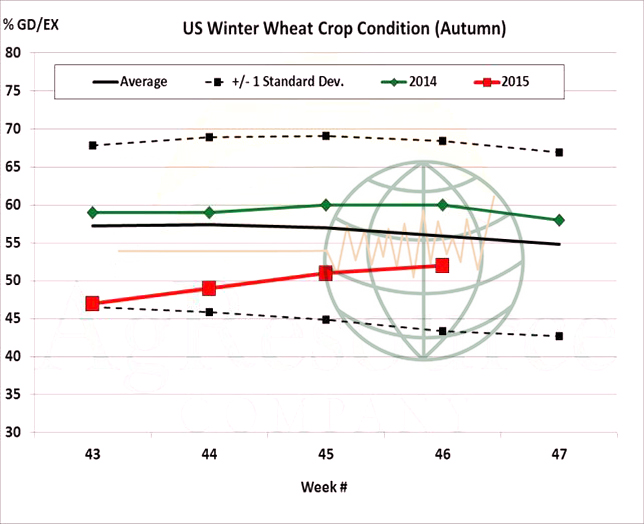
  • Last night’s weekly US crop condition and progress report showed US winter wheat good/excellent ratings were boosted 1% to 52%, vs. 60% last year. The biggest improvements are noted in; CA, IN, MO, OH and OR. Wheat planting has reached 94% complete, with emergence at 87%. Soybeans are reported to be fully harvested and corn is 96% gathered.


16 November 2015

  • It has been a relatively uneventful start to the week in Chicago markets and this has reflected in Europe as well. It is reported that volumes are low because traders are looking away from ags for better opportunities. As Chicago markets near multi-year low levels  and global farmers hang onto their recent harvest, the market needs to find a fresh bearish input for pressure to remain on still lower price levels. Tonight’s COT report will be keenly inspected to see just how much selling power may be in the hands of the funds.
  • Today’s NOPA crush report showed October’s soybean crush to be 158.9 million bu and soybean oil stocks reaching 1.408 billion lbs. Last year’s comparable crush rate 157.96 and the latest number was a touch below expectation. Crush rate to date is record large but US crush margins are in decline.
  • One commentator has described the current market climate as “too cheap to sell and no fundamental reason to buy.