3 December 2015

  • Chicago markets are higher as we write this, wheat sharply so amid what has been described as “macro inspired” trading. Today’s highlight has been the surging value of the €uro, which followed a disappointing ECB rate cut by Mario Draghi (ECB leader), which in turn saw the US$ plunge to four week lows.
  • It is estimated that the non-commercial short in Chicago wheat stands at 100,000 contracts compared with the record set last May at 110,000 contracts. It is these positions that are being covered at present – do not forget both Chicago and Kansas wheat futures were at contract lows yesterday and the power of a short covering rally should not be overlooked (have we mentioned this previously?)! Corn has followed and soybeans are also higher despite largely favourable S American weather forecasts and weaker than expected US export sales.
  • It is our opinion that the US$ will remain strong, recall US$ rallies tend to be long-term affairs, and the current issue is how deep will the current correction be. There was an expectation of an ECB rate cut of as much as 0.2%, and the actual cut of 0.1% caught traders off guard hence the sharp exchange rate move that followed.
  • Crude oil has rallied $1.60/barrel with gasoline and ethanol also higher.
  • The USDA has today released its weekly export figures as detailed below:

Wheat: 432,900 mt, which is within estimates of 250,000-500,000 mt.
Corn: 499,400 mt, which is below estimates of 500,000-1,100,000 mt.
Soybeans: 878,300 mt, which is within estimates of 800,000-1,200,000 mt.
Soybean Meal: 77.500 mt, which is below estimates of 150,000-300,000 mt.
Soybean Oil: 5,300 mt, which is below estimates of 10,000-25,000 mt.

  • For their respective marketing years to date, the US has sold 672 million bu of corn, down 25% from last year; 1,211 million bu of soybeans, down 17%; 532 million bu of wheat, down 14%; 5.4 million mt of soybean meal, down 20%; and 498,000 mt of soybean oil, up 40% from a year ago. The discrepancies from year-ago levels are generally unchanged from recent weeks. No new sales were announced by FAS this morning.
  • Brussels has issued weekly wheat export certificates totalling 1,109,556 mt by far the largest week so far this season and nearly double last week’s figure. This brings the season total to 10,762,381 mt, which is 1,996,455 mt (15.65%) behind last year. To reach the USDA’s latest EU wheat export total of 33.5 million mt it will be necessary for exports to hit an average of just over 710,000 mt for each of the remaining 32 weeks in the season.
  • Informa Economics has raised its estimate for Argentine 2015/16 corn output to 21 million mt from 18.5 million previously.Their soybean estimate is down by ½ million mt to 58.5 million mt. Argentina last year produced 26.5 million mt of corn and 60.8 million mt of soybeans. 2015/16 Brazilian soybean output is revised higher at 101.4 million mt, a 400,000 mt increase whilst 2015 all corn output is trimmed ½ million mt to 81.3 million mt. Last year’s Brazilian output saw soybeans at96.2 million mt and corn at 85 million mt.
  • Historically, year-ends tend to be price supportive and with relatively high fund net short positions this year look very vulnerable to spikes higher as position size is reduced. Today’s US$ drop may well have provided the trigger for a short covering spree. However, global fundamentals still show that the wheat market in particular, and others somewhat less so, are weighed down by huge surpluses and limited buying interest. Unless we see a significant crop damaging or restricting weather event we would expect a resumption of price pressure and believe that rallies will provide selling opportunities.

2 December 2015

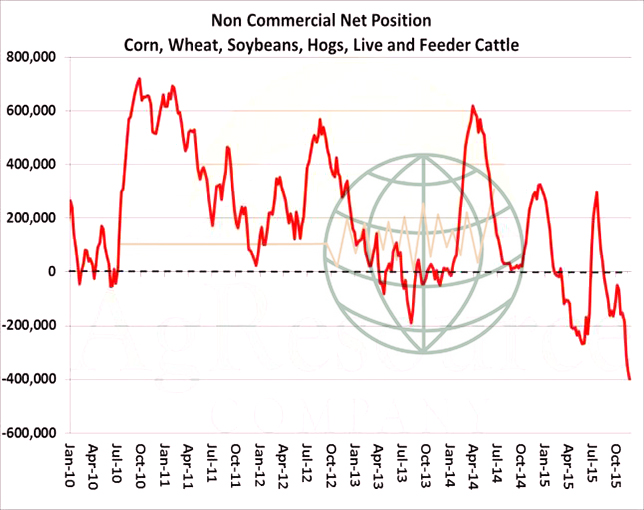
  • Corn and soybean markets in recent weeks have been reacting to moderately supportive input – Monday’s EPA ruling, a lack of Argentine soybean offers, competitive Gulf corn offers – and funds’ sizeable short position has helped with the rally. The graphic below displays non-commercial traders’ net position in ag markets, and their current net short position (400,000 contracts) is the largest since the supplemental data series began in 2006. It’s difficult to be fundamentally bullish amid policy changes in Argentina and with El Niño to dominate the global climate into next summer. However, the market is increasingly lacking new sellers, whether it be farmers or speculators. Short covering rallies will develop periodically in the weeks ahead, and could well be good opportunities to make sales.

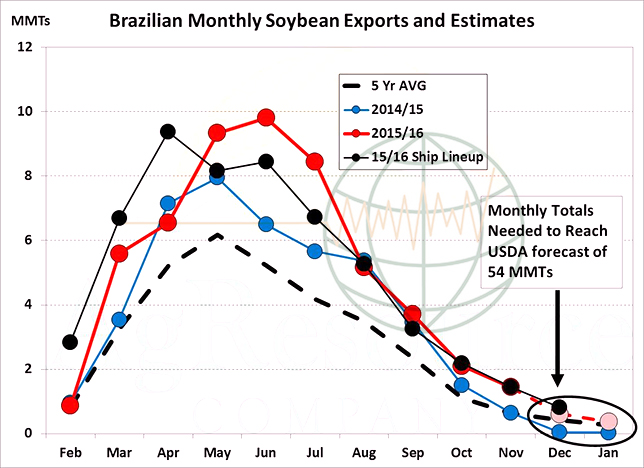
  • Brazilian trade data released on Tuesday showed official November soybean exports as reported by the government at 1.44 million mt. The 2015 November total was at a four year high and the second largest on record, but also in line with expectations based on private shipping data. Both the USDA and CONAB have been forced to increase export estimates over the last several months, as their annual projections have been reached far earlier in the year. CONAB has raised their projection for five straight months, while the USDA’s most recent projection of 54 million mt is 7 million over their June projection. The chart below shows projections for December and January exports, to meet the USDA forecast, but the Brazilian lineup continues to add late year ships, and is already indicating a larger than needed export total.

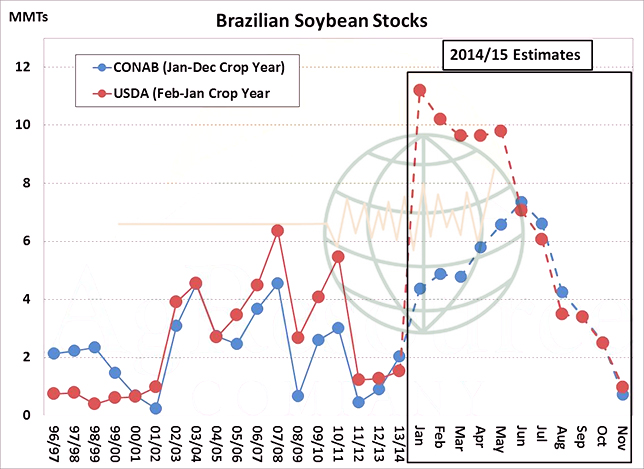
  • Ship lineups have for months indicated that both the USDA and CONAB have been underestimating the Brazilian soybean export total. The chart plots the history of the two agencies ending stocks projections, by month, for the 2014/15 crop. At the peak in January, the USDA projected Brazilian soybean stocks at 11 million mt versus CONAB’s January estimate of 4.4 million mt. The two agency estimates finally converged in June, and have since moved lower in tandem as late season exports have continually exceeded expectations. Most recently, the USDA cut their stocks forecast by 1.5 million mt to 972,000, and CONAB made a 1.8 million mt reduction to 720,000 mt. The increased Brazilian export totals have made a visible dent in the US export shipment pace, with cumulative shipments through last week off some 58 million bu from a year ago.

  • Brazilian corn exports in November totaled 4.76 million mt, down 1.8 million from October’s record but still well above last year. Year to date Brazilian shipments rest at 18.2 million mt, a full 5 million (38%) above last year, and similarly strong shipment totals are expected into January. In keeping track of weekly corn ship lineups in Brazil, it is notable that the pace of new additions has not changed much as of late November. Total Brazilian corn export commitments as of last week totalled 30.8 million mt, already 99% of the USDA’s annual forecast and up 72% from last year. The slope of the red line continues to point upwards, and we view the USDA’s forecast as some 1-2 million mt too low. The sales pace will be slowing in the weeks ahead, but this year has been an indicator of what Brazil can do with a record crop. Brazilian sales and shipments will be large in 2016 without adverse weather in C and N crop areas next spring, and we maintain that it is competition for global corn exports that will cap rallies, fundamentally. The US has to work (hard) to compete for world share.

  • Chicago markets have seen another mixed day with the grains a touch lower and soybeans a touch higher. There remains no evidence of a demand story to add further support prices, in fact, the opposite is probably more realistic.

1 December 2015

  • Last night saw US winter wheat condition reported at 55% good/excellent compared with 53% a week ago and 58% a year ago.
  • Australia’s ABARES have forecast 2015/16 wheat production at 23.98 million mt, which is below September’s estimated 25.28 million mt. Canola (rapeseed) output was forecast at 2.99 million mt (September 3.15 million mt). Reductions are blamed on El Niño influences have adversely impacted growing conditions.
  • Yesterday also saw the US Federal Government/EPA raise the Renewable Fuel Standard (RFS) for biofuels, albeit only slightly. The chart below illustrates the increase was less than the original 2007 Energy Bill called for, however ag markets will take the news as supportive creating upside potential for the biofuel crops of corn and soybean oil. Quite how much corn or vegetable oil will be used in the coming years is next to impossible to calculate, and with funds heavily short this could be a “trigger” for some upside. We do not believe this is a long-term price direction changer at this time.
  • As we approach the close in Chicago corn and soybeans are in positive territory (just) whilst wheat is trading a touch lower.
  • Brazil’s export data for the month of November included corn shipments of 4.8 million mt, down 14% from October’s record but up 60% from November of 2014. Year to date Brazilian corn exports total 18.2 million mt, vs. 13.2 million mt a year ago, and large shipments will continue into January – though new sales will be in decline. Brazilian soybean exports in November totalled a surprisingly large 1.4 million mt, vs. just 180,000 mt a year ago, though it should be noted that Brazil’s soybean shipping season is coming to an end.
  • A few sporadic corn offers still exist in S America for nearby shipment, but US Gulf corn retains the title as the world’s low cost seller into February – a change from the position of only a few weeks ago.
  • Russian wheat prices, however, overnight fell to $194-195/mt for Dec/Jan arrival, vs. $197-199/mt a week ago, and US wheat futures have been unable to benefit from rising corn and soybean markets due to the sheer size of available exportable supplies in Europe and across the Black Sea Region. There is still widespread talk and/or concern about poor winter wheat conditions in Ukraine, which should not be dismissed at this time, but old crop cash values still indicate relative abundance. We note that Argentine offers beyond January are in decline amid solid growing conditions and the coming end to grain export taxes.
  • It appears that spec traders are heavily short, and short covering rallies will happen periodically into the end of the year. Following the EPA’s ruling, our best guess is that the USDA will hike its corn and soyoil consumption forecasts slightly, which in the case of corn is based mostly on the pace of ethanol production to date. We do not view the ruling as having a meaningful impact on balance sheets, however. Any test of $9.15-9.20, basis Nov ’16 soybeans looks like providing another selling opportunity.
  • Summary:
    • Soybeans – We are in a position to see further short-covering bounces; oil firm
    • Corn – We are in a position to see short-covering with trend funds short 150,000 contracts.
    • Wheat – Extreme oversold position with record short KC and trend funds short 84,000 contracts.