
To download our review of yesterday’s USDA report please click on the link below:
Monthly Archives: January 2016
12 January 2016
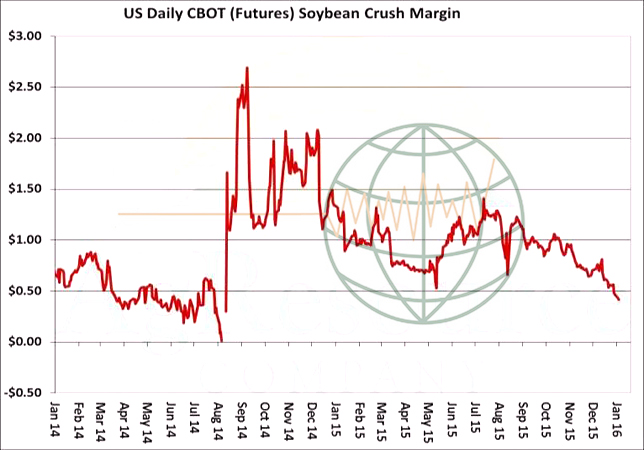
- US soybean crush margins have steadily declined since August, and when one considers that cash soybean meal is being traded at values well below Chicago, the margins for US soybean processors is dismal, and unlikely to improve anytime soon. We would expect that an oversupply of cash soybean meal will ultimately weight on Chicago soybean meal futures and produce lower lows in futures in coming months. This year’s crush margins are very different from last year – limiting demand for beans.
- Brazil’s CONAB updated their 2015/16 crop estimates with corn 300,000 mt higher at 82.3 million mt (split 27.76 million mt for the first crop and 54.56 million mt for the safrinha crop). Soybeans were estimated 102.1 million mt, down 400,000 million mt month on month and wheat was 100,000 mt lower at 5.5 million mt.
- Today’s January USDA WASDE report offered something of a reprieve for the bulls and the big question now is, “Will it last?”. Both 2015 US corn and soybean yields were reduced and soybean harvested acres were trimmed back too. Winter wheat seeding fell below the average of trade expectations at 36.6 million acres, down some 2.72 million acres from last year. We would expect to see midwest farmers plant more soybeans, sorghum and corn in place of winter wheat, which may come through in future reports.
- In the face of favourable S American weather if still feels as if the report is unlikely to change the longer term market direction, but a fund short covering bounce looks likely. The approach of the S American harvest and lacklustre global demand continues to look a formidable longer term obstacle to significant and lasting price increases.
- It remains true that the funds are big shorts and the January report was supportive. However, cuts of 53 million bu of 2015 US corn production, 51 million bu of 2015 US soybean production and a lower US winter wheat seeding total does not alter prevailing bearish price trends. Once the fund short covering runs its course, the market will understand that Argentina and Brazil are aggressive in offering corn, wheat and soybeans for export, and that WASDE has yet to fully reduce US corn, soybean and wheat export estimates enough. Moreover, we believe that the USDA is still way too high with its 2015/16 US soybean crush estimate. Unfortunately, the January report does not build demand in a more worrisome macroeconomic world. Allow the rally to run its course would be our view at this time.
To download our USDA Report recap as a pdf file please click on the link below:
11 January 2016
- Crude oil markets have fallen to a new 14 year low of $32.73/barrel earlier today and appear intent on targeting the $30 level (or lower). Technical chart support rests at the 2002 lows of around $20/barrel and abundant supplies together with slowing global growth do not bode well for an immediate recovery. Whilst it would normally be expected that Chicago agri markets would follow lower in sympathy (which they are to an extent) tomorrows USDA reports are providing some support today. Clearly the outside economic world leans bearish for now.
- We have an interesting premium in January soybean futures over the March contract (some 19 cents) leaving many pondering why! Fundamentally there looks as if the US will hold as much as 500 million bu carryout for the 2015/16 crop and this would point to the spread being “wrong”. It is possible that damage to the load facilities in the Illinois/Mississippi rivers is greater than currently admitted, which could account for the nearby premium, but this needs to be watched.
- In the US gasoline prices are falling faster than ethanol and blending margins are falling into deep red territory, leaving the potential for further US stock build this week. The speed of decline in US energies is making it difficult for ethanol to keep pace, and falling corn values reflects, at least in part, fears for a bearish feeding demand picture amid negative margins.
- Fob wheat values in the Black Sea continue to decline as volume offers increase and the value of the Russian Ruble and the Kazakhstan Tenge hit all time lows again. Such currency positions do nothing to discourage both production and exports from the respective nations.
- The interesting point in today’s price action was the failure to sustain the early rally and the funds lack of desire to exit their (huge) net short positions ahead of tomorrow’s report. The macro winds are blowing in a deflationary direction and the concern has to be that Central Banks will be unable (or unwilling) to gather sufficient QE support to change the trend. One source described crude oil as the “canary in the coal mine” of what may occur in the Chicago grain markets this summer in the absence of adverse weather in any or all of the US, Russia, Europe or China. The potential for prices cheaper than any had previously thought possible really does exist. Our view is that if the market rallies after tomorrow’s report it will be an excellent short trade opportunity.
8 January 2016
To download our weekly update as a PDF file please click on the link below:
Weekend summary 8 January 2016
Our weekly fund position charts can be downloaded by clicking on the link below:
7 January 2016
- From a longer term weather perspective the latest NOAA (National Oceanic and Atmospheric Administration) ENSO (El Niño Southern Oscillation) forecast calls for El Niño lingering across the Equatorial Pacific this summer. This is much different from the dire La Niña warnings of October and November. El Niño continued to strengthen amid world oceans that are their warmest on record. It is expected that the world weather forecasting community will lower their expectations of a dire Midwest drought in coming months as La Niña now looks to be put off until Q4.
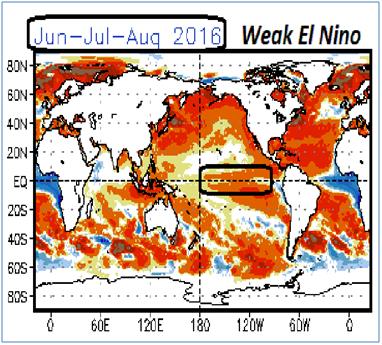
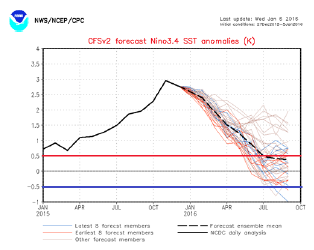
- Longer term, the climate forecasting community has become less aggressive on El Niño’s decline through the next six months. El Niño has doubtless peaked, but the odds of La Niña being established by summer are falling rapidly. The graphic below display a host of model projections into October, and notice the median projection features a weak but lingering El Niño into autumn. As such, it’s premature to discuss a hot/dry US growing season in 2016.
- The USDA has today released its weekly export figures as detailed below:
Wheat: 76,500 mt, which is below estimates of 200,000-400,000 mt.
Corn: 252,900 mt, which is below estimates of 400,000-600,000 mt.
Soybeans: 638,800 mt, which is within estimates of 400,000-700,000 mt.
Soybean Meal: 46,500 mt, which is below estimates of 50,000-150,000 mt.
Soybean Oil: 3,500 mt, which is within estimates of zero-20,000 mt.
- Brussels has issued weekly wheat export certificates totalling 397,143 mt, which brings the season total to 13,979,514 mt. This is 1.474 million mt (9.54%) behind last year.
- Chicago markets have found some stability ahead of the usually exciting January report scheduled for release next Tuesday and limited market movement is anticipated between now and report day. Barring surprise corn or soybean residual use figures we would expect focus to return swiftly to slow US exports and generally favourable global weather conditions.
6 January 2016
- Global political tension levels have moved up a notch today in the wake of N Korea’s successful test of a Hydrogen Bomb. Anxiety levels within Asian and global financial markets have increased as the world debates what or if to do anything. The Chinese Yuan continues to depreciate with the Central Bank sets its value lower each day of this new year and it appears that investors are losing confidence in Beijing’s economic abilities.
- Informa Economics’ latest data release shows their estimate for the 2015/16 Brazilian corn and soybean crops unchanged month on month at 81.3 million mt and 101.4 million mt respectively. Their estimates for Argentinian corn are 1 million mt higher month on month at 22 million mt, whist the soybean crop is left unchanged at 58.5 million mt. Informa have also reduced their estimate of the Indian 2016/17 wheat crop by 4 million mt to 85 million mt.
- General market commentary:
Soybeans are oversold but with declining crude oil levels soybean oil is relatively overbought.
Corn markets have more selling to absorb in Brazil and Argentina remains active.
Wheat markets are responding to lack of weather issues from key exporters and this is keeping the trend down
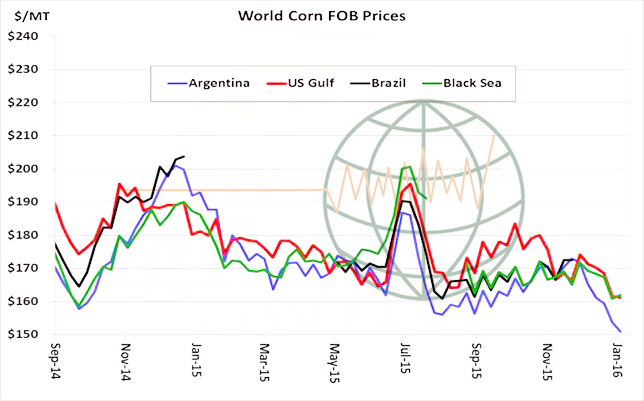
- Argentine fob corn prices have fallen to multi-year lows with offers at $151/mt with bids below $150/mt. This is now lower than the late summer lows of 2014 when Chicago spot corn futures fell to $3.20/bu. The US corn market is overvalued relative to the world which is why a pig producer is willing to import Argentine feed wheat into the SE US. Until there is a bottom in Argentine corn offers, Chicago corn will likely struggle to rally.
- Chicago markets saw an early decline but when Mar ’16 corn failed to breach $3.50/bu key support a short covering rally ensued. The market is only too well aware of the extent of the fund net short position and is consequently wary of a spike higher, and with the January USDA report scheduled for 12 January reduced exposure is the order of the day and this will likely lend some support or even a modest bounce ahead of publication.
- Global grain markets show little sign of vigour, Argentina’s corn and wheat offerings are steadier whilst French and Black Sea wheat offers are weaker. Global importers and consumers are showing little interest in adding to forward cover with books already well filled into spring and early summer.
- In summary, fund short positions offer the opportunity for a bounce but end users are unlikely to chase any rally in the face of current fundamentals and improving S American weather prospects.
5 January 2016
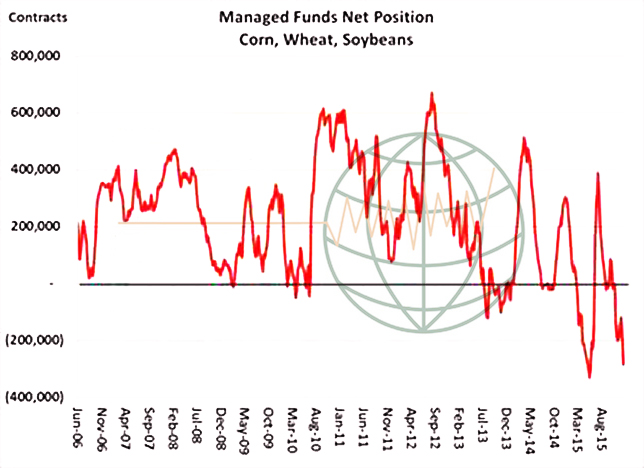
- Last night saw the publication of the holiday delayed CFTC report which showed a significant expansion in the overall fund cumulative net short position in wheat, corn and soybeans. Our archives (which go back to the start of 2012) show the largest cumulative net short position with both wheat and soybeans at individual record short levels. Whilst it should be noted that the large net short fund position does not engender a bull market we note that there seems to be no compelling fundamental to spur a rally. However, the fund short does raise a cautionary note ahead of the January 12th USDA Crop report. Research argues that the large net short fund position will cause Chicago prices to trade sideways into the January report – with the report to determine valuations in to February.
- Brussels has issued weekly wheat export certificates totalling 354,519 mt, which brings the season total to 13,582,371 mt. This is 1.652 million mt (10.84) behind last year and leaves a requirement of a minimum weekly export total of over 711,000 mt to hit the latest USDA export total.
- Trade in Chicago has been somewhat slower today with some slight gains showing across all three key ag commodities as we approach the close. Regardless of fund positions, which are stemming the enthusiasm of the bears to push much lower for now, global FOB prices continue to soften and fundamentals argue this is correct – for now,Argentina continues to lead the way lower in searching for grain and soybean demand. It is rumoured that Argentine low protein wheat has traded into SE USA, and whilst confirmation is lacking it appears that the calculations work. Despite the recent export tax reductions/removal and Peso devaluation in Argentina there remains much unsold soybean supply in the hands of farmers who are reported to have only sold 2-3 million mt. It is estimated that as much as 15-16 million mt of old crop supply remains to be sold and with Brazil still in place to record a record crop we could well have greater pressure to see before prices eventually bottom out.
4 January 2016
- Today’s first full working weekday back saw some sharply lower prices in Chicago as US and global equity markets traded lower. A firming US$ and ongoing concern over global economic growth prospects carried into the new year from 2015. In addition, an oversupplied world crude oil market created disappointment with political tensions high between Iran and Saudi Arabia not translating into a bullish price impact. New Year price tone remains stubbornly bearish with the only safe haven appearing in the form of gold and slowing global growth being the main drag on ag commodities.
- CBOT wheat and corn fell to fresh contract lows and Mar ’16 soybeans within 8 cents of its contract low. Continuation charts suggest support lies at $3.49 for Mar ’16 corn and $4.51 for Mar ’16 wheat.
- Wheat prices for Black Sea weakened as many celebrate the orthodox Christmas and New Year holiday, and if USDA export estimates are to be reached in either Black Sea or EU sellers will have to become more aggressive with price. Unless this is we will be facing record milling wheat stocks in the EU assuming a normal 2016 harvest.
- Brazilian exports in December were reported as soybeans 730,000 mt (vs. 1.44 million mt Nov and 140,000 mt last year), soybean meal 1.04 million mt (vs, 1.13 million mt Nov and 870,000 last year) soybean oil 163,550 mt (vs. 111,720 mt Nov and 65,130 last year). Corn exports in December were reported at 6.27 million mt, record large (vs. 4.76 million mt Nov and 3.4 million mt last year). Exports across the board were larger than generally anticipated by the trade.
- Fund selling has continued and tonights holiday delayed CFTC report is expected to show an increase in fund short position, we will update our charts tomorrow.