11 February 2016

  • Low volume and mixed has been the tone of early Chicago trade with the grains trading either side of unchanged while soybeans have traded mostly in the green. Volume has been extremely light and for now, Chicago does not appear to be paying much attention to the sinking world financial markets.
  • The US DOW is reflecting a 330 point loss amid the weakness in Asian markets and talk from a prominent hedge fund that the potential Chinese banking crisis could be five times worse that the US subprime loan crisis of 2008/09 based on all of China’s leverage and lack of credit diligence. They (hedge fund) noted in a letter to investors, that Chinese loans are made as political favours not on sound banking/credit diligence! Do not underestimate the potential impact of this looking forward.
  • WTI crude oil prices have fallen back near their prior lows at $26.19/barrel.  Currently, WTI March Crude oil is down $1.18 at $26.27/barrel and traders are holding their breath that the recent lows hold. A close in new contract lows would set a downside price target of $20/barrel and further pressure the CRB Index, and expand the talk of deflation. With US ethanol stocks at record levels, this new drop in crude will not bode well for the biofuels with unleaded gasoline trading at $.95-.98/gallon.
  • Additional rain is forecast to drop across Argentina and S Brazil in the next few days as the soybean harvest speeds ahead across N Brazil. Following another 1-3.00” of rain across the drier areas of Argentina, soil moisture should be in good shape for corn pollination and soybean bloom/podding. The rains return in the 11-15 day period across N Brazil which would be ideal for just planted winter corn.
  • Soaking rains are forecast to fall across the S Plains late next week and weekend. The moisture would maintain high rated crops and provide an added boost to soil moisture. Climatologists are no longer is expecting La Niña in 2016 as the Equatorial Pacific remains historically warm.
  • S American markets will slowly return today with soybean/corn hedge pressure expected into the US’s three day weekend. US financial markets are closed on Monday for the President’s Day holiday as the Brazilian harvest advances.
  • European fob wheat is steady with a weak undertone while palmoil values could be peaking from the bearish undertow from crude oil. If crude oil falls to new lows, we fear that Chicago grain and soybean futures will follow.

10 February 2016

  • After yesterday’s market excitement (tongue in cheek comment) we have seen US wheat futures recover from technically oversold levels whilst corn and soybeans sit near unchanged. Matif wheat has enjoyed a modest bounce off its contract lows but let’s be clear, there is nothing in the way of fresh bullish news to substantiate any lasting price uplift.
  • US agri crop sales reporting announced a sale of new crop corn to Japan but nothing else, and we are starting to see global soybean complex demand in transition to S America. Brazilian and Argentine beans for April and further forward delivery are offered in the $321-$328/mt range, the lowest in years and this is as much as $20/mt below US Gulf levels. Both S American countries will start to battle it out for global volume sales once harvest really gets going in March
  • France’s Farm Ministry has pegged new crop wheat seedings at a 5.2 million ha, an 80-year high, and a sizeable crop is in the making amid a lack of winterkill and adequate precipitation.
  • Since late last summer, and following the USDA’s reduction in US grain demand and US soybean crush, the markets have digested a flood of bearish input with limited reaction noted today. Fresh news, however, continues to lean a bit negative, and we maintain that it’s critical to view semi-lasting bounces as limited in duration whilst everything else remains unchanged. Downside risk remains given “normal” weather.

8 February 2016

  • Chicago markets are trending lower as we head to the close and some contracts are heading towards contract lows once again. There is doubtless some pre-report positioning ahead of tomorrow’s report, exits from long soybean oil/short soybean meal have been reported although volume has been subdued. The S American harvest is picking up pace and it feels as if this will currently limit rallies from both a duration and size perspective.
  • Global macros, including equity markets have been in something of a meltdown with the Dow shedding 300 points and crude oil has again dipped below the $30/barrel mark. European and US bank shares have seen some of the biggest hits leaving some questioning future credit risk – something worth watching.
  • As much as 90% of the Argentine soybean crop has been reported to be rated good/excellent in a report sanctioned by the Argentine government. Old crop Argy beans are trading at at significant $30 premium to new crop, which appears to be encouraging farmer selling of their hoarded supplies, particularly now as much needed rains have fallen across a broad swath of the pampas. With the Peso in decline it would seem eminently sensible for the farmer to take advantage of the nearby premium.
  • The Russian government has not made an announcement on export duties as was expected. The prospect for an increase in wheat export duty is looking unlikely due to the falling value of the Ruble, although some believe a modest duty may be imposed on corn and/or barley exports. Recall that Russia needs hard currency for their economy.
  • Chicago markets look to be stuck with the fallout from global financial markets and a test of contract lows is looking entirely possible. Soybean meal looks as if it will struggle to sustain any significant gains in the face of weakening US cash demand. Global fob offers for wheat, corn and soybeans continue to weaken as they try and find some demand.

4 February 2016

  • Yesterday Informa Economics released their latest 2015/16 production forecasts for S America with Argentine corn output increased to 26 million mt from 22 million previously. Argentine soybean production is also higher at 60 million mt, an increase from 58.5 million mt. Brazil’s corn output is forecast higher at 81.6 million mt from 81.3 million previously. Soybean output in Brazil was reduced to 100.5 million mt from 101.4 million.
  • Conab, for comparison purposes, put Brazil’s corn crop at 83.3 million mt, 1 million higher than a month ago, and the soybean crop at 100.9 million mt, 1.2 million lower month on month but this would still represent a record output if reached.
  • To conclude the raft of data today, StatsCan reported 2015 year end wheat stocks at 20.7 million mt, below trade estimates of 21.8 million and last year’s 25.6 million mt. Canola (rapeseed) stocks were reported at 12.1 million mt, above trade estimates of 11.5 million but below last year’s 12.6 million mt.
  • The USDA has today released its weekly export figures as detailed below:

Wheat: 154,000 mt, which is below estimates of 200,000-400,000 mt.
Corn: 1,143,500 mt, which is above estimates of 800,000-1,000,000 mt.
Soybeans: 22,100 mt, which is below estimates of 400,000-600,000 mt.
Soybean Meal: 12,800 mt, which is within estimates of 5,000-25,000 mt.
Soybean Oil: 12,800 mt, which is within estimates of 5,000-25,000 mt.

  • Brussels has issued weekly wheat export certificates totalling 826,594 mt, which brings the season total to 17,019,839 mt. This is 707,143 mt (5.99%) behind last year. The last couple of weeks’ volume are about on pace to hit the USDA’s latest 32.5 million mt season total, but need to be matched each and every week for the remainder of the season if the total is to be hit.
  • Chicago’s early rally faded as wheat led the way lower in the wake of what was described as “disappointing” price results from Algeria’s tender and ongoing weakness in global fob levels. Despite the fall in the US$ prices in Chicago closed lower pretty much across the spectrum. The US$ has lost around 3% this week as bullish trades are unwound amid concern that US payrolls will reflect post holiday weakness, which will likely place interest rate hikes on hold. The fear that a continuation of stuttering global economic outlook will drag US GDP lower is the cause of bullish US$ trade being unwound. Algeria’s tender was concluded at a reported $178 basis CIF and is thought to be mainly French origin although there has been a suggestion that UK origin may feature. The price works back to a fob level equivalent to $171-172, which is a multi year low and below current replacement levels, perhaps indicating eagerness to book volume sales ahead of the 2016 harvest.
  • The news of the Algerian price has many wondering if EU wheat will cost into Mexico and SE USA as a feed ingredient. The feeling is that at a $1.50/mt premium for wheat over US corn, and its improved feeding value, will attract interest from US livestock feeders. Little wonder US Gulf corn is losing export demand!
  • Price trends in US markets has been broadly sideways for some three weeks but global wheat prices are continuing lower as too much supply chases too little demand. Next week’s WASDE report should see US export volumes trimmed on corn and wheat and reduce 2015/16 soybean crush leaving elevated end stocks, and the outcome should be lower prices. We are watching price rallies failing well below technical resistance levels suggesting that physical sellers rather than technical chartists are running the market at present.

3 February 2016

  • World wheat cash offers best illustrate the demand issues facing global grain markets. Just yesterday French offers for March posted new seasonal lows, as Egypt rejected a cargo over the weekend due to phytosanitary issues that we reported yesterday, and as we calculate record (or close to record) surpluses across the Black Sea and Europe. US wheat, meanwhile, has been flat. Wheat markets elsewhere are probing for a level that boosts major importer consumption, but they do not seem to have found it yet, and financing on behalf of major importers has become a real issue.

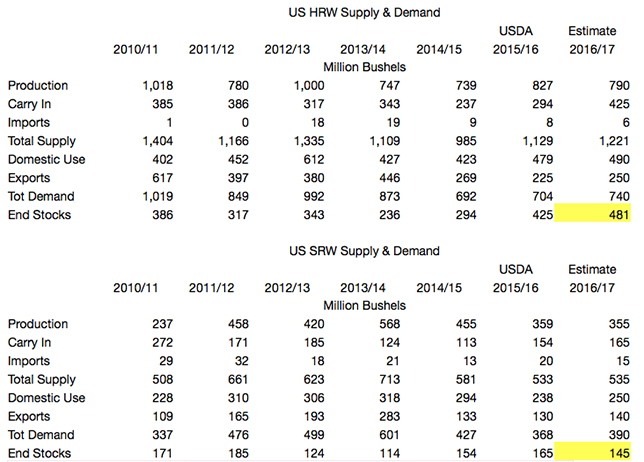
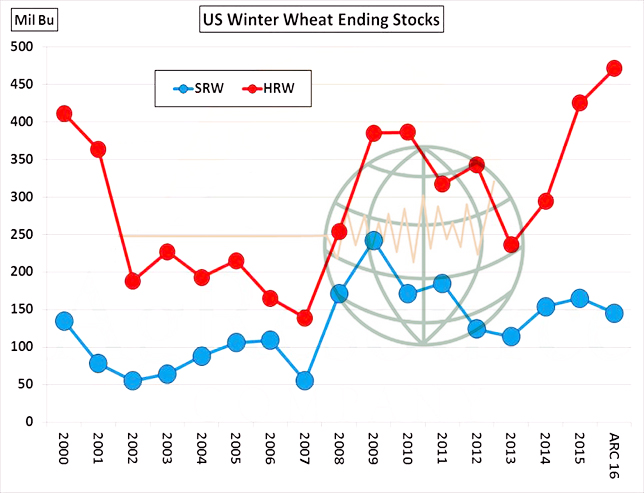
  • In its January seedings report, NASS cut 2016 Hard Red Wheat planted area by 2.4 million acres from the previous year, and cut Soft Red plantings by 370,000 acres. The tables below assume average abandonment and trend yields, and notice that if realised, production is only modestly changed from 2015/16, and total supplies will be steady to higher amid enlarged carryover stocks Total US wheat consumption is projected slightly larger in 2016/17 amid a boost in world trade, weather across wheat areas of N Africa, the Middle East and Brazil has been less than perfect – but Hard Red stocks will remain burdensomely large. Soft Red stocks are projected to contract 20 million bu, but will be very close to the five year average. Soft Red premiums to Hard Red will expand over time. The point of is that even a sharp decline in US acres does not change in the structure of the US wheat market (a demand-driven bear market). Adverse weather is needed to prevent another build in all-wheat stocks.


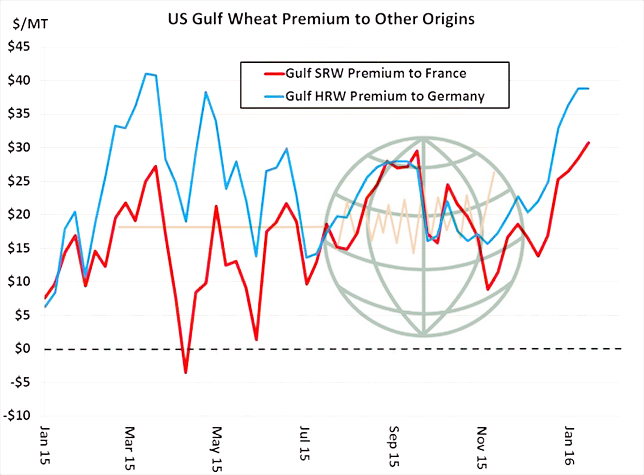
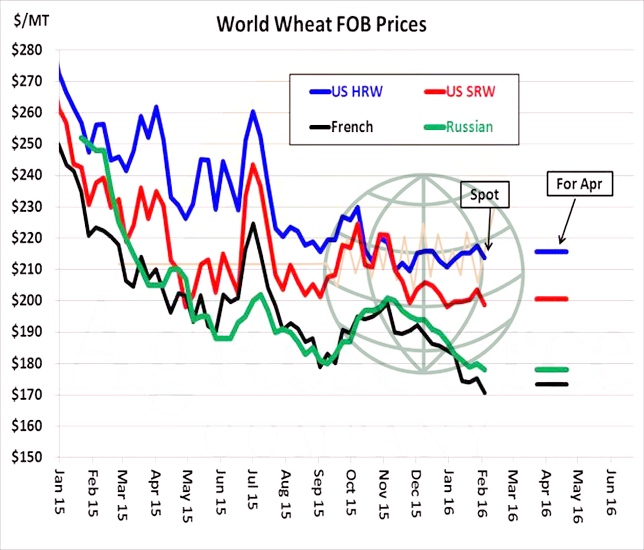
  • Funds continue to slowly pare back their large net short position, but world the cash market remains decidedly weak. As reported, Egypt found no offers at its latest tender, with major exporters citing Egyptian credit difficulties and stringent phytosanitary specifications. Egypt faces a real problem, both political and economic, if it cannot source wheat in a timely matter. However, major exporters also have a problem with massive remaining surpluses and Egyptian demand is needed. French cash prices fell $1/mt to just over $169 (a new seasonal low, and a level comparable to $3.95, basis spot Chicago), and the graphic below displays the US’s premium to competing markets. The current $30-40/mt premium has been rare over the last 12 months, and this disconnect between the US and world markets is unlikely to last. The global market has the potential to bottom out closer to $160/mt this spring, and it’s important to keep this in mind. Note, too, that ENSO forecasts continue to trend towards El Niño lingering throughout 2016, which will be a boon for S Plains soil moisture.

2 February 2016

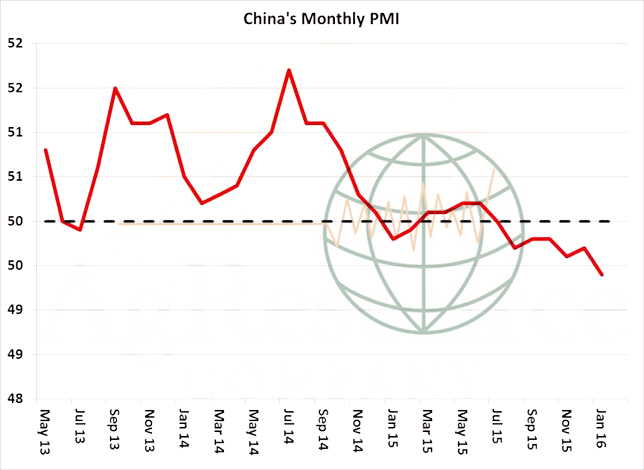
  • Macro markets have kicked off February with a whimper, mostly due to ongoing negative indicators from China. The graphic below charts monthly PMI, and notice that this indicator has been at levels that show economic contraction (50) since summer. A string of six consecutive months of contraction in the manufacturing sector is not helpful to the macroeconomic climate, and we expect global investors to remain wary of risk until emerging markets show signs of strength.

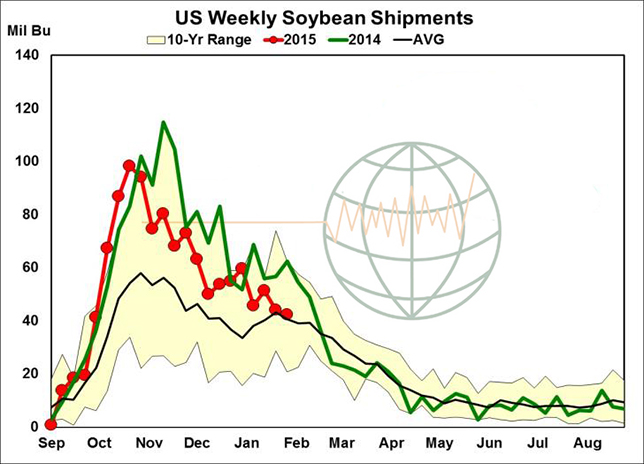
  • Weekly soybean export inspections were within expectations, but also the lowest since early October, at 42.4 million bu. The cumulative annual total slipped further behind last year, down 172 million bu or 13% vs. the USDA’s annual forecast that calls for just an 8% decline in US soybean exports. NASS reported a total December soybean crush of 167 million bu, in line with expectations and 9 million bu over December’s NOPA total. Both meal and oil yields were below the NOPA total. S American weather forecasts lean bearish for Chicago  trade, while discounted prices on soybeans and meal look to slow US export programs.

  • Egypt’s GASC today announced a new wheat tender for early March shipment only to later announce its cancellation due to lack of offers. Whether the lack of offers is in any way connected to three cargo rejections for ergot contamination (according to Reuters) is clearly a matter for speculation, but the timing of both events looks highly correlated! Rejection for trace contamination, within the 0.05% tender specification, seems highly suspicious and if we were the exporter/shipper we would be speaking with legal counsel about initiating arbitration proceedings. Seemingly there is a difference of opinion between Egypt’s supply ministry, which includes GASC, who maintain they will allow shipments within specification whereas the quarantine authorities have refused to accept even trace contamination. Left hand – right hand???? The additional risk is too much for exporters to take on board, particularly when prices are extremely competitive right now and the required risk premium too high.
  • We now face an interesting conundrum with Egypt not in a position to lose global connections and ties whilst exporters still have issues reducing their record surplus stocks.
  • Outside markets continue weak with crude oil weak at midday, down $1.30/barrel and gasoline also down, the DOW was lower, down 285 points at midday and European wheat markets also displaying weakness. Fund short covering has been ongoing in the last couple of weeks or so, yet remain net short in the three major ag commodities (estimated soybeans short 80,000, corn 125,000 and wheat 100,000). The slow and steady short covering exodus has not produced a volatile spike, which would have likely ensued if the exit had been been less orderly.

1 February 2016

  • Wheat futures have extended their overnight decline amid similar weakness in European futures, but overall the markets have been relatively inactive. Spot Paris milling wheat has posted a new contract low, which along with an unchanged €uro will push French wheat offers even lower.
  • China’s monthly PMI updates did no favours to macro markets today,earlier crude was down $2.00/barrel at $31.50, and both gasoline and ethanol were following, and the DOW is down 100 points. Investors remain uneasy amid ongoing negative macro indicators – Japan’s negative interest rates, poor data from China, and the US Fed’s recognition that economic growth in the US has been a bit shaky.
  • Brazilian trade data in January featured corn exports 4.5 million mt, which is another record for the month, and this suggests that the USDA is still some 2-3 million mt too low with their Brazilian corn shipment estimate, and surprisingly, a few cargoes of corn keep getting added to the vessel lineup. Brazilian soybean exports in January totalled 390,000 mt vs. near zero last year. We calculate new crop Brazilian soybean commitments as of last week at a record large 6.0 million mt, vs. 3.4 million a year ago. Weakness in the Real (compared to a year ago) will likely further boost early sales of Brazilian soybeans.
  • A flood of data will be released through the rest of this week; grain and soybean crush is due after the close, Stats Canada’s tri-annual stocks of grain and oilseeds will be published on Thursday  and monthly winter wheat conditions will be released later this evening. However, market-driving news is left to the USDA’s Outlook conference in mid-February and two-sided trading will likely continue in the weeks ahead.
  • Non-commercial traders have embarked on slow but steady short covering since early January, and only now have they pared back their positions to more reasonable levels. Rallies in the short term will hinge more upon actually bullish data, which is not widely available, while declines await S American harvest results and early crop conditions in the far Southern US in early March. We expect the next leg down to be a function of fob corn and soybean offers from S America in late February/early March. Amid current Brazilian soybean production estimates, there’s still downside risk in global oilseed prices.
  • Over the weekend it was confirmed that Egypt has, in fact, rejected the ergot contaminated wheat cargo that has been the subject of retesting in recent days. The longer term implications of this are yet to be felt, but there will doubtless be some reaction from traders (at least in France) in the next tender.