16 June 2016

  • The USDA has today released its weekly export figures as detailed below:

Wheat: 762,800 mt, which is above estimates of 250,000-450,000 mt.
Corn: 1,088,400 mt, which is below estimates of 1,100,000-1,600,000 mt.
Soybeans: 1,585,000 mt, which is above estimates of 1,100,000-1,400,000 mt.
Soybean Meal: 192,900 mt, which is within estimates of 150,000-450,000 mt.
Soybean Oil: 15,700 mt, which is within estimates of 10,000-50,000 mt.
  • Brussels has issued weekly wheat export certificates totalling 893689 mt, which brings the season total to 31.85 million mt. This is 246,396 mt (0.77%) behind last year.
  • We have today seen Chicago markets (also mirrored in London and Paris) reacting to some degree of risk minimisation from hedge funds (Brexit) and longer range central US weather forecasts that do not foresee dire drought conditions. Funds appeared as aggressive sellers taking corn, soybeans and wheat to sharp morning losses, soybeans and meal in the lead with the grains following behind. Consequently tonight we see the technical chart analysis as somewhat more bearish although a rally into the weekend is not out of question but this will not be seen (by ourselves at the very least) as bullish right now.
  • Interestingly, the US Climate Prediction Centre called for near to above normal temperatures during July and August as well as failing to offer any severe dry conditions in the same time frame. Fund managers seem to have taken this message on board today, liquidating some of their long positions and take exposure off the table.
  • Brazil has announced that it would provisionally drop their restrictions to some US GMO corn to open the chance of imports. The harvest in Mato Grosso is just 10% completed, but will seriously ramp up in July. It will take at least 3 to 4 weeks to move US corn to Brazil, which means that it would arrive during the gut slot of their harvest. Most see the Governments move as too little too late with S American corn premiums in what seems to be fast retreat.
  • Currently there is just not enough rain for the heart of the central US over the next 10 to 14 days to sustain the current Chicago decline. There are signs of tropical systems forming in the Gulf, but that does not occur until early July and consequently confidence is low. A secondary price rally could well unfold until better Midwest rains are confirmed by the forecasting models.

15 June 2016

  • Chicago markets started higher but failed as fund selling on the rally was noted as midwest cash grain movement grew. Old crop grain selling on the back of rains in the northern midwest encouraged farmers although their southern counterparts are less happy with rainfall amounts and are reporting some crop stress. Eyes are clearly on coming weather and how much heat/dryness is on the cards in the coming week.
  • It feels as if the market is already trading reduced yields (below trend), the question being are we to expect a decline from here or see improvement with better rainfall? Current pricing in corn suggests a corn yield somewhere around 11-14 bushels/acre below trend at present, which would equate to 154-157 bushels/acre. Markets appear to be assuming warm/dry conditions will persist into July. Soybeans are much better able to withstand adverse conditions as we well know and have witnessed in previous years.

13 June 2016

  • The morning saw sharp gains in Chicago markets as less than expected rain was predicted for the week as well as warm to hot temperatures. July soybeans saw $12/bu tested (but not reached) and July corn saw the 2015 spot high ($4.3875) also tested (similarly not breached). Wheat was somewhat less inclined to rally given the record large US and world stocks forecast by the USDA in Friday’s release.
  • Latter trade was somewhat less robust than was maybe anticipated, lower than early trade. Fund profit taking ahead of prospective midwest rain this week and some issues/concerns over Brexit, which has prompted some suggestion that others may follow if Britain does indeed exit.
  • It seems that corn is leading the market at it is about to enter its key pollination stage whilst soybeans are more tolerant of any prospective heat and/or dryness. It should be noted that such conditions are, as yet, not in the forecast and we are merely seeing some fairly substantial weather risk premium in pricing at present.
  • Informa estimated 2016 US corn seeding at 92.566 million acres, below last month’s 93.376 million and USDA’s 93.6 million. Soybeans were estimated at 83.761 million acres, up from 83.006 million a month ago and significantly above the USDA’s 82.2 million. Total wheat acres were estimated at 50.2 million, above 49.994 last month. The estimates failed to move the marketplace.
  • It is a yield and weather discussion going forward. US 2016 corn and soybean crops still holds a considerable amount of yield potential if cooler/wetter conditions return. However, the current pattern does give rise to some concern with soil moisture in fast retreat. It is difficult to be overly prescriptive until there is more clarity on the 2016 summer weather outlook.

9 June 2016

  • The USDA has today released its weekly export figures as detailed below:

Wheat: 223,800 mt, which is within estimates of 100,000-550,000 mt.
Corn: 1,679,200 mt, which is above estimates of 1,100,000-1,500,000 mt.
Soybeans: 1,234,000 mt, which is above estimates of 800,000-1,200,000 mt.
Soybean Meal: 181,000 mt, which is within estimates of 175,000-420,000 mt.
Soybean Oil: 22,100 mt, which is within estimates of 10,000-50,000 mt.
  • Brussels has issued weekly wheat export certificates totalling 395,005 mt, which brings the season total to 30,956,198 mt. This is 1.923 million mt (1.91%) behind last year.
  • In outside markets we have seen a stronger US$, op 0.5% and near the week’s high, and crude oil off $0.75/barrel, which has perhaps stemmed some of the recent enthusiasm that has prevailed in Chicago. However, 60 cent gains in new crop soybeans in less than a week cannot be described as a non-event by any stretch of the imagination!
  • We have seen variable fundamental input today with US weather forecasts improving noticeably although there corn belt remains rather wet through next week. Soybean and corn export data (above) was better than expected and Brazil’s CONAB confirmed further cuts in yield to both corn and soybean crops. Wheat led the way lower early today on what we fundamentally believe to be a story that lacks any bullishness.
  • CONAB lowered its Brazilian corn production estimate nearly 4 million mt to 76.2 million. This is a bit lower than expected, but close to many private trade estimates. Brazil’s exportable surplus is estimated at 23-24 million mt, which is still sizeable but compares to the USDA’s 26 million. Brazil’s shortfall is in part responsible for the recent boost in US sales. Soybean production was pegged at 95.6 million mt, vs. 96.9 last month and 96.2 a year ago. Brazilian soybean basis and ship lineup data suggests Brazil is nearly sold out, and that farmers will be reluctant to sell whatever remains of their crop. On the flip side, the earlier than expected end to Brazil’s soybean loading program will allow corn exports to begin smoothly in mid/late summer. The Brazilian government looks to auction off reserve corn to help livestock operations, but the Brazilian corn market is expected to loosen substantially. The safrinha harvest will be ongoing into August. Argentine harvest progress and yield updates will be released after the close tonight and the soybean harvest progress is expected to reach 85-88% complete with corn harvest estimated at 33-35%.
  • US cash basis prices were weaker yesterday with farmers both good and willing sellers on the rally. We have stocks and seeding updates due at the end of the month and markets are far from decided upon actual weather models, conditions and patterns into July/August although the perceived potential for heat and dryness will doubtless linger until disproved. Our view continues to have the large global stockpiles that continue to overhang current S American and US new crop supplies amid a mediocre demand pattern. Weather remains a non-threat in the US into late June when we will start to see the key corn pollination period starting in the Delta, SE and S Midwest.

7 June 2016

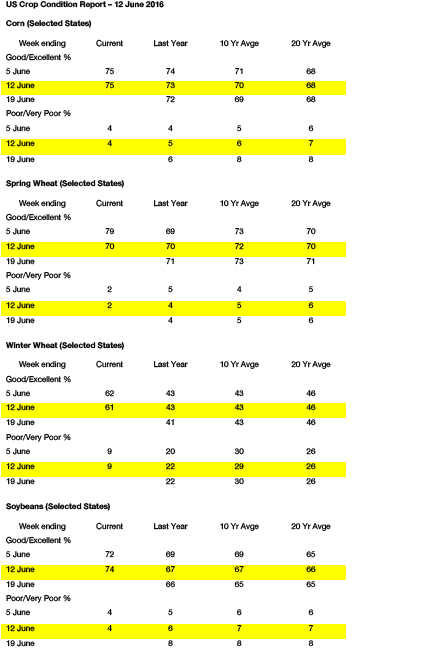
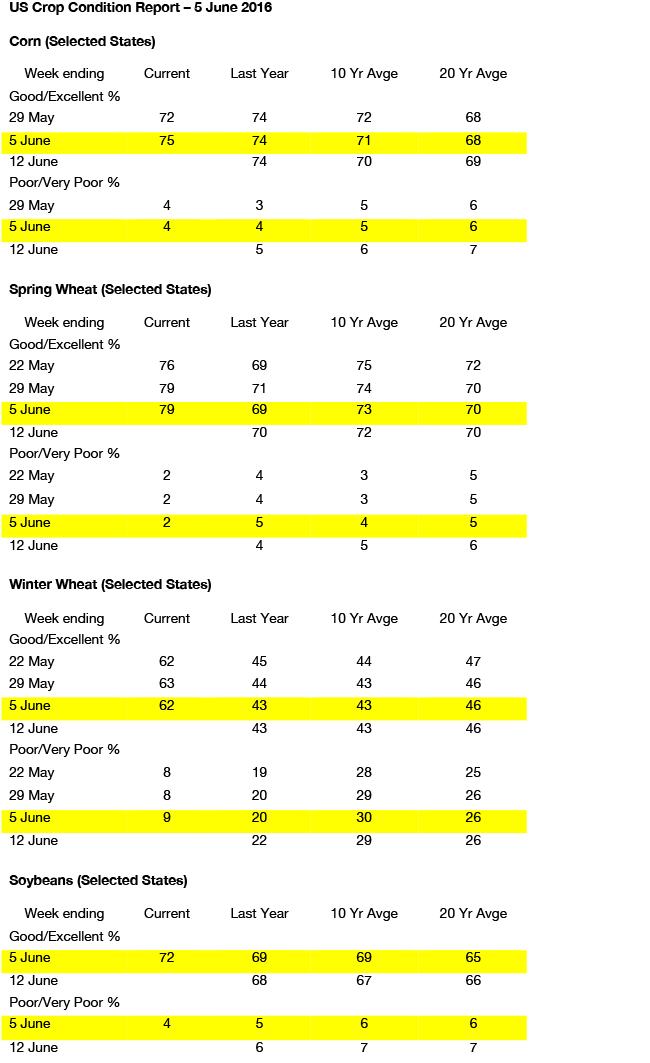
  • The morning saw wheat catching bids on the back of fresh fund short covering whilst corn and soybeans eased a touch on solid crop condition ratings (see above) as well as improved Midwest rain chances in the coming week.
  • The rally in wheat has little substance as far as fundamentals are concerned, it all appears to be driven by technicals and fund short covering.
  • The longs fund positions in corn and soybeans require an input from US weather if the bullish momentum is to be maintained.
  • Russia’s IKAR raised total grain output estimate to 109 million mt, which includes 64.5 million mt of wheat. Note that both figures, if achieved, will be record large.
  • The debate over US weather rages on, but there is little question right now that the flow of Gulf moisture to the north will improve next week allowing for a warm/wetter period across the Central US. Immature corn/soybean crops are rooting down, but rains will be required in the last week of June for high yield potential to be maintained. The frost in S Brazil has no impact on their mature corn production.

6 June 2016

  • An emotional/fear packed morning of Chicago trade with speculators piling into fresh market length as they ponder whether hot Midwest temps this weekend could be the start of the La Niña drought? A slew of private forecasters are using ENSO analogs to forecast a 2016 Midwest drought, speculators understand that it’s time for a real weather market to begin. Whether such thinking is correct has yet to be determined, but there is no evidence that a “dome of doom” is prepared to settle across the Central US in June. The coming heat/dryness this week appears to be a rather normal interlude to the start of summer. New crop corn and soybeans scored new rally highs, while wheat followed on massive fund short covering.
  • There appears to be little evidence of any massive flooding or ponding of fields outside of those that abut major tributaries like the Seine River. Most of the European flood damage to crops is modest and at this time we are not looking for a substantial cut in yields. However, the recent cool/wet weather has pushed back the wheat harvest to early to mid July. This means that wheat quality issues will be resolved in the next 3-4 weeks. Amid saturated soils, there could be a larger share of French/German wheat that is now degraded to feed quality. The French/German weather forecast is improved for the flooded areas this week with sunshine/warmth. However, the forecast models have the rains returning next week to the Paris Basin. Sunny, warm and dry weather is now desired for EU and Russian winter wheat crops into harvest.
  • Brazilian and Argentine farmers are becoming much more active sellers of newly harvested cash corn with prices at record highs. The corn harvest is starting to more actively advance with some cutting the corn at high test weights to quickly meet market demand. The Argentine soybean harvest should reach at least 85% completed this week with yields holding steady.
  • It is all about weather in the US at present, and a week of warm/dry weather during June favors (not harms) crop yields – if the rain returns as forecast.
