
11 July 2016

  • The week has started lower in Chicago grains, corn and wheat, today whilst soybean are just trading in positive territory. Selling in the grains may well be linked to the USDA July report scheduled for release tomorrow. The trade is anticipating an increase in the US 2016 all wheat crop and a cut in US corn feed and residual volumes based on 3rd quarter demand patterns. Both would add to end stocks and added to the global grains situation this has triggered selling momentum, not unsurprisingly. US old crop soybean stocks will likely decline with new crop stocks holding steady on additional acres. However, the market is still attempting to reconcile weather and the possibility of a hot and/or dry August. The soybean balance sheet is somewhat more fragile than that of the grains and has limited room to accommodate any new crop supply losses.
  • It feels appropriate to ease back somewhat on our bearish mentality on the worrisome weather forecast of excessive heat/dryness that starts next week. Midwest crops today are favorable with adequate soil moisture. The big question going forward is whether a more adverse weather will develop to impact as much as 10% of the US corn yield in the fill stage and have a more important impact on soybeans. The debate of good crops today and bad weather tomorrow will most likely persist into the end of the week.
  • In other news today, SovEcon has increased its estimate of Russian 2016 wheat output to 66.1 million mt from 64.4 million mt previously. IKAR reported Russian 12.5% protein wheat to be priced at £165/mt, which is some $7/mt lower than a week ago, other similar reduced price levels are also noted, the progress of harvest appears to be the driver.
7 July 2016

  • Thursday has been another “down” day in Chicago with soybeans and meal setting the pace on fund spread unwinding (long soybean short grain). It was reported that the funds were also liquidating long corn positions as well as long soybean and soybean meal positions.
  • Brazil’s CONAB announced a sizeable reduction in the 2016 Brazilian corn crop with the total crop now estimated at just 69.1 million mt, down from 76.2 million in June. This compares to a crop estimate of 77.5 million mt from the USDA in June and 85.0 million mt produced in 2014. USDA pegged 2015/16 Brazilian corn exports at 22.5 million mt, which now appears to be too large by at least 5 million. Brazil’s winter corn crop was pegged by CONAB at 43.1 million mt as dire drought had an adverse impact on yield. Research argues that Brazilian corn exports will slide to no more than 17.5 million mt, which is the lowest since 2010. The export demand will flow to others including the US, Argentina and Ukraine. The USDA could easily justify raising 2016/17 US corn exports by 100-175 million bu.
  • The decline in Brazilian 2016 corn production makes the sharp premium rise in fob offers from Brazil more understandable. Brazil cannot afford to export more corn or its domestic users will eventually run into supply shortages. The refilling of the Brazilian cash pipeline amid the smaller harvest will maintain sky high Brazilian corn premiums, and pull a portion of the Argentine corn crop across the border. Longer term, Brazilian farmers will be encouraged to seed additional corn acres vs. soybeans which could limit Brazil’s ability to fill Chinese soybean demand. This is likely to support November ‘17 soybeans under $9.50/bu and offer support to November 2016 soybeans below $10.25. CONAB also trimmed their 2016 soybean crop to 95.3 million mt from 95.6 million mt. The USDA June estimate for Brazil’s soybean crop was 97.0 million mt. The CONAB estimates is some 1.7 million mt lower, which is likely to come from exports. This is one primary reason why Brazil has already left the world soybean export arena.
  • The sharp reduction in the 2016 Brazilian corn crop will most likely maintain robust US corn exports well into 2017. In fact, the fear is growing that US export elevations to ship out large tonnages of corn and soybeans will become strained during the harvest period. Yet, funds are still too long and liquidating length amid bearish chart based patterns. Our view is that on price breaks it would be prudent to shift from a bearish to more neutral Chicago view.

6 July 2016

  • Stratégie Grains have cut French soft wheat output by 2 million mt to 36.5 million mt on account of damage caused to the crop by persistent rainfall.
  • The Russian AgMin reports their wheat harvest to be well under way with over 4 million mt already gathered and yields looking promising at 4.45 mt/ha, up from last year’s 3.74 mt/ha. IKAR (the Russian consultancy, Institute for Agricultural Market Studies) forecasts the crop to be 65-66 million mt, up from 61 million mt last year.
  • AgroConsult also report the Ukraine harvest to be under way again with improved early yields at 3.75 mt/ha, up from 3.2 mt/ha last season. They forecast the crop at 23.3 to 24.2 million mt, a drop from last year’s 26.5 million mt.
  • Today has seen Chicago markets lower with soybeans pacing the decline and grains following. Rain across IL and bearish technical indicators are giving the funds second thoughts about holding on to their large (and largely stale) long positions. Selling has seen corn at fresh lows although wheat was holding yesterday’s lows. Soybeans have shed $1/bu in a few short sessions and funds are quoting “blood on the streets” as large margin calls are made. There will likely be a bounce, but this will only come when the funds have done eating their long and wrong positions, maybe at the end of the week or early next week.
  • Early EU wheat and barley yields have failed to impress, falling below producer expectations, as excess rainfall has caused poor grain fill and test weights. Nitrogen leaching from soils has been suggested to be a cause leaving crops searching for nutrients. The barley harvest is well underway across France and early yields are down 6-15%. Barley yields are often is a good barometer for wheat, and the trade is braced for a smaller and low quality crop harvest. Wheat cutting will get underway in earnest next week and a better assessment of the French and S German crop will then be offered. As of today, disappointment is the word that comes up repeatedly when talking to European farmers.
  • FOB premiums for corn keep rising as Chicago corn declines. September US corn fob is offered at $1.00 over, but Brazil corn in that same position is offered at $1.15 over or $180/mt. One would have expected that with the Safrihina corn harvest reaching 25% that there would be cash pressure on Brazilian corn export offers. However, no such pressure is being witnessed, and this has some speculating that the Brazilian corn crop could be well under USDA and/or private estimates or that the refilling of the pipeline is much more robust. Ukraine fob corn offered for October is now $.50/bu cheaper than Brazilian fob offers. The reduced Brazilian corn export program could push additional demand back to the US or Ukraine into early 2017.
  • The funds are exiting their long positions as the soybean complex has fallen below key moving averages and their losses in corn have become sizeable! However, its only July 6th and sub $3.30 spot corn, or sub $4.00 spot Chicago wheat is just too cheap for what is currently fundamentally known. Moreover, we suspect that China is just waiting to pounce on the soybean market when there are signs of a bottom. China has a huge amount of cash soybeans yet to secure from September forward with spot crush margins now at their best levels since mid 2014. Consequently, we currently struggle to become significantly bearish soybeans with huge cash demand in the offing.

6 July 2016

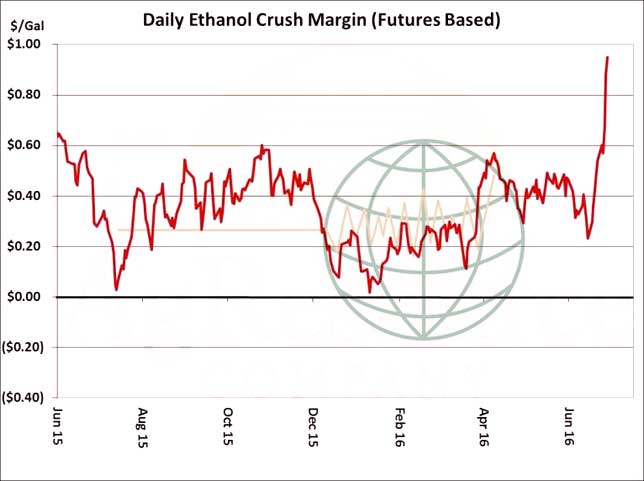
  • US ethanol margins have soared on this price break with corn prices dropping nearly $1.00/bu in just the past two weeks. Near normal Central US weather and sticky cash ethanol prices have supported the big surge. Look for US ethanol plants to ramp up production amid $1/gallon margins. US corn yields have yet to be determined, but strong ethanol and livestock margins are likely to place a bid under spot corn prices.

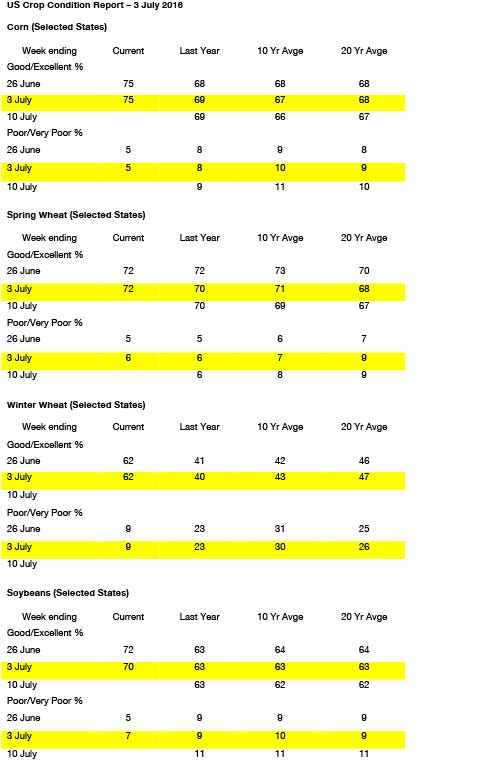
  • Soybeans and meal keyed off of a deep break in Chinese meal prices overnight and gapped lower at Tuesday’s open. The sharply lower open was followed by technical selling/liquidation that had both beans and meal trading to limit losses. After the close, the Crop Progress report showed that 70% of the US soybean crop was rated as either good or excellent, down from 72% last week, but still well over last year’s 63%. Overall, crop ratings declined in 8 states, increased in 5 states, and were unchanged in 5 states. The best rated soybeans in the country are found in WI and the lowest are in MO and AR, but as a whole, the US soybean crop is still the 6th best rated crop on record, and assuming minimal changes over the next three weeks, yield models shows an August yield of 48 bushels/acre. November soybeans are back testing the May high, and our outlook has turned neutral on this break. Chinese soybean demand has been unrelenting, and US export demand will be strong in the coming months.
  • Corn futures fell sharply, though ended well above session lows, amid weekend precip across the Southern Corn Belt, coming rainfall across Northern areas, and as competing grain prices in Europe and the Black Sea remain weak. Black Sea feed wheat offers have fallen to $157-159/mt for Aug/Sep, which is comparable to $3.10, basis Sep Chicago futures. A more neutral short term outlook is advised as US weather takes on much more importance during pollination, but we would be willing sellers of 20-30 cent rallies. The world is awash in grain. US crop conditions as of Sunday were unchanged at 75% good/excellent, vs. 69% a year ago. Declines are noted in MI, ND and SD; improvement is noted in CO, KS, KY, MO and OH. Rainfall of .50-2.00” into Thurs/Fri is likely to elevate ratings across the N half of the Corn Belt, and work still suggests a final yield of 168-173 bushels/acre. 15% of the crop is silking, and so weather in the next 10-12 days will have huge importance in determining yield, particularly temperatures. There is no threat currently, but the market will be especially sensitive to changes from weather run to weather run this week. Dec corn has reached our initial downside target of $3.50. Confirmation of above-trend US yield is needed to propel the market downwards. Rallies, however, will further curtail export potential. CBOT futures look to trade in a range from $3.40-3.80 into late month.
  • US wheat futures rallied 3-8 cents, with spring contracts pacing the advance. It is estimated that funds in Chicago this Tuesday were short a net 120,000 contracts, the largest short position since April, and some measure of profit taking can be expected at or near contract lows. Russian cash prices fell another $1/mt for Aug-Sep delivery, with offers there comparable to $3.90, basis Sep Chicago. Russian crop estimates have centered on 65-67 million mt, a new record and compared to the USDA’s 64. We note that domestic prices in S Russia are beginning to collapse as harvest expands, and we reiterate that a lasting bottom on global market isn’t expected until early Aug. A slow grind lower in global cash grain prices is expected in the weeks ahead, and the US will have to follow to maintain market share. Russian cash prices will remain the market’s primary driver. US spring wheat crop conditions are unchanged at 72% good/excellent, right at average and vs. 70% a year ago. The spring crop is 74% headed (vs. 45% last year). Winter wheat is 58% harvested nationally, including 79% in KS. The wheat market lacks bullish fuel, though a more neutral outlook is forecast beyond the next 2-3 weeks.

5 July 2016

  • Early Chicago markets saw a red and almost bloody start to the holiday shortened week with corn, soybeans and wheat all falling to sharp losses. Improved central US weather has been the trigger as wheat slumped to decade lows and corn hitting lows not seen since harvest 2014. Midday saw selling pressure ease but it could return into the close if the funds decide to follow through.
  • Limit down soybean meal has pressured Chicago soybeans while the grains are seeing consumptive feed demand on acute weakness. We have to turn a touch more more bullish soybeans on this break while we are starting to reduce our bearishness in the grains. Corn and wheat prices have nearly reached our downside price targets. A recovery into late week is expected to be led by soybeans and meal.