
8 November 2016

  • Today, which is the day of the BIG US vote, has seen Chicago markets surging higher with the funds emerging as big buyers and end users adding to coverage ahead of the election results as well as tomorrow’s USDA crop report. Soybean oil has led the way higher on the coattails of Malaysian palm oil, which overnight reached two year highs. Grains were the follower.
  • The most common explanation for the Chicago rally is that everyone is bearish! Traders are wondering who will be the sellers following the USDA report with US producers nearly completed with their summer row crop harvest and US corn, soybean and wheat exports (shipments as well as commitments) well above last year. Our guess is that short covering precedes the USDA report, but that with S American weather largely favorable, it will be difficult to sustain a post report rally in Chicago futures.
  • Since mid summer we have been outlining our expectations for a “big crop”, “big demand” marketplace with a seasonal rally high to be posted sometime between late October and mid November. Our thinking has not changed assuming normal S American weather. The point is that Chicago markets would be trading in a range with neither rallies or breaks being able to follow through in a generally range bound marketplace. January ’17 soybeans above $10.25 and December ’16 corn above $3.60 appears to us to be fundamentally unjustified at this time.
  • Mato Grosso and much of the N Brazilian soybean crop has been planted at a record fast pace this year. This means that as much as 9-11 million mt of Brazilian soybeans could be harvested by mid February given normal weather conditions. This would potentially place Brazil as a much more aggressive and earlier soybean exporter than in previous years. Furthermore, this would allow Brazil a more lengthy window to seed their winter corn crop and for seasonal rains to fall. The outlook for Brazilian soybean and corn crops is improving amid the fast seeding pace and favourable weather pattern to date.
7 November 2016

  • Chicago markets have started the week with the grains, corn and wheat, lower and soybeans trading in positive territory. Weekly US export inspections remain robust with weekly soybean figures near record high levels. Clearly export demand for the US is positive and as a consequence becoming bearish is somewhat difficult until such time as we are more informed upon how S American crops are faring.
  • It has been noticeable that cash wheat prices in India have been escalating and it seems that their import campaign will continue for the foreseeable future. Black Sea wheat prices firmed at the end of last week despite Egypt’s currency float and associated devaluation, the US remains well placed to pick up global trade at the present time.
  • In S America the latest weather forecast is unchanged with some less than welcome rains in the wettest parts of Argentina’s southern agricultural belt for the next few days, however dry and warmer weather is currently scheduled to follow. That aside, normal to above normal rain is forecast across most of C and N Brazil, which will help to replenish soil moisture levels there with even the dries parts on NE Brazil getting better rain chances into late November.. Whilst planting delays are noted in Argentina we see the overall climate as non-threatening at this time.
  • Overall, whilst we have seen barn busting soybean and corn yields and bountiful wheat supplies in the US this season, there is doubtless pressure on S America to perform. Consequently, if there is going to be a move lower in prices it is unlikely until early 2017 when the state of play in S America is better understood. We have seen in previous years a degree of “counting the (S American) chickens” before their crops are guaranteed, we should ensure that we do not fall into this trap in the coming year.

3 November 2016

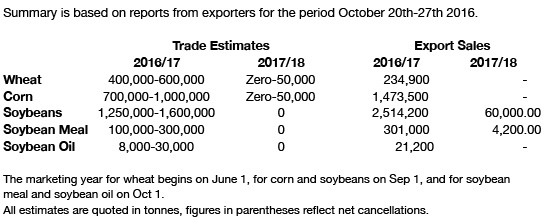
  • US weekly export data released today is as follows:

  • Brussels has issued weekly wheat export certificates totalling 452,003 mt, which brings the season total to 8.99 million mt. This is 1.03 million mt (12.97%) ahead of last year. Barley exports for the week reached 40,175 mt, which brings the season total to 1.33 million mt, which is 2.96 million mt (69.1)% behind last year.

  • Strong weekly US export sales saw Chicago markets rally early on but fund selling (re)emerged in wheat as fund managers still appear to be in liquidation mode taking risk off the table ahead of next week’s USDA crop report. December ’16 Chicago wheat futures dropped below the 20 day moving average whilst corn prices continued to soften. A comment echoed by a number of fund managers, who are holding their smallest positions in many years, suggests that there are too many unknowns to hold large positions. Once the US election results are known and the USDA report is published this may well change.

  • US soybean export sales were the largest of the marketing year to date with China reported to have taken 19.4 million mt, and the “unknown” destinations accounting for 9.8 million. More than half of the “unknown” volume will likely end up in China, which means that China has now secured some 900 million bu of US origin soybeans. Estimates suggest that they will take at least 32 million mt (1,175 million bu) of US soybeans in the season.

  • Black Sea wheat prices are steady to firm with farmer selling lacklustre, the outlook for Black Sea wheat remains seasonally up into the winter and snow cover across Russia is dramatically expanding southward. Some traders doubt that Egypt’s floating of their currency will have any substantial impact on their future wheat demand. The public buyer, GASC, will likely have to take up a greater portion of demand from the private sector and we would anticipate a new  wheat tender next week.

  • The market is continuing to liquidate and we see support at $9.80 (Dec ’16 soybeans), $3.42 (Dec ’16 corn) and $4.08 (Dec  ’16 wheat). We still see Chicago markets as rangebound with limited downside and we would be reluctant to sell breaks or buy rallies. The “big crop” “big demand” marketplace is still in evidence and when one trader wants to “zig” there will be others wanting to “zag”. Beware!