13 December 2016

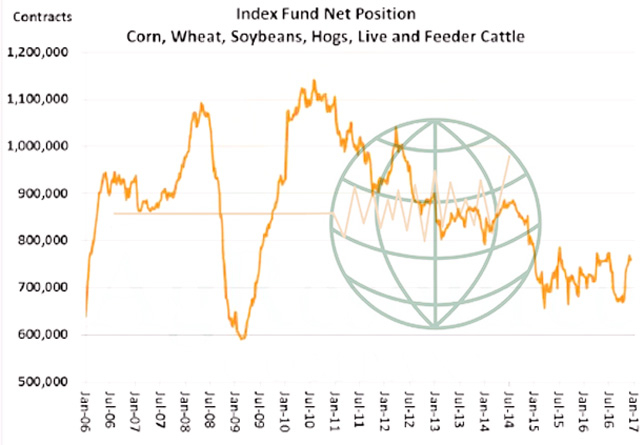
  • Funds continue to pile into new length in the commodity space as measured by the CFTC Index fund positions in ags. For the year, commodities are up around 18% as an asset class, which has some fund managers taking note. One way to participate is through index fund purchases, and we suspect that funds will continue to push additional investment into the commodity space into early 2017. This is one reason why the ag markets have not traded very “fundamental” since early autumn.

  • Today has seem March ’17 Chicago corn push above the $3.61 resistance level whilst soybeans have traded either side of unchanged as the market vacillates between paying attention to coming rains in Argentina and  S Brazil or the tightening soybean meal market in China on account of crush plant closures allegedly due to environmental reasons. Many are suggesting that fresh money (which should always be watched closely) is being pushed into index funds and this is having its effect on prices. Fund managers are looking at record high US equity prices, the tightening US labour market and the slosh of cash that is circulating the world and chanting “inflation”. “Trumponics” and the expected fiscal stimulus has unleashed more confidence in US political leadership, which is helping the velocity of money. Whether it is crude oil, cotton or cattle, the markets are seeing better demand and this is helping higher prices.
  • This week’s jump in crude oil and unleaded gasoline prices is causing huge margins for ethanol producers. Calculations put the ethanol futures crush margin at the highs of the year above $1.23/gallon with plant margins close to $.40/gallon over all costs. Both are some of the best production margins in years, which has plants/producers looking for cash corn and willing to secure futures to lock down future profits.
  • The closure of 6-8 Chinese crush plants for a week has further tightened domestic soybean meal supplies within China and pushed their soy crush margins to a three year high. The exceptional margins has Chinese crushers looking to secure soybeans on any Chicago weakness. A further decline in the value of the Yuan vs. the US$ is likely to keep pulling Chinese soybean demand forward. China has already crushed 2 million mt more soybeans in the crop year to date than last year.
  • More traders are talking inflation price trends that could keep Chicago prices heading sideways to higher into the year end. Brazilian and Argentine farmers are not willing sellers fearing further losses in their currency. Our mindset remains one of looking for some additional gains into year end as funds place inflationary bets at the Chicago Board of Trade. A 50% recovery of the summer decline crosses at $3.72 basis spot Chicago corn futures – watch this one carefully!

12 December 2016

  • Early rally efforts in Chicago markets failed with corn, wheat and soybeans all lower as we approach the close. Funds, whom were early buyers, appear to have reverted to selling as markets eased. Saudi Arabia’s purchase of 750,000 mt of hard wheat is reputedly to be sourced mainly from the US, although we are not convinced of this at present.
  • The market today is correcting Friday’s rally as traders debate the Argentine and S Brazilian rainfall forecast for next week. Little or no rain occurs this week and the weekend has warming temperatures according to latest forecasts. Some high temperatures will reach the upper 90’s and lower 100’s on the weekend. We continue to want to sell a rally into the end of the year or opening days of 2017. China’s falling Yuan will likely keep a bid under soy!

9 December 2016

  • Following mixed but quieter trade through most of the morning, Chicago grain and oilseed markets briefly came to life with the release of the December WASDE report, but volume has been fairly light for a USDA report day. The report was not expected to offer any major changes to either the US or world balance sheets, and the USDA met those expectations with just some minor tweaking of estimates. Markets broke at the report release, but have generally traded quietly and are mixed around unchanged. The US corn balance sheet was left nearly untouched from November. The only change that was noted was an increase in the season average price forecast, which increased by 5 cents, to $3.05-3.65. In the wheat estimates, no changes were made to supply or demand forecasts. Again, the only significant change was to the season average price forecast which was raised by10 cents to $3.60-3.80.
  • The USDA held demand and stocks estimates unchanged in the soybean balance sheet, but did raise the season average price forecast by 25 cents to $8.70-10.20. The largest changes in the December report were in the soybean product markets. As expected, soybean oil used for biodiesel was increased by 250 million lbs to 6,200 million  The increase was a disapointment for a number of biofuel bulls, who were looking for a significant increase. Historically, the December WASDE report has done a good job forecasting annual biodiesel demand, and we continue to advise following the USDA’s lead on this very complicated topic. The WASDE report lowered the estimate for soybean meal yield, and production was thus reduced slightly from November, while exports were lowered by 200,000 short tons to 11.8 million tons.
  • The December WASDE report will be the last major update from the USDA for the year, and with the report now in the rear view mirror and just two full trading weeks left in the year, S American weather will garner the trade’s attention into the January Crop Production and WASDE reports. Brazilian crops are generally in great shape, and consequently the focus will be on whether rains in the extended forecast develop for the driest parts of Argentina. Our view is that it will take significant crop shortfalls in S America to support lasting rallies.

To download our USDA recap please click on the link below:

USDA-Recap-9-December-16

7 December 2016

  • Today’s theme has been one of consolidation, corn and wheat futures in Chicago have eased and early gains in soybeans have similarly been eroded. Dry Argentine weather forecasts are being discounted by traders who are holding profits ahead of the weekend (it’s only Wednesday!) and Friday’s USDA report. We should also not discount the fact that weather forecasts can, and do, change in the space of a weekend, and traders would not want to be caught wrong footed, in a long position, should this be the case. The opening market next week could well prove interesting/exciting depending on weather updates.
  • US President Elect Trump is said to have picked Terry Branstad, a longtime friend of Chinese President Xi Jinping, as US Ambassador to China according to media sources. The appointment may go some way to cooling off building rhetoric that the new administration wants to label China as a currency manipulator. The appointment is being cheered by many US farm groups, that have been worried about nationalism and more protectionist trade policies.  There is no indication from the new Trump Administration that they are planning to extend the $1.00/gallon credit for biodiesel producers. The credit will expire on January 1st. Most Washington sources expect that any new support to the US biodiesel industry will come from a comprehensive tax legislation that could be enacted by the second quarter of 2017, until then, many biodiesel producers will be left wondering about their future profitability.
  • Big picture – one can only be bearish with improved rain chances across Argentina and S Brazil.

6 December 2016

  • China has announced that it would try to double its biofuel production by 2020. At headline value, this sounds rather impressive, but when you reach into the data, you find that such a move would increase their 2017 corn ethanol demand by just 3.15 million mt. Such demand would be welcomed, not only by local growers but also by global exporters, but it does not materially alter the landscape for Chinese corn prices or supplies with their domestic stocks pegged at over 200 million mt by traders. China at some point will likely have to export corn.
  • We have not seen a “turnaround Tuesday” as corn, wheat and soybeans in Chicago have continued higher on further fund buying. January ’17 soybeans have moved to their late November peak price levels whilst corn has hit levels not seen since early November. Wheat followed, but in a more half hearted manner as cash markets have been reluctant to follow. Weather premium is being added “just in case” the Argentine and S Brazil conditions continue dry for an extended period.
  • StatsCan produced a 2016 all wheat crop of 31.73 million mt including 7.7 million of durum, 20.4 million of spring wheat, and 3.15 million of winter wheat. This wheat crop was 4.2 million mt larger than last year, and the second largest crop on record. The October snows did not seem to produce much impact on yield with the late October warmth allowing for a salvage of this year’s production. The finding of the additional durum wheat is important to world prices. StatsCan also increased their canola (rapeseed) crop to 18.4 million mt, which was also a record. The crop was slightly smaller than trade estimates that came in at 18.8 million mt. Nonetheless, the crop is sizeable and will offer the world considerable export capacity. As a sideline, soybean production was also record large at 6.5 million mt. The StatsCan crop estimates were considered slightly bearish amid the sheer amount of supply that was offered. In the past two days, the Aussie and StatsCan data has added 4.5 million mt to world wheat production, and we expect that the Argentine wheat crop will increase by another 1-1.5 million mt, which means that the world has just uncovered an extra 6 million mt of exportable wheat. This raises the supply competition for all world wheat exporters into June.
  • Funds are covering net shorts in the grains while building the largest net long in soybeans since mid summer. US soybean sales continue to build and there is support for the forthcoming WASDE report to elevate the US soybean export total on Friday. There is some rain in the extended forecast for Argentina, but with the medium range models still offering dryness, our trust in that potential moisture is somewhat low. The market will add premium to price until better Argy rain chances are confirmed.

5 December 2016

  • Although no losses have yet occurred in Argentine crops (in fact wheat yields continue to rise as the harvest advances), a forecast from the National Weather Service (NWS) is calling for continued below normal rainfall into the end of February. This caught the market short and sparked a sizeable Monday rally, although the market closed below the session highs. Much of C and N Argentina is forecast to see just 20-40% of normal from December into February. Whilst this is not totally fresh news it seems to have only just caught the attention of fund managers, who have reacted today. As we have previously pointed out, the importance os S American weather is beginning to gather significance from a market perspective. La Niña is fading (if it existed at all) and a more normal climate should resume.
  • It has been up and away with Chicago markets rallying sharply with corn in the lead as dry Argentine weather forecasts are being discussed. As of today, no crop losses are noted as surplus soil moisture is being maintained. It is the outlook for the second half of December that will be important going forward.

1 December 2016

  • The US has released weekly export data as follows:

  • Brussels has issued weekly wheat export certificates totalling 929,568 mt, which brings the season total to 11.184 million mt, this weekly volume is the season to date’s largest and is 422,092 mt (3.9%) ahead of last year. Barley exports for the week reached 37,110 mt, which brings the season total to 1.723 million mt, which is 2.937 million mt (63)% behind last year.
  • We come towards the end of another day and see another new contract low in December ’16 Chicago and Kansas wheat futures, which is also reflected in European futures that closed lower again. Global cash wheat prices are seemingly unchanged despite lower futures.
  • Reports of swine flu in Russia are circulating but have had no market impact so far. Whilst there is no change to grain flows at present, there is always a possibility that quarantine measures may be instigated and this could impact international trade. The balance of Russian wheat exports, estimated at 15-17 million mt for the remainder of the season, are both relevant and important to global pricing structure and this issue will bear close scrutiny going forward.
  • Crude oil values have risen once again with $2.00/barrel added to prices amid optimism over further OPEC follow through and the US$ is a shade lower.
  • Brazilian weather forecasts are wetter in the extended forecast but drier in Argentina. The Argentine dryness is also worth keeping an eye on through December as corn and soybean planting progress approaches 60-70% in the next week or so. Brazilian forecasts appear highly favourable at this time with steady precipitation persisting in the next two weeks and potentially further forward.
  • This weekend’s Italian vote on constitutional reform will be relevant as far as international currencies are concerned as well as global financial markets. Our thoughts are that we could well be approaching a low within global wheat pricing as well as a high in soybean futures subject to there not being a switch to hot/dry Brazilian conditions in January.