
16 January 2017

  • Brief update this afternoon as the US is celebrating another holiday – Martin Luther King Day and markets there are closed.
  • On Saturday Egypt’s GASC purchased another 235,000 mt of wheat, for mid-February shipment, Russia securing 175,000 mt and Romania the balance of 60,000 mt. Season to date purchases now stand at 3.41 million mt and this tranche cost an average of $199.81/mt basis C&F (the Romanian purchase came in at just over $200/mt), which is around $2/mt more than their last purchase partially attributable to rising freight costs. Noticeable absentees from the offer lineup included EU (France in particular), US and Argentina.
12 January 2017

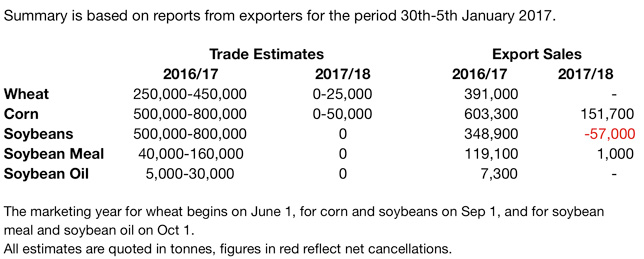
  • US export data was released as follows:

  • Brussels has issued weekly wheat export certificates totalling 338,080 mt, which brings the season total to 14.37 million mt. This is 393,186 mt (2.66%) behind last year. Barley exports for the week reached 110,386 mt, which brings the season total to 2.27 million mt.
  • The 2017 USDA January Crop Report was considered slightly bullish for US corn/soybeans amid falling 2016 production, while Chicago wheat prices rallied on a 10% fall in US winter wheat seeding. US 2016/17 corn stocks also declined 48 million bu on a hike in US ethanol production and fall in the US yield/harvested acres. The big surprise was the drop in 2016/17 US soybean end stocks to 420 million bu, a drop of 60 million which accounted for the smaller US production. The smaller US old crop harvest is going to accentuate the importance of S American crop sizes and production in the weeks just ahead. Chicago will likelyl not fall into a lasting bearish price trend until large S American crops are confirmed. The USDA data will likely maintain Chicago prices within the prior range without adverse S American weather. NASS dropped their 2016 US corn yield by 0.7 bushels/acre to 174.6 bushels/acre with harvested acres falling 100,000. The US 2016 corn yield and production is record large at 174.6 bushels/acre and 15,148 million bu.
  • 2016/17 US corn end stocks fell to 2,355 million bu, down 48 million from December based on a 78 million bu fall in the US 2016 crop, an increase of 25 million bu in ethanol, and a 50 million bu cut in feed/residual use. December 1st US corn stocks at 12.4 million bu came in 100 million above trade estimates, and 1.2 million bu above last year. The change allowed for US corn average cash price to be raised by 5 cents/bu to $3.40. World 2016/17 corn stocks were lowered 1.4 million mt to 221.0 million mt. Brazilian corn production was left at 86.5 million mt, Argentina at 36.5 million mt, while S Africa held at 13.0 million mt. The lower world corn stocks were mostly due to US adjustments in production.
  • US 2016 soybean production was lowered by 54 million bu due to a 300,000 acre decline in harvested acres and a 0.4 bushels/acre drop in yield. US soybean imports were cut by 5 million bu leaving total 2016 production to fall 59 million bu. With the addition of 1 million bu to the residual, total 2016/17 US soybean stocks fell 60 million bu to 420 million with the average US farmgate price raised to $9.50. The US January S&D argues for US soybeans to hold between $9.50-10.50 into spring. World 2016/17 soybean end stocks fell 82.3 million bu with much of the decline coming from the US. The 2017 Brazilian soybean harvest was raised to 104 million mt, while the Argentine crop held steady at 57 million. The 2016 Chinese soybean harvest was raised to 12.9 million mt from 12.50 million mt. Many would argue that the Argentine soybean crop estimate is too large by 2-5 million mt.
  • We calculate September-December US wheat feed/residual use at -32 million bu with US corn feed/residual use at a record large 2,269 million bu. US soybean residual use is calculated at 197 million bu. The US corn and wheat feed/residual use totals were below trade expectations, and slightly bearish. US 2017 winter wheat seeding fell by a larger than expected 3.7 million acres to 32.8 million. Kansas planted 1.1 million acres less than 2015, while Texas and Oklahoma seeded 500,000 acres less. The 2017 NASS wheat seeding data argues total 2017 US wheat harvested data will be just 40 million acres. US 2016/17 wheat end stocks were raised to 1,186 million bu. US feed/residual use was lowered by 35 million bu to 225 million bu. We would expect another 10-15 million bu in its feeding estimate. This would leave 2016/17 US wheat end stocks at or just above 1,200 million bu which is more than enough wheat to cap rallies in spot Chicago futures at $4.30-4.40. We see nothing in the USDA January report that is going to kick prices out of the current sideways trend. Only adverse weather can lift spot Chicago corn futures above $3.75, spot Chicago soybeans above $10.60, and spot Chicago wheat futures above $4.40. Longer term, the “big crop” vs. “big demand” scenario will shift more to just a big crop with prices to drift lower into the US spring planting season. Adverse Argentine weather forecasts have to be monitored as their key reproductive period of the growing season comes from late January into March.

11 January 2017

  • It has been a lower day pretty much across the board today in Chicago markets, Paris too, with London wheat bucking the trend by moving higher in what we see as a currency driven move.
  • The imposition of Chinese import duties on US DDG’s, improved rain prospects for both the Plains and N Brazil and a slowing export demand from China have all conspired to trigger long liquidation and selling in Chicago ahead of the USDA report tomorrow. Corn, wheat and soybeans are all lower with wheat falling below key technical support levels. The day’s tone has been bearish to say the least.
  • Needed moisture is forecast for the US Plains where the dormant HRW crop will benefit and the limited stress it is enduring will ease. Market chatter is suggesting that EU wheat is being imported into the US on the current rally although we are unable to confirm this. Global wheat prices are starting to slide in the face of unsold Black Sea supplies and an aggressive export programme out of Ukraine. Once again we appear to be facing wheat supply pressure as export demand is being sought. Adverse weather is required in the Black Sea region if the US market is to break through technical price resistance.
  • Our concern is that tomorrow’s USDA report will not push corn, wheat or soybeans out of their recent price ranges. As previously reported, the big unknown remains the fate of the Argentine soybean crop and whether flooding in the north or dryness in the south will significantly reduce their output in 2017.

10 January 2017

  • What one day takes, another day gives back! This morning’s weather news in S America showed the two models (EU and GFS) to be in agreement with an expansion of rainfall across C and N Brazil whilst maintaining an unwelcome pattern of showers across N Argentina. Shorter term dryness concerns across Goias and Minas Gerais in C Brazil will ease somewhat although longer term patterns may well change and concerns would rise accordingly. Weather models do suggest that dryness will return to around 25% of the NE Brazilian agricultural belt in the second half of January. Only Bahia in the far NE of the country, which accounts for around 5% of soybean production, will be left drier than normal in the coming ten days or so according to forecasters. Clearly Brazilian weather has improved when compared with late December but too much rain will continue to fall across the northern half of Argentinian agri belt in the remainder of January leaving question marks over unplanted acres and lost output.
  • Chicago markets are mixed with less than an hour to go, soybeans are holding onto gains whilst the grains, corn and wheat are in negative territory. The trade is attempting to comprehend and balance the S American weather and its overall impact upon soybean output with Brazil seemingly positive at present whilst Argentina is struggling.
  • CONAB estimated their 2017 Brazilian corn harvest at 84.5 million mt, up 700,000 mt from their December forecast, and up 17.5 million mt from last year. WASDE projected the 2017 Brazilian corn crop at 86.5 million mt. We note that the WASDE December forecast had the 2017 Brazilian soybean crop at 102.0 million mt and the Argentine 2017 soybean crop at 57.0 million mt. Most S American market watchers now place the Brazilian soybean crop at 104 million mt and Argentina at 52.0 million mt, which on a combined basis is still short by 3 million mt from the December WASDE forecast. January’s WASDE offering will make interesting reading when released on Thursday.
  • Our view right now is that it is far too soon to project a big drop in Argentine soybean output given the chances of a drier spell for the wetter north of the country and better rainfall chances in the drier south. Until we see a confirmed adverse weather situation in S America, Argentina in particular, we would tend to pull away from a bullish stance.

9 January 2017

  • We start the week with Chicago markets in corn, wheat and soybeans all now trading in positive territory. March ’17 soybeans pushed above $10.00/bu once again and whilst early rallies in the grains failed they have moved higher with an hour of trading to go. Expectations were for soybeans to ease with increased rain chances in N Brazil next week, but the trade seems to have other ideas. It seems that traders are happy to hold long positions into the USDA report later this week, although there is clearly still time for this to change.
  • There are those who expect the report to be bearish for soybeans with record US yields and bullish for wheat with the second lowest acreage sown since 1900. One thing we have learned is that trying to predict USDA and CONAB reports is not a game for the faint of heart and is never a certainty.
  • China is once again pricing soybeans in Chicago, their first venture in some weeks, and S America is also benefitting from their return to the market. Russian grain export data through to December is reported to be disappointing, and therein lies the possibility that they will become more aggressive in FOB pricing through the winter months.
  • The trade is awaiting the Index Fund rebalance (buying) near the close in Chicago tonight. This rebuying could prop up the market heading the USDA report on Thursday. We would anticipate CONAB’s Tuesday morning report to reflect a Brazilian soybean crop of 101.5-103 million mt. This is still a choppy marketplace and we would stand aside until after Thursday’s report. Our market bias remains sideways as the “big crop” vs. “big demand’ scenario remains in place.

5 January 2017

  • It appears that Ukraine crops are at risk from frost over the next several days with temperatures reaching –20℃ in some areas as the current level of snow cover is insufficient for reliable protection of winter crops. Ukrainian farmers increased the area sown this season to 8.1 million hectares from 7.8 million last year. According to Farm Futures, U.S. farmers planted 34.8 million acres of winter wheat this season which would be the smallest area since 1913. All of the reductions came from hard red winter wheat as low profit margins have curtailed plantings in the Plains, and by way of comparison last year farmers planted 36.13 million acres of winter wheat. March Chicago wheat futures traded to a high of $4.19/bu yesterday which is the highest level since the December high. Declining winter wheat conditions in Oklahoma, Nebraska, Colorado and Kansas along with a weaker US$ added support to prices. The fund rebalancing that begins next week has also given the market support, as current estimates have the index buying at 35,000 contracts next week. The Ukraine 2017 wheat output could fall to 23.5 million mt down from last year’s 26.1 million and the USDA estimate of 27.0 million according to UkrAgroConsult. The market is doing its job, prices are dictating reduced plantings!
  • Brussels has issued weekly wheat export certificates totalling 1.04 million mt, which brings the season total to 14.03 million mt. This is 52,076 mt (0.4%) ahead of last year. Barley exports for the week reached 164,246 mt, which brings the season total to 2.16 million mt, which is 3.44 million mt (71.4)% behind last year. Note that this week’s data reflects two weeks exports as no data was released last week due to Christmas holiday breaks.
  • US export data is not available today due to the holiday break, and is scheduled to be released tomorrow.
  • In Chicago the grains, corn and wheat are firmer today whilst soybeans are trading just in negative territory. March corn is testing December highs whilst March wheat has exceeded December’s levels and is pushing into November’s higher prices. Funds are covering short positions as prices push above key resistance levels with an upcoming USDA report looming, which some are fearing will contain bullish data. Price upside in soybeans will be determined by S American weather in the coming five or six weeks, and as we suggested yesterday, we could see funds adding to long positions across the soybean complex bolstering prices still further.
  • There is some widespread debate as to the acreage losses due to excessive wet weather across N Argentina and the acute dryness across S Argentina. Some analysts are citing soy seeding losses of 1.0 million ha. Such a seeding loss would produce production losses in the order of 3 million mt. Others see seeding losses closer to 400-500,000 ha, which is about half of the prior estimate. Our best estimate at this timee is losses of 600,000 ha which could trim production to 54.5-55 million mt. This compares to the December WASDE forecast of 57 million mt. Perhaps the bigger question pertains to the continuation of the excessive rains and its impact on Argentine 2017 soybean yields.

4 January 2017

  • The two key weather models (EU and GFS) have trended wetter across the dries parts of Goias and Minas Gerais, which account for some 20-25% of soybean output in Brazil, in the coming ten days. Whilst this will relieve current dryness the longer range forecasts suggest dryness will remain an issue. Rainfall of three to five inches per week will be needed to maintain Brazilian yield potential and we do have some concern that there is a building soil moisture deficit.
  • US Exporters typically ship 30% of final corn shipments by this point in year; last year 20%; this year 30% of USDA’s target shipped so far.
  • US Exporters typically ship 58% of final wheat shipments by this point in year; last year 58%; this year 58% of USDA’s target shipped so far.
  • US Exporters typically ship 51% of final soybean shipments by this point in year; last year 53%; this year 59% of USDA’s target shipped so far.
  • Chicago traders are starting to take more notice of S American weather with corn, wheat and soybeans all higher at midday. We have previously suggested that S American weather was a likely trigger for price moves, and is appears that we are witnessing just that at this time; whether this is the start of a lasting trend change or not remains to be seen but we would not wish to be short here! In addition, it seems that additional money is moving into the ag commodity space, adding to upward pressure. Today has also marked a noticeable lack of producer selling in both S America and the US. With US farmers estimated to have sold as much as 70% of their soybean crop it remains for long holding fund managers to take their place as sellers, and with early signs that an upward trend may be about to start in earnest we would not hold our breath waiting for this to happen.
  • S Korea, which has culled up to 30 million birds in the last six weeks due to avail influenza, has cut its egg import tariff to zero with immediate effect to combat sharply rising egg prices. Prices have risen buy as much as 50%in recent weeks.
  • Have we seen the lows in markets, particularly soybeans? Difficult question to answer, and an adventurous trader may well be inclined to jump onto this move with a view to higher prices in the coming few weeks as N Brazil stays dry and Argentina sees excess soil moisture and flooding in some areas, all of which has the potential to limit yields and output. As ever, we would wish for some certainty over likely S American crop output before making a final recommendation, but our gut says higher prices appear likely for now.