15 September 2017

  • Chicago soybean futures eased on Friday on pre weekend harvest hedge selling. Soybeans rallied a sharp $.40/bu following the USDA September crop report on end user pricing and short covering. November soybeans failed to exceed resistance at $9.80, but the market did forge a (bullish) weekly upside reversal. This will be noted by fund managers early next week. Traders/fund managers are not believing the USDA’s September soybean yield of 49.9 bushels/acre amid record soybean pod weights. They argue that unlike recent years, the acute Midwest dryness limited top pod formation/fill. Managed money is net short 4,408 contracts of soybeans, net short 32,000 contracts of soymeal and long a record 100,000 contracts of soybean oil. The huge fund soybean oil length is a market risk, but cash soybean oil basis continues to improve on sliding US stocks and strong demand from biodiesel producers. A modest correction could occur, but we doubt that December soybean oil can drop below $.335. Soybeans closed higher for the fourth week in a row and forged a bullish reversal. Midwest soybean yield data and S American weather will drive Chicago price action into early October.
  • Corn traded in just a 3 cent range, with again limited news and outside influences noted. Crude ended mixed, but similarly uneventful, and amid warming temperatures harvest will expand northward rather quickly in the next several weeks. Combine yield data will drive short term direction. Managed funds through the week ending Tuesday were short 119,412 contracts in Chicago, up some 10,000 from the previous week, which is the second largest net short as of mid-September since record keeping began in 2006. Funds’ net position this evening is pegged between 115-120,000, the point being new bearish info has to emerge to attract new selling. Longer term, our view is that trend/above yields must be confirmed in S America for spot futures to trade below $3.40. It is far too early to say much about S American potential, but do highlight a rapidly building La Niña, and La Niña events in 2008 and 2011 pulled Argentine corn yield 14% below trend, it is certainly something to watch. Nearby, choppy trading and narrow ranges are expected.
  • Larger than expected N Hemisphere (Russia namely) wheat crop size has been digested, and the market’s focus is shifting quickly to S Hemisphere prospects. Australia will stay nearly completely dry into late month, and yet more frost scares are possible in NSW this weekend. Freezing/near freezing lows will be widespread. Aussie and Argentine crops are being downgraded, but there is just too much wheat in exportable positions currently, and until late 2017/early 2018, Russia will stay aggressive. Russian interior prices fell again this week, posting new three year lows. S Russia replacement costs are pegged at $155/mt, which is likely to keep Russian fob offers into October stable at $182-187/mt, basis spot. As such, for the US to stay competitive, Chicago and Kansas futures must trade in a range of $4.30-4.60, basis December.  Managed funds are short a net 83,745 contracts in Chicago, broadly unchanged on the week, and lofty European prices will push demand to the US beyond autumn
14 September 2017

  • Soybean futures regained all of their September Crop Report losses and poked above the early September rally high at $9.77½  November futures closed above its 50 day moving average at $9.735 with the next upside price target is a weekly downtrend line that crosses just under $10.00. Strong and record large world soybean demand has prevented spot Chicago futures from falling below $9.00-9.20 support since early 2016, and we see no reason for such a break now with US farmers initially finding disappointing yield trends. Just a few fields are being cut in Central IL and Southern IA with results 4-11 bushels/acre below last year. Small bean size and fewer four pod beans are being tagged as the reason for the early yield drag. Traders will listen to the combines in the weeks just ahead to decide on whether the NASS 49.9 bushels/acre yield is correct. Our bet is a yield of 47 bushels/acre.
  • Corn futures ended slightly higher, as actual yield data is just weeks away. Following the flood of bearish news since early August, combine reports must confirm NASS’s expectation to renew any bearish sentiment. Crude is again approaching $50/barrel, and a push to produce elevated levels of gasoline lies in the offing following two devastating hurricanes. US gasoline stocks through the week ending Sep 8th were down a hefty 8.4 million barrels to 218.3 million, a new 1½ year low. US ethanol production and blending margins remain firm. However, US corn export demand continues to suffer, particularly to traditional destinations such as Mexico. Reduced yield prospects continue to battle against the loss of export demand, and we are maintaining a more neutral outlook. Seasonal lows have likely been scored. Fundamentally, the next bear leg will hinge upon favorable S American crop establishment, which is far from certain. Argentine planting progress is delayed amid ongoing rain.
  • Wheat futures ended mixed in the US (additional profit taking is noted in Minneapolis), and higher in Europe, although London was hit by a stronger Sterling due to expectation of an interest rate hike, and so far seasonal trends seem to be intact. In spite of record production in Russia, the fob market there is up $6/mt from early September, and in each year since 2012 a fairly noticeable recovery has occurred in value in the Sep-Nov quarter. S Hemisphere production is also gaining importance, and weather in Argentina and Australia is far from ideal. Note that we would expect the second half of the crop year to be very different from the first in terms of US export demand, and following the recent break in KC futures, only Russian origin is cheaper than Gulf HRW through November. The EU market is losing its share of world trade. Still no rain is offered to Australia through the next ten days. Fortunately excessive heat is absent, but a pattern shift is needed very quickly to salvage yield potential. Vegetation health continues to erode across NSW and Queensland (which account for 35% of total Aussie production), and without rainfall by late September, an Aussie crop below 20 million mt becomes much more likely. Too much rain has fallen in Argentina, and the Buenos Aires Grain Exchange is now indicating declining crop conditions and lost acreage there. Sustained rallies will be rather difficult as there’s just too much wheat in the Black Sea. However, we do maintain that seasonal lows have been scored.

13 September 2017

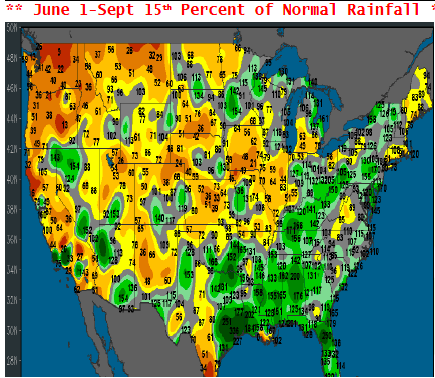
  • Call us old fashioned if you like, but the assumption may be wrong and we continue to argue that water is one of the main ingredients to grow a trend or above trendline yield US corn or soybean crop. The map below reflects percent of normal rainfall since June 1st, the real start of the growing season. 40% of the Midwest and Plains received less than 60% of normal rain since June 1. Historically, such lack of water produces a below trend yield. NASS continues to say above trend, and we will have to await actual harvest yield data to solve/end this debate. 

  • Soybeans traded higher overnight, and extended gains through midweek trade. The market broke lower at the report release on Tuesday on a larger than expected yield/crop size, but further review of the USDA’s assumption of a record heavy pod weight has cast doubt on September estimates. At the close November soybeans were 10 cents higher and back above the 100 day moving average. Crop size and yields were the key numbers in Tuesday’s WASDE report, though the USDA also made significant changes to the soybean oil estimates. Following the Commerce Dept’s ruling against Argentine and Indonesian biodiesel imports, the USDA raised their estimate of 2016/17 soybean oil for biodiesel demand by 50 million lbs to a record large 6,050 million lbs. Soybean oil demand for biodiesel in 2017/18 was increased by 1,050 million lbs. This means that 31% of US soybean oil production will be used for biodiesel versus 28% in 2016/17. Our view for the soybean market stays bullish, as we look for a US soybean yield closer to 47 bushels/acre, while we expect Chinese demand to develop on corrections ahead of harvest.
  • Corn traded higher overnight and was positive through most of the day, though late day selling put December through to May contracts back to unchanged at the close. The latest update to the Brazilian corn lineup shows just over 1.7 million mt have sailed in September, with another 3.2 million that are scheduled to sail by months end. If realised, total exports of 5 million mt would be just under August exports, but still more than double last year and the largest September export figure on record. Cumulative Mar- Feb exports at just over 15 million mt would also be a record shipment pace. Brazil is in the process of shipping out a monster crop, though the USDA has already accounted for slower US exports in its balance sheet, with US trade to fall 19%. We remain neutral corn, with downside risk limited ahead of harvest. The market awaits actual harvest results to determine if the USDA’s yield is still too high.
  • Wheat futures were mostly higher with the Chicago Sep contract up 6 cents; the KC Sep contract closed up 5 cents while the MGE old-crop contracts were up from 2-3 cents. In the September WASDE, despite strong exports to date and competitive prices, USDA did not raise its projection of US exports primarily because of the record size of the exportable surplus of wheat from the “Black Sea” exporters. In order to achieve the USDA’s projection for combined record exports of 56.6 million mt, these countries will have to, on average, export a record quantity in each of the ten months remaining in the Jul-Jun marketing year. Global wheat prices appear to be bottoming and will rally if problems arise with Black Sea logistics or on further losses in the Argie and/or Aussie crops.

11 September 2017

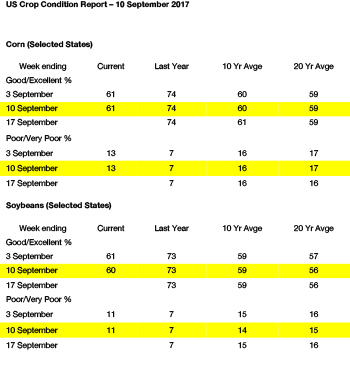
  • US crop condition data has been released as follows:
  • Monday was a mixed day of trade, with soybeans back and forth around unchanged before ending 2 cents lower. Soybean product markets were mixed through the day with meal leading the complex lower, while soybeanoil followed palm oil futures higher following the monthly Malaysian palm oil report. The Malaysian Palm Oil Board reported August palm oil production was down slightly from July, while exports were above expectations and at a three month high. End of month stocks fell short of expectations, and November palm oil rallied following the report release to the best close since January. After the close, NASS reported national soybean crop ratings at 60% good/excellent versus 61% last week, and 73% a year ago. National good/excellent ratings have been stable, despite rainfall totals across the Cornbelt that have been well below normal in the last month. The key figure in Tuesday’s crop report will be the implied pod weight used to forecast yield. Our outlook stays bullish on sharp breaks amid building Chinese demand and a view that crop size estimates will decline in upcoming USDA reports.
  • Corn futures simply marked time ahead of tomorrow’s yield updates. Crude recovered modestly from Friday’s losses. US crop conditions this week are unchanged. By-state ratings were fine-tuned marginally, but otherwise national good/excellent ratings through the remainder of the season are not expected to change from 61% currently, vs. 74% a year ago. Analysis of crop conditions, Pro Farmer data, and other tours of the Midwest suggest yield will be down, but only 1-3 bu/acre by Oct/Nov. Old crop exports will be raised 50-100 million bu on Tuesday, but otherwise the updated US balance sheet will be fairly unexciting. It’s unlikely that end stocks fall below 2,000 million bu, which in turn keeps fair value at $3.40-3.90, basis December futures. We do mention that global feed wheat prices have rallied some $5/mt in the last three weeks, and unlike a year ago Gulf corn is offered at a discount to EU/Black Sea wheat. This will aid corn demand as a whole, but there are still a few months in which S America will dominate trade. Both bulls and bears will struggle for leverage unless actual yield data is surprisingly low.
  • US and European wheat futures both ended lower. In the US weakness is a function of a lack of any news, and talk of better than expected spring wheat yields in Canada. In Europe, exports continue to suffer and news today that Egypt has rejected a cargo of French wheat due to quality issues is viewed as further limited demand. Russia looks to dominate sales to Egypt over the next several months. The US$ rallied, and so far the US$ Index has held support at 91 points. US winter wheat planting through to Sunday reached 5% complete, vs. 6% on average, and amid upcoming rainfall planting looks to accelerate in late Sep/early Oct. The Black Sea fob market is again slightly firmer this week, with Russian offered through Nov at $185-187/mt. Comparable Gulf HRW is quoted this evening at $192-194, which is competitive but Russia will easily be the world’s dominant exporter through  thisautumn. The Russian market very likely bottomed in late August, but longer term Russia fully aims to expand wheat production and exports, and a major drought is needed to really alter the structure of the market. Tuesday’s WASDE will have only limited US wheat changes, as USDA will wait for NASS’s Small Grains Summary due at the end of the month.

7 September 2017

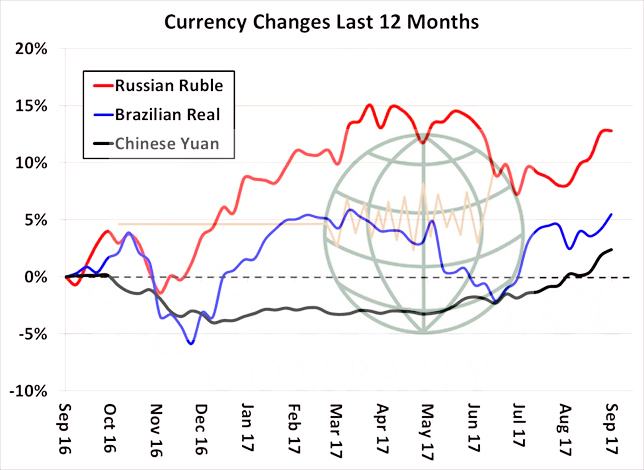
  • World currency markets remain dominated by a falling US$ and strength elsewhere, as signs of economic growth reappear in emerging markets and as political uncertainty in the US does no favours for the US$. The graphic below shows that, in the last 12 months, the Russian ruble has rallied 12%, the Brazilian real is up roughly 5%. Even China’s yuan has recovered from early-year losses. Purchasing power in major importing countries is rising, albeit slowly, and the rally in major exporting currencies may work against further acreage expansion in 2018.

  • Chicago markets have been somewhat more mixed today with the grains losing more than soybeans. Hurricane Irma continues to threaten although key crop regions appear, at present, to be spared some of the horrors experienced elsewhere.
  • Europe has confirmed that it will allow imports of biodiesel from Argentina, which will act to replace lost US demand. A major shuffling of biodiesel/soybean oil trade flows is in the works, but work suggest lofty soybean oil prices are likely a longer term phenomenon. Argentine soybean crush will be salvaged, Argentine meal exports will be sustained, and oil’s share of crush is expected to rally further.
  • The US$ has fallen to a fresh 2½ year low at 91.60. The €uro, ruble and Brazilian real are stronger, and despite ongoing political chaos in Brazil, former president Dilma is now accused of having run what is essentially an organised crime operation. Assuming today’s change in Brazil’s currency, cash corn in S Brazil is now pegged at $2.55/bu.
  • The European Central Bank has again opted to leave interest rates unchanged. A rise in jobless claims in the US has tempered ideas of a further rate hike here in 2017. Russia this week has indicated it is planning some kind of rail subsidy, perhaps eliminating the current rail tariff altogether, aimed at accelerating grain exports. This, of course, will lower real transportation costs, which will help the farmer there, but won’t change Russia’s export capacity unless the subsidy is crop specific, namely if wheat shipments are favoured, it will provide more incentive to export wheat at the cost of barley and corn. More will be known about this subsidy after this week’s Russian Grain Union meeting.
  • Australia’s forecast is still very dry through late September, and recall ABARES releases its September Aussie crop report next Tuesday. Trade estimates on Aussie wheat production range between 21-23 million mt, vs. the USDA’s 23.5. A much wetter pattern in late Sep/early Oct is needed to prevent further losses.
  • Back and forth trading is expected into next week’s USDA and ABARES crop releases. We would caution that only slightly more objective yield data will be available to NASS than was available in August, and so major changes will likely await the October report, and actual yield data in late Sep will take priority. 

6 September 2017

  • We have seen another session in Chicago where prices have been broadly in positive territory. Soybean oil is flirting with multi-month highs on the back of suggestions that lower than expected oil content in soybeans as a consequence of cooler finishing temperatures this growing season. Crude oil remains on the up, gaining another $0.80/barrel whilst the US$ tests the 92 point index level, below this there is little technical support until 90, so we may be at a pivotal point.
  • Brazil’s CONAB this morning projected first crop corn seedings to decline, which is not surprising given very weak interior cash prices there. Cotton and soybean acreage is forecast to expand modestly. Note that cash corn in Parana (a major producer of both 1st and 2nd crop corn) this morning rests at $100/mt ($2.55/bu), vs. $160/mt ($4.10/bu) on this week a year ago. Strength in Brazil’s currency has exacerbated losses in Chicago markets.
  • StatsCan published its July 31st stocks report, which included all-wheat stocks of 6.9 million mt, vs. 5.2 million a year ago, and canola stocks of 1.3 million mt, vs. 2.1 million. These numbers are generally in line with USDA’s annual balance sheets, but also confirm that year-end Canadian canola stocks will be a very tight 200-250,000 mt. Some degree of canola rationing will be needed in Canada this year, and the market’s premium to soybeans, $50-55/mt, persists. Note also that the Canadian dollar has posted new two year high this morning.
  • It is another macro-themed day, aided a bit by further soil moisture loss into the end of the growing season. Whether lasting bottoms have been scored will hinge upon the direction of yield updates in next week’s WASDE, and ou opinion is that we have to wait on actual combine data before there is any real clarification on US crop size. We do mention that S America’s corn market bottomed in late July, and Black Sea wheat prices have stabilised as harvest there surpasses 60%.

5 September 2017

  • Today’s market opening saw a strong start with an open chart gap in Nov ’17 soybeans, which spurred additional buying. Funds have been active buyers upon their return from the holiday weekend and also were active in December corn as they cover net short positions, and wheat has joined in for the trip!
  • The CRB Index has rallied strongly with crude oil up $1.50/barrel in the face of strong global demand and uncertainty over hurricane Irma, which if hot on the heels of the damage already done by Harvey.
  • The USDA September Crop Report will be released one week from today. The trade is generally looking for increased yield/production based on good/excellent condition ratings rising through August. However, producers would argue that the great variability of the crop leaves some doubt on this analysis with USDA field surveys to gain in crop size importance. Russia has now harvested 67.8 million mt of wheat and 17.5 million mt of barley. The yield to date is record large at 3.84 mt/ha (57 bushels/acre vs last year’s record 47.1 bushels/acre). The Russian wheat yield seems impossible, being well above the US. However, Russia has had extremely favourable weather and really advanced their agronomics of wheat farming. Russia’s massive wheat crop will have an export tail well into early 2019.
  •  It has been a macro day with the CRB Index rallying sharply with gains noted across the commodity spectrum.Hurricane Irma is a dangerous storm and it looks likely to make landfall in FL. The storm’s sheer strength is causing some issues for the forecast models.