
10 October 2017

  • Soybeans were higher overnight and lightly mixed around unchanged at the close, with November soybeans once again stopping at the contract’s 200 day moving average. Trade news was supportive, with export inspections above expectations and up 22 million bu from last week at 55 million, while the USDA announced sales of nearly 5 million bu to Chinese buyers. Soyoil followed palm oil prices down as monthly Malaysian palm oil stocks were reported at a 19 month high of 2 million mtMTs. After the close, NASS reported that 36% of the US soybean crop had been harvested as of Sunday. The weekly total was slightly behind expectations, and still lagging the 5 year average by 7%. Light rains across the Midwest are forecast  ease on Wednesday, though the forecast shows storms returning over the weekend. However, we expect the US harvest to reach 50% complete by mid-month. Wednesday’s trade will feature final positioning ahead of the October crop report. Seasonal trends are bullish for both Chicago and basis values into the end of the year, and we are positive on any post report price break.
  • December corn ended fractionally lower, and traded in a range of just a 1.75 cents on Tuesday  which is dull even compared to recent weeks. There is little incentive to establish any new large position ahead of the USDA’s WASDE, in which the trade expects a slight boost in yield. We estimate that managed funds are already short a net 152,000 contracts this evening, vs. 143,000 last Tuesday, and vs. 130,000 on this week in 2016. Notice that December corn’s chart-based support and resistance continues to narrow, and now rests between $3.45 and $3.51. A weekly settlement above or below this would seemingly attract the next move. Our opinion is that support will hold as S American weather to date has been far from ideal, and as there is no sign that of an imminent collapse in cash milling and feed wheat prices. Crop progress continues to lag, with maturity over the weekend reaching 82%, vs. 92% a year ago, and with harvest just 22% complete, vs. 37% on average this week. Ongoing sideways trading is expected, but a close eye will be kept on S American weather. Brazilian farmers, via lower first-crop seeding, appear to be betting on an extended wet season next spring.
  • Wheat futures, like corn, are unwilling to move ahead of Thursday’s USDA report. Fresh input today is neutral, though we do mention funds have added roughly 10,000 contracts to their net short position since last Tuesday. The spec community as a whole is leaning a bit bearish heading into the October reports. Winter wheat planting as of Sunday reached 48% complete nationwide, vs. 58% on average. Delays are most noticeable across the S and C Plains, where too much rain has fallen (150-600% of normal in the last 14 days), and seeding in KS is just 27% complete, half of what it is normally in early October. This is also the lowest on record. How this affects final wheat acreage is unknown, but certainly cash prices are offering little incentive to boost area. Egypt secured 170,000 mt of Russian wheat for late November delivery. Egypt paid an average price of $199/mt, basis fob, unchanged from last week. Along with stable interior prices in S Russia, downside risk in the world cash market appears to be limited to $1- 3/mt.
9 October 2017

  • The morning has been mixed in Chicago with soybeans trading either side of unchanged, while the grains (corn and wheat) are slightly lower. The volume of trade has been modest with most fund managers waiting for Thursday’s USDA report before adding to their positions. Funds are looking at using any post report break to make new purchases as grains and soybeans are seen as cheap with S American weather worries likely to expand and worsen into November.
  • US weekly export inspections included; 30.8 million bu of corn, 32.9 million bu of soybeans, and 25.4 million bu of wheat. The wheat total was above expectations while corn and soybeans were in line with trade expectations. For their respective crop years to date, the US has shipped 364 million bu of wheat (down 8 million or 2% from last year. US soybean exports for the crop year stand at 146 million bu, 21 million or 16.6% above last year. US soybean exports for September are likely to be record large. US corn exports from September 1 stand at a not so good 115 million bu or down 111 million from last year or down 49%. Brazil and Argentine continue to export record totals of corn which is cutting into the US corn export share. We note that the recent rains across the NW Midwest are expected to help refill the Mississippi River and lower barge freight rates. This should help firm basis bids along waterways and in the interior.
  • Brazilian wheat millers are showing concern about their wheat crop amid all of the rain that has fallen across S Brazil (and a likely sharp reduction in crop quality). The Argentine wheat crop is also suffering from excessive water which is likely to impact its quality. The Argy wheat harvest is still a few weeks off, but already, talk is emerging that Brazil will be forced to take US HRW wheat since Russian wheat has not been approved for import. The next 2-3 weeks will be key for the 2017 Brazilian wheat crop, and whether Argentine wheat can supply Brazil with 12% plus wheat. Black Sea sources report that port capacity to load out wheat in key Russian export terminals is now fully booked through to mid December, which is one reason why Black Sea wheat/barley prices are firming. Russian corn will also be available for export by mid November. The logistical pressures are growing!
  • In summary, US interior cash basis levels should improve as producers are not willing cash sellers. Fund managers are hoping for an October post report break to get long. S American weather is concerning for wheat and early soybean seeding. Our concern is that dry N Brazilian weather will persist into November. The funds have liquidated most of their long soyoil/short meal spread, so a US yield above 51 bushels/acre is needed to forge a lasting price decline. CONAB is out with Brazilian 2018 crop estimates on Tuesday morning.

6 October 2017

  • Soybean prices eased overnight on profit taking, but firm grain prices and improving cash basis supported higher trade through Friday. At the close, November futures were up 4 cents for the day and 5 cents higher for the week. The main feature for next week’s market will be the October Crop Report on Thursday. Soybean yield results around the Midwest have been highly variable, and the average trade estimate keeps yield unchanged at 49.9 bushels/acre. Our bias leans towards 48 bushels/acre.
  • December corn futures rallied very slightly, but again traded in just a three-cent range. End user demand continues on breaks as cattle prices inch higher, barge freight declines and spot ethanol production margins are still good, though have fallen some $.30/gallon in the last two weeks. The very latest weather model runs still lack any pattern change in Central and Northern Brazil, and operational forecasts now stretch into October 22. First-crop corn planting is also being slowed in S Brazil amid soaking rainfall, which will continue steadily for another two weeks, and flood concerns will be rising. It has been a less than ideal start for S America. Aside from a major surprise in NASS’s October production next week, there is just not going to be much to drive the market higher or lower, but longer term our work suggests that highly favourable weather is needed in S America from now until late spring to trigger sub $3.40 spot futures.
  • Wheat ended higher in the US, lower in Europe, and much of this attributed to currency changes. The US$ ended the session lower following disappointing US employment data, while the €uro strengthened slightly. Interior Russian prices were again steady in both Rubles and US$. There is a rather wide spread ($50/mt) between interior and fob prices, but the fact that the interior market has stabilised is important. Russian fob offers this evening are weaker, but only very slightly, and US Gulf HRW is offered competitively. The USDA’s October WASDE will be the first in which Australian production is seriously adjusted, but otherwise we doubt any fireworks lie in the offing.

5 October 2017

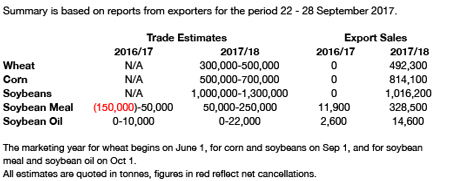
  • US export data has been released as follows:
  • Chicago markets are mostly higher through to midday on expectations of large Chinese demand returning next week together with less than stellar yield reports so far this week. Weekly export data showed better than anticipated volumes for wheat and corn, but lower figures for soybeans. Expectation is that commercial interest in soybeans will grow during October as river water levels rise and Chinese demand picks up.
  • The US$ is higher today and crude oil is also making gains, spot prices reaching $51.00/barrel.  Informa Economics, in its monthly update raised US corn and soybean yields, albeit very slightly. Corn yield is now pegged at 170.5 bushels/acre, vs. 169.7 in September and the USDA’s 169.9. Soybean yield is forecast at 50.0 bushels/acre, vs. 49.9 in September and the USDA’s 49.9. Whether corn yield is between 166-170 bushels/acre won’t much affect the US balance sheet, but even small changes in soybean yield are important. We maintain a yield forecast of 48 bushels/acre, and key will be combine reports from later planted crop in the E Midwest, where in much of IL, WI, IN and MI just 20-30% of normal rain fell in August and September.
  • Russia’s Ag Ministry has pegged the wheat crop there at 81.4 million mt, vs. the USDA’s 81. This is not an official estimate, but we do mention that interior Russian wheat prices last week firmed just a bit. Updated interior prices on Friday will be watched closely. We would expect tomorrow’s CFTC report to include a net fund short in corn worth 145,000 contracts, up 12,000 on the week; a net short in Chicago wheat worth 70,000, up 5,000 on the week, and a fund net long in soybeans of 30,000, up just marginally on the week. Funds’ short position in corn has expanded some 80,000 contracts since late August. US corn stocks are high, and the Oct WASDE won’t do much to change this, but the spec community is already positioned for this.
  • We maintain a broadly neutral outlook, but following last week’s stocks report, a US soybean  yield of 49 bushels/acre (plus) must be confirmed for any break in price to be sustained. Central Brazil will stay rather dry over the next 10 days.

4 October 2017

  • Early selling in the soybean market found demand, that put soybean prices 2-3 cents higher at the close on Wednesday. Market news has been exceptionally slow this week, and China remains on holiday. In the soy product markets, soyoil was able to build on Tuesday’s recovery, and meal slipped lower on product spreading. The export sales report on Thursday will provide a new fundamental data point for what has so far been a very slow week of trade. Soybean export sales announcements through the week totalled 454,000 mt, and the trade estimates call for a weekly sales in a range of 1 to 1.3 million mt.
  • Dec corn tested its contract low, recovered slightly thereafter, but again traded in just a three cent range. There is still no compelling evidence to support a major move in either direction in the near term, and instead corn looks to be a follower of neighbouring wheat and soybean markets. US ethanol production last week totalled a hefty 297 million gallons, up 4 million on the previous week and compared to 288 million on this week a year. Ethanol stocks, however, were boosted 35 million gallons, which was mostly a function of negative residual use, and so a sharp decline in export interest. Whether this is just temporary will be watched closely in the weeks ahead. Argentine origin is still by far the world’s cheapest feedgrain, but Gulf corn is otherwise offered competitively in Q1 2018. US exports will likely lag into late year, but we simply wish to highlight the rally in Black Sea grain prices. A bearish outlook requires a national US yield of 170 bushels/acre or better, while a bullish outlook demands a S American weather issue. Sideways trade will likely continue.
  • EU and Black Sea wheat markets were quiet and little changed, while US futures fell 5-6 cents, basis Kansas/Chicago, amid the coming shift to wetter Central US weather. This will especially benefit the SRW Belt, which has been extremely dry over the last 45 days, and soil moisture is noticeably lacking. Much of MO, IL, WI and MI will see cumulative totals upwards of 2-3”, and it couldn’t come fast enough as SRW planting typically accelerates in October. Otherwise, fresh news remains lacking. Gulf HRW is, on paper, just $1/mt above comparable Russian origin, basis fob. The EU and GFS weather models are in fair agreement that better rainfall lies ahead for the driest areas of NSW (Australia) beyond Oct 10, but we note that precipitation recorded there in September totalled just .30”, which rivals the drought of 2007.

3 October 2017

  • Soybeans were back and forth, in uneventful trade on Tuesday and 1-2 cents lower at the close. Soymeal continued to trade in a broad range, while soyoil marked the first higher close out of the last nine trading days. The soybean harvest is advancing well, though high freight costs are keeping cash basis levels under pressure. However, barge rates for Nov/Dec are significantly cheaper, suggesting that spot basis should stabilise by mid-month. Seasonally, Chicago soybean futures tend to bottom in early October.
  • Dec corn fell another 2 cents, and is again stuck between its seasonal low and its 20-day moving average. Grain transportation issues have wreaked havoc on interior cash basis levels, but this will be a short term phenomenon, particularly as better rainfall lies ahead, and doesn’t change annual corn supply and demand. Black Sea feed wheat prices are down slightly ($.50/mt, $.01/bu), but maintains a hefty premium to US and S American corn offers. We doubt that Black Sea grain highs are in, but rather that market has taken a pause following a  six week long rally. Fresh market-driving input remains lacking, though we would mention that funds are expanding their net short position, which this evening is estimated at 141,000 contracts, vs. 133,000 last Tuesday.
  • US and European futures wheat settled modestly higher today, driven in part by validation of the recent rally in Black Sea fob quotes. Egypt secured three cargoes of Russian wheat, which was not a surprise, but the tender was executed at an average fob price of $199/mt, vs. $197 two weeks ago, and Russia continues to find record export demand. Russian offers today are fractionally lower, EU prices are slightly higher, and generally high quality milling wheat is offered from the US, Europe and Black Sea in a range of $194-200/mt, a rather narrow range compared to recent weeks. Seasonal trends in Europe and Russia still point upwards, and so any further break in Kansas/Chicago will find at least some incremental export interest. We maintain that seasonal lows were scored in August, and with funds still holding a sizeable net short in Chicago (70,000 contracts), this potentially supports our view.

2 October 2017

  • Chicago markets are all trading towards the close in the red as crude oil sheds as much as $1.30/barrel and the US$ rallies further; other news is remarkably absent. December corn is once again below its 20 day moving average, wheat is faltering having made monthly highs last week, and November soybeans are solidly below the 50 day moving average.
  • The September Grain Stocks Report was considered bullish for soybeans as stocks came in at 301 million bu, well below expectations and down 44 million from the September supply and demand report. Last year’s production was revised lower by 10.6 million bu and demand was posted higher from both crush and exports. A 1 bu/acre yield cut in the USDA October report would equate to end stocks of 339 million bu, and a 2 bu/acre cut would see that figure at 249 million bu. There are some who anticipate yields starting to drop off as harvest progresses and later planted beans, which saw a dry finish to their growing period, are harvested. If this situation materialises we could well see traders’ mindset change and thoughts moving away from ample supplies to tight supplies.
  • Corn figures in the report were also considered bullish compared with trade estimates as September 1st stocks were reported at 2.295 billion bu compared with the average trade estimate of 2.346 billion. With the market currently very oversold and prices cheap enough to support better demand we see downside as extremely tough to substantiate.
  • Wheat data was deemed just about bearish compared with trade estimates, wheat stocks came in at 2.253 billion bu vs. average estimates of 2.203 billion.
  • Our view remains that market lows were scored in late August yet there is currently insufficient bullish or bearish information to substantiate a definitive trend either higher or lower. The October USDA crop report is only just around the corner, and last week’s stocks report has added a degree of pressure on US soybean yield  of 48 bushels/acre plus to keep stock levels from dipping below 400 million bu. Watch this space is our thought!