
14 November 2017

  • The equatorial Pacific has been at La Niña thresholds for two consecutive months, and all weather models remain in agreement that La Niña will be established officially by December. La Niña then persists into Feb/Mar. This won’t be an issue for the N Hemisphere growing season (neutral ENSO is expected by spring), but a close eye needs to be kept on S Brazil and Argentina over the next 90 days. Brazil’s forecast is a bit wetter in the 6-10 day period, and soaking rainfall upwards of 4-6” will impact parts of Mato Grosso, Goias and Minas Gerais, where it is most needed. The EU and GFS weather models are in fair agreement on light to moderate, but scattered, rain impacting Argentina late next week. Temperatures in Argentina will rise into the 70s and low 80s, and so much more rain will be needed by early December. 30-day rainfall in Cordoba, Santa Fe and fringe areas of N Argentina rests at 40-60% of normal. Next week’s rain event will do little to boost soil moisture.
  • Two issues will keep growth the US’s share of world trade limited over the next 12 months, and both centre on Russia. The first is that following incredible yields in 2017, trend yield in Russia will be elevated, and in fact trend yield there is growing at a pace much faster than anywhere else. A simple 20-year linear trend in 2018/19 is pegged at 2.68 mt/ha. Trend yield in Russia has grown 27% since 2010, which compares to growth in US trend wheat yield of just 9%. Russian farmers keep getting better! The second is that, while logistics will indeed cap exports, carryover stocks are forecast at a near record large 17 million mt. This will keep the domestic market in Russia depressed, and also provide a rather large buffer against weather issues next spring and summer. We note that above normal precipitation and above normal temperatures have been recorded in the Black Sea so far this autumn.
  • We expect Russian wheat acreage to rise 1-2% on last year, as farmers there have maintained profitability despite a drop in price and as weather has been quite favourable in Southern and Central Russia this autumn. Assuming slightly larger total wheat area and trend yield, Russian wheat supply in 2018/19, assuming even semi-normal weather, will stay above 90 million mt and thus sustain Russia as the world’s dominant exporter in Aug-Dec of 2018. Domestic feed and food use is projected higher, albeit slightly, and exports of 34 million mt will likely be hit pretty easily. Stocks/use at 15% in 2018/19 will be about average, but notice that it is well above 2015/16. Russia does not aim to store grain, it’s just that in 2017 it will be forced to. The balance sheet tightens next year assuming normal weather, but a major change in world cash prices is unlikely.
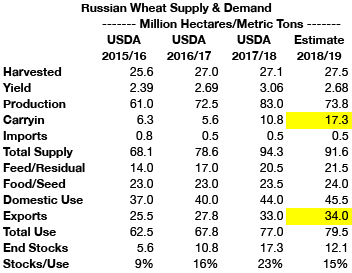
  • There is a decent correlation between Russian interior prices and Russian wheat stocks measured as a percent of domestic use. Or, rather, price correlates with the need to sell excess supply. Assuming our preliminary 2018/19 Russian wheat balance sheets, replacement costs in S Russia, from where a majority of exports are sourced, will likely hit a low of $180/mt in Sep-Oct. Assuming normal cost and freight, Russian fob prices next will range from $195- 205/mt, vs. $185-195/mt so far in 2017. However, with Gulf wheat basis in recent years ranging from 60-200 cents over futures, the US market does not expand its share of world exports unless spot futures stay below $4.80. A Russian crop of 65 million mt or less, a yield 10% below trend, is needed to allow US exports to reach above 1,050 million bu.
  • Soybeans stayed under pressure through Tuesday after breaking through major moving averages at the start of the week. Fundamentally the market is struggling under the large crop and slowing exports, while Brazilian weather forecasts have turned more favourable as planting starts to wind down. Funds were estimated sellers of; 6,000 soybean, 2,000 soymeal, and 3,500 soyoil contracts. With harvest near complete across the Midwest, cash supplies pressures are easing and supporting cash basis up and down the US river system. Basis prices at terminals on the IL and MS rivers are now $.30 over the lows that were scored in late September. Basis at processors in the Eastern Cornbelt has also improved, though cash markets across the Midwest are holding well under a year ago. NOPA will release soybean crush data for October on Wednesday, and ahead of the report the average trade estimate calls for a crush rate near 165 million bu, or unchanged from a year ago. The November Crop Report was the last for the year, and the December WASDE is typically uneventful. The next major fundamental update will likely be in January, which looks to leave Chicago futures in a broad range.
  • December corn continues to eye the September contract’s low ahead of first notice day at $3.30-3.35. The USDA’s November WASDE confirmed there is an overabundance of supply, particularly across the Plains, and large deliveries are likely. Funds, however, are now short an estimated 245,000 contracts, a new record, and we doubt sub-$3.30 spot futures lies in the offing. Biofuel margins remain solid in spite of today’s drop in crude and gasoline futures. Argentine basis is strengthening, albeit slowly. S America’s Dec-Feb climate outlook will be updated Thursday morning, and with La Niña to be established soon, it will be interesting to see NOAA’s opinion on rainfall in Argentina and S Brazil. Light and scattered showers will impact parts of Central Argentina next week, but a trend of declining soil moisture will continue into late November, but it remains that either a sharp cut in US acreage or S American yields is needed to balance major exporter supply and demand. More than anything a lack of fresh input into the holidays will sustain listless trading.
  • The US$ plunged today, and with wheat not subject to changing biofuel margins the market was allowed to stabilise following Monday’s collapse. There is little fresh news available, though there is talk Egypt may again lower its ergot tolerance to 0%, and as the Russian Ruble continues to weaken, rallies will be limited to fund short covering affairs. We peg managed funds’ net short this evening at 124,000 contracts. Even other world markets appear stuck. EU and Black Sea fob offers continue to do very little on a weekly basis and are offered near parity with one another through winter (Russia still wins based on quality and freight). Gulf basis, however, has rallied and has pushed comparable HRW offers to levels well above the world market. Iraq interest is noted, but otherwise lasting rallies in futures will do more harm than good to US demand. Abnormally warm temperatures will continue across the Black Sea region into the opening days of December, and so the seasonal slowdown in Russian shipments will be a bit delayed. Short covering rallies do lie in the offing.
13 November 2017

  • There is still too much grain supply chasing limited demand growth, which will be exacerbated by this year’s record corn yield. Rallies will struggle. However, managed funds’ combined net short in wheat and corn is approaching record levels, and with producer corn selling to be lacking into the new year, it is left to the spec trade to up their bearish bets for price to erode further. It is not that balance sheets are tightening, but the flow of money suggests downside risk is limited.
  • Soybeans closed lower on Monday on technical selling following disappointing US export data and favorable S American weather forecasts. Funds were estimated sellers of; 9,500 soybean, 4,000 soymeal, and 5,000 soyoil contracts. After the close, the Commitment of Traders report showed that as of last Tuesday, funds had been net long nearly 47,000 contracts in soybeans. US Soybean export inspections were within expectations, but fell to a 4 week low of 77 million bu. After a strong start to the year, inspections began to disapoint in late October and the export has steadily slipped further behind last year as Brazil has maintained strong late season exports. NASS reported that the 2017 soybean harvest has now reached 93% complete versus the 5 year average of 95%. MN was the only Cornbelt state that has completed harvest, but most look to wrap the 2017 harvest up in the next 10 days. Brazilian weather will take increasing importance in the upcoming months, though planting is still underway.
  • Weaker major exporting currencies and a lack of fresh export news sent corn to minor losses, though December futures managed to hold above prior lows. The market lacks a story on both sides for now, and until more is known about the duration of Argentine dryness, and whether it persists into December, both the bulls and bears will struggle for leverage. The CFTC’s report released on Monday pegged managed funds net short position as of last Tuesday at 206,000 contracts, up slightly on the previous week. Following post-WASDE report selling, we estimate funds’ net position this evening at a record large 231,000 contracts. US farmers will likely stay absent from the market, and the question ahead is who is left to sell? Harvest progress as of Sunday reached 83% complete, vs. 91% on average this week, but amid complete dryness across the Plains and W Midwest through late November, some 92-94% of the crop will be gathered by the coming weekend. Dryness in Argentina is viewed as favourable in the very near term, but the EU ensemble weather model on Monday afternoon maintains a lack of meaningful rain there through to November 28. Holiday-reduced volume lies ahead; S American weather will be the market’s primary driver of price beyond the US Thanksgiving holiday.
  • The Russian Ruble found new lows for the recent move, and as such lowered the cost of replacement in interior markets across the country. Russian fob offers Monday evening were unchanged, but the market seemed to have slowed demand above $196/mt, basis spot, and so we expect both rallies and breaks to struggle into the holidays. We also mention that managed funds as of last Tuesday were short a net 125,000 contracts, not quite a record but far more than expected. Funds are also short a net 24,000 contracts of HRW, which is getting rather close to the all-time record posted in mid-2016. The market for new short positions is lacking. US winter wheat crop conditions as of Sunday fell to 54% good/excellent, vs. 55% a week ago and slightly below average. Deterioration is noted in IL, MO, MT, SD and TX, and we look for further erosion in good/excellent ratings into December amid expanding dryness across the Southern and Central Plains. It doesn’t pay to be bearish here, but we doubt the market can fund much demand on rallies.

8 November 2017

  • Pre-report positioning remains the morning theme in Chicago with soyoil futures breaking out to the topside on the charts. December soyoil futures has surged to new rally highs (above the late October top at $35.13) with the next upside price target being the late summer highs at $36.00. The rally in soyoil has supported soybean futures as funds continue to use the soy complex as their long peg. Corn and wheat futures are sagging on large crop ideas and a continued decline in world wheat values. The grains lack a story, but if the USDA does not shock traders with a bearish corn yield on Thursday morning, fund managers appear to be willing to take profits off the table with energy prices rising on Mid-East political tensions. It is estimated that funds are net short a record 220,000 contracts of corn and 124,000 contracts of Chicago wheat.
  • Egypt’s GASC purchased 120,000 mt of Russian wheat for late December shipment at $196.50/mt which in using $13.50/mt for freight, works back to a CIF price of $210/mt. The C&F price is down $2.00 from recent purchases and reflects the softening price structure in world wheat values. The EU is becoming more aggressive in its fob wheat offers as its need to raise exports is increasing. The net result is that the US’s export window of opportunity is narrowing with favourable weather offered for Black Sea grain loadings for a few more weeks.
  • US ethanol production was equal to last week at 1,057,000 barrels/day. This would consume some 311 million bu of corn, just below the prior all time record set in 2016. Weekly US ethanol stocks fell 3 million gallons to 897 million, but the total was still up 11% from last year. US unleaded gasoline stocks at 209.5 million barrels, are down 5% from last year, while US crude oil stocks are down 6% from last year at 455 million barrels.
  • The S America weather forecast is little changed from the overnight run with 10 days of drier than normal weather for S Brazil and N Brazil. The drying trend will help accelerate the spring seeding pace, but rain will be needed beyond November 20 from preventing soil moisture from reaching short or very short levels. The good news is that no extreme heat is forecast. Rains will persist across N Brazil for the rest of the week before a drying trend evolves. Temperatures look to average below normal for the next seven days with some 90’s creeping into S Brazil and Argentina on the weekend (and beyond). The forecast is largely favourable assuming that the rains return in the 11-15 day period across Argentina and S Brazil.
  • Very near term market price direction will be provided by the USDA’s updates on Thursday, but as mentioned previously any post-report break will bought, and any rally will be sold by the farmer. Until more is known about S American potential (in January) choppy, sideways trade will persist. Strength in energy markets is noteworthy.

7 November 2017

  • It has been a mixed morning in Chicago with the grains lower and the soy complex higher on pre report positioning and fund dealings. Funds are heavily long soy vs. the grains on spreads, and they are pushing their case based on growing profits. Moreover, the USDA November Crop Report on Thursday is expected to confirm enlarged 2017 US corn yields with a decline in the 2017 US soybean yield. Pre report positioning is ongoing with resistance noted just above $10.00 in January soybeans while support rests under $3.46 in December corn. Chicago December wheat remains bound in a range of; $4.10-4.30 ahead of 1st notice day and weak cash markets. We look for existing midday trends to continue into the close, and for low volume trend to persist into Thursday. If prices are to move ahead of the Thanksgiving Day holiday, it will have to be post the report on Thursday and Friday.
  • Argentine President Macri is moving again to help farmers with a proposed tax break for fertiliser purchases and applications. Fertilisers would be tax deductible,  a further incentive for Argentine farmers to plant more corn. There continues to be rumors that Macri could alter his proposed export tax reduction program for soybeans (0.5% per month from January forward) due to elevated cash flow needs of the Government. No confirmation of the soy export tax rumors are offered, but a similar change occurred last November. The Argentine Government continues to bet on its farmers to raise its GDP rate.
  • Black Sea fob wheat values are slipping as active shipments continue from Russia, and the weather forecasts hint that Russian loadings will remain active for another 14 days. 2017/18 Russian wheat export estimates are rising and could reach 34-35 million mt with favourable weather conditions into December.
  • Pre report bets are being placed (bullish soy/ bearish grains) as S American weather forecasts are not straight forward favorable with La Niña building rapidly. There will be weather scares, and the big question is who is going to sell the grains to new lows? Farmers are not interested in selling cash corn at these prices and funds are heavily short.

6 November 2017

  • Soybeans were higher at the morning open and expanded gains into late in the day on fund short covering ahead of the November Crop Report, and strength in the soyoil market. Soyoil found support near the 50 day moving average and followed energy markets, which rallied on Mideast political concerns. Soybean export inspections were at expectations for last week and were just under 92 million bu. After a strong start to the year and record exports in September, the weekly export rate has levelled off over the last two weeks. Cumulative inspections now total 546 million bu versus 600 million last year. After the close, NASS reported that the US soybean harvest had advanced to 90% complete on a national basis, versus the five year average of 91% complete. Most of the Cornbelt are above 90%, though harvest in IN remains the farthest behind at 85% complete. General commodity trends are bullish with the CRB Index reaching a nine month high this week, yet funds are still heavily short the ag markets.
  • December corn ended fractionally lower, but downside risk ahead of Thursday’s report is limited. We have documented managed funds’ current short position, which is still near record large, and crude’s rally has the potential to change the structure of global currency markets, note that even Brazil’s Real correlates strongly with crude value over time, and a close eye will kept on weekly EIA data and energy markets as a whole in the weeks and months ahead. Nationwide corn harvest as of Sunday reached 70% complete, up 16% on the week, but down 13% from average for early November. Of note is that progress in WI is not even half completed. Interior basis continues to strengthen in many locations. Otherwise, lesser feedgrain markets (barley) continue to rally, and it’s noteworthy that barley fob offers are at/slightly above Black Sea milling wheat. Increasingly work shows that that harvest lows have been scored.
  • US and European wheat futures ended moderately higher, driven by positioning ahead of the USDA’s report (following another build in funds’ short position last week) and as the rally in crude futures shows no signs of ending. Geopolitical concerns in Saudi Arabia, coupled with falling US crude/gas stocks, have pushed spot WTI crude to $57.30. A further rally in crude will be watched closely, and could have supportive market implications. US winter wheat good/excellent ratings increased two points to 55%, and are now on par with the longer term average. Conditions rose substantially in MT, NE and TX, and were up four points in KS, but others states were little changed. Currencies in Russia, Australia, Canada and S America strengthened further today, although the Russian Ruble’s reaction to crude’s rally so far has been muted, We would highlight the strong correlation between currencies in Russia, Canada, N Africa and the Mid-East and energy prices longer term. Crude’s collapse triggered the recent expansion in global cropped acreage (via weak major exporter currencies), and so crude’s potential will be incredibly important longer term. Both the bulls and bears will struggle for leverage.

2 November 2017

  • Seasonal price trends for wheat are generally down into the first half of December. It is possible, but seasonally rare that US wheat futures would bottom in late October. Funds are heavy short wheat futures, which makes the market subject to short term rallies. However, we would argue that it will be mid-December before a more lasting rally effort can unfold. Note that any rally in US wheat futures has to be tied to reduced Russian exports, which also concurrently occurs in December.
  • Following firm overnight trading, soybeans were able to extend gains through Thursday in technical trade. Fundamental there was nothing new in the market, rather January soybeans willingness to hold at the 200 day moving average over the last two weeks, along with limited hedge selling on the decline has triggered fund short covering. Chinese soymeal stocks continue to decline, after reaching historic levels late last summer. At the peak, meal stocks were thought to be over 1.2 million mt, but have since been cut in half. Stocks last week were estimated at just 664,000 mt. Note that over the last several years, estimated crush margins and meal stocks have had a near inverse relationship, with margins turning positive, as meal stocks began to decline back in August. Heading into the end of the week, the soybean charts look more supportive with January stopping just under $10.00. However, we expect that much improved hedge selling will develop on a recovery back to the October high near $10.10.
  • December corn rallied 2 cents on decent export sales, but mostly due to fund money flow. Managed funds earlier this week could very well have held a record net short position, and we mention that the spec short has exceeded the commercial short, and so a rally was due. Fundamentals, however, have changed little in recent weeks. US corn prices are stuck between rising world feed prices and ongoing cheap S American offers, and a general lack of early season weather threats in Brazil and Argentina. Export sales through the week ending October 26 totalled 32 million bu, down roughly 20 million from the prior week but still right at the pace needed to hit the USDA’s forecast. We would note that feed wheat and barley prices continue to rally, and maintain sizeable premiums to world corn offers. This is positive for US corn, but to sustain such a pace of export demand into mid-2018 requires adverse S American weather, which is not evident as of now. Much of Argentina’s crop is rated as good or excellent. Funds short position is viewed as excessive, but trading above $3.75 basis March, will be tough without major declines in S American surpluses.
  • Chicago wheat futures are now flat on the week following a flood of short covering today, and as Iraq looks to have secured 400,000plus mt of US HRW this week, vs. a reported 100,000 mt on Tuesday. EU cash prices rallied quickly by $4-5/mt, Russian wheat is firm at $193-196/mt through early 2018, and the market still lacks a bullish or bearish story in the near to medium term. Weekly US export sales through last Thursday totaled 13 million bu, down fractionally from the period week and a bit below the pace needed to hit the USDA’s forecast. There is nothing yet to suggest a lasting boost in US demand is imminent, though S Hemisphere harvest data is awaited. Argentina’s harvest is just beginning, and this week reached 3.5% complete. Yield so far is pegged at 1.3 mt/ha, vs. 1.6 mt/ha on this week a year ago, but the Buenos Aires Grain Exchange maintains a production estimate of 17 million mt, vs. the USDA’s 17.5 million. Such a harvest will allow for exports of 10.5-11.0 million mt, down from last year but still large. Funds’ short position is sizeable and futures were again nearing oversold levels, but rallies will struggle amid a still rather loose major exporter balance sheet.

1 November 2017

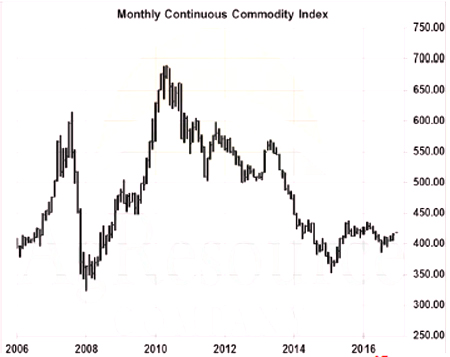
  • The monthly CRB chart offers technical hope that the bear market in commodities (that started back in 2011) is changing. For just the 2nd time in recent years, the CRB closed higher for 2 consecutive months. A third month of higher close in November would spur additional demand into early 2018. Crude oil and metals have been the bullish stalwarts, but livestock and a few of the tropical soft markets have started to follow. The expanding world GDP looks to underpin the CRB. 

  • Following firm trade overnight, soybean futures came to life Wednesday morning and closed up 6-7 cents on technical buying. Soy product markets finished higher, with December meal finding support at the 50 day moving average, and gaining slightly on soyoil. Brazilian farmers were active with their soybean planting last week, with planting progress across the key producing states now estimated at 49% complete versus 34% last week and the 5 year average of 52%. Producers across the Midwest ran planters around the clock ahead of a wetter forecast for the early days of November. Farmers in the largest producing state of Mato Grosso now have 68% of their seed in the ground. By next week, we expect that progress should reach 63-65% and near 90% by the end of the month. We see January soybeans caught in a wide range, with support expected on breaks back to $9.70, while rallies back above $10.20 are sure to find farm selling as cash values near $10.00.
  • Corn futures 5-day decline was halted amid further expansion in funds’ net short (open interest on Tuesday increased 25,000 contracts) and as US ethanol production continues at a record pace. There is still no major story for US or world grain markets, but downside risk below $3.40 basis December, is limited. US ethanol production last week totaled a near record 310 million gallons, up 10 million on the same week a year ago, and particularly high for late October. Ethanol stocks remain large, but current economics bode favourably for the biofuel. Gasoline stocks continue to erode, and the recent boost in US/world energy prices makes fundamental sense. The incentive to blend ethanol remains elevated, and record corn use is expected. FC Stone in its October report raised US corn yield to 173.7 bushels/acre, just 1 bu shy of last year’s record and which if realised will add 75-100 million bu to 2017/18 US corn end stocks. Consequently any meaningful tightening of the US balance sheet demands adverse S American weather, which is possible but won’t be a market factor until January. Both the bulls and the bears will continue to struggle in the meantime.
  • Chicago wheat traded in just a 3 cent range, but ended the day steady to fractionally lower. Funds have built a sizeable short position, but at 100,000 contracts is still 60,000 shy of the 2016’s record. French milling wheat futures are nearing contract lows, and this along with weakness in the €uro have pulled European cash prices to levels at or below Russian origin. German offers for nearby delivery have fallen some $15/mt from highs posted in mid-summer. Competition for world demand remains stiff. Ongoing warmth in the Black Sea will sustain an elevated shipment pace in Russia, and any boost in the US’s share of world trade awaits the winter months. A shift to wetter weather in eastern Australia into late November is occurring at the wrong time, harvest is dead ahead, but otherwise rallies demand adverse S American weather this winter, or drought in the Black Sea next spring. Wheat lacks a story.

31 October 2017

  • Tuesday was another quiet day of trading across the soy complex, that left January soybeans just over unchanged. Support at the 200 day moving average continues to hold, though the markets are still struggling to find direction. It is still early in the year, however early season soybean crush rates are have so far held above a year ago on a week to week basis. Last week’s crush was estimated at 1.75 million mt, and note that there has only been one week this year that has been under 1.7 million mt, which was during the October holiday. Seasonally, weekly processing rates tend to trend higher into the New Year Holiday, which this year is 2 weeks later than 2017 and lands in mid-February. Soybean basis remains historically weak, but holding above the late September lows and should further improves as harvest across most states starts winding down. Seasonally, it’s the wrong time of year to be overly bearish soybeans.
  • Corn futures ended lower with December again flirting with major chart-based support. The contract has struggled at resistance levels, and is expected to stay bound to a rather narrow trading range. Weekly US ethanol production (due Wednesday morning) should be strong, but the USDA’s November WASDE is likely to feature another boost in 2017 US yield and end stocks. US harvest progress as of late October vs. changes in corn yield from October to final since 1990 shows a correlation that is not overly strong, but more times than not, a slower than normal harvest results in yield hikes beyond October. This model suggests another 0.5-1.0 bushels/acre boost in yield in the November or January reports, which is also validated by combine harvest data. Rallies will struggle.However, managed funds are short an estimated 200,000 corn contracts, a level that’s only been exceeded in five weeks since 2006. ENSO forecasts are a bit stronger with La Niña in December/ January, and so a close eye will be kept on coming Argentina dryness. This is no place to be bearish of corn. 
  • Winter wheat futures fell to new contract lows as the market continues to reel from recent tender results, which included aggressive offers, and as currencies in Russia, Australia and Canada all weakened. The Canadian and Australian dollars rest at multi-week lows, and overall steep competition for exports is ongoing. The trade views current US winter wheat crop ratings as adequate for maintaining trend yield potential at this early date. Russian exporters look to scramble to clear stocks ahead of the winter months, but in the next few weeks there is no sign of freezing temperatures in areas surrounding the Black Sea. World cash wheat markets have been unwilling to break, but equally unwilling to rally. Gulf HRW this evening holds a modest premium to comparable origins, and so sales and shipments in the next several weeks will stay just so-so. Funds are heavily short in Chicago and Kansas (an estimated 102,000 and 17,000, respectively), and a modest bounce could occur at any time. However, rallies beyond 15- 20 cents will struggle without adverse S American weather. We see wheat as range bound between $4.10-4.50 basis spot Chicago futures.