8 December 2017

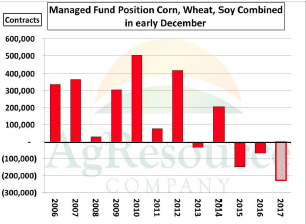
  • Funds have been trimming net short position in grains, and adding modestly to their net long in soybeans. Still, the combined position is historically short, and we advise caution against turning bearish on breaks. A vast majority of the S American growing season is yet to come (recall Brazil’s drought in 2016 began in late January), and the short side of the market remains pretty crowded.

  • Soybeans were higher overnight, but found selling right from the morning open that kept soybeans and meal down through most of the day. The break in meal offered support to the soyoil prices on meal/oil spreads. Commodity fund traders were estimated as net sellers of 5,000 soybean and 4,500 soymeal contracts, and bought 4,000 contracts in the soyoil market. The Commitment of Traders report confirmed that funds had added to their soybean position through last week. Funds were estimated as net long nearly 55,000 futures contracts and were net short 1,751 contracts in the options market. Hedgers used the rally to 5 month highs for sales, taking their hedged position (net short) to the most in 7 weeks. Hedgers were net short near 120,000 contracts vs. 245,000 a year ago. The USDA’s WASDE and the Brazilian crop report will be released on Tuesday, and are expected to feature slower US exports and a larger Brazilian crop. After the reports are released, S American weather will drive Chicago soy trading into early 2018.
  • Corn futures today ended slightly higher, and largely shrugged off a much wetter Argentine pattern predicted by the GFS weather forecast at midday. Indeed, the EU model this afternoon failed to validate the GFS’s solution, particularly in C Argentina, and instead rainfall over the next 10 days will be rather scattered. Some rain will fall, but not enough to reverse the trend in soil moisture. Sunday night’s forecast is key, particularly as the models start to peek into the latter part of December. We maintain that any meaningful pattern shift there will be difficult over the next 30-45 days amid ongoing cool equatorial Pacific Ocean temperatures. Otherwise, the managed funds as of Tuesday were short a net 161,000 contracts in Chicago, a number roughly in line with expectations, if perhaps a bit smaller. Short term direction will upon whether heavy rain finally appears in Argentina’s 10-day forecast, and we note that 45-day precipitation across much of Argentina’s Corn Belt ranges from 40-60% of normal.
  • US wheat futures find newer contract lows today, as the delivery period has proven rather bearish and as there is an otherwise lack of fresh news. Managed funds as of Tuesday were short a net 119,000 contracts, vs. 123,000 the prior week, and are likely short some 130,000 contracts today. Some kind of short-covering rally is expected before year’s end. EU wheat futures and cash prices attempted to rally slightly today, and so comparable Gulf HRW will be offered Monday at a $3-4/mt discount to German/Baltic origin, and surpluses in N Europe continue to dwindle. Domestic Russian prices remain stable, the US market has corrected sharply, and we fully expect Russian fob offers to stay at $190- 195/mt into early 2018, which is not bearish relative to current US futures prices. A needed demand driver is still absent, but amid funds’ short, developing drought across the Central US, and competitive Gulf prices a bearish stance is not advised.

7 December 2017

  • It has been another down day in Chicago. Export sales were decent, and better than expected in soybeans, while the midday GFS weather forecast has added heavy rainfall to S Brazil beginning late next week. Argentina’s forecast is little change, and is still dry and rather hot into the latter part of December. Outside markets are mixed, with crude up $.60/barrel, which is rallying gasoline’s premium to ethanol further. Through the week ending November 30, US exporters sold abroad a net 35 million bu of corn, up 11 million from the prior week and some 8 million above the pace needed to hit the USDA’s forecast. Wheat sales totalled 12 million bu, nearly double the previous week but still disappointing. Soybean sales totalled a respectable 74 million bu, up 40 million from the previous week and the highest since mid-October.
  • For their respective crop years to date, the US has exported 902 million bu of corn, down 27% from last year; 642 million bu of wheat, down 10%; and 1,335 million bu of soybeans, down 16% from a year ago. No changes are warranted to wheat and corn export forecasts based on pace analysis, but the overall sum of foreign soybean demand remains lacklustre. A downward revision in coming WASDE reports is logical, but we wonder if the USDA requires more input on S American production before starting the process. Recall beans sales and shipments beyond Apr/May can vary substantially based on S American balance sheets.
  • Russia has announced it will spend roughly $34 million in grain transportation subsidies in an effort to boost export capacity in 2018, and which may also help boost domestic prices, which as of last week are down substantially (about 15-20% in Ruble terms) from this week in 2016. The battle between uncertain, and largely concerning, S American weather, and next week’s WASDE report, which will again confirm sizeable stocks of major crops will sustain choppy trading, and only in late winter will a majority of S America’s crop-critical weather have passed.
  • Stats Can data on Wednesday and next week’s rain event in Argentina have weighed on the markets recently. The entirety of South America’s growing season lies ahead!

6 December 2017

  • Stats Can’s numbers this morning were indeed bearish, pretty much as anticipated. Final wheat production is pegged at 30 million mt, up 3 million from the USDA’s last estimate in November. Much of this will be added to Canada’s exportable surplus, and higher protein wheat futures contracts in the US were down 6-8 cents at midday. Stats Can also raised canola (rapeseed) production to 21.3 million mt, vs. 19.9 million previously, which will ease concerns over an ever tightening Canadian canola balance sheet. Large Canadian canola and soy exports are expected through the balance of the crop year.
  • Energy futures ended sharply lower today as US motor gasoline stocks built and a seasonal lull in consumption lies ahead. US crude stocks remain well below the levels of recent years, and the difference is widening, and of course weaker prices do little to boost production.
  • Following higher overnight trade, soy futures turned down after the morning open on profit taking, and in sympathy with weakness in the wheat market. Fundamental news for the day was limited to S American weather updates, which remain warm and dry for the next 10 days. January and March soybeans were able to build late day support after both contracts closed out open chart gaps that were left from Monday’s trade. Commodity fund traders were estimated sellers of 9,000 soybean, 5,000 soymeal, and 4,000 soyoil contracts. Soymeal has lead the soy trade this week, lifting Chicago soy crush margins. The spot spread today traded as high as $1.20/bu and closed at $1.15, verus $.74 a year ago. Forward margins are also similarly strong, giving processors the opportunity to lock down an average margin of $1.09/bu to the end of the year versus $.83 a year ago. Next week’s WASDE report is expected to show a slower US export forecast and larger end stocks, though the market this week is following S American weather.
  • Chicago corn futures ended slightly lower, but mostly shrugged off weakness in neighboring wheat and soy markets. We view strength in corn today as a function of another week of record ethanol production, and the fact that a meaningful pattern shift is still unlikely in Argentina and S Brazil by late December. Through the week ending last Friday, US ethanol plants produced a record 326 million gallons, a full 10 million above the prior record set two weeks ago, and which further argues the USDA’s projected ethanol demand draw is 25-50 million bu too low. Ethanol production margins have eroded rather quickly (calculated today at $.25/gallon, vs. $.60 in early November), but ethanol’s discount to gasoline remains substantial, and non-domestic blend disappearance continues at a record pace. The point is that, fundamentally, we doubt much downside risk in corn exists below $3.45, basis March, and the overall S American weather pattern remains concerning. Funds may be more willing to part with sizeable short positions by late month if weather doesn’t improve.
  • Spring wheat futures led the way down today, as Stats Can added 3 million mt to Canada’s all-wheat production total. This goes a long way in easing concerns over the availability of high protein wheat in North America, and also suggests the US can boost cross-border trade if any real shortages develop. We would point out that Stats Can production figures are now largely satelite based, but any correction to production awaits Stats Can’s next stocks reprot, which isn’t due until early February. Funds sold and estimated 4,500 contracts in Chicago. World markets also ended lower following Stats Can’s report, with EU origin wheat down a full $3-4/mt this evening, but the news should be fully digested by early Thursday. Otherwise, US export sales are likely to rise slowly as, on paper, the Gulf HRW market is more competitive. Managed funds’ net short today is calculated at 125,000 contracts, which is sizeable. We would look for a modest rebound from contract lows, but suggest that rallies require the loss of corn yield in S America.

5 December 2017

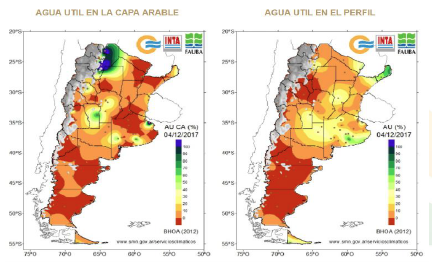
  • Much of Argentina is parched, drier than a year ago. The map below, on the left, shows topsoil moisture while the chart to the right is subsoil. Notice that subsoil moisture is currently only 20- 40% of normal, meaning that upcoming rainfall will be highly important for crops during the last half of December. 

  • Following firm overnight trade, soybean futures rallied to strong gains on Tuesday. Weather models project limited rains across key growing regions for Argentina and S Brazil, which fueled fund buying through Tuesday’s trading. Soymeal led Tuesday’s rally on concerns that Argentine meal exports could be reduced by a smaller Argentine crop. At the close, funds were estimated as net buyers of; 9,500 soybeans, 7,000 soymeal, and 1,000 soyoil contracts. Soymeal trade data for October was disapointing. US exports totaled 781,746 short tons, a 16% decline from last year, and the slowest October export figure since 2011. While the USDA has a long history of underestimating soymeal exports, it appears that the current forecast is not likely to increase without a big jump in shipments. We expect Chicago soy markets will continue to add weather premium until the S American weather forecast changes. However, US soy supplies are record large and we would believe that Argentine dryness would have to cut 10% off yield expectation to justify a rally above $11.00.
  • Chicago corn inched to minor gains, and March is positioned firmly between its 50-day moving average and its contract low. Weather premium needs to be sustained until/unless it rains in Argentina and S Brazil, but the trade is also beginning to position for next week’s WASDE, in which large US and global stocks will again be confirmed. There is little to do other than wait for clarity on Jan-Feb S American weather, but we do mention that newly updated climate outlooks indicate ongoing heat and dryness in Argentina through January. Wednesday’s EIA report should again include near record US ethanol production through the week ending last Friday, and still there is no indication of any real slowdown in ethanol export demand. Brazilian cash ethanol prices continue to move higher, and the rally has more than offset Brazil’s 20% tariff on imports from the US. China also looks to ramp up its blending program, which at first will be comprised of imported ethanol. The battle between slow exports, but strong biofuel consumption and adverse S American weather will, in our view, sustain fair value at $3.48-3.65, basis March Chicago futures.
  • US wheat futures ended lower, as again markets were unable to find much buying interest at technical resistance price levels. Funds returned to adding net short positions. Traders across the globe are beginning to wind down for the year, but there remains no compelling evidence for a major move in either direction. Ongoing warmth in the Black Sea, where temperatures remain some 15-20 degrees above average, will sustain Russian shipments in the weeks ahead, but managed funds’ net short position this evening is pegged at 120,000 contracts, little changed from last week and still sizeable relative to history. While Russia wheat prices continue to do very little, higher protein markets elsewhere have rallied decently in the last two weeks. German fob prices are testing multi-week highs, and contacts suggest the rally there is fundamentally based. We remain close to contract price lows, and the US wheat balance sheet will be tightening in the years amid the loss of acreage and a lack of substantial yield growth. 

4 December 2017

  • The morning started out green across Chicago, but has turned mixed at midmorning as the grains slide back into the red. Soybean futures have held in the green on the prospect of Argentine and S Brazilian dryness and on bullish technical considerations. Soyoil and grain prices are back lower, but funds are nearing a point of being sold out of their market length in soyoil. Continuing a trend from the overnight, the volume of Chicago grain has been active as the US stock market pushes to new highs on proposed US tax legislation. Inflation is a subject being talked about by commodity traders, but until there is actual statistical evidence of inflation, many traders are loath to make any new bullish positions. Chicago brokers report that funds have bought 4,700 contracts of soybeans and 6,600 contracts of soymeal, while selling 12,000 contracts of corn and 1,200 contracts of wheat. In soybean products, funds have sold 3,000 contracts of soyoil and bought 6,200 contracts of soymeal. Our next upside price target for January soymeal rests at $350/ton.
  • For the week ending November 30, the US exported 23.1 million bu of corn, 15.0 million bu of wheat and 66.2 million bu of soybeans. The corn and wheat exports were below trade expectations. For their respective crop years to date, the US has exported 309.2 million bu of corn (down 232 million or 43%), 839.7 million bu of soybeans (down 119 million or 12%, and 469 million bu of wheat (down 33 million or 6,5%). US corn and soybean exports are lagging the pace of the WASDE annual forecast, but we doubt that any big change will occur in next week’s December WASDE report with so much unknown about 2018 S American crop prospects.
  • Argentine fob corn offers continues to rise on threatening weather and limited US farm selling. US Gulf fob corn is now priced at a discount to Argentine origin for January, which should start to pull demand to the US. The US has a good shot of being the world’s cheapest corn offer from now through late winter, a big boost for potential future US corn sales. If Chicago traders were really worried about dry/warming Argentine and S Brazilian weather, the Chicago rally would be led by corn. The Chicago corn market touched the 50 day moving average and is down nearly 4 cents at midday. The first Argentine corn crop will be pollinating in 2-3 weeks as sources tell us that stress is building. If Chicago was really worried about La Niña weather, its corn that is being adversely impacted. Currently It is not, which tells us that the worry is not all that great and that it is all about “fund order flows” for now.
  • The market appears to be struggling with dry Argentine and S Brazilian weather forecasts. It is early in the growing season, but La Niña is building in strength and we see no evidence of a pattern change at midday. The worry over Argentine drought is likely to worsen heading into the end of December. Worrisome weather is confirmed by Chicago option volatility rising today as the market prepares for greater supply uncertainty. Corn and soyoil should be nearing a trading bottom while beans try to fill an open chart gap at $9.9575 basis January futures (which we have mentioned previously!).

30 November 2017

  • Extremely cold ocean water continues to pool across the Eastern Pacific with each week being cooler than the last. This unusual broad build-up of cold Pacific ocean water to the west of S America looks to maintain a dry flow across Argentina and S Brazil for weeks to come. Exceptionally wet weather conditions will likely occur across N Brazil. The continued combination could pose elevated risks for summer row crops into early 2018. Our concern for S American weather is increasing amid the deepening cold across the equatorial Pacific.
  • Choppy, but generally lower trade unfold across the Chicago soy markets as the trade responded to the EPA’s announcement for upcoming biofuel targets. Soyoil tried to rally on the news, but faded as the EPA data did not offer any surprises. January soybeans turned down and slipped under it’s 50 day moving average, while the January crush spread rallied to a new high and traded over $1.05/bu. Funds were estimated sellers of; 6,500 soybean and 3,000 soyoil contracts, and buyers of 3,500 contracts in the soymeal market. Funds continue to pile into meal/oil spreads. The November WASDE estimated 2017/18 soyoil usage for biodiesel at 7,000 million lbs, or 13% more than in 2016/17. The history of the December WASDE estimate against actual soyoil demand, shows that over the last 5 years the December forecast has on average been within 4% of actual biofuel demand. With today’s announcement being only 50-150 million lbs better from the July proposal, we do not anticipate any significant changes from WASDE in December. Census will be out with their Crush report on Friday, which could show a deeper decline on stock based upon marginal imports. We are becoming more concerned on S America weather with heat to arrive in December for dry Argentina and S Brazil. Consequently, we see price breaks as buying opportunities.
  • Corn futures rallied 2 cents amid a focus on an intensifying La Niña and rising cash prices in S America. First notice day has come and gone, interior basis levels are steady to firmer, and it is likely that a secondary low has been scored, at least until/unless a more normal pattern of rainfall develops in Argentina. Recall December is a key month for first planted corn there. US export sales through the week ending Nov 23 totalled 24 million bu, down 19 million from the previous week, but roughly in line with the pace needed to reach USDA’s annual target. Argentine and US Gulf cash basis levels are pretty even, and the next round of meaningful weakness in S American cash markets will likely not occur until late winter, when the earliest planted fields are harvested. The USDA’s 1,925 million bu forecast looks a bit more accurate. Spotty showers in Argentina through the weekend will satisfy current moisture demands, but longer term there is still an elevated risk of heat and dryness, which climate outlooks are beginning to show, and the question thereafter is just how long La Niña lasts. Funds are huge shorts, which in itself presents an elevated risk potential.
  • US wheat futures were unwilling to follow corn higher amid slow US export demand and huge Chicago deliveries. Following several weeks of decent export business, a second consecutive week has passed with sales below what’s needed to hit the USDA’s target. Gulf HRW is somewhat more competitive now, but lasting rallies will again harm Jan-Mar potential without a similar rally in Black Sea cash prices. US export sales through the week ending last Thursday totalled a meagre 7 million bu, half of the required pace, and amid ongoing warmth in Ukraine and Russia we doubt much improvement lies ahead in the next couple weeks. There is increasing evidence to suggest high quality exportable surpluses in N Europe are dwindling fast, but this has so far failed to spark much interest in US HRW wheat. We maintains that a secondary bottom was scored early this week, and an expanding Plains drought needs watching, and should expand amid a strengthening La Niña. However, rallies will continue to be modest short covering affairs unless adverse S American weather bulls corn prices.