30 November 2018

  • The G20 meeting has started in Argentina and Chicago grain values are firmer on optimism that China will offer to buy more US goods (including agricultural products) to reduce the US/China trade deficit. Most experts agree that there will be little progress on IT protection and China’s industrial ambition, but the key question is whether Trump will allow a “trade truce” to work through the complexities of IT protection. Such a truce would only occur with China’s promise of large Chinese purchases of US goods, and there was a deadline for reaching a IT deal. To date, China has not admitted any theft of IT property and for the Government to agree to negotiations would be a big step forward. USTR head Robert Lighthizer on the sidelines of G20 said that he would be surprised if the China dinner fails.
  • For the US is to enter into a “trade truce” would require that China open its market to greater imports of US goods (including ag) that provides Trump with a win in terms of getting China to bend on the Chinese trade surplus. The IT and industrial policy part of US/China negotiations are so complex that it will take months (maybe years) to complete. The hope of the US ag industry is that China is willing to open its markets such that negotiations on IT protection can continue well into the middle of 2019. The next 36 hours will tell if China is willing to throw open their markets and talk IT thereafter.
  • FAS announced that 120,000 mt of US soybeans were sold to an unknown destination. The US/Mexico/Canada signed the USMCA agreement today for North American trade. The agreement will now go back to each government for legislative approval. There are political headwinds for a US approval and should there be any long-term approval delays, NAFTA could return. There are objections for Democrats in the House that there is a need for the agreement to be modified. There are rumours that the US is willing to drop their steel/aluminum tariffs early next week now that the agreement is signed. We would highlight that they are only rumours, but that would be enough for Mexico/Canada to drop their tariffs on some US ag goods including meats and dairy products.
  • The Brazilian soy crop estimates continue to rise, we expect that CONAB will raise their crop estimate to 122-124 million mt in their December report.
  • The midday S American weather forecast is similar to the overnight solution with much above normal rain to fall across the northern half of Brazil with totals of 3-8.00”. Below normal rainfall is expected across Argentina and S Brazil as spring planting accelerates. No extreme heat is foreseen due to persistent cloud cover across Brazil. Highs will range from the 80’s to lower 90’s across Brazil. The dryness across Argentina and S Brazil is favourable for now, but concern is growing that Asian rust (plant disease) could hurt soy yields in Mato Grosso, Goias and Bahia amid weeks of above normal rainfall. Producers are spraying fungicide to combat the disease.
  • Sunday night will prove dynamic for Chicago trade as the details of the Trump/Xi dinner is known. The market is optimistic on some sort of truce. We are not alone in not having any idea what the final deal will be. However, amid growing S American crop sizes, one would have to be careful about becoming too bullish as new competition for US soybean exports is only some six weeks off. Wheat has more upside risk as world demand shifts to the US/EU. Corn is a tug of war between soybeans and wheat.

To download our weekly update as a PDF file please click on the link below:
Weekend summary 30 November 2018

29 November 2018

  • “Tweets and Political Trade Posturing” has been trade in Chicago with corn, soybeans and wheat trading either side of unchanged. The volume of trade has been active in corn, but less so in wheat and soybeans. Algo trading funds that trade the news have been active with purchases in corn/soybeans on the early tweets from Trump. Chicago lacks a trend and most traders expects fireworks on Sunday night from whatever comes forward from G20 and Argentina. We maintain that trading politics is nearly impossible and lasting trends in Chicago will be difficult to sustain. Our expectation for the close is mixed, with selling in soybeans as US/S American farmers are picking up their cash sales. US farmers appear to be willing to shed some cash soybean supply while holding onto their grain stores.
  • Chicago brokers report that funds have bought; 2,300 contracts of wheat, 5,500 contracts of corn and 5,500 contracts of soybeans. In soy products, funds have bought 2,100 soymeal while being flat in soyoil.
  • President Trump in a press briefing (and tweet) suggested that he may be close to a deal with China. However, it also commented that he liked the flow of billions into the US Treasury, and he may not do a deal. Chicago rallied and then eased as the double talk made a bull or bear position difficult. Importantly, Trump has asked China Trade Hawk Peter Navarro to join the Trump/Xi dinner which will be seen by China as adversarial. Most Washington watchers thinks the inclusion of Navarro reduces the chances for a trade truce. Trump also stated that he will not be meeting with Putin due to raw nerves with Ukraine amid the capture of their naval vessels on Sunday. There are so many variables in the air that it will be up to the personal relationship of Trump and Xi and whether they can find common ground to call for a truce. No one knows what will happen with this important G20 meeting.
  • US export sales for the week ending Nov 22 were; 13.9 million bu of wheat, 49.9 million bu of corn, and 23.1 million bu of soybeans. For their respective crop years to date, the US has sold 547 million bu of wheat (down 84 million or 13.3%) 1,007 million bu of corn (up 140 million or 16%), and 854 million bu of soybeans (down 407 million or 32%). The sales totals were deemed neutral/slightly bearish.
  • There is a growing political risk that the Trump Administration may shut down the US Government if funding for a US/Mexico border wall is not raised to $5.0 billion in an Appropriations Bill. The shutdown would occur around Dec 8 and it could impact the USDA Dec WASDE report (and weekly export and sales reports).
  • The midday S American weather forecast is similar to the overnight solution with above normal rain to fall across the northern half of Brazil with totals of 3-8.00”. Below normal rainfall is expected across Argentina as spring planting accelerates. No extreme heat is foreseen due to persistent cloud cover. Highs will range from the 70’s and 80’s across Argentina and the 80’s to lower 90’s across Brazil.
  • Sunday night will prove to be dynamic for Chicago trade as the details of the Trump/Xi dinner to resolve trade differences are known. Our advice is to hope for the best but manage risk like it is a monthly USDA crop report. No one really has any idea whether the US/China trade war will have a truce or push to a more aggressive phase, consequently look for choppy Chicago trade to continue into the weekend.

28 November 2018

  • Russian wheat export volumes will likely be in sharp decline beyond the middle of December as exporters adhere to pledged export totals and the cost of replacement soars as wheat must be sourced from deeper in the interior as stocks in the west are exhausted. There are eleven time zones in Russia and trucking or railing it from Siberia to the SE Russian export market is extremely expensive. The big Russian wheat program has would seem to have reached its zenith.
  • It has been a morning of positioning with deeply green values this morning. The market is too short of soybeans/soyoil, which heading into a weekend of political uncertainty (G20/Trump/Xi) is producing active fund short covering. The grains are following. A deepening trade war worry pressured the market on Monday with recovery over the past two trading sessions. The rally has been bigger than the decline as funds are short nearly 70,000 contracts of soybeans and 76,000 contracts of soyoil. We see no reason for spot Chicago soybean futures to rally above $9.00 without a trade deal. Chinese President Xi speaking in Spain pushed free world trade rather than regional protectionism. Xi offered conciliatory statements on US/Chinese trade and IP protection, which Chicago liked. However, the Xi statements are not implying that China is willing to bend to US demands. There remains great political uncertainty as to what US President Trump will accept as a truce.
  • Chicago brokers report that funds have bought; 3,100 contracts of wheat, 5,500 contracts of corn and 6,100 contracts of soybeans. In soy products, funds have bought 2,200 soymeal and 6,800 contracts of soyoil. FAS reported that the US sold 268,748 contracts of soybeans for delivery to unknown destinations. The rumoured buyer is either Mexico or the EU. Algeria purchased 600,000 mt of optional origin wheat on Tuesday. Some traders argue that US HRW wheat was included in the sale by Cargill. The wheat would have to be dramatically discounted on a FOB basis to work.
  • The midday S American weather forecast is like the overnight solution with heavy rains slated to fall across the northern half of Brazil with totals of 3-8.00”. Below normal rains are expected across Argentina as spring planting accelerates. No extreme heat is foreseen due to persistent cloud cover across Brazil. Highs will range from the 70’s and 80’s across Argentina and the 80’s to lower 90’s across Brazil. The forecast is generally favourable for crops with too much rain for local parts of Brazil.
  • The politics of trade is driving Chicago markets this morning. Soy prices are higher on the hope for a US/China deal. Research leans that a truce will be reached at the G20 dinner between Trump/Xi late week. However, it is it can only be a best guess. On the bearish side, China may be willing to bet that Trump has just 12-18 months of leadership remaining, before the next US election process starts. For China, this is not a lot of time with Brazil looking to produce a record large soy crop of 122-126 million mt. The point is that strong rallies near $9.00 would appear to be a near to mid-term upside for soybeans as this price has halted Chicago soy rallies since the US/China trade war started last summer.

27 November 2018

  • US wheat futures are lower with the row crops firmer at midday in Chicago. Soybeans have led the bullish charge with double digit gains tied to news that a US Tax Extenders Bill includes a plant/animal-based feedstock biodiesel credit that starts at $1.00 gallon, followed by a gradual subsidy phase out and expiration in 2024. The renewed subsidy has supported a rally in soyoil futures. If the Bill is passed (expected) it would help maintain US soy crush margins. We note that US soyoil demand is record large due to the ending of Argentine biodiesel imports last year.
  • Chicago brokers report that funds have sold; 4,500 contracts of wheat, while buying 200 contracts of corn and 4,300 contracts of soybeans. In soy products, funds have sold 1,200 soymeal and bought 4,300 contracts of soyoil.
  • Algeria is tendering for wheat with the result due Wednesday. It is widely expected that Argentina will fill the tender, but US export sources report that US HRW wheat on a landed basis almost works. French fob SRW is the most expensive soft wheat in the world at $233/mt, but because of its proximity to Algeria, its only $3-5/mt more on a landed basis. Key will be whether the French are willing to sell wheat below replacement to gain the business.
  • There are rumours that Chinese traders had heard that President Trump was going to bash China with talk heightened tariffs late Monday. They sold soybeans ahead of the news. These traders are said to be now covering short soybeans as the market did not follow through. Moreover, we note that unlike prior tough tariff talk from President Trump, China made no comment on being bullied overnight. A Hong Kong scholar Lau (close ties to the Chinese Government) indicated that a truce in the trade war would be offered in Buenos Aires with the details to be ironed out in a framework negotiating agreement. Soybeans are trading back and forth as the political winds blow ahead the G20 meeting!
  • Russia is unwilling to let international mediators settle their dispute with Ukraine with President Putin to announce Russia’s response in the next few days. The nerves in the Black Sea are raw and need to be closely monitored
  • The midday S American weather forecast is slightly drier for Argentina, but equally wet for Brazil. Totals of 3-6.00” of rain look to drop across the northern half of Brazil with 0.5-2.00” for S Brazil and Argentina over the next 10 days. Near normal rains are expected across Argentina as spring planting accelerates. No extreme heat is foreseen due to persistent cloud cover across Brazil. Highs will range from the 70’s and 80’s across Argentina and the 80’s to lower 90’s across Brazil.
  • Big picture politics rules once again. Today there is trade optimism from China that a framework for further talks can be uncovered in Buenos Aries at G20. China did not respond to new Trump Trade Tariff threats overnight. Traders are pessimistic on the prospect for a US/China trade framework while US farmers are optimistic. If the US and China call a truce and keep negotiations going; that will be seen as bullish for Chicago. It is China trade, Ukraine/Russia, and Brexit that holds the market’s attention. This produces whipsaw markets. First notice day looms on Friday against Dec futures. Trading politics is more difficult than trading a weather market.

26 November 2018

  • The summer row crop markets have felt selling pressure from the opening as bearish bets are placed against the coming US/China trade dinner later this week. The market doubts that the US and China will be able to come to an agreement which has sent soy futures lower this morning. Moreover, traders continue to discuss favourable S American weather and the coming competition of trade for the US. Corn has followed soybeans, while the wheat market hangs on the green in building US and world wheat demand. We look for a mixed close as traders try to position for Trump/Xi G20 event.
  • Chicago brokers report that funds have sold; 7,500 contracts of soybeans and 5,900 contracts of corn, while buying 1,900 contracts of wheat. In soy products, funds have sold 3,200 soymeal and 3,500 contracts of soyoil. An increase in Brazilian cash related selling of soybeans is noted this morning. Farmers fear that a US/China trade deal could get done which further drops their cash premiums. The Brazilian market has been suffering from deflating premiums for much of the past three weeks, and farmers are worried with crops looking favourable heading into December.
  • Goldman Sachs has put out a bullish general commodity forecast this morning with energy, metals and even ags topping their purchase list. Goldman argued that in 2019, commodities should enjoy a 19% return. Goldman looks for the late week US/China trade agreement and an OPEC cut of crude production as providing the fundamental inertia to start a rally. The Goldman buy recommendation is likely to have asset managers looking at commodities by year end.
  • The Russian ag ministry forecast their initial 2019 grain crop at 110 million mt, the same as this year. Total planted area is estimated at 80.5 million ha, an increase of 1.3 million ha. The report made no mention of winter wheat acres, but a modest increase was likely included. It needs to be remembered that for the past three years, Russian winter grains have escaped winterkill damage. It will be interesting to see that occurs in 2019. Producer sources tell us the condition of the 2019 Russian wheat crop is well below 2016 or 2017.
  • US export inspections for the week ending November 22 included 40.6 million bu of soybeans, 44 million bu of corn, and 9.3 million bu of wheat.
  • The midday S American GFS weather forecast is wet for N and C Brazil over the next 10 days. Totals of 3-6.00” look to drop across the northern half of Brazil. Near normal rains are expected across Argentina as spring planting returns following heavy rains during the first half of Nov. No extreme heat is noted with temperatures to average near to below normal due to persistent cloud cover. There is a risk of too much rain falling across N Brazil that could cause an increase in disease pressures.
  • Forecasting trade politics is impossible. One can take educated views, but that is about it. President Trump has smouldering battles that he must tend to on the international front in; Iran, the Saudis, the Chinese and now the Russians and their provocation of Ukraine. Will Trump get tough with Russia, unlike Obama when the Russians took Crimea. Ukraine is said to be pulling its wheat offers in the world market. It is hard to become bearish of sub $3.60 Dec corn or sub $4.60 Dec KC wheat. Our view is that although politics are uncertain, there is more risk to the upside than downside, as we have previously publicised.

21 November 2018

  • It has been a mixed trading session in Chicago this morning in light volume. Corn and soybeans have firmed into the midday trade while wheat is still holding in the red. The volume of trade has been light with it not taking much volume to push values around. Long wheat/short soy spread unwinding is featured.
  • Chicago brokers report that funds have sold; 2,500 contracts of wheat, 1,400 contracts of corn, while buying 3,000 contracts of soybeans, 1,000 contracts of soymeal and 2,800 contracts of soyoil. The double bottom in soyoil prices along with record large biofuel demand has funds looking at new long positions The spot KC wheat/corn spread has narrowed into $1.07 wheat premium, the tightest since major wheat lows where scored in June. The spread peaked at $2.15 KC wheat premium in August and has retreated $1.08. The big question is whether KC wheat needs to become a feedgrain (with world wheat stock/use ratios nearing a record lows and the Russian’s slowing down their export program). UK feed wheat is offered at an equivalent of $233/mt with Ukraine feed wheat offered at $221/mt. US 12% fob Gulf HRW milling wheat is offered at $232/mt or $1/mt below UK feed wheat and just $11/mt above Ukraine offers. KC wheat relative to corn or feed wheat is deemed as cheap. The world is short of hi pro wheat.
  • US weekly ethanol production was 1,042 barrels/day vs 1,067 last week. This produced 306 million gallons of ethanol vs 314 million a week ago. US ethanol stocks fell 30 million gallons to 988 million gallons, up 4% from a year ago. US crude oil stocks rose to 447 million barrels, up 4.7 million barrels. However, the 447 million barrels of stock is down 2% from last year. The big question for the US crude market going forward is whether OPEC will trim their production by 1 million barrels/day in their December meeting.
  • December Chicago options will expire on Friday and few fireworks are expected.
  • The November Cattle On Feed Report was bullish with placements at just 93%, while marketing and the on feed totals were 104%. The placement total was well under expectations and seen as bullish which pushed February futures to resistance at $121-122.00.
  • The midday S American GFS weather forecast features heavy and localised flooding rain for N and C Brazil. Rainfall totals of 4-9.00” look to drop across the northern half of Brazil into December 1. The rains could raise disease concern as the soybean crop pushes into the reproductive phase. Near normal rains are expected across Argentina as spring planting accelerates.
  • The price decline in wheat makes no fundamental sense, but values are being pushed by ongoing fund selling and bearish chart patterns. Soy futures are rising on wet Brazilian weather and hope for a US/China trade deal next week. Dec corn has bounced off of key support at $3.60. We could be pushed into a bet that the US and China will keep talking after next week’s Trump/Xi dinner as any escalation of trade tensions would further batter the US stock market.
  • Tomorrow is Thanksgiving in the US and we will be limiting commentary accordingly.

20 November 2018

  • It has been a low volume and mixed morning in Chicago with corn/wheat trading either side of unchanged while soy futures push higher. The volume of trade remains restricted by the pending US holiday and US/China trade uncertainty. The market’s focus on US/China trade remains acute. Comments from US National Economic Council director Larry Kudlow to Fox News this morning sparked a sharp rally in Chicago soybeans. Kudlow stated that Trump believes that China would like to have a deal and is optimistic on next week’s US/China trade talks. Kudlow also offered that very detailed talks are ongoing on all levels.
  • US comments from Trump/Kudlow on China trade are consistent and argue that the hardliners within the Trump Administration are being silenced ahead of next week’s G20 meeting. A US/China trade deal in 2019 would favour President Trump’s 2020 reelection bid as he can focus on infrastructure and the benefits that his trade deals have provided to farmers/manufactures and the general US working population. Chicago values are acutely focused on next week’s dinner.
  • Russian wheat stock data as of November 1 reflect a sharp drop from last year. Wheat stocks in Krasnodor are down 80%, Kursk down 75%, and Stravpol down 70% with Rostov down 62%. The sharp fall in SE Russian wheat stocks in the export corridor means that exporters will have to pull wheat from far western locations. This is likely the reason why Russian interior wheat prices are rising again and will be a growing concern to the Government and their developing livestock industry. Russia has exported 20 million mt of wheat, but its exporters will struggle with winter weather and tight wheat stocks going forward. Although there is talk that Pakistan may subsidise wheat exports, multi-national exporters are doubtful that subsidised tonnages will surpass 750,000 mt to neighboring countries. Last year, Pakistan exported 900,000 mt of wheat from late February into September. The odds are low that Pakistan will offer wheat to the world wheat market until February amid low soil moisture levels and a tightening domestic federal budget.
  • US crude oil prices are sharply lower with January futures below $55.00. Sinking crude looks to pressure OPEC into cutting production to support income.
  • The midday GFS S American weather forecast is wetter in far Northern Argentina, which is not a major producing area, and unchanged in Brazil. The worry is still centered on excessive rainfall in Mato Grosso, Goias and Minas Gerais, which account for some 50% of bean production and 30% of Brazil’s first corn crop. Rainfall does shift northward in the 6-10 day period, but weekly totals upwards of 2-4+” will continue across Central areas. The GFS forecast is drier in Brazil beginning Dec 3, but confidence so far out is low. A string of sunny days is desired.
  • Politics drove beans down on Monday and are driving beans higher today. Much will depend upon the language of late November’s Trump/Xi dinner. The odds are that both sides will keep talking, which Chicago will like. US wheat futures are down on fund selling, but Russian prices are rising in the interior amid tightening stocks. With Argentine crop quality being questioned, this is no place to be bearish of wheat as weak long are being flushed out.

19 November 2018

  • Red with a little bit of green in corn/oats has been the morning in Chicago. The soybean market has paced the decline with wheat in tow. The entire Chicago market has a heavy feel as traders fret about the coming US/China trade talks amid liquidation into December’s first notice day next week.
  • There has also been talk that the Pakistan ag ministry has asked the Government for export subsidies to help them export wheat. The request is for $105/mt, which no one seems to know whether it will be approved. However, the market is taking it as bearish as it would potentially be another source of wheat. We note that the Pakistan Ag Ministry request is for 3 million mt of wheat at $105/mt subsidy. The USDA has Pakistan exporting 1.0 million mt with ending stocks at just over 4.0 million of wheat in 2018/19. If the Pakistan Government did just 2 million of export subsidies, it would cut their end stocks to just 3.0 million mt, the lowest stock total since 2013. At this point it is just an ag ministry request and no one seems to know if the Government even has the funds available. Also, Pakistan is a WTO member which could make large subsidised volumes complicated
  • US export inspections for the week ending November 15th were; 31.4 million bu of corn, 18.7 million bu of wheat, and 38.8 million bu of soybeans. For their respective crop years to date, the US has shipped out 470 million bu of corn (up 80% on last year and well above USDA’s forecast for a 1% increase), 405 million bu of soybeans (which is down 43% and below the USDA annual forecast for a 11% reduction), US wheat exports stand at 360 million bu (down 18% and well below the USDA’s 14% increase). The corn export total was supportive with wheat/soybeans slightly bearish.
  • US ag groups are publicly speaking out against the Brexit plan announced by Prime Minister May as it would assure that the UK keeps restrictive EU farm policy, which the Trump Administration was expecting them to do away with to enter into a new US/UK Free Trade Agreement. All eyes are on the UK and whether Prime Minister May can secure enough votes in Parliament for approval.
  • The midday GFS S American weather forecast is wetter in Northern Brazil where upwards of 4-8”” of rain will fall over the next 10 days. Coverage will include much of Mato Grosso and Goias. The GFS has extended the pattern of excessive rainfall into the 11-15 day period. The S American jet stream does move northward next week. This will trigger a needed drier pattern in Southern Brazil and Argentina. This is too much rain even for tropical areas of Brazil. The concern for crops will be an ongoing wet weather flow for December that limits sunshine and raises disease concern for reproducing soybeans. Argentine weather has improved with a drier overall upper air flow.
  • It is all about politics and the Trump/Xi meeting heading into the end of November. We understand the bearish US soybean balance sheet, but it only takes talk of a trade deal to produce a sharp rally. We expect that China will agree again to secure an additional $30-35 billion of US ag goods annually, just like they did in May. This would produce a lasting bullish structural change for US agriculture. It is therefore hard to be a bear or bull amid the US/China politics.

16 November 2018

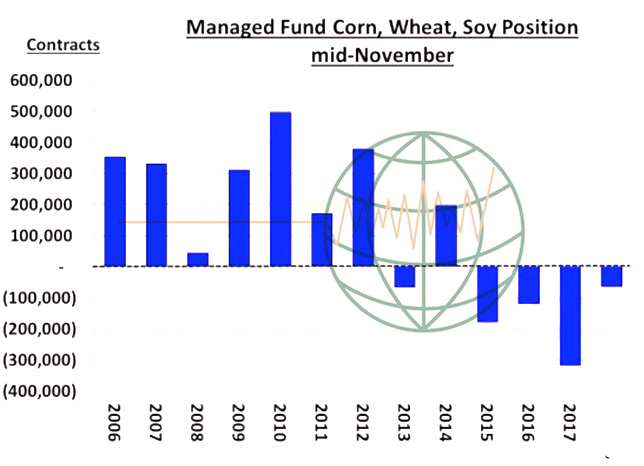
  • Funds are net short a combined 63,728 contracts of corn, soybeans and Chicago wheat. This position makes sense amid lingering barriers to Chinese imports. The fundamental outlook favours grains over soy into the spring of 2019, but we do expect this net fund position to get to flat (as we have frequently suggested) rather quickly should US-China trade dialogue be positive later this year.


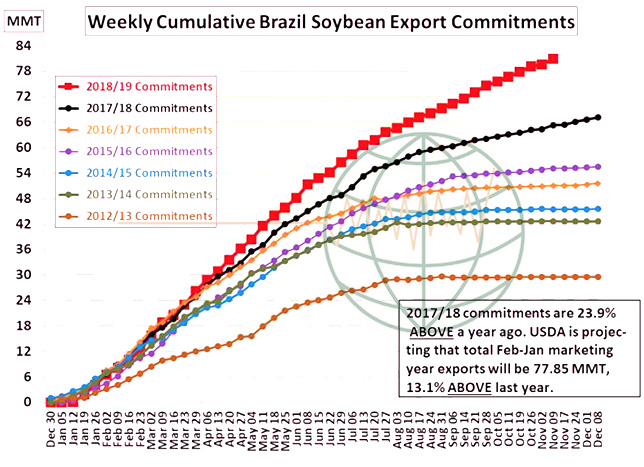
  • Jan soybean futures had their highest close in almost a month. The market has rallied on rising optimism that China and the US might resolve their trade dispute. But, even if talks are successful, nobody is projecting a resolution until sometime after January. By then, Brazil will be exporting its record soybean crop. It is unlikely that US exports will see much of a benefit until next autumn. The USDA raised Brazil’s old-crop soybeans by 3 million mt in its November WASDE. However, the Brazilian crushers association ABIOVE pegged exports at 79 million mt. ABIOVE uses a slightly different local marketing year (Jan-Dec) vs USDA’s Feb-Jan but the implication is that USDA’s projection is perhaps 2-3 million mt too low. One Brazilian grain merchant went so far as to project exports of 83 million mt. As of Nov 9, ship lineups indicated that Brazil’s export “commitments” were 81 million mt. That is 15.7 million or 24% above a year ago. USDA is projecting exports will rise just 13%. Without a US-Sino trade agreement, futures are at risk of falling to $8.00 or below.


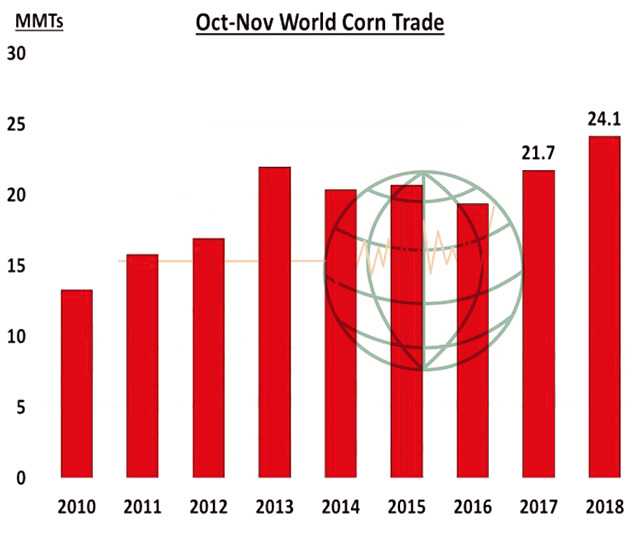
  • Dec corn fell 3 cents amid competing crosscurrents. Concern over the pace of global economic growth continues. Crude ended flat. World cash basis levels are up on the week but unchanged on the day, and competition with Ukraine into Asia will be ongoing in the months ahead. Funds on Tuesday were long a net 18,000 contracts, vs. 27,000 the previous week. Funds today are estimated to be short closer to even. US weekly export sales totaled a decent 35 million bu, up 8 million on the week and right at the pace needed to hit the USDA’s target. Competition for market share is noted, but our supportive thesis centres on world trade as a whole. Using ship lineups, we estimate Oct-Nov combined world corn trade at a record 24.1 million mt. Expensive feed/milling wheat and barley will keep global corn demand strong. There is enough interest to put both US and Ukrainian exports at record levels. The next potentially market-moving event will be the G20 meeting, which begins on Nov 30. Thereafter, it is S American weather. A lasting period of dryness is needed in Argentina, while a drier overall pattern is desired in Brazil. Of note also is that Dec oat futures rallied 6 cents and are once again flirting with $3.00.


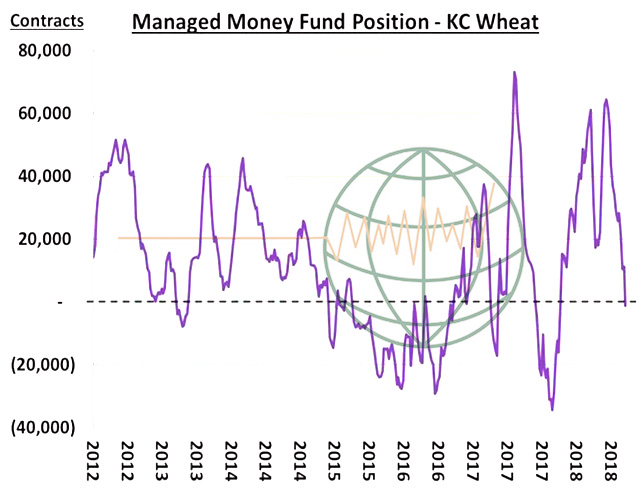
  • US wheat futures ended steady to higher with KC gaining on other classes. As expected, managed funds were net short (1,000 contracts) in KC on Tuesday, and this evening are estimated to be short closer to 5-6,000 contracts. It has taken nine months, but length in KC has been fully liquidated. A more supportive trend is expected moving forward as major importers begin to seek high-protein coverage for 2019. The US is well positioned to boost market share. There are no details surrounding Saudi Arabia’s tender for 475,000 mt. But also recall Iraq will be in the market on the weekend. Egypt’s last tender was for late Dec shipment, and so we expect Egypt to return shortly. Russian interior prices are higher in US$ terms this week. Replacement value is pegged at $170/mt, and when adding taxes exporter margins remain thin. Seasonal trends in world cash prices are higher through the winter months. We maintain a longer term bullish outlook. Note that any build in new crop exporter stocks require widespread favourable weather next spring/summer.

To download our weekly update as a PDF file please click on the link below:
Weekend summary 16 November 2018

Our weekly fund position charts can be downloaded by clicking on the link below:

Fund positions disaggregated data


15 November 2018

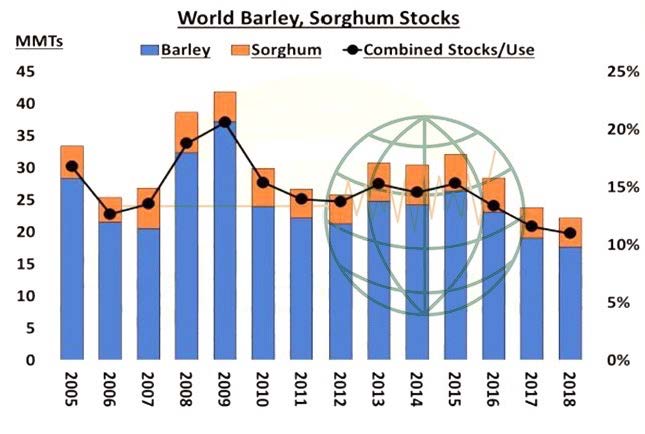
  • Combined world barley and sorghum end stocks in 2018/19 are projected at a record low 22 million mt. More attention than ever will be paid to rainfall and soil moisture in Eastern Australia this winter, as Australia quietly is the world’s second largest exporter of sorghum. A big crop is needed to fill Aussie’s own domestic feed demand, much less export 1.0-1.5 million mt.

  • Chicago futures are mostly higher are midday as corn, soybeans and wheat values climb. The summer row crops have been leading the advance while KC wheat is being pulled along. KC/Chi spread unwinding should be nearing an end with the Saudi wheat tender on Friday being very important for the US/world marketplace early next week. And GASC should be seeing this modest downdraft in world wheat prices as another forward buying opportunity. January soybeans are getting close to key resistance at $9.00 on short covering ahead of the Trump/Xi meeting in Buenos Aries while corn is following.
  • Chicago brokers estimate that funds have bought 3,400 contracts of soybeans, 4,900 contracts of corn, and 1,300 contracts of Chicago wheat. In soy products, funds have bought 2,900 contracts of soymeal and 3,100 contracts of soyoil.
  • Saudi Arabia issued a tender to secure 475,000 mt of world hard wheat (12.5% protein) for January to March. Russian wheat does not work on specs, so it is down to German, US or Argentina to fill the demand. Most in the EU argue that only a few cargoes of hi pro German wheat are available, not enough following last summer drought. As such, the Americas have a good chance of filling much of the tender demand. The big question is whether Argentine exporters will be willing to sell 12.5% protein wheat to Saudi following the flooding rains of last weekend. Sprout damage is already being reported which will turn an unknown portion of their milling wheat into feed. Argy wheat crop estimates are also in decline to 18-18.5 million mt from 19-19.5 million. US HRW wheat has a good chance to fill a portion of the tender. And, remember that of the 14 million mt of Argentine wheat exports, Brazil plans take at least half at 7.0-7.5 million during 2018/19.
  • WASDE head, Seth Meyers, at a Geneva Switzerland grain conference indicated that their 2018/19 US and world soybean export estimates included no new US soybean sales to China and that the US would fill 84-85% of non-Chinese world soybean trade demand. This means that any further cut to US soybean exports have to come from non-Chinese buyers.
  • NOPA soybean crush in October totalled 172.4 million bu, a bit higher than trade guesses and a new all-time record, barely edging out March’s 171.9. Soy oil stocks fell to 1,503 million, vs. 1,531 last month and 1,224 million a year ago. Soy oil disappearance is strong.
  • The midday GFS S American weather forecast is wetter across Central and Northern Brazil in the 10 day forecast and slightly drier in Northern Argentina. The rains for Central Brazil are adding up and agronomists are starting to worry about disease heading into the vegetative growth and early bloom period. Excessive totals of 6-12” are likely in the next 10 days. So far the weather across most of Brazil has been favourable, but the forecast needs to be watched. A series of ligh/moderate events Nov 22-25 will trigger accumulation of 1-2” across Buenos Aires, Santa Fe and Entre Rios in Argentina. Too much rain in N and C Brazil and Argentina remains the crop worry of the moment.
  • Russian wheat exporters are reluctant to sell beyond December amid the fear of an export ban or restriction. January soybeans have resistance above $9.00 and December corn above $3.80.