
11 April 2024

  • HEADLINES: USDA April report uninspiring, WASDE holds Brazilian soy crop at 155 million mt; Chicago choppiness to persist; N Hemisphere weather drives direction into May.
  • The USDA April WASDE report was uninspiring. WASDE left its estimate of the 2024 Brazilian soybean crop at 155 million mt, implying that the spread to CONAB’s April estimate (released this morning) will widen out to a record large 8.5 million mt. WASDE has held a better track record in recent years, but such a large crop disparity will not be resolved until Brazilian export and crush data identifies which government agency is correct by September/October.
  • WASDE left its Brazilian corn crop estimate at 124 million mt and decided to hold fast on their 2024 Argentine soybean crop forecast at 50 million mt but trimmed the Argentine corn crop by 1 million to 55 million mt. China’s 2023/24 soybean imports were unchanged at a record large 105 million mt.
  • The Brazilian corn crop estimate spread (WASDE vs CONAB) is 14 million mt, while two Argentine commodity exchanges argue that WASDE is too high on its corn production by 2-4.5 million mt for a total of 16-18.5 million mt. Admittedly it will require additional time and harvest data to better understand Argentine corn stunt disease. But from a market perspective, the differences between S American crop estimates are massive for April.
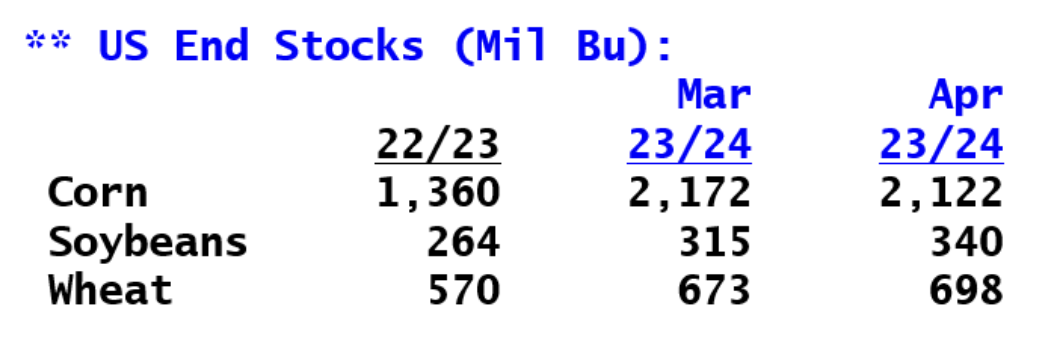
  • The USDA raised feed/residual use and the ethanol grind by 25 million bu for a bump in total US corn demand to 14,605 million bu. We argue that WASDE is still too low on its annual feed/residual estimate by 50-75 million bu. No change was made to US 2023/24 corn exports related to the limited change in S American corn supplies. The average US cash farmgate price is $4.70/bu.
  • US 2023/24 soybean exports were cut 20 million to 1,700 million bu on the slow export and sales pace. No change was made on the US crush rate which is surprising considering record large monthly crush data. The March crush rate will now loom large for the May WASDE report. WASDE trimmed US soybean imports by 5 million bu and adjusted seed/residual down by 11 million bu. The average farmgate price eased by $0.10/bu to $12.55.
  • US soyoil stocks rose by 45 million pounds on a modest gain in production of 45 million pounds while imports rose 50 million pounds while exports gained a like 50 million pounds. The net result was 2023/24 US soyoil end stocks at 1,627 million pounds, up 45 million pounds from March.
  • Global end stocks of corn, soybeans and wheat were virtually unchanged from March with only modest adjustments in demand. Global corn and soybean stocks are large, but wheat stocks are forecast to decline in 2024/25. The USDA April reports will not hold the attention of the market beyond today. Unfortunately, choppiness is likely to persist until there is a clear supply risk via weather.
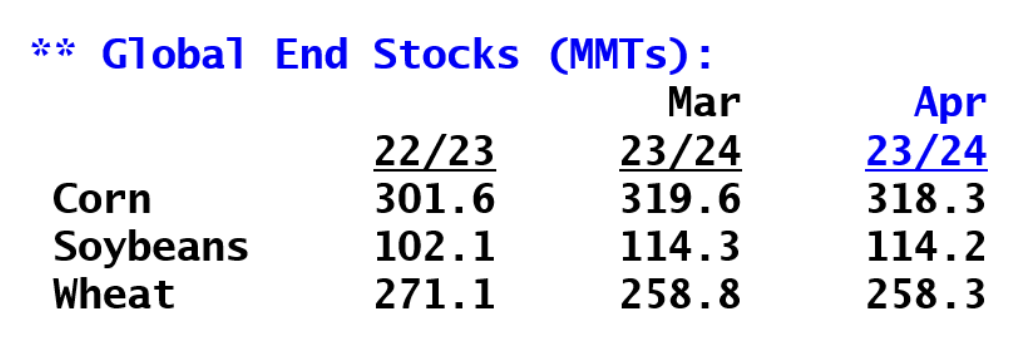
  • April WASDE wheat data leans slightly bearish as US residual use was trimmed by more than expected. 2023/24 US feed/residual was cut 30 million bu, with US end stocks raised to 698 million bu, vs. 673 million in March. Imports were lowered 5 million. We view USDA’s lowering US feed/residual as too aggressive, but this debate will go unresolved until end stocks are published in June. The additional old crop supply provides a buffer against weather/yield issues, but we note that it was spring, white and durum balance sheets that loosen. US SRW stocks were left unchanged at 119 million bu, and it remains that record yield is needed to prevent SRW stocks contraction in 2024 due to lost acres. US HRW end stocks were lowered 5 million to 277 million bu.
  • Exporter wheat stocks increased 1 million to 61.6 million mt. 2023 European production was raised 500,000 mt. Stocks in Kazakhstan were increased 500,000 mt amid lower projected export demand. That US and exporter stocks were lifted isn’t bullish of price today, but nothing in USDA’s April report was market changing. We maintain that the exporter balance sheet tightens in crop year 2024/25 amid reduced carryover and as production will be steady/lower amid lost winter acres in the US and W Europe. The duration of dryness in the US Plains and Black Sea remain top priority.
  • World ag markets’ reaction to USDA’s report is understandably muted. N Hemisphere is a big deal amid CONAB’s commitment to sharp declines in Brazilian output and an Argentine corn crop no bigger than 52 million mt due to disease pressure. Funds are carrying a record large net short position in the 2024 growing season. Don’t take your eye off Mother Nature!

10 April 2024

  • HEADLINES: Chicago mixed with European wheat closing strongly; Soybeans sag on bearish US soy export expectations; Drier GFS weather forecast for Northern Plains next 10 days.
  • Positioning for the USDA/CONAB Reports. Chicago grain futures are mixed at midday with soybean futures weaker while the grains hold in the green. The USDA April report will be released Thursday, and pre-report positioning is featured this morning. Traders are betting that USDA will cut US 2023/24 soybean exports by 20-40 million bu due to S American sales competition and slowing US export sales. Moreover, traders expect that WASDE will raise US corn ethanol demand by 25 million to a record 5,400 million bu and adjust 2023/24 US corn feed/residual upwards by 50-75 million bu due to near record September-February US corn feeding rate that was expressed in the March 1 Stocks report. Price (the market) is doing its job by initially building US corn domestic use. US 2023/24 wheat end stocks are forecast to be slightly larger on a potential cut in feed use of 10-15 million bu. The report lean is supportive to corn, neutral to slightly bearish wheat, and bearish soybeans.
  • We would argue that WASDE must also raise its 2023/24 US soybean crush rate by 20-30 million bu which would nearly offset the entire export decline, but WASDE may wait until the May report before raising crush in their wanting to make sure the US soybean processor is able to maintain a margin. US crush margins are floating just about profitability depending on the age of plant. We see soybeans as a sell the rumour and buy the fact opportunity.
  • The USDA announced the sale of 254,000 mt of US soybeans that were sold to an unknown destination for the 2023/24 crop year. The buyer is rumoured to be the EU that is securing/importing US old crop soybeans, crushing them and then drawing back the soyoil into the US for various carbon and blender’s credits. The spread between Brazilian and the US Gulf is just 28-35 cents/bu for mid to late summer which favours US soybeans if soyoil is exported back to the US for subsidy. We understand that 500,000 mt of old crop US soybeans have been sold in recent days to EU crushers to profit from like transactions. Spot Chicago soyoil is testing key chart support at the 50-day moving average and bottom of a flag formation.
  • US ethanol production was 310 million gallons last week, up 10% from last year, but down 5 million gallons from last week. US weekly ethanol stocks were 1,101 million gallons which was up 4% from last year as it nears a seasonal peak. The strong US usage season for ethanol is just ahead and stocks will soon start to be draw down on the return of 15% ethanol blends across the Central US. We would argue that WASDE should raise the US 2023/24 corn ethanol grind by 25 million bu either tomorrow or in May. Seasonal downtime is ahead, and the size of the decline will define if additional corn grind increases are needed. US ethanol margins are profitable, and the swap market argues that cash ethanol prices are rising on demand. The weekly production of US ethanol is record large.
  • Chicago brokers estimate that managed money has sold 4,600 contracts of soybeans while buying 1,900 contracts of wheat, and 4,100 contracts of corn. In soy products, managed money has sold 3,200 soyoil and 2,500 contracts of meal.
  • Additional heavy rain will drop across the N Delta and the Gulf States for another 24 hours where corn seeding windows are closing. The system pushes northeast through the Eastern Midwest with rainfall of 0.4-1.50”. The Plains and the W Midwest stay dry with warming temperatures.  A new system forms over the E Plains on Monday and slowly lifts northeast. The model is slightly further east with less rain compared to the overnight run and more like the EU model, though it is wetter through the Eastern Dakotas with rainfall of 0.25-1.00”. This storm lifts northeast into Thursday with cold and dry weather encompassing the Central US into the next weekend.
  • Chicago grain futures are awaiting the April CONAB/WASDE reports tomorrow. The reports are expected to be non-inspiring, and the focus of traders quickly shifts back to Central US and world weather. Planting will accelerate across the Plains/W Midwest, but N and W Plains dryness causes worry for wheat.

9 April 2024

  • HEADLINES: Chicago to stay choppy ahead of April WASDE release on Thursday; NASS to end county yield and livestock reporting in 2024; Midday GFS weather forecast too wet Gulf Coast States, too dry Western Plains.
  • More Choppiness! Chicago futures tried to push lower and break to the downside this morning and failed. Chicago values are weaker at midday, but off the early lows that were set right after the morning reopening. The volume of trade is limited at midday as the bulls and bears fight for directional dominance. We have been warning that neither rallies nor breaks will be able to carry through. And we doubt that Thursday’s USDA WADSE and CONAB reports will alter the wide Brazilian corn and soybean crop size discussion that persists. The bears argue that that the Brazilian soybean crop is north of 156 million mt due to expanded harvested acres, while a host of private sector analysts project a crop south of 149 million mt. Brazilian soy production stretches 2,300 miles from north to south and trying to be exact with seeded/harvested acres is impossible. Both the bulls and the bears will have to wait until Brazilian soybean exports seasonally run out to decipher whether Brazil’s soybean crop is 155 million mt plus or 144 million or less. We look for a mixed Chicago grain close with the market now trading in a range for the past 5 weeks. A bounce on Wednesday is expected ahead of Thursday’s WASDE report.
  • USDA announced that a 124,000 mt of US soybeans were sold for the 2023/24 crop year under the daily sales reporting system.  The unknown buyer is said to be Mexico, or the EU. Brazilian soybeans fob offers have risen to 24 cents over for July and 34 cents over for August which narrows their advantage vs the US Gulf at 60 over for July and 67 cents from August. The Brazilian soybean price discount to the US Gulf is just 34 cents vs last year at $2.00 Brazil under. The Brazilian cash soybean market is seasonally gaining and suggesting that the 2024 Brazilian soybean crop is under 150 million mt.
  • Brazilian interior soyoil basis is firm on strong domestic demand due to the elevated soyoil into diesel blend rate of 14%. Moreover, improving export demand for Brazilian soyoil due to its discount to palmoil is pulling cash soyoil basis bids upwards. China and India are buyers of S American soyoil on price spreads that will underpin Chicago soyoil futures below $0.46. The US cash soyoil basis is leaking, but S American soyoil is strong on demand.
  • HRW farmers are increasingly becoming worried by soil moisture dryness across the W Plains as rain appears to be limited into late April with warming temperatures. High temperatures will push into the 70’s/80’s with a few lower 90’s. Kansas crop ratings rose slightly this past week, but producers expect NASS ratings to decline without a weather pattern change. US HRW wheat ratings are below the 5-year average with NASS sending enumerators to the fields for yield measurements in several weeks. The bulk of KS/NE is dry into April 22 with showers to dot the Texas Panhandle in the week 2 forecast. The sharp decline in ENSO/Equatorial Pacific Ocean temperatures maintain a dry Plains trend.
  • Chicago brokers estimate that managed money has sold 1,000 contracts of wheat and 2,100 contracts of corn, while being flat in soybeans. Funds have sold 1,700 contracts of soyoil and bought 2,600 contracts of soymeal.
  • Additional heavy rains will drop across the Southern Delta and the Gulf States where corn seeding windows are closing. Farmers will have to switch acres to soybeans or enrol ground in the Prevent Plant program and take the summer off. The parade of wet weather across the Gulf States and the SE US shows no sign of ending. However, the good news is that rains are forecast for the N Plains and the SC Canadian Prairies where dryness has been a feature looking backwards to December. Iowa farmers are hoping that the rain extends southward to boost soil moisture.
  • Chicago grain prices are locked into a range awaiting the start of Midwest seeding. Seasonally, the risk vs reward is to the upside with Thursday’s WASDE report unlikely to produce any fireworks. NASS cancelled the July Cattle Stocks report along with county estimates for crops and livestock, which is disappointing.

8 April 2024

  • HEADLINES: Chicago firm at midday; Independent forecasters raise Brazilian soy estimate and lower corn; US weather pattern stagnates.
  • Ag markets at midday are mostly firm, with only soyoil weaker on crude’s modest correction as the world vegoil market’s rally pauses. Palm oil overnight fell 42 ringgits. Spot European rapeseed is down, with cash rapeseed oil in northern Europe flat at €950/mt. Rallies in May Chicago soyoil since mid-March have lost vigour at the contract’s 100-day moving average, but downside below $0.47 is low. It remains that the US soyoil must keep supplies in the domestic marketplace, which mandates premiums to other oils. We also note spot Malaysian palm oil doesn’t tend to score its seasonal peak until May.
  • US export inspections in the week ending April 4 included 56 million bu of corn, vs. 58 million the previous week and vs. an average needed to hit USDA’s annual target of 34 million bu/week. Recall weekly USDA/FGIS data doesn’t capture the full extent of US corn demand amid enlarged truck/rail movement into Mexico. Physical corn export loadings are expected to rise further in the next 30-45 days. There is evidence to support a 25-50 million bu hike in annual shipments as US origin is still competitive with S American into early summer.
  • US soy inspections were 18 million bu, vs. 20 million the previous week and unchanged from early April a year ago. We note the prior week’s shipments were revised upward 5 million bu. Wheat inspections totalled 18 million vs. 21 million the prior week. China loaded 56,400 mt of US wheat, mostly from the Gulf.
  • For their respective crop years to date, the US has inspected for export 1,076 million bu of corn, up 35% year on year, 564 million bu of wheat, down 11%, and 1,381 million bu of soybeans, down 19%. USDA is likely to shuffle its total US soy disappearance in its April WASDE by boosting crush but trimming exports 25 million bu.
  • Private forecasters updated Brazilian soy production, which figure has been raised to 145.5 million mt, vs. 143.9 previously, but still well below USDA’s 155. Total Brazilian corn production is estimated at 114 million mt, vs. 115 previously, as forecasters are less optimistic that safrinha area will be increased. CONAB’s acreage adjustment Thursday will be watched closely, but barring a major hike the global feed market is left with a Brazilian corn crop some 20-22 million mt below last year.
  • Otherwise not much in the way of market changing news. Weather forecasts grab increasingly more attention as the calendar inches closer to May. Contacts suggest HRW conditions are fine today, but soil moisture loss will be rapid over the next two weeks as temperatures rise, and meaningful precipitation stays south and east of major producing areas. Yet, there is no threat to spring row crop planting west of the Mississippi River. Timely seeding dates lie ahead.
  • The midday GFS weather forecast is consistent in allowing better rain chances into the Dakotas beyond April 15, but confidence over the placement and intensity of this event is low. Unwanted soaking showers persist across the Delta and far E Midwest. A rapid warming of temperatures occurs across the Southern and Central Plains this week.
  • Choppiness continues. It is difficult to be bearish seasonally in spring, but a new clear supply threat is needed to accelerate speculative short covering. The duration of heat/dryness in the Plains needs watching.

5 April 2024

  • HEADLINES: Chicago steady/higher at midday; Argentine corn production estimate trimmed; Crude at newer seasonal high.
  • Midday Chicago values are mostly firm but off session highs. The addition of premium in wheat was warranted but few want to make long-term speculations on the pace of Russian wheat exports in Apr-June. Ukrainian corn fob premiums have eased slightly, and May corn once again struggled at its 50 and 100-day moving average as a planting window opens in the Plains/W Midwest mid-April onward. We anticipate a strong close, but key today/early next week is whether May corn can close above $4.38, May Chicago wheat above $5.68 and May soy above $11.85. On the week, corn and soy are down $0.08; May Chicago wheat is up $0.13/bu.
  • We do note that spot Russian fob wheat offers have risen to $213/mt for nearby shipment, which compares to mid-March’s low of $198. It is tough to be bearish of wheat at current prices until/unless regular rain develops across the Black Sea region, which remains unlikely into April 20, while the loss of 1.1 million acres of US SRW mandates near ideal Midwest weather to keep end stocks stable. Temperatures in IL, IN and OH will be monitored this weekend and current forecasts project overnight lows of 29-31 degrees. Sub-28-degree readings trigger wheat stress.
  • The Buenos Aires Grain Exchange this morning trimmed its Argentine corn production forecast to 52 million mt, vs. 54 previously and vs. USDA’s projected 56. The crop’s rating this week fell to just 17% good/excellent, vs. 22% a week ago. Damage from insect-carrying bacteria is cited, while heavy rain/thunderstorms in March were a negative in east/northeast production areas. BAGE’s and CONAB’s combined S American corn production forecast of 165 million mt sits 15 million below USDA’s and 8 million below last year. Most private Argentine crop estimates moved towards 52-54 million mt, vs. mid-season estimates upward of 58-60. Exporter corn production in calendar year 2024 is likely to drop 23-25 million mt amid reduced seedings in Brazil, the US and Ukraine.
  • BAGE left its Argentine soy production estimate unchanged at 52.5 million mt, vs. USDA’s 50.
  • Spot soyoil is up $0.40/lb amid further strength in crude and gasoline. Additionally, global vegoil/fat prices have moved higher in the last week, and unlike a year ago, soyoil’s premium to competing markets is small.
  • At the time of writing spot Paris milling wheat is up €2.75/mt and spot EU rapeseed is up a sizable €9.50/mt. Needed dryness develops in Western Europe beyond early next week, with corn there typically planted in April. Spotty showers are hinted at in E Ukraine/C Russia, but rapid net soil moisture loss persists across core Russian winter wheat areas through April 20.
  • The midday GFS weather forecast is a bit further east with soaking rainfall in the Southern US. 10-day accumulation of 5-8” will favour east LA and MS, but seeding delays will be widespread across the Delta region. The GFS forecast remains in agreement in calling for heavy showers across the E Midwest. The C Plains and southern Canada stay arid. Warmer temperatures develop beginning early next week.
  • US, exporter, and world balance sheet changes, and price discovery, moving forward will be almost exclusively a function of weather patterns. El Niño is set to collapse in the next 45-60 days, which we would expect to bring about changeable/unpredictable weather patterns. It is still too early to chase large daily moves, but there is less tolerance for adversity amid reduced US cropped area. Wheat has the best story today if the Black Sea climate fails to change by mid-May.

4 April 2024

  • Two very recent news flashes:
  • Russian authorities are holding up two Egyptian ships loaded with wheat for export, in the latest sign that a domestic dispute between a key grain trader and the agriculture regulator is hindering deliveries abroad. The ships are carrying cargoes from Grainflower DMCC, which people familiar with the matter say is an export partner of Russian trader TD Rif. Rif has been targeted by the industry watchdog recently. Egypt’s Supply Minister Ali El-Mosilhy told Bloomberg News the ships were denied permission to sail because they did not have the right documents and are now being held up in Russian ports. They were meant to sail by the end of March, according to a January tender, and Egypt is waiting for a response from Russian embassy officials on the issue, El-Mosilhy said. The people linking Grainflower to Rif asked not to be identified as the topic is sensitive. Last month, Rif’s owner said the firm’s exports were being blocked and that it’s facing pressure to sell its assets for a “negligible price.” Meanwhile, the agriculture regulator has said it’s stopping some exports by Rif due to “systematic inconsistencies” in grain safety and quality. Egypt is a major importer and a key customer for Russian exporters. Spokespeople for Russia’s agriculture ministry and regulator did not immediately respond to email and phone requests for comment, nor did representatives for Rif and Grainflower. El-Mosilhy said that Egypt will decide what to do with the cargoes once it receives a response from Russia on the ships, which are named Wadi Almolouk and Wadi Safaga.
  • Polish farmers have for months been blockading the country’s border crossings, particularly with Ukraine, against the import of cheaper food products they say is harming their livelihoods. Poland plans to earmark PLN 2 billion (€467 million) on grain subsidies to help its farmers compete with a glut of Ukrainian produce and battle low market prices, a deputy agriculture minister has said. Polish farmers have for months been blockading the country’s border crossings, particularly with Ukraine, against the import of cheaper food products they say is harming their livelihoods. Stefan Krajewski told reporters on Thursday that the agriculture ministry was working on draft regulations intended to implement the demands of protesting farmers. “The drafts are ready, they must go through their own procedural path, but we want to introduce them as soon as possible,” he said. Among the planned regulations, according to Krajewski, is one regarding subsidies for the purchase of around 5 million mt of grain. “We want to allocate approximately PLN 2 billion to purchasing surplus grain from the market… arrangements with the Ministry of Finance on this matter are currently underway,” Krajewski said. He added that the subsidies would be paid out by the end of May.
  • HEADLINES: Chicago mixed/uneventful; US export demand cools in week ending March 28; GFS weather forecast warm/hot in US mid-April.
  • Midday Chicago values are mixed, with corn and wheat steady/higher and beans lower as oil/oil share corrects on weakness in crude. Spot WTI crude at midday is down $0.60/barrel at $84.85. Energy markets are overbought and last week’s counter-seasonal modest build in stocks has paused crude’s rally at $85. Crude is unlikely to reach a seasonal top until May, but a more two-sided energy marketplace is forecast nearby. The Dow is up 183 points.
  • US export demand in the week ending March 28 eased from prior weeks. Corn sales totalled 37 million bu, vs. 48 million the prior week. Corn export sales tend to drift lower beyond late March/early April as S American surpluses become imminent, though we note weekly sales into late August must now average only 17 million bu. Soybean export sales were 7 million, vs. 10 million the prior week. Wheat sales totalled 0.6 million bu vs. 12 million the prior week. USDA in its April WASDE is expected to leave its annual corn and wheat projections unchanged while trimming soy exports 10-20 million bu.
  • Longer term, there remains evidence available that USDA’s 2023/24 corn export forecast is understated.
  • Official Census corn exports in February were 211 million, 39 million (23%) above weekly FGIS inspections during the month. Cumulative official Sep-Feb exports sit at 948 million bu, 40% above last year, vs. USDA’s projected 26% increase. Incredible Mexican demand, which is not fully accounted for in weekly FGIS data, is cited with respect to this year’s sizable difference between USDA and Census numbers. US exports have committed 727 million bu to Mexico, up 195 million (36%) on last year. Recall even amid record Mexican corn imports, Mexican corn stocks will be just 2.5 million mt, which covers only 19 days of consumption. Mexico has become an even more critical market for US ag.
  • Census soy exports in February totalled 193 million bu, vs. 197 million a year ago and right at expectations. Official wheat exports in Feb were 76 million bu, a marketing year high and up 24 million year on year.
  • The midday GFS weather forecast maintains needed showers in the driest areas of Mato Grosso do Sul, while the monsoon continues to perform normally in Mato Grosso into April 15. Safrinha yield ideas are improved from mid-March, but it is lingering drought in Parana, which accounts for 15% of total safrinha production, and 2024’s decline in planted area that caps total Brazilian production at 115-117 million mt, vs. 137 last year. The Black Sea forecast is keeps rainfall in southern Russia light/spotty in nature. Temperatures in Ukraine/Russia stay abnormally warm.
  • The midday GFS weather forecast is wetter across the Delta/Southeast but consistent elsewhere. 10-day rainfall in LA, AR and MS is now forecast in a range of 5-8”, which triggers regional flooding and shifts more acres from corn to soy. A lengthy period of dryness blankets the Plains and Midwest into mid-month, and temperatures rise considerably beginning this weekend. The GFS forecast is likely overdone, but today features high temperatures in the 70s & low 80s April 13-15. Heat favours fieldwork and planting, but the extreme nature of the N American climate continues.
  • The theme stays rangebound nearby. Seasonal trends are positive into early summer and prices today are aligned with old crop supply and demand. Be prepared for weather-based volatility post-planting.

3 April 2024

  • HEADLINES: Chicago firm at midday; US ethanol grind stays strong; US dollar struggles at chart resistance.
  • Midday Chicago values are again mixed, with wheat up 10-12 cents, corn following and soybeans trading both sides of unchanged. A reversal of macro sentiment, a weaker US dollar specifically, has provided a pillar of support to the raw material space as the US$ index has struggled at major chart-based resistance. There is talk of China cancelling previous purchases of Ukrainian corn, but details are lacking. We note Dalian futures in China have been firm this week, and so it will be difficult to slow Chinese corn imports and also have feed market price deflation. Spot WTI crude is up $0.70/barrel at $85.90. The Dow is up 30 points.
  • It is difficult to find a specific catalyst for this morning’s strength in wheat, but it is difficult to be bearish seasonally and as the Russian fob market firms. Recall US SRW seedings in 2024 are down 1.1 million acres (15%) year on year, while spring seedings are near unchanged. Only the HRW balance sheet will feature stocks building in 2024, and there will be a need for regular rain in TX, OK and KS by late April. The HRW crop is rated highly today, but early April conditions correlate only loosely with final yields.
  • We would also note that the spot Indian milling wheat market is unmoved at $8.00/bu (equivalent) despite harvest having begun. The Indian wheat market tends to score its annual low in April, and the lack of any break in the next 30 days would be noteworthy. USDA’s attaché this week pegged 2024 Indian wheat production at 112.5 million mt, up 1.9 million on last year and record high. Yet, due to carryover stocks being decimated in the last two years, the Indian wheat balance stays historically tight in crop year 2024/25.
  • US ethanol production in the week ending March 29 totalled 315 million gallons, up 5.6 million on the prior week, 7% above last year and an all-time record for the last week of March. We estimate corn used for the production of ethanol in March at 461 million bu, up 6% year on year and the second largest for the month on record. USDA’s ethanol grind forecast is 25-50 million bu too low, and ethanol export demand has been particularly robust as the Brazilian market’s premium to US Gulf origin since early Feb has ranged from $0.10-0.20/gallon.
  • EU/Black and S American weather forecasts at midday are consistent with morning output. Heavy rainfall continues into mid-month across Mato Grosso, Goias and fringe safrinha producing areas further north. Rainfall expands into the driest areas of Mato Grosso do Sul and Parana, but not until April 11-12. A stagnant pattern of dryness persists in E Europe, Ukraine, and Russia into April 18. Russian dryness grabs much more attention if it persists into late April. Abnormally warm temperatures accelerate evaporation in the next two weeks.
  • The midday GFS weather forecast continues to trend drier across the US Plains, with rainfall now completely eliminated from TX, OK, KS and CO. Whether the EU model follows is key, as short-term moisture deficits begin to mount across the US HRW Belt. Otherwise, heavy precipitation into mid-April favours the W Midwest and Delta/Southeast, where soaking totals of 3-5” are forecast. A warmer temperature profile beginning next week sets the stage for Midwest fieldwork/planting opportunities in the second half of April.
  • Choppiness continues. Both the bulls and bears need meaningful perceived balance sheet changes for leverage, and we reiterate that it is Mother Nature that takes control May 1 onward. Our work suggests medium-term risks lean toward the upside amid funds’ sizable, short ag position and as weather extremes have been present for months. Stay cautious in chasing daily moves.

2 April 2024

  • HEADLINES: Corn falls on Midwest planting weather forecast; Oil share spread out to 42%; India government wants first shot at wheat harvest.
  • Midday Chicago values are mixed with the grains lower while the soy complex bounces. Selling in corn futures developed on news that China may be slowing its corn import pace, but more importantly on the open planting window that is offered across the Midwest after April 12. Warmer Central US temperatures and sunny skies are viewed as bearish as US corn seed gets planted on a timely basis. And history shows that when corn is planted early, US farmers tend to seed more corn and less soybeans. Hence the modest strength in the soy complex. Wheat is just a follower with May Chicago wheat futures unable to rise above its 50-day moving average. As corn sagged, so did wheat.
  • It seems Chicago/Paris futures are not ready to sustain a trend. Avoid selling sharp down days (today) or chasing rallies like last Thursday. Soyoil has a bull story on rising tropical oil values and the coming increase in US renewable diesel capacity. Also, the California Air Quality Board will be voting on feedstock origin certification in BOD meetings scheduled on April 11 and April 25-26. The certification of feedstock origins should help limit the import of tropical oils that are passed along as used cooking oil. A close above $0.498 May soyoil is needed to confirm a more bullish trend on the daily charts.
  • Managed money has been on both sides of the Chicago grain markets this morning. Futures brokers estimate that fund managers have sold 5,400 contracts of corn and 3,200 contracts of wheat, and 3,700 contracts of soymeal. Fund managers have purchased 2,900 contracts of soybeans and 3,100 contracts of soyoil. We calculate that the oil share spread has pushed out to a new high at 42.4%.
  • Central US weather is gaining the attention of traders. An open mid-April window for corn/soybean seeding is pressuring summer row crop futures, while Paris wheat futures are finding support on the excessively wet conditions across Western Europe and the net drying of soils across the Black Sea. And the US Plains need rain. There is a chance of Plains rain from April 10-12. Thereafter, rain chances decline as a broad ridge/trough form across the US. World weather patterns lean supportive of wheat and slightly bearish of summer row crops. In particular, close attention needs to be paid to Black Sea weather (warming temperatures and limited rain into April 20) for wheat.
  • India is asking traders to avoid securing new crop wheat so that state reserves can be replenished. India’s state wheat stocks are at a 7-year low. The last time that the Indian government made such a request of traders was back in 2007 when world wheat values neared record highs. India is forecast to harvest a 2024 wheat crop of 112 million mt, right at estimated domestic consumption implying that 2024/25 Indian wheat carry in stocks will be no larger than 9-10 million mt. India is on the cusp of becoming a sizeable wheat importer in coming years as its population and standard of living improves.
  • The midday weather forecast is drier across the W Midwest and the Plains than was offered overnight and on Monday. The models have shifted the heavier rains further east. Note that the Northern Plains hold in an arid weather trend as does much of the Canadian Prairies. Any weather delayed seeding will be across the NE US and the Gulf States where 2-4.00” of rain are forecast to fall. Warmth spreads across the entire Central US in the week 2 forecast with moderate ridge of high pressure to build across the South-Central US. This ridge is progressive and does not pose a drought risk.
  • Neither the bulls nor bears are pleased with choppy Chicago price action following last week’s USDA March Stocks/Seeding Report. Sustained price trends are lacking with soyoil being the only commodity that has upside based on rising world tropical oil demand. A close above $0.498 May soyoil would confirm the next bull leg. April Chicago grain prices are often changeable like spring weather. May corn futures have support below $4.25 and May wheat below $5.40, and May soybeans below $11.70.

1 April 2024

  • HEADLINES: Chicago starts new month/quarter with fund selling; Saudi purchases 795,000 mt of world wheat; China ships out US wheat.
  • Midday Chicago values are red in a correction of Thursday’s post NASS crop report rally. Central US weather forecasts are favourable, and the NASS crop progress report is expected to show improved winter wheat conditions relative to prior years later this afternoon. And the bears argue that NASS will find acres by the late June Final Seeding report with normal spring weather. The combined impact has been a correction of Thursday’s Chicago rally with corn/wheat futures sliding back to the middle of their recent trading ranges.
  • Soyoil futures are higher on active oil share spreading for seasonal considerations, the onboarding of the Phillips 66 renewable diesel plant in Rodeo California, and 2 California Air Quality BOD meetings with proposals on the table for feedstock supply origination certification.
  • We expect a lower Chicago close today, doubting that either breaks or rallies can be sustained. World farmers are becoming more bullish and holding back on cash sales in the Black Sea, S America, and the US. Adverse weather in the EU (too wet), Black Sea (too dry) with the Brazilian soybean harvest surpassing 80% this week prevents breaks from being sustained. Otherwise, an adequate supply of old crop cash grain/soy caps rallies and the leaves Chicago in a choppy overall trend nearby.
  • The new quarter started with fund selling. Chicago brokers estimate that funds have sold 6,900 contracts of corn, 2,200 contracts of wheat, and 4,700 contracts of soybeans. In the products managed money has sold 3,600 contracts of soymeal and bought 1,500 contracts of soyoil.
  • For the week ending March 28 the US exported 56.4 million bu of corn, 15.2 million bu of soybeans, and 18.3 million bu of wheat. Mexico and China were the big importers of US soybeans, while China shipped 200,000 mt of US wheat). We estimate that the US has just 600,000 mt of US wheat that is open to ship of a sales total of 2.087 million mt. China has shipped out 1.5 million mt of US wheat in total in the crop year to date.
  • For their respective crop years, the US has exported 1,018 million bu of corn (up 256 million or 33%), 1,359 million bu of soybeans (down 312 million or 19%), and 543 million bu of wheat (down 75 million or 12%). We look for WASDE to raise their 2023/24 soybean crush estimate upwards and adjust exports down by a like amount on April 11, allowing US soybean end stocks to hold at 315 million bu. WASDE should also raise its corn export forecast by 25-50 million bu based on record large Mexican import demand. Otherwise, any change in the April WASDE report will all be focused on S American crop sizes.
  • Saudi Arabia is said to have purchased 800,000 mt of wheat for delivery into July at CIF prices that range from $252-273/mt according to export sources. The Saudi wheat was sold as optional origin and today would be supplied by the Black Sea on price. The Saudi purchase news has supported Chicago wheat values.
  • Three storm systems take aim on the Central and Eastern Midwest over the next 10 days producing 0.75-4.00” of combined rainfall. The heaviest rain will be focused on IL, PA and TN. Spring seeding efforts will be initially delayed with the system for April 10-12 being further east than the overnight run. Snows are forecast for WI and portions of the upper Lake States mid-week. Warming temperatures follow with highs in the 50’s/60’s and lower 70’s.
  • Chicago breaks will be well supported by short covering ahead of the new Northern Hemisphere growing season since the March Stocks/Seeding Report did not hold a bearish surprise. US winter wheat condition ratings will be well above recent years this afternoon. However, spring crops in W Europe are soaked and farmers are becoming worried with corn planting to begin in earnest next week. Ongoing dryness and budding heat draw Black Sea soil moisture downwards into mid-April. This is a crop area that will need close attention into May.