16 July 2015

  • The USDA has today released its weekly export figures as detailed below:

Wheat: 291,500 mt, which is below estimates of 300,000-500,000 mt.
Corn: 656,200 mt, which is within estimates of 475,000-825,000 mt.
Soybeans: 552,500 mt, which is above estimates of 150,000-550,000 mt.
Soybean Meal: 72,200 mt, which is below estimates of 125,000-300,000 mt.
Soybean Oil: 3,600 mt, which is within estimates of zero-15,000 mt.
  • US old crop corn exports were a marketing year low at only 13 million bu (330,000 mt) while old crop wheat sales were just 10.7 million bu (291,000 mt) and old crop soybeans were 1.7 million bu (46,000 mt). New crop sales were little better with corn at 12.8 million bu (325,000 mt), and soybeans at 18.6 million bu (506,000 mt). All told, total sales were around half the volume they should be at this time of year demonstrating the point we repeat ad nauseam, I.e. The US is struggling as prices rally while other key exporters are far cheaper on an FOB basis.
  • Brussels has issued weekly wheat export certificates amounting to  494,856 mt, which brings the season total to 974,548 mt. The season to date total is 579,514 mt ahead of last year.
  • US and world weather has improved in the past week with needed drying over much of the waterlogged E Midwest while the rain chances shift NW to include the N Plains, W and N Midwest. The rain here is desired. Also, the key corn and soy areas of the N Plains of China have received needed moisture – as have most of the Canadian Prairies and Eastern Europe. Even E Australia has enjoyed an abundance of rain for their new wheat crop. This leaves only France/Spain as being in dire need of rainfall. The good news here is that the major forecast models now offer 2 chances of moisture in the next 8 days. It will be welcomed; US and world weather is improving.
  • Algeria is reported to have purchased between 300,000-400,000 mt of wheat at a price of $222-224 C&F for Oct shipment, which looks to be $7-9  below replacement basis yesterday’s levels. Currently French wheat calculates into Mexico, below US – yes that is correct! Russian is cheaper than French, and their feed grade wheat is cheaper still making it a competitor to corn. In terms of more unusual markets or market anomalies, it is strongly rumoured that Dreyfus are to ship two cargoes of Argentine soybean meal into the SE US (alongside some grain) with arrivals anticipated in late Aug/early Sep and October. This news was probably the trigger for the soybean market to drop into negative territory towards the close tonight – another argument for overpriced US markets (sorry to labour the point!).
  • Matif corn markets lifted higher on growing crop concerns as heat records were broken across France. Aside from some isolated thunderstorms there is little in the way of precipitation forecast for the stressed French crop. Focus on the EU corn crop at 62 million mt, and falling, together with imports at 15 million mt, and rising, places strong focus on Ukraine’s S&D. There is a strong argument for corn consumers in Europe to consider taking cover right now!

15 July 2015

  • Today has seen a mostly weaker Chicago led by soybeans as light soybean/corn spreads were unwound on profit taking. Chinese stock market weakness added to the weaker tone. Also the fundamentally overpriced US soybean and meal markets when compared with S America appears to be being noticed right now. Technical support in Sep CBOT wheat has also given way leading to weakness.
  • As the US$ rallied energies (crude oil, gasoline and ethanol) weakened pressuring ag markets. Weekly US ethanol production was 289 million gallons, 1 million lower than the previous week, and roughly in line with the pace needed to meet the USDA’s projected forecast.
  • The US weather forecast, which is so influential right now, is little changed with helpful rain across the W and N Corn Belt with warm/dry conditions in the East. There is no excessive heat indicated outside the S and E Plains.
  • Anticipated export sales are at levels unlikely to inspire confidence of a return to US competitiveness and as such new crop corn and soybean export commitments look as if they will remain well behind last year’s levels.
  • US corn and soybean markets will require a steady flow of bullish news (where from we know not) in order to maintain the recent rally. Yield data will be unknown until August/September and coming weather looks favourable, and the US’s poor position as far as export competitiveness in global markets will likely cap rallies. In the absence of lasting heat/dryness in August, or a rapid shift to further flooding in the E Midwest, it certainly feels as we have made intermediate highs in the early part of this week.
  • Yesterday (in the absence of an update due to travel commitments) saw Egypt secure a further 235,000 mt of wheat, 120,000 mt from Romania and 115,000 mt from Russia pretty much as expected. The volume of offers from Russia and Romania reached over 800,000 mt, all offered cheaper C&F than the single French FOB cargo (most of the French were away celebrating Bastille Day). Of note is that the Russian/Romanian prices were some$15-30/mt below comparable US Gulf levels further highlighting the non-competitive position of the US right now.

  • The Iran nuclear deal looks as if it will open the path to weaker crude oil/biofuel prices as well as the return of Iran to the wheat market (despite their $50/mt import duty which may be something of an obstacle). Something to watch in coming weeks and months.

14 July 2015

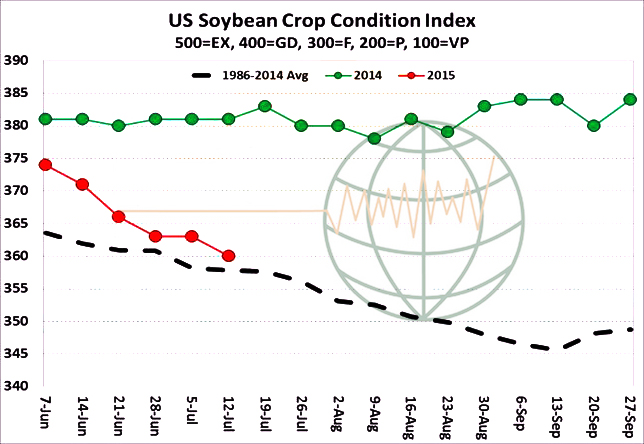
  • NASS reported a further decline in soybean crop ratings, with national good/excellent slipping 1% to 62% as declines in the east continued to offset gains in the west. Excluding the 2012 drought, IN crop ratings are now the lowest since 1996 (for mid-July) while MN ratings are the 2nd best on record. It’s a case of the good and ugly for Midwest soybean conditions. 38% of the crop was blooming and 6% was setting pods, both of which are right near the 5 year average. The weather forecast at the start of the week calls for near to above average temps with near to below normal rain for the wettest parts of the Midwest. Our view is that the season’s low in crop condition ratings is at hand. US ratings will likely improve into August. We hold to a US soybean yield of 45.5 bushels/acre and that a seasonal high is being scored at the CBOT amid bearish seasonal trends.

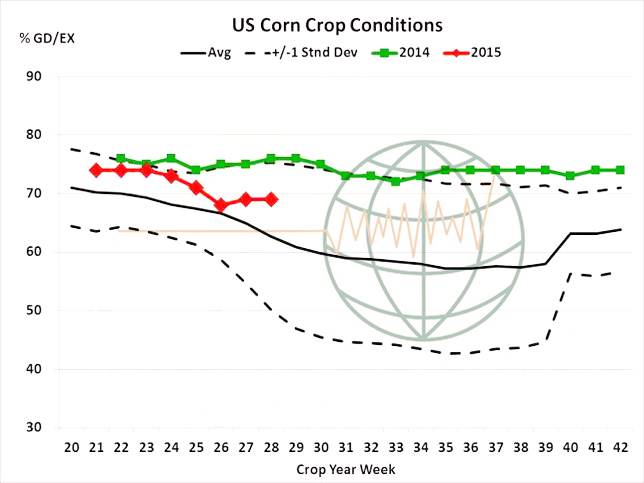
  • US weekly corn crop conditions were steady at 69% good/excellent. Changes of note included good/excellent downgrades of 4-5% in IL, OH and PA which was offset by 1-2% improvements across MN, MO, NE and the Dakotas. The ratings point to WASDE being right on keeping yields at trend at 166.8 bushels/acre. In 1993, another wet year, US corn good/excellent ratings fell to just 49% good/excellent, 20% lower than the current crop. The 2015 US corn crop is 27% silking, vs. 31% a year ago and 34% on average. We view this evening’s crop update as bearish relative to $4.50 Dec, with the 2-week forecast projecting welcomed warm/drier weather across the E Corn Belt. And while the speculative market debates yield/production, prices are viewed as expensive against S American & Black Sea origin supplies as well as deferred ethanol margins.  A US yield at or above 164 suggests a range of $3.60- 3.90. Current corn futures are very rich relative to known fundamentals.

  • US spring wheat crop conditions improved 1% to 71% good/excellent amid uniform boosts across the Dakotas, MN and ID. This compares to 70% good/excellent a year ago and a 10-year average of 68%. The crop is 91% headed, vs. 66% a year ago. Winter wheat is 65% harvested. Our sources maintain a Russian harvest estimate of 57-59 million mt and so total Black Sea production may rise another 1-2 million mt in subsequent WASDE releases. We expect a test of $5.30, Chicago, once a top is posted in corn, and wheat is overvalued via any statistical measure above $5.50. The world market is facing record large stocks. There is no demand story in wheat and futures are overvalued relative to stock/use analysis.

13 July 2015

  • Today’s early decline in prices in Chicago failed to hold with the funds once again moving in to buy, which saw prices move into positive territory, although not convincingly higher. Discussion on yield and weather has moved up a gear following Friday’s USDA report and is the current “hot topic”.
  • The bulls are arguing that US 2015 corn yield will be below 160 bushels/acre, and the bears are calling for trend or better. In fact, the USDA type corn yield model based on Central US rainfall and precipitation that has occurred and what is forecast for the next 2 weeks argues for a US corn yield of 172-173 bushels/acre – a record! To counter this, growers are citing record rains that have caused significant losses and a below 160 bushels/acre yield. Some areas have seen soybean and corn crops washed away by rain, but this is only in localised areas. It appears that you pay your money and take your choice. In corn, will the yield be above 170 or below 160? That is the question!
  • Today’s crop condition report may help to strengthen one or other side of the debate, and we will report the figures tomorrow, but for now it appears the trade is looking for a 1-2% decline in good/excellent rating in both soybeans and corn. This is probably one of the reasons for the funds to be adding length to their positions.
  • It should be noted that both crops have historically suffered more in hot and dry conditions rather than in wet conditions and the likelihood of wet conditions lasting through the remainder of July and August is remote. It should be borne in mind that the wet conditions will likely leave corn and soybean crops with shallow root systems as they have not had to “search deep” for moisture! A change to hot and dry conditions could leave such shallow rooted crops vulnerable to stress, but it is far too early to be considering such matters just yet.
  • In Paris the Matif wheat market fell to 2-week lows as harvest moved ahead without interruption and demand patters remained thin to say the least. Both Russian and Ukraine harvests are reported to be slower than last year but both are reporting higher overall yields. However, the Russian export tax position continues to be a lottery and a meeting between the government and customs officials may (but we are sceptical) bring a resolution.
  • The potential Greek deal (potential as it needs ratification by the Greek government) brought little relief to the strained €uro and Greece has yet to find interim financing – no easy task. It should be noted that the Greek Finance Ministry has effectively surrendered all control to the Troika as Tsipras caved in on just about everything!

12 July 2015

Weekly CCI Analysis:

The CCI/CRB index closed lower with crude oil pushing closer to $50/barrel amid the anxiety over China and Greece’s economic outlooks. Greece is seeking a package of $50 billion to stay in the €uro while China is struggling to maintain its pace of 7% GDP rate growth as it becomes more of a domestic led economy. Although China’s stock market was able to recovery 8-9% by the end of the week, the damage to consumer confidence was already accomplished with 1000’s of stock issues closed and a loss of $3 trillion noted. We have previously pointed out the serious issues that China has with excessive debt and a rapidly ageing population. Although China will be likely be able to orchestrate a stock market recovery, the outlook for China’s future economic expansion is dimming. This means that the bullish super cycle for world commodities will have to find another long-term demand driver into 2020.

Longer-term soybean analysis:

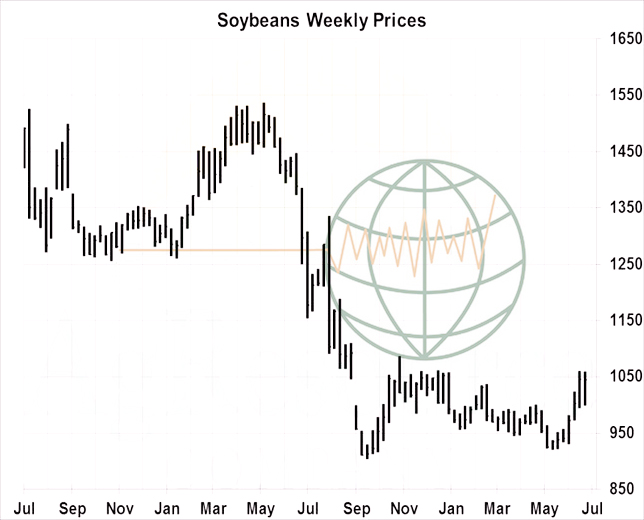
Soybean futures traded a broad range through the week and finished little changed. Selling and profit taking developed in the first half of the week, while fund buying and short covering returned into and after the July WASDE report. The report offered little insight, but expectedly confirmed a tighter old crop balance sheet. The USDA lowered old crop stocks to 255 million bu on increased crush, exports, and residual use. New crop US soybean production increased due to larger acreage and no change in yield, while stocks declined due to lower carry in. The big question for the market going forward is weather and yield. Warmer/sunny/drier weather conditions are needed in the E Midwest for crop condition ratings to improve. We believe in a minimum US 2015 soybean yield estimate of 45.5 bushels/acre – 0.5 bushels/acre under the NASS July forecast. Longer term, it’s the lack of US soybean export demand that will pressure prices as China is active in securing Latin American soybeans that could drop US soybean exports by 100-200 million bu and raise 15/16 US soybean stocks above 500 million bu.
Longer-term corn analysis:

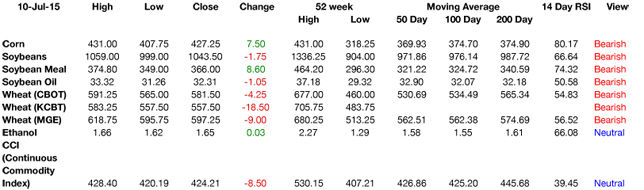
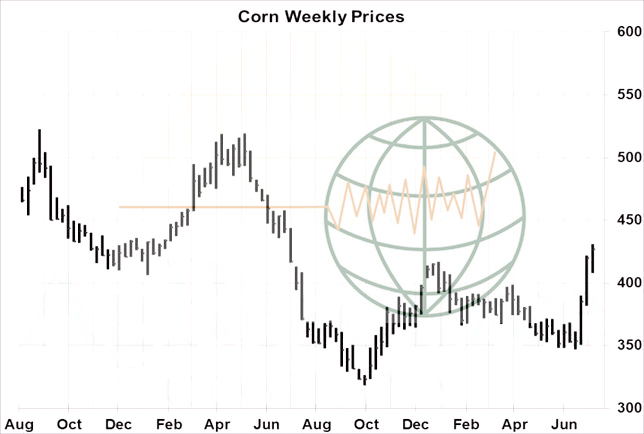
Corn futures settled 6-7 cents higher and advanced to new rally highs. Greater than expected rain fell across portions of IL/IN this week, and the trade’s estimates on yield are wide ranging. Funds are placed firmly on the long side of the market. Whether these new bets are ill placed will hinge upon July/August weather – which we note is improving. The models in recent days have trended drier/warmer across the C and E Midwest. If this outlook is realised, we maintain that national yield will exist in a range of 164-168 bushels/acre, which in turn suggests an average fall price of $3.40-3.70, basis Dec. Even the USDA’s crop balance sheet in July suggests the market is overvalued by 30-40 cents. The focus of the market will shift to lacklustre export interest beyond the next 5 weeks. US exports are needed to sustain any lasting bull run, and this will be difficult amid steep discounts in South America. Brazil sold 2 cargoes of their corn into the US this week. A more dire weather pattern in July is needed to validate $4.50 Dec.
Longer-term wheat analysis:

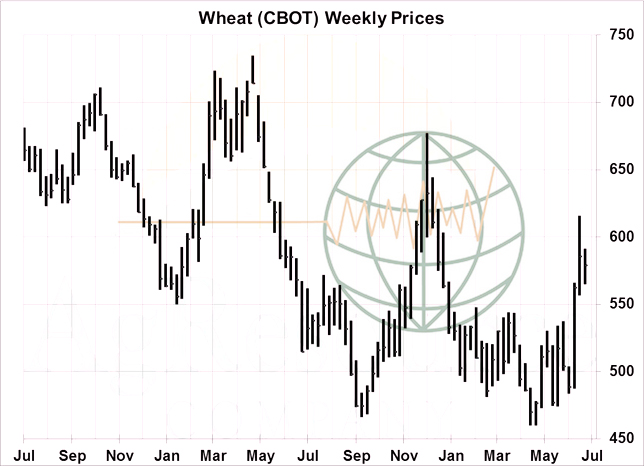
The wheat market lost 14-20 cents as the interest of funds in new long positions waned. Black Sea cash prices are only inching higher, rather than following sharp gains in the US, and prices now are only discouraging demand growth. The USDA’s July WASDE added more fundamentally bearish input by raising Black Sea production (and exports), and projecting total world end stocks in 2015 at a record large 220 million mt. This is largely due to lower Chinese demand, but is also indicative of weak global consumption. Russian fob prices remain the world’s benchmark and offers for Aug/Sep rest at $200-205/mt, which is comparable to $4.90- 5.00 spot Chicago. EU wheat is offered at an equivalent to $5.15. We view Chicago wheat as overvalued by some 30-50 cents. Funds are expected to liquidate their newly established net long position as the US export opportunity languishes. A return to $5.00 is forecast.
8 July 2015

  • CBOT markets have managed to regain some of Tuesday’s losses as fund buyers emerged once again to defend their longs. Wetter weather in the E Midwest is once again being discussed with ½-2” likely in the next 24 hours. Additionally, the market is nervous ahead of Friday’s July crop report.
  • Informa Economics has reduced its estimate of soybean plantings in the state of Missouri by 1 million acres (from the USDA’s June estimate) due to rain delays. It also cut its estimate of US 2015 soybean output to 3.77 billion bu, reflecting a 41 million bu drop in Missouri’s output based upon the reduction in plantings.
  • Wheat yields in C France are reported to be better than expected, which is encouraging.
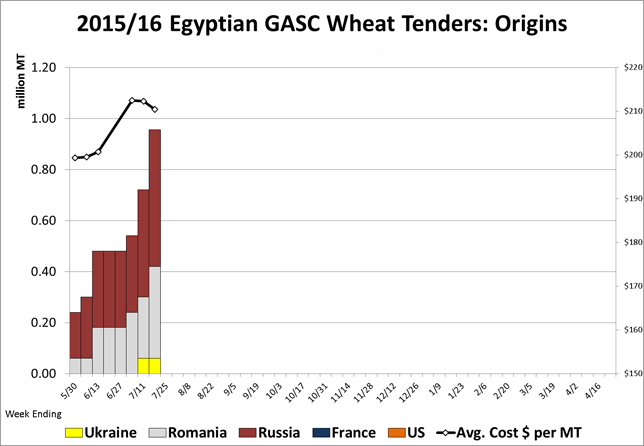
  • Egypt’s GASC purchased 180,000 mt of wheat for August 11-20 shipment, at an average price of $212.26/mt, a shade below their last purchase on 2 July. Russia picked up 120,000 mt and Ukraine the balance in a lineup of offers that also included France ($20 too expensive) and Romania ($1-2 too expensive). Matif prices slumped as much on the reaction to the lack of business secured by the French as well as on yesterday’s French AgMin crop number.

7 July 2015

  • Tuesday’s trade has shown us some lower levels on the back of further improvement in Midwest weather and a risk-off mentality, both of which have combined to pressure prices, particularly so in early trade. Both China economic and Greek exit concerns have headlined as the CRB Index continues to fall, sharply. The US DOW looks to be set for its lowest close since February as global markets fret over future global economic growth, and Greece’s unpaid debt burden.
  • Funds and large speculators are reported to have been huge sellers – seemingly they now appreciate that the recent rally was built upon a record shift of managed money from equity and industrial commodities into the ags. It appears that the funds have not been moved from their longs in grains, whilst in the soy complex it is the soybean oil market that has reflected the funds length disposal. Soybean oil is closely watching, indeed following, crude oil which is itself watching the nuclear negotiations in Iran – that extended overnight.significant
  • US soybean crushers and grain consumers are reported to have secured significant volumes of cash supplies during the past few weeks of price rally and have cover extending well into August. They are now looking for improved weather and its impact upon new crop prices before extending their cover further forward.
  • Reports from the Black Sea are suggesting that there will likely be an upward revision to the 2015 Russian wheat crop, possibly as high as 59 million mt, on the back of high early reported harvest yields in SW Russia. The early harvest is also reported to be of high quality, but the unknowns over the export tax situation has prevented any significant market move. Exporters are reported to have reduced bids to growers  on both the yield and quality news as well as the export tax uncertainties.
  • Matif wheat closed €4 lower helped by losses in Chicago as well as reports of better than expected prospects in C France as well as a French AgMin crop forecast of 37.9 million mt, up 1% on last year. Additionally, one major weather model has taken most of the heat out of the European forecast from Wednesday, but not added rain apart from in Germany.