
11 December 2014

  • CBOT markets have seen something of a bounce following yesterday’s decline post USDA data release. Fund buying was, once again, in evidence with corn (Mar ’15) regaining the $4.00/bu mark although closing below that level. Corn’s gains have pulled soybeans higher and wheat followed dutifully.
  • Egypt’s GASC made another purchase, again January shipment, and we can only describe the outcome as a surprise. Offers on paper yesterday were around the $259 FOB level, yet GASC secured 60,000mt of French at $247.24 FOB and 120,000 mt of Russian at an average of $$250.70 FOB – this is about a $10 drop in a day! What should we conclude? There were cargoes in place which needed to be moved; January may be the last month of shipment; there is more good wheat in Russia than previously thought. Any one of these could be correct, as could any combination. Interestingly there was an offer from the US at $277 FOB plus $31 freight, why bother? Maybe this was just to show how uncompetitive US wheat truly is right now! Maybe CBOT markets should take heed, listen and adjust accordingly. MATIF wheat traded as much as €3 lower, but finished the day pretty much unchanged, and FOB buyers withdrew from the market en masse.
  • EU wheat export pace slowed a touch this week with 377,640 mt of export certificates granted. This keeps the season total ahead of last season but by 709,060 mt (5.38%) rather than the one million mt plus we have been used to in recent weeks. Corn imports for the week reached 102,000 mt bringing the Oct-Sep season total to 984,000 mt vs. 2.541 million mt last year.
  • US weekly export data was released as follows:

Wheat; 526,500 mt which is above estimates of 250,000-450,000 mt.
Corn; 962,800 mt which is within estimates of 800,000-1,000,000 mt.
Soybeans; 810,300 mt which is within estimates of 700,000-1,000,000 mt.
Soybean meal; 88,600 mt which is within estimates of 50,000-200,000 mt.
Soybean oil; 14,700 mt which is below estimates of 15,000-30,000 mt.

  • There is talk today that China will allow DDG’s from the US to be imported, via some channels, and this has supported corn somewhat. The suggestion that this is “payback” for losses on cargoes last year holds water although there is no official sanction on the deal. In addition, it should also be noted that volume is expected to be very limited simply because China has too much of its own corn to even consider volume imports.
  • We should also be mindful that news of the upcoming Chinese delegation to the US should be taken with a pinch of salt. The signing of the usual frame contracts for soybeans and the like (with no performance bonds or penalties for failure to perform) is simply part of the annual seasonal pantomime – and we will doubtless hear of substantial soybean “deals” on the table. Caution on this point is the watchword..
8 December 2014

  • Wednesday’s USDA report is just around the corner and markets are trading cautiously until release, there is an anticipation of US soybean stocks reducing on account of higher than anticipated exports and this is underpinning prices at present.
  • There is a suggestion that Ukraine has defaulted on 500,000 mt of corn sold to China due to “difficulties” in sourcing, although this is unconfirmed at this time. There is also talk of China permitting imports of US DDG’s to assist end users who are experiencing financial difficulties, and is despite the ongoing MIR162 debacle. DDG markets have rallied a touch on the news but it has to be said there is no shortage given the recent ethanol production uplift.
  • Crude oil prices are lower once again with markets shedding more than $2/barrel and there is something of a drag on commodities as a result. The US$ is stable and the Russian Rouble remains deeply troubled amid lost oil revenues.
  • The US weather forecast appears to offer a retreat of tdry conditions across the West Coast and Southern Plains in the coming two weeks with a cumulative 6-8” moisture across CA, OK and WA in the next 10 days and an isolated system working across TX, OK and East KS by the weekend. Temperatures look to remain mild and major snowfalls look absent through to 22 Dec.
  • S American forecasts maintain a stagnant pattern of light to moderate rains across most of Brazil and Paraguay in the coming ten days with Argentina a little drier. The pattern looks favourable, and crop health maps continue to show improvement. The developing El Niño pattern suggests that S American forecasts (normal temperatures and precipitation) are unlikely to change into early January.
  • Drier areas of W Australia are forecast to receive welcome rains in the coming ten day period whilst a mix of rain/sunshine elsewhere will permit a more normalised planting pace.

4 December 2014

  • Starting tonight’s update with Europe it was interesting to note the MATIF wheat was down €3 for most of the day, with London correspondingly low, before bouncing €2 off its lows, and unusually it is difficult to see why. The price uptick happened prior to the release of Brussels export data as well as the 140 point rally in the Euro on the back of President Mario Draghi’s comments. Weekly wheat exports reached 761,129 mt, which brings the season total to 13.52 million mt, 1.15 million mt (9.3%) ahead of last year’s record pace. EU corn imports for the Oct-Sep season reached 882,000 mt with the week seeing 231,000 mt imported. Last year’s comparable figure stood at 2.262 million mt, which highlights the year on year swing in appetite for corn. However, this weeks import figure marks a season high, and may well be the first sign of awareness of the relative cereal prices with corn starting to look cheap once again. The trend is worth watching as any significant increase may well place adverse pressure on wheat end stocks, with all that this entails.
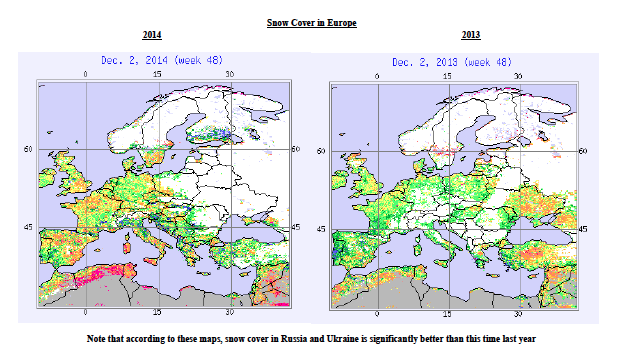
  • For those who have proclaimed doom and gloom over Russian and Ukrainian cereal crops suffering extreme cold and lack of snow cover, the following graphic may ease the fears somewhat. According to our sources there is little in the way of seasonal anomaly and snow cover is generally pretty good. 


  • CBOT prices started the day in defensive territory before US weekly export data was published which showed soybean and corn exports to be larger than expected which triggered a move higher. Full figures are as follows:

Wheat; 313,200 mt which is within estimates of 300,000-500,000 mt.
Corn; 1,170,600 mt which is above estimates of 600,000-800,000 mt.
Soybeans; 1,179,800 mt which is above estimates of 650,000-850,000 mt.
Soybean meal; 227,200 mt which is above estimates of minus 50,000-plus 60,000 mt.
Soybean oil; 25,100 mt which is within estimates of10,000-30,000 mt.

  • StatsCan released their latest figures which showed the 2014 all wheat crop1.8 million mt higher than previously estimated at 29.28 million mt which was above trade estimates of 27.8 million mt although below last year’s record 37.53 million mt. The canola (rapeseed) crop was seen at 15.56 million mt below last year’s 17.97 million mt but still the second best figure on record. This latest update was1.46 million mt above StatsCan’s previous estimate and above trade estimates of 14.6 million mt.
  • Finally, there has been a suggestion that the Argentine government is to limit credit offered to farmers who hoard soybeans – our take on this one is struggling to get into print!

3 December 2014

  • Markets have continued lower today in slower trade and some of the losses have been regained in later trade as crude oil and outside markets have displayed some stabilisation. The decline was led by wheat, for a change, as Egypt secured Eastern European and Black Sea wheat in its latest tender, amongst a pretty good volume offering, and Kansas futures saw a big volume of deliveries tendered.
  • GASC’s latest tender saw three French offers for the early Jan ’15 shipment period, albeit prices were not sufficiently competitive, Romania picked up 120,000 mt and Ukraine 55,000 mt. EU wheat markets declined sharply, probably more on a little publicised meeting in Moscow between the AgMin and Deputy PM at which it was decided to take no decision on export restrictions. With no further meetings scheduled, the market gave back recent gains in sharp style. Doubtless Egypt’s GASC is probably delighted to have something competitive other than French on this occasion. US was notable, but not surprising, by its lack of offers given recent upward price moves and this continues to highlight their lack of current competitiveness.
  • Informa Economics today updated its global crop production estimates including a Brazilian soybean output for 2014/15 at 93.5 million mt, a 500,000 mt increase on their previous estimate. Argentine output was trimmed 500,000 mt to 55.5 million mt. Of note was the estimate for 2015/16 Russian wheat output at 55 million mt, which at 4 million mt below the current year is an improvement on more recent pessimistic suggestions.

2 December 2014

  • There is a distinct lack of fresh fundamental news today, so we will be brief! Soybeans have led the markets lower presumably on the back of traditional seasonal demand tailing off and also on favourable S American weather forecasts tat stretch into the latter part of December. Of note is that fund buying in wheat appears to be tailing off.
  • Crude oil was losing more value at midday and gold was also trading lower amid commodity indices all showing lower numbers.The US$ hit fresh highs once again in what seems like an unshakeable trend right now.
  • The “head and shoulders” chart formation in soybeans and meal is being tested today and a close below the “neckline (inline with today’s lows) would put significant pressure on markets in coming days. LATE NOTE – CBOT closed below the neckline – look for lower soy and products prices in coming days.
  • From a physical grain perspective the cash markets in Europe and Black Sea present an interesting perspective which does not fully correlate with MATIF or CBOT wheat futures. Be cautious in the run up to year end, all may not be as it seems.

1 December 2014

  • Monday sees a return to normality as far as working hours and routines are concerned. As we awoke it felt as if some bargains might be on the horizon in the aftermath of the late Friday lashing which afflicted CBOT soybean and corn markets after we had (nearly) all closed up shop for the weekend. The decision by OPEC to hold crude oil output steady had a depressing impact on global energy prices which retreated to their lowest levels since 2009. Competition between the traditional crude producers and the shale producers is likely to keep pressure on biofuels from corn and vegoils. The global oversupply in oil and the fact that US blending margins for both ethanol and biodiesel are deeply negative adds to the pressure.
  • The technical “head and shoulders” pattern which has been building in soybean and meal charts remains in place and it feels very much as if this will be tested in coming days. The level of support seen will be important and a determinant of future direction into the year end.
  • The weekend saw no fresh news on the legislative position to be adopted by Russia in relation to grain exports and the Rouble continued to look weak. There were rumours of tariff imposition late last week although it seems that by the time these could be put in place, which would likely be Feb/Mar 2015, up to 90% of the exportable crop would already be exported. Therefore market strength related to the news appears a little premature to say the least.
  • News that one of the worlds biggest hedge fund managers, Brevan Howard, is to shut its $610 million commodities fund following losses suggested to be 4.25% to October ’14, highlights the ongoing poor performance in the commodities world. The Thompson Reuters Core Commodities CRB Index, which embraces 19 commodities, has fallen by 9.2% this year, its biggest fall since 2008. Excess supplies and weaker growth in China, a major buyer of commodities including soybeans, iron ore and copper, has impacted market prices and outlook negatively. The outlook for China remains weak and appears to be heading for its slowest expansion in growth in 24 years. Little wonder that “tremors” are being felt elsewhere and nervousness over growth around the world abounds.
  • A quick round up of global weather issues highlights that drought is persisting in Russian winter grain regions. Cold and dry conditions persist across EasternRussia which is reported to be impacting winter grains negatively although we believe it is perhaps a little early to be raising concern levels too high. Lack of snow cover is reported to have allowed frost to penetrate deeply into soils. The key Southern District which produces over 60% of winter wheat has received only 8mm out of the usual 35mm of rainfall in the last month. Late summer drought has lasted with only 55% of normal precipitation falling across the four key southern regions of Krasnodar, Stavropol, Rostov and Volgograd. The Black Earth wheat, north and east of Ukraine, has received only 25% of normal rainfall in the last three months. In total, some 80% of Russian wheat area is under some form of stress and this needs to be watched in coming weeks.
  • It is reported that another (3rd) cargo of EU feed wheat has been sold into the US. This latest cargo is reported to be French origin, and it should be stressed this is, as yet, unconfirmed.
  • Fund buying of wheat has been the feature of the day as prices get close to $5.90/$6.00 basis the Mar ’15 contract. These price levels feel very heavy, particularly in relation to corn, and we would expect to see feed users and ethanol producers looking very closely at the economics of switching away from wheat and into corn.
  • China has reported its corn stockpile to be at a record high of 120 million mt, which is 42.4 million mt or 55% above the USDA’s latest estimates. Stock of this level equates to 60% of annual usage and there are suggestions that additional storage is needed to accommodate the enormous stockpile. The record stocks have been encouraged by a government minimum price reported to be over $10.00/bu in 2014 as well as improvements in agricultural practice which have improved output significantly. Record yields have been set in each of the last seven seasons as well as growth in planted acres resulting in today’s reported stock levels. Under current WTO commitments China cannot subsidise exports and will have to increase domestic consumption in order to utilise stocks. It is expected that GMO and phyto-sanitary rules will be fully utilised by China to reduce or eliminate cheaper imports, and it is estimated that up to four years could be required to reduce stocks to a manageable level.

28 November 2014

  • News has been limited as the US holiday has taken its toll on market activity, however, CBOT markets closed in an explosion of activity with the soybean complex sharply lower in late trade, corn also lower but to a lesser extent whilst wheat made somer further gains.
  • Focussing on wheat to begin, the Russian Deputy Ag Minister, Dmitry Yuryev, advised that Russia will not ban grain exports in 2015 due to the sharp fall in the value of the Rouble, however, it could consider a variable tariff on grain exports. The trade seem to be dismissing any tariff adjustment in the near term as Russian export pace so far this year has made new record highs. Unless severe adverse weather conditions impact crop development and overwintering it is not expected that an export tax will be applied.
  • From a technical chart perspective (in soybeans and meal) we have been watching the formation of a “head and shoulders” pattern in recent days, and it appears that this has been recognised and technical traders are jumping  on board. There is a methodology that allows a calculation of the move, which is a mirror of the upside, and (if fulfilled) would provide good rewards to those who have the confidence to short the market.
  • This is traditionally the time when seasonal “tops” are scored more often than not, and (given favourable S American weather) we could be in for a repetition this year.
  • Now that the Thanksgiving holiday is behind us, and we return to a full week of trading next week, we would expect the fundamentals to reassert themselves and the older downtrend to be resumed.

26 November 2014

  • Today has seen the grains making gains and the soybean complex shedding value ahead of the US Thanksgiving holiday shutdown. Trade has been active ahead of the Friday December first notice day and the holiday weekend has created active rolling of positions to deferred contract months. Interestingly we have seen the Dec/Jan soybean meal spread push wider to a new high of $24.00 Dec premium, which is doubtless causing someone some pain. The last high was set in October and today’s new high created a flurry of activity, which when added to EU and US meal shorts being forced (as December looms large) to close Dec positions in the thin pre-holiday market, pushed front month values even higher. The high values may well incentivise crushers to tender meal onto the futures market at a record and somewhat surprising market high.
  • The announcement of a further sale by US exporters of soybeans (120,000 mt) to China came as something of a surprise. However, unpicking the details suggest that it was traded on a basis and could well be switched to S America if the March cash basis permits, and it seems almost inevitable (at this time) that it will. The large volume of soybeans already shipped and en route to China as their crush margins ease back also points to softening import demand into the New Year.
  • Nearer to home, the EU’s proposed €315 billion investment package, aimed at boosting the flagging economy, pushed equity markets modestly higher.The US$ also rallied as the market viewed the package proposal as being “too little, too late”. Crude oil also eased further to fresh lows ahead of the upcoming OPEC meeting.
  • Soc Gen, in a widely distributed forecast has stated its bearish outlook for soybeans with a price forecast for the Jul/Sep quarter dropping to $9.49/bu, more than $1.00 lower than current values. They added that the near term faced the challenge of a drop off in export demand for soybean meal, which has latterly been the price prop for markets. Sales pace was noted to have eased back from its early rapid level as new crop soybean supplies reached the market. Their view on S American output was interesting insofar as they saw it “mixed” with an El Niño pattern potentially leaving N Brazil with dry conditions, and S Brazil to C Argentina wetter than average. If output came in at expectation they suggested that it would herald a further downtrend in already reduced prices in the second half of 2015 in an overall picture of more than adequate global stocks.