3 April 2013

  • Today sees a plethora of data releases, key items are listed below:
  • Russia’s AgMin reports their 2013 grain crop at 90-92 million mt, which is a downgrade from their last estimated level of 90-95 million mt although an increase from last year’s 71 million mt.
  • Argentina’s Rosario Grain Exchange (RGE) estimates the 2012/13 soybean crop at 48 million mt, which is unchanged from a month ago; their forecast for the corn crop is 25.3 million mt, which is a 200,000 mt reduction from last month’s estimate.
  • Informa Economics released estimates as follows; the 2012/13 Argentine corn crop at 25.3 million mt, a 300,000 mt reduction mom, Brazil’s 2012/13 corn crop is estimated to be 71.95 million mt, a 350,000 mt increase mom, China’s 2013/14 corn crop is forecast at 213 million mt, an 8 million mt  increase mom.
  • Informa’s soybean estimates are for the 2012/13 Argentine crop to come in at 52 million mt, a 1 million mt increase mom; Brazil’s crop is seen at 83.25 million mt, a 1.25 million mt decrease mom.
  • In the news today we read a number of reports of “bird flu” in China, to which a number of deaths (human) are attributed. In 2009 a global flu pandemic was predicted, based upon a similar bird flu strain, albeit the prediction did not materialise into reality. As a consequence we have seen a decline in soybean prices, initially on the Dalian exchange, on fears of reduced soybean meal consumption.
  • EU grains have made gains and are now not too far below pre-Thursday report levels. News that EU crops (specifically UK, France and Germany) are three to four weeks behind normal, when placed into the context that EU wide stocks that are at just over three weeks consumption, makes for a fascinating potential market development. Add to the EU situation a potentially very tight Russian wheat supply, by which we understand potentially running out, the picture becomes doubly interesting and we will look with interest to see how this unfolds in coming weeks.
  • The latest Russian wheat outlook looks to be challenging to say the least. Poor autumn establishment in dry conditions, followed by Oct-Dec sub normal precipitation led to the crop entering dormancy in poor condition. Improved winter rains have improved matters but possibly too late to see a full recovery and crop potential. Spring weather, specifically rainfall will be absolutely key in determining output for the region.

2 April 2013

  • Where to start is probably the first thing on our mind this evening! Two days of what can only be described as a “bloodbath” have left Tuesday opening markets in something of a recovery mode following Thursday’s surprise data, all of which is now today’s fish and chip wrapping. All eyes are now awaiting April’s USDA report, probably in the hope that there will be something to feed the bulls rather than further fattening the bears and their incessant appetite for lower levels.
  • If we look back for a few moments, Thursday’s CBOT corn trading volume was the 2nd largest ever recorded at over 655,000 contracts, Monday (which was a working day in Chicago) hit close to 600,000 contracts also. Combined volume over the two days amounted to almost HALF the total annual US corn production; this perhaps illustrates the significance of Thursday’s report!
  • One significant follow through effect of the report and its numbers is that the $1.00/bu price drop will, and is, encouraging ethanol producers, export demand and feed usage. Ethanol margins will most likely increase, livestock producers will likely benefit and importers will see an opportunity to lock in better purchase prices. In our opinion, this is not conducive to preserving US stocks at the correct level to see them last until harvest – clearly time will tell.
  • The drop in corn has had its knock on effect on both soybean and wheat prices, which have similarly dropped in big style, leaving value to end consumers. Little wonder that we see, and hear, from many who express a desire to progress on a “hand to mouth” basis going forward.
  • In other news it seems that planting progress for corn in the US is slowing as Midwest weather sees a return to cold and wet conditions. Spring wheat planting progress in S Dakota, where winterkill is reported to be above average (up to 26% winterkill is reported) , is also marginally behind average for this time of year. One commentator reported the central Plains wheat area as a “disaster zone” with crop condition at an all time low.
  • In the UK conditions continue to heap misery upon hard pressed arable farmers. March has seen the coldest conditions in over 50 years, delaying field work and pressuring output forecasts even at this early date. Spring sowings are reported to be at 15% compared with an average of 50% at this time; temperatures over the last week have barely crept above 0℃, when last year the UK was basking in 23℃ and fieldworks were well above the norm. Some are questioning the potential for significant acreages in the UK to be left unplanted, or fallow, if conditions do n to change for the better, and quickly. The upshot of this will be for an even greater “hit” to output, which is already forecast at multi-year lows.
  • Finally, we hear that the Ensus bio-ethanol plant on Teeside is to close once again, for an unknown period, citing “adverse market conditions”. The plant has only recently reopened following its latest shutdown. The “on-again, off-again” approach leaves little confidence in wheat consumption as well as DDG availability going forward. Competitive US ethanol imports as a result of subsidies and EU duty anomalies do little to assist the North East based plant.
  • Clearly, the return to work following the Easter break has not come as an easy one. Challenges on many fronts continue to rear their heads and the way forward is less than clear right now.

27 March 2013

  • A look back over recent years data show that in the days following the March stocks and seeding report markets have a strong tendency to some extreme volatility, the difficulty is in objectively picking the correct direction! Bullish, or bearish, which way will it go tomorrow? One level of difficulty which we face here in Europe is that by the time we digest the figures the game will be over and the sop shut for a four day weekend as Ester kicks in. By the time we return on Tuesday it will all be old news and markets will have reached their new trading levels.
  • Trade estimates for the March 1st stocks are as follows (billion bu):

                    Average            Range
Corn            5.030            4.916 – 5.248
Soybeans    0.947            0.912 – 1.059
Wheat         1.167            1.010 – 1.238

  • Interestingly, the spread of estimates is biggest in corn with 332 million bu, followed by wheat at 228 million bu and soybeans bringing up the rear at 147 million bu. Clearly, with such a range there are going to be winners and losers as with all markets and we await tomorrow’s report with interest.
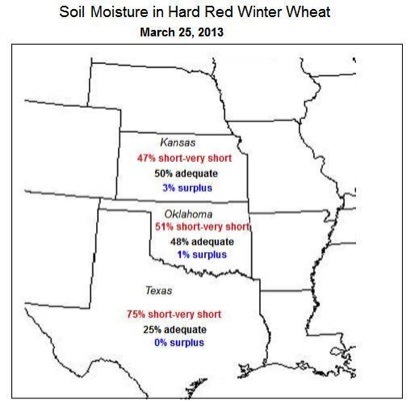
  • US hard red winter wheat producers in the top three states report a worsening of crop condition with 27% reaching good/excellent and 34% poor/very poor with 39% reported as fair. Soil moisture has declined in recent weeks with little rainfall in the region in the last fortnight. It appears that Texas has seen particularly arid conditions as growers report 75% short or very short of topsoil moisture.


  • Drought at this time is particularly bad for wheat crop development as the plant is jointing and in need of ample soil moisture to assist development of essential flag leaf formation in coming weeks. Added to the soil moisture issue, the recent cold snap has hit plants well past dormancy, and as such more susceptible to damage. It is highly possible that secondary tillering, if it occurs, will compensate for current damage, but if we have a repetition of these cold conditions the resultant damage is likely to be more permanent and yield reducing.

26 March 2013

  • We move another day closer to Thursday’s influential stocks and planting report with weather attempting to delay plantings in the US. The implication of delayed corn planting is that it defers the pollination phase until the hotter weather and, as we saw last year, damage to output can be serious if temperatures remain in the 100℉ or higher zone.
  • EU weather also remains in the headlines with northern and central Europe receiving cold temperatures and sufficient moisture in the form of rain, hail or snow to create waterlogged conditions sufficient to both delay plantings and also harvest. Added to the huge pace of exports and consequent tightening end season stocks it looks as if Europe is heading towards an increasingly squeezed position.
  • In a semi comical moment we heard that the Brazilian judiciary were attempting to impose fines upon truckers for illegal parking on the highway, when in reality they are queuing to deliver their consignments of soybeans into the well documented congested port zones. The fact that this is really happening makes it “semi” rather than “totally” comical! However, on a more serious note, the issue is adding further pressure to an extremely pressured situation and momentum back to US supplies is growing. This, added to the possibility of a bullish report on Thursday, could well provide strong upside price movements, which will not have much of a time related relief valve given the Easter weekend break.
  • In other news, Oil World today reported their latest forecasts with the Argentine soybean crop at 48.5 million mt, which is reduced from 50 million mt a month ago (but still up from 39.7 last year). The Brazilian crop was forecast at 81.3 million mt, down 700,000 mt last month, but an improvement on last year’s 66.4 million mt. To contrast this, AgroConsult reported their outlook for the Brazilian crop at 84.4 million mt, which is 200,000 mt up on their last month’s estimate.

25 March 2013

  • CBOT markets have started the week in lacklustre style with only corn showing any sign of strength, but that evidence so far this week is minimal. Perhaps this is unsurprising ahead of Thursday’s stocks and seeding reports; predicting what will be reported has become a better spectator rather than participative sport these days. Trying to second guess what will be reported has not met with huge success so fat this year. That said, we do have a view, and we favour tightening stocks in soybeans and corn, which we have mentioned once or twice before!
  • Seemingly the UK is not the only place to be impacted by snowfall this weekend, the US Plains and Midwest have also been the recipient of significant snowfall as well as extreme cold. Hardly classic spring weather and potentially cause for delays in both sowing and harvest which is hardly what the globally tight markets are needing right now.
  • On a brighter note, at least the US drought which began last year and extended well into the winter has had some relief from rain and snowfall. The downside is that we will be looking at delayed seeding, potentially delayed harvest and the consequent extension of usage which will further stretch already stretched corn and soybean stocks. There appears little likelihood of a reduction in corn grind for ethanol because of mandated inclusion, and feeders (poultry in particular) have no current reason to ease back as prices remain subdued – for now. We remain vigilant for “triggers” which will change the current benign pricing scenario – maybe Thursday will bring one of them to the attention of the trade.

22 March 2013

  • How things change! On this, the third day of Spring we wake up to blizzard conditions across much of northern UK and ten inches of snow with more to come in the next 24 hours. Southern regions, whilst not experiencing snowfall, are being hit with further torrential rainfall which will hit farmers who were starting to see soils drying out sufficiently to allow fieldwork. This unseasonal turn of events will further delay spring planting and potentially push harvest back to some degree. This has already been voiced as a concern from a pan-European perspective and at a time when predicted end of season stock levels are already stretched close to breaking point. Any increase in consumption as a consequence of an extended season will add to the looming problem.
  • London and Paris wheat markets have seen some gains this week, reaching levels last seen over a month ago. Whilst following stronger CBOT levels, the fundamentals this side of the “pond” have assisted the uplift. Recent overhead resistance in May ’13 Paris wheat has been breached to the upside and should provide some degree of support going forward. Physical markets in Europe have seen some good support on a cash basis and premiums over futures have remained strong. Domestic demand in both the UK and Europe has been good, as has export demand, all adding to positive sentiment.
  • In a more global context we heard earlier in the week that China was reportedly cancelling up to 2 million mt of soybeans on the pretext that shipping delays in Brazilian ports had placed sellers in a default position. This news was unsubstantiated and we subsequently picked up on reports of the Chinese government selling substantial stocks of state owned beans to allow crushing to continue in the face of shipping delays. Chinese crush margins remain strongly positive and it appears that meal demand too is buoyant. Consequently, our conclusions are that rumours have been planted to encourage lower prices thereby permitting purchases to be made at advantageous prices or switching of supplies back to the US. In addition China will, in due course, seek to replenish their stockpiles; presumably when cheaper and more abundant supplies are available.
  • The Cypriot “bank raid” continues to rumble on with no resolve since erupting last weekend. Banks remain closed, ostensibly to prevent a run on cash, and debate continues back and forth as to whether smaller depositors will or won’t be taxed. Whilst Cyprus may not be the most significant player in the EU, the potential precedent and its impact on others is not being overlooked. Other countries and their depositors are, not unreasonably, nervous of their own position. The Eurozone crisis, which has slipped from headline news in recent weeks, has once again moved back into a prominent position.
  • In conclusion, we see continued pressure on old crop grains, and maintain our view that gaps in cover should be few and far between. Protein (soybean meal) price does have the feeling that it is vulnerable to downside just as soon as S American supplies become freely available and port congestion issues subside – hopefully sooner rather than later. The USDA stocks and plantings reports, issued next week, may well trigger some old crop upside if our view on stocks is reflected in the numbers. Certainly it has felt as if CBOT markets have been trading with this in mind this week.


21 March 2013

  • Following on from yesterday we can report that China is supposedly selling significant quantities of state owned soybean stocks to crushers to assist depleted supplies caused by Brazilian port congestion and associated shipment delays. Sales from state reserves will need to be replaced in due course, presumably when prices have eased – whenever that may be!
  • Interestingly, ahead of the eagerly anticipated USDA report, we are starting to see a plethora of acreage and output forecasts, the latest Reuters reported farm survey talks of the largest corn area since 1936 at 97.43 million acres. The same survey also reports intentions to plant a record soybean acreage at 79.09 million acres, a 2.5% increase from last year. Clearly, in the wake of stocks which are close to record lows the need to rebuild stocks has never been stronger. For survey numbers to become reality it is important for both prices and weather to play their part in the equation, and it is entirely possible that wheat could well lose out in the overall scheme of things.
  • The International Grains Council (IGC) have put forward their view that world wheat output will rise in 2013/14 to a four year high with a corresponding increases in end stocks of 3 million mt, this number is a drop in the ocean compared with the 20 million mt decline seen in 2012/13.
  • The UK is forecast to return to cold and wintery conditions tomorrow with significant snowfall predicted for large swathes of the country further adding to the gloomy outlook for autumn sown crops and further delaying spring sowing. The ongoing cold also leaves us pessimistic as far as the prospect of early harvest is concerned.
  • The US it would seem is similarly experiencing frost, snow and below average temperatures, which are deepening frozen soil conditions rather than bringing on the spring thaw. These conditions can be a mixed blessing, in some areas the increased snow cover could well add to overall precipitation totals aiding eventual crop development, in others spring sowing delays may detract from overall output, As the saying goes, “you pay your money, and take your choice!”
  • US weekly exports were reported as follows:

Wheat: 573,300 mt which was within estimates of 550,000 to 1.12 million mt
Corn: 275,500 mt which was within estimates of 50,000 to 650,000 mt
Soybeans; 341,900 mt which was below estimates of 450,000 to 1 million mt
Soybean meal: 143,400 mt which was above estimates of 40,000 to 120,000 mt
Soybean Oil: 19,600 mt which was above estimates of zero to 15,000 mt

20 March 2013

  • We have see another day of gains in London & Paris wheat markets, May ’13 gaining £4.40/mt and €8.50/mt respectively. Clearly there has been some “following” of US markets, but technical resistance levels in Paris (€240.00 basis May ’13) have been broken, encouraging higher levels. Cash bids (and premiums) have remained strong and as the prospect of an early harvest recedes in the face of ongoing cold and wet conditions, current record low forecast stocks will be further pressured by an extended season. Both France and Germany are seeing strong domestic demand and export interest adding additional pressures.
  • In the US early interest was evident in both soybean and wheat markets as buyers sought early value; cash bids for corn continued to rise and traders started to exhibit signs of concern over the potential for bullish numbers in the end March stock report, which is due to be released on 28 March.
  • Reuters commodity forecasting arm, Lanworth, has released its latest estimates, the highlights including an anticipated record US soybean area at 81.3 million acres with 3.455 billion bu output, a slight reduction from their last estimate. Corn was forecast at 96.5 million acres with output pegged at 13.64 billion bu, also a slight reduction on last forecasts. The report stated that flat profitability in corn as well as changed crop rotation and a return to “normal” spring weather were key reasons for the increase in soybean acres. We have picked up elsewhere that as a result of last year’s “corn on corn” yielding disappointingly and fears of continued dry conditions may well be additional reasons for growers to favour soybeans over corn this coming season.
  • In the same report, Lanworth increased its forecast of Argentine corn production to 25.5 million mt, a 600,000 mt increase, and also increased its outlook for soybean output to 50.5 million mt, an increase of 1.1 million mt. Brazil’s soybean output was forecast at 81.1 million mt, a modest 300,000 mt increase, whereas corn output was cut 0.5 million mt to 76.4 million mt.
  • Finally, Reuters news reports that India is engaged in discussion with Egypt over the potential to supply wheat. India has large residual stocks following a series of good crops with output exceeding domestic demand. This has left India in need of additional sales in order to make space for the forthcoming harvest next month, which is expected to be in excess of 92 million mt; domestic demand is estimated at about 76 million mt, which by our calculation is a surplus of 16 million mt.

19 March 2013

  • Markets have taken a slightly more pragmatic approach to the Cypriot crisis, which appears to be heading towards a “softer” raid upon deposits belonging to smaller savers. Until a decision is reached, the banks remain closed to prevent a run on cash withdrawals, and this is expected to last until Thursday. Russian opposition has been noticeable, probably due to the fact that it transpires that around one third of all deposits in Cypriot banks are Russian owned! The IMF is supportive of the somewhat modified proposition, presumably as are smaller depositors!
  • Australia’s ABARES (Australian Bureau of Agriculture and Resource Economics) and the UN (United Nations) have forecast global wheat output to grow to its second highest level on record, 690 million mt, they believe a return to more normal growing conditions, as far as moisture and temperature are concerned, is on the cards. Global end stocks are similarly estimated to rise, an additional 2 million mt is predicted to be added to bring the figure to 176 million mt. An overall increase in food supply is seen with rice output heading for a record according to the UN, and record US soybean and corn crops predicted by the USDA.
  • Reuters news wires have been active with reports of up to 2 million mt of soybean shipments due to be cancelled by China following shipping delays in Brazil as a result of the much publicised port congestion. Supplier default is cited as due cause for the cancellations, and Chinese buyers are presumably not keen to extend shipment periods on, what are now, expensive purchases. It must be pointed out that the reports are, at this time, unsubstantiated, and possibly rumour only in an attempt to get prices down sufficiently to permit Brazilian soybeans to be swapped into US. Crush margins remain strong in China and demand appears to continue to be strong, so news of such wholesale cancellations could well be tactical rather than factual.
  • Following on from yesterday’s Egypt news, there are reports today that the government are discussing plans to ration subsidised bread; we believe this to be linked to the ongoing IMF loan discussions. When added to the upcoming strike by bakers due to high wheat/flour prices, we could be looking at another politically explosive situation – remember the “Arab Spring” which was triggered by high grain/flour/bread prices?
  • One thing is for sure, and that is we continue to live in an interesting world.

18 March 2013

  • The weekend news has been dominated by reports that Cyprus may be forced by Eurozone finance ministers into making depositors in Cypriot banks share in the costs of the latest bailout. The Euro fell to its lowest vs the US$ this year and the rise in the US$ has left commodities under pressure throughout the day. Reaction has largely been one of a “flight to safety” as gold has risen over 1% in value, being viewed as a “safe haven” – for now!
  • At the same time the IMF is in talks with Egypt with a view to making loans, necessary to allow government backing to wheat importers, when they make purchases (notably absent in recent times). The nation’s past refusal of loans is believed to be because of the stigma associated with implied austerity measures and the potential domestic disturbances which could follow. We have referred in recent days to the news that Egypt has been publicly stating it has large wheat stocks, and added our sceptical view that this could well be a “smokescreen” to mask the true reason for their lack of recent wheat tenders.
  • Reuters today reported that Ukraine may be about to extend its current (informal) grain export cap leaving the government free to exert greater control over domestic price levels. The limits imposed on 2012/13 export volumes were brought about by a combination of drought reducing overall output and growth in foreign demand around the world, both of which conspired to potentially leave Ukraine with insufficient stocks to last until the 2013 harvest.
  • Brazil’s top soybean producing state, Mato Grosso, has benefitted from its recent dry spell which has permitted swift progress for the harvest, but could well prove to be the undoing of the “safrinha”, or second, crop of corn which is traditionally planted following the soybean harvest. Soil moisture levels, essential for successful germination and development, have suffered following the recent dry period. March, a traditionally very wet month in Mato Grosso, has seen little, if any rainfall so far. Pre-planting estimates of Brazilian next corn harvest have been similar to last year’s bumper crop, which reached a record 73.5 million mt. Unless rainfall materialises, and soon, these sort of output levels will be unlikely as dry conditions will not permit the crop to get as good a start as it received last season.