7 July 2015

  • The fund positions were updated with data released last night (rather than last Friday on account of the 4th July US holiday). Readers will notice some big changes; we have seen the largest weekly combined soybean, corn and wheat net gain since our data collation began at the start of 2012. The funds added a massive 253,336 contracts (corn 147,053, wheat 56,863 and soybeans 49,420) This still leaves them net short in corn and wheat, 9,214 and 22,413 respectively and we saw the net soybean long position position grow week on week.
  • Our weekly fund position charts can be downloaded by clicking on the link below:

Fund positions

  • We have in recent weeks reflected on what we saw as a massive shift of ownership within the CBOT grain and soy markets. Key moving averages were breached and fund managers piled into a massive amount of long corn positions that drove CBOT values higher into July. The chart below reflects this massive ownership change and whether this net long fund position is justified will be determined by weather and yield estimates in coming weeks.

  • Soybean planting progress through Sunday advanced to 96% complete, with this week’s report to be the last national planting progress update. Crop ratings were unchanged with national good/excellent steady at 63%. MO soybean seeding advanced to 73% and by next week we argue that some 80% will be planted leaving 1-1.1 million acres unseeded. We continue to hold to a bearish outlook on large global stocks and declining competitiveness in global markets. S American exports look to deeply cut into traditional US business leaving the US with a potential to hold over 400 million bu of 2015/16 stocks.

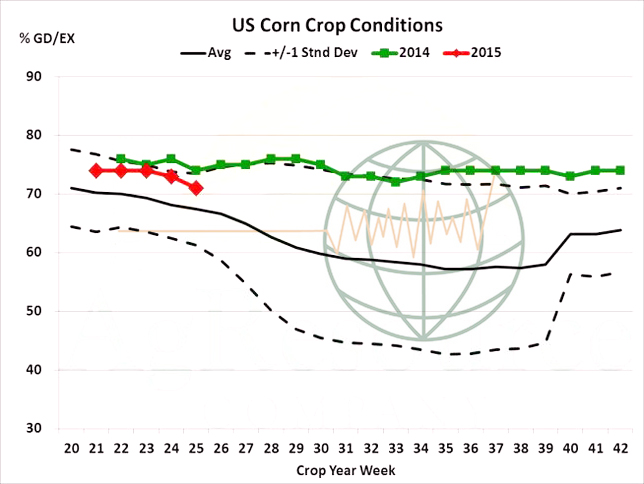
  • US corn good/excellent ratings were pegged at 69%, vs. 68% a week ago and 75% last year. Highlights include 3% improvements in MN, MO, OH and TN, while IL, IA and KS were down 1%. Such a national rating – as of this week – points toward a yield range of 164- 169 bu/acre. Further improvement is expected next Monday. The US crop is 12% silking.

  • US wheat crop ratings are down slightly on the week. Winter wheat conditions are put at 40% good/excellent, vs. 41% a week ago. Ratings across the PNW continue to erode, with ID and WA down 3 and 6 points, respectively. Good/excellent in KS is up 1% at 33%. Good/excellent is OH is pegged at 52%, up 6% on the week. US spring conditions fell 1% to 70% good/excellent – also amid deterioration in ID and WA. Winter wheat is 55% harvested, unchanged from last year. Spring wheat is 76% headed, vs. 44% a year ago.
6 July 2015

  • Today is a sad day for traditionalists, like us, the closing bell in Chicago will mark the last open outcry market in grain and soy futures, with all trade thereafter being electronic. Option trade will continue as previously but we will see the end of some 167 years of pit based trading come to an end!
  • It has been an interesting start to the week, particularly in the light of recent higher prices, as we have seen improved US Midwest weather pressuring CBOT soybeans, corn and wheat (significantly earlier in the day). Some of the losses in wheat were pared back as speculative buying kicked in on the back of EU dryness and question marks over just how much damage may, or may not, have hit the crop which is just about to enter harvest. Do not forget that the recent US and world rally was sparked by “reduced supplies due to adverse weather”. How and when the rally ceases will also be a function of Mother Nature; thereafter it will be demand that will be the driver of price direction.
  • Further market concerns remained over the Greek “Tragedy” which continues to play out in the mast bare faced display of brinkmanship (or blind hope) we can recall. The €uro showed less weakness than might have been expected but the issue has been rolling on for so long, maybe, just maybe, the market is already fully reflecting a Grexit.
  • Crude oil (August WTI) fell more than $3/barrel on the potential for Iran seeing an easing of sanctions tied to a proposed nuclear deal, and this was its lowest level since April.
  • The US weather outlook appears to be improving and this should see an easing or capping of the latest price rally, hopefully confirming our view of last week that a seasonal top is being formed. US export demand is at best sluggish in soybeans, corn and wheat with the limited Chinese soybean interest being filled by S America, and this looks as if it will remain the case well into October unless we see a substantial change in the current price relationship between S & N Americas.
  • Closer to home whilst we saw Matif wheat close up 50c it is clear than nearby cash positions are searching for buyers, cash premiums in France, Germany and the Baltic were all falling in thin vessel lineups. The south/Balkans harvest reportedly beat the heat, expectations are rising up to Paris, but north of Paris is much more debatable (the Paris Basin should start harvesting this weekend). European temperatures are forecast to ease this week although they remain above normal but rain looks mostly confined to Germany, the Baltic, parts of central Europe and S Russia where there are reportedly some specific weight problems. Also, Russian exports in general are again a mess: as customs officials are reported to have no clear instructions on what price to use, they are reportedly taking average prices since 1st January from their own data, which is producing export taxes of $10-30 instead of just $1 – helpful to all concerned!

2 July 2015

  • Paris wheat hit a contract high close (but not quite a contract high) as weather concerns continue to bite and internet pictures circulating of crops on fire amid all time temperature highs across much of Europe (although not Greece!). Wheat is probably the least affected, particularly compared with corn and spring barley and the USDA’s latest 4% production decline may prove to be optimistic. Matif corn took its gains to €33 in under two weeks as the current heat shows little sign of relief and non-irrigated crops are reported to be in a mess and irrigation controls/quotas are being questioned, added to which any precipitation across Ukraine in the next two weeks has been removed and temperatures are forecast to rise. The crucial crop pollination period is about to commence, and the timing could not be worse.
  • Egypt purchased a single 60,000 mt cargo of wheat for 1-10 August shipment from Romania at $212.47 C&F, which compares with their last purchase on 12 June that was priced at shade over $200 C&F. Russia, France and Ukraine all offered, but the list of offers was not (unsurprisingly given current weather concerns) huge.
  • The IMF have openly stated that Greece needs both debt extensions and a write down, and if they put forward a “No” vote on Sunday all talks are over. Brussels issued weekly wheat export licences totalling 311,539 mt which brings the season total to 33,163,315 mt, this is 3.517 million mt (11.86%) above last year.
  • In the US fund buying was reported to be only moderate as cash selling in S America was active and the US farmer was a slower seller. US crushers are reported to have sufficient cover to around mid August and once they add a further couple of weeks there will be much less aggressive buying around with harvest just around the corner.
  • Informa Economics estimated the 2015 US soybean crop at 3,808 million bu, corn at 13,412 million bu and all US winter wheat at 1,477 million bu. Compared to the June WASDE/NASS reports, US estimated corn production is down 176 million bu, US soybean production is down 42 million bu and US winter wheat production down 33 million bu. All combined, this amounts to 251 million bu or 1.3% of estimated US production.
  • It appears that everything (US wise) is now about Central US weather going forward and the forecast looks to be improving! As Informa advised yesterday, it is too early to rule out trend or above trend yields in corn or soybeans although we would not expect to see this reflected in next week’s WASE report. Strong inward fund flows in recent days are more linked to technical, chart based patterns than fundamentals – we believe – and the dramatic price rise we have witnessed justifies a substantial US and world cropping decline, which we doubt will materialise. Unless we see a dire Central US weather disruption, our belief is that we are witnessing a “price top” formation and buying into such a rise would, at this time, be unwise. Time will prove us right or wrong – and we hope that it is the former rather than the latter!

29 June 2015

  • Another day higher as the transfer of ownership continues from grower to funds. The fund appetite for the grains and less so for the soybean complex has continued again as the USDA report looms large. The S American farmer has been an active seller on the rally allowing him to reduce the size of his cash stocks, which he has been holding for many months. CBOT volumes have simply been huge.
  • US winter wheat condition is reported as 41% good/excellent, unchanged week on week, which surprised many who expected a decline due to the ongoing rains. The condition is better the last year’s 30% and the crop is 38% harvested well above estimates of 30% and up from 19% week on week but below last year’s 42%. US spring wheat is 72% good/excellent, up 1% week on week, again surprising many who were expecting a drop.
  • Corn condition dropped 3% good/excellent week on week to 68%, which is also down year on year from 75%, whilst soybeans saw a 2% week on week drop to 63%, which compares with 72% year on year. Both ratings reflect the recent rains. Soybeans are 94% planted, only a 4% gain in a week but only 1% behind last year.

25 June 2015

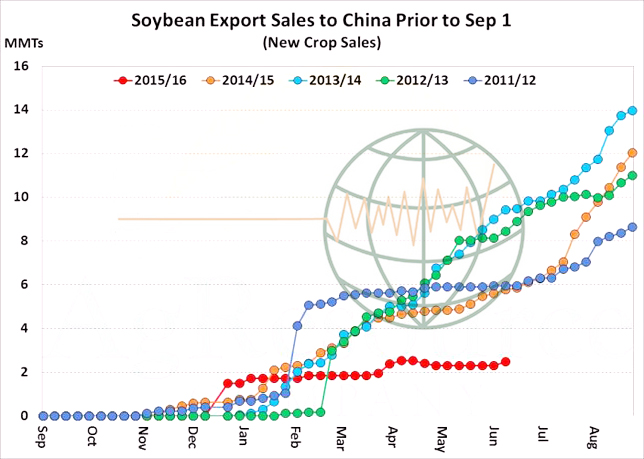
  • Another day of massive short covering saw soybean prices push to strong gains. Further rainfall in the forecast for the wettest parts of the Midwest and concerns over another drop in crop ratings were the fodder for the bulls. US export data  was uneventful, but what has been significant for some while now is that China has been absent from the US market for new crop soybeans. The chart below shows that China has secured only 2.5 million mt this year vs. 5.8 million mt a year ago and 8-10 million mt in the two preceding years. S America is a cheaper seller as far forward as the end of the year, pressuring further US sales at this time. Oct/Nov traditional US business is being picked up by both Brazil and Argentina as we have previously mentioned, and if the US is not to be left with massive unsold stocks, something has to give – prices maybe?

  • Crop ratings have dropped in a few states, but the majority of the US crop continues to hold up well above average right now. Currently, the US crop look on track to make 3.75 billion bu and with such a crop the US can ill afford to lose out on further export deals.
  • Corn rallied sharply with wheat and soybeans as 1-3” of rain appeared in the forecasts, which leaves the weekly gain around 24 cents so far and open interest in the market has declined significantly. The upcoming USDA report will have had a large degree of influence on this move as traders reposition and reduce risk but it feels like the move has been mostly weather related, in the context of a huge fund net short. There is talk of a sizeable increase to the Brazilian winter corn crop in coming days and S American corn remains some $2-6 below US Gulf into Aug/Sep whilst Ukrainian corn is offered $10 below US for Oct on an FOB basis. Additionally there is a good rain forecast for Ukraine in coming days which has the potential to boost their crop still further. Our view is that the weather has to remain significantly adverse in the US for this bullish move to persist.
  • Wheat traded in sympathy with its neighbours, as would be expected and talk of heat and dryness across the spring wheat regions of Kazakhstan and parts of the Russian Volga region as well as Canada lent some support. The Black Sea forecast contains beneficial rain. US exports for the week were nearly on the pace to match the USDA’s forecast, however total 2015/16 commitments rest at 201 million bu, down 65 million, or 25% from a year ago, whereas the USDA was forecasting an 8% increase! Ongoing price competitiveness of the US Gulf remains an issue, is there a theme going on here!!!
  • Brussels has issued weekly wheat export certificates amounting to  370,195 mt, which brings the season total to 32,851,776 mt. The season to date total is now 3.499 million mt (11.92%) ahead of last year.

24 June 2015

  • The US soybean weather outlook for July remains favourable and the bears are looking for a final bounce into the USDA report to allow what may well become the final big selling opportunity of the season although there is a suggestion that there could be an acreage re-survey by NASS on account of June rainfall which is adding to current uncertainty in the market.
  • In corn markets an improving US weather forecast (drier) and corn exports within expectations this week are the key elements to the market ahead of the USDA report next Tuesday. It feels that there are fewer concerns over a bullish surprise in the report than is the case for soybeans.
  • As far as wheat is concerned there are insufficient weather issues around to materially impact the cash market, particularly in the face of limited demand, and it is difficult to see the US futures market holding current levels given the prospect of end stocks pushing close to 1 billion bu.
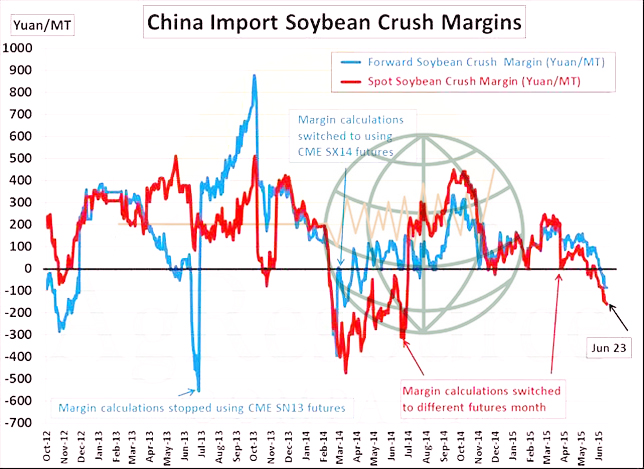
  • Chinese soybean crush margins have fallen to their lowest levels in a year with meal prices just off 8 year lows. Reduced Chinese pig numbers and an unprofitable broiler industry have curtailed domestic soybean meal use. What is different from 2014 is that new crop Chinese crush margins are also negative – which along with cheaper Latin American offers is slowing US new crop soybean sales to China. And Chinese crushers are opting for cheaper Argentine soybeans through October. US 2015/16 soybean exports appear likely to fall below that of 2014/15 in our opinion.


23 June 2015

  • Further fund short covering in corn and wheat offered support whilst a slowdown in fund demand across the soybean complex had the opposite effect. It appears the US farmer is a better seller of old crop corn and S America is active in October fob soybeans, effectively stealing the US “gut slot” of harvest. The record large S American soybean crop is narrowing the US window of opportunity to export. This could become a major issue following the June crop report.
  • The US$ surged again to sharp gains as the market continued to worry over another “let’s kick the tin along the road again”by Greece. The Greek deal (or no deal) and comments from the US Federal Reserve that two interest rate hikes are indeed possible in 2015 has set the stage well and truly for the US$ rally to persist – likely for the remainder of the year.
  • US weather patterns look more normal with another chance of C and E Midwest rain later in the week before a cooler and drier outlook develops. The outlook for rain moves south early next week which would be ideal. The critical corn pollination weather looks close to perfect, cool with showers, rather than any prolonged heat which is always so damaging to overall output.

22 June 2015

  • Some fund short covering was noted in Monday trade in wheat and soybeans. Corn appears to want to stay with recent lows and the market appears reluctant to cover those shorts – right now, suggesting that technical chart issues are more of a focus than fundamentals. It looks highly possible that we may, just may, be forming a chart “top” in soybeans and wheat, with a mid-week a likely time frame – if it occurs!
  • The soybean (July) chart looks to be testing the higher end of the downtrend channel, which has been in place since the season top formed last November. A close, basis the July contract, above $9.90 would break the downtrend. Our “top forming” comment above coincides with the spot soybean/corn ratio pushing out to 2.8:1 Monday, which is the same ratio at which the market topped in late February!
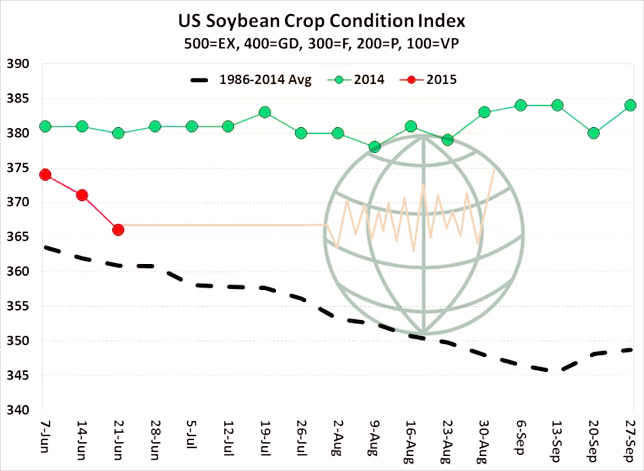
  • After the close, NASS reported that US soybean planting progress had advanced to 90% through Sunday. Crop condition ratings inched lower with good/excellent ratings at 65%. The index of all crop ratings was lower but, remained well above the long term historical average which would justify a 46 bu/acre yield. We see this recent rally as being largely technically driven as trader’s position ahead of major USDA reports next week, as well as the end of month/quarter. Technical rallies usually end once prices have reached key technical targets, which we see at $9.90-10 July and $9.60-9.70 November. We expect a summer high to be traded in coming days with prices to slide lower into the June 30th report.

  • Nationally, the US corn crop is rated as 71% good/excellent, down 2% points from last week and a year ago. As expected, substantial declines (11-19%) were recorded across IL, IN, OH and NC due to adverse weather. Partially offsetting this were moderate boosts in CO, SD and MN. Current conditions will not cause NASS to change their yield estimate in July. Early yield models suggests a national US yield of 165-168 bu/acre. Next week’s crop progress will include % silking. Corn in S IL will start pollinating next week.