
26 March 2015

  • Interestingly we have seen a down day in Chicago today with wheat pacing the decline on “technical weakness”. The May ’15 contract traded easily below its 50 day moving average and its cousin, corn, failed to find support at its 100 day moving average. An increasingly wetter weather pattern is forecast to the far northern and far southern US Plains into the crucial (from a crop development perspective) early April period, and maybe more importantly the lingering dry conditions across Europe and Black Sea regions appears to be disappearing and possibly eliminated by mid-April.
  • The USDA has today released its weekly export figures as detailed below, wheat sales in particular were disappointing:

Wheat: 181,700 mt, which is below estimates of 200,000-400,000 mt.
Corn: 464,000 mt, which is within estimates of 400,000-600,000 mt.
Soybeans: 726,000 mt, which is above estimates of 100,000-300,000 mt.
Soybean Meal: 228,200 mt, which is above estimates of 50,000-150,000 mt.
Soybean Oil: 22,400 mt which is above estimates of zero-20,000 mt.

  • For their respective marketing years to date, the US has sold 1,456 million bu of corn, down 8% from last year; 1,781 million bu of soybeans, up 9% from last year and 99% of the USDA’s 14/15 forecast; and 836 million bu of wheat, down 24% from last year. Just 10 weeks are left in wheat’s marketing year, and an average weekly pace of 7 million bu is needed to meet the USDA’s target, which may well be a tall order given current lack of competitiveness.
  • Brussels issued a further big week of wheat export certificates totalling 780,993 mt, which brings the season total to 25,836,202 mt. This is 1.87 million mt (7.8%) ahead of last year’s record pace.This week’s exports are marginally behind last week but still represent a significant volume. Stratégie Grains have left their season total unchanged at 30 million mt, which is 1.5 million mt behind the USDA’s February estimate. It seems there is still no shortage of EU (or Russian for that matter) wheat available for export sales.
  • It should be noted that wheat sales have been made to Algeria and Korea at prices that calculate back to a discount when compared with replacement. Clearly our above point regarding wheat availability holds water!
  • The International Grains Council (IGC) has released its latest update in which it has forecast a reduction in the 2015/16 global grain crop to 709 million mt, 10 million mt below 2014/15. In addition they reduced 2015/16 global corn production sharply year on year by 49 million mt to 941 million mt. Yield reduction from current year bumper levels was cited as the key driver for the reduction in corn output, and the lower volume is expected to result in a reduction in corn fed to livestock, which would offset the “hit” to end stocks.
  • Coceral have reduced the EU soft wheat crop for 2015 to 138.6 million mt, which is a 9.7 million mt reduction year on year. They also reduced barley output by1.8 million mt to 58.4 million mt, corn was seen 7.8 million mt lower at 66 million mt and finally rapeseed was estimated at 200,000 mt lower at 21.6 million mt. Clearly their view was that 2014 was a bumper crop unlikely to be repeated for a second year in a row.
25 March 2015

  • CBOT markets closed with soybeans, meal and wheat all lower and corn just in positive territory after a day of mixed fortunes trading either side of unchanged in a choppy session. The lid was kept on soybean selling by news that Brazil’s truck drivers are to meet with the government tomorrow and the risk of roadblocks has once again hit the headlines. The trucker’s demands are pretty much unchanged, and it feels as if the government wants to drag negotiations into late spring, as by then much of the soybean and corn crops will be transported to end users and the impact of militancy will be reduced. The decline in wheat was prompted by improved northern hemisphere weather prospects. Whilst confirmation of rain across the US Plains is needed the forecasting models appear to have good agreement; the Black Sea forecast calls for soaking rains across the whole of Ukraine as well as south and west Russia in the coming 3 to 10 days.Further rains are also forecast across central Ukraine and central Russia in the 11 to 15 day time frame.
  • Generally in today’s mixed trade it appears clear that traders are unwilling to embrace fresh risk ahead of the upcoming USDA report.
  • In other news Brazil’s AgroConsult has estimated the 2014/14 soybean crop at 95.8 million mt, which is 1.1 million mt above their last forecast. They also put the corn crop at 79.4 million mt, an increase of 400,000 mt on their previous estimate. Early season Brazilian soybean exports (Jan to March) are suggested to be below last season’s 10.4 million mt, possibly below 6 million mt. The delays in harvest and trucker’s dispute are blamed (somewhat unfairly in our view); our suggestions point to a slow down in Chinese trade compared with last season. Abiove continue to see good prospects for the season with a target of 48 million mt, which is some 5% up year on year. Remaining in S America, the Argentine soybean harvest is reported to be 5% complete with yields reportedly “high”.
  • Finally, Russia’s AgMin are now suggesting winterkill losses will be less than the 21% previously suggested, their latest figure stands at 16.8%, and supports their latest 100 million mt all grain harvest figure.

23 March 2015

  • CBOT markets closed higher with soybeans pacing the advance as FOB premiums in Brazil rally. There is little else in the way of fresh news to justify higher levels. Weather forecasts in the northern hemisphere are unchanged with a progressively wetter outlook for the US upper midwest, Europe and Black Sea into early April. Perhaps tellingly the US$ is down a touch and crude oil prices are up slightly.
  • It appears that fund short covering has been active today, driven by shorter than expected net positions reported on Friday evening and doubtless the looming USDA stocks and seedings report is adding to nervousness.
  • Prices for Russian domestic wheat in the central region have fallen to 10,000 Roubles/mt, marginally below the 10,100 Roubles /mt government target. Some intervention purchases are expected in coming days and weeks and volume secured will dictate the outcome of the export tariff. Continuation or otherwise of the tariff is a major issue for world trade particularly into the 2015/16 crop year.

19 March 2015

  • Markets are lacklustre today with thin volumes and trade has been both sides of unchanged. Wheat has caught a bid on dry conditions and fund selling in corn has eased from the last few days. It feels like apathy is ruling the markets right now and there is a desire to see the USDA report and move on!
  • The USDA has today released its weekly export figures as detailed below:

Wheat: 534.800 mt, which is within estimates of 350,000-550,000 mt.
Corn: 567,100 mt, which is within estimates of 500,000-700,000 mt.
Soybeans: 347,000 mt, which is within estimates of 250,000-450,000 mt.
Soybean Meal: 217,600 mt, which is above estimates of zero-150,000 mt.
Soybean Oil: 8,100 mt which is within estimates of zero-20,000 mt.

  • Brussels issued another big week of wheat export certificates totalling 800,818 mt, which brings the season total to 25,055,209 mt. This is 1.989 million mt (8.62%) ahead of last year’s record pace.The pace of exports has picked up week on week and it remains to be seen whether the USDA’s 31.5 million mt forecast will be achieved.
  • In the absence of any significant news it remains to be noted that in wheat we have huge currency volatility, politics, weather concerns, a near record fund short and a major report some two weeks away. Old crop cash markets may continue to suffer but it is likely that deferred risk will come off the table for now. In corn, despite delays in the south we are seeing warm dry conditions in the rest of the US which could make this a fast plant year – historically this can produce big acreage changes (gains?) from March intentions to final numbers. In soybeans, the huge S American crop is almost home and dry (no pun intended), the Brazilian Real is flirting again with recent lows despite yesterday’s US$ reversal , Argentine farmers are said to need cash and we reported on the Farm Futures acres yesterday, which all looks negative at face value. However, the long US$ trade continues to look crowded, particularly with month and quarter end looming. Open interest has risen substantially and there is no agreement on US acres yet for either beans or corn and Brazilian truckers may still have some fight left in them. Long term may well be lower but we should all be aware that there is no easy money to be had in these markets right now.

19 March 2015

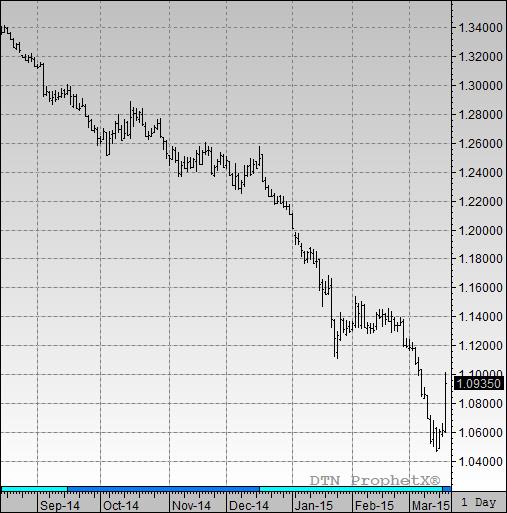
The US$ crashed yesterday afternoon to its biggest daily loss since 2009. The US Central Bank decided to remain dovish in its assessment of the US economic outlook and when they would normalize US interest rates. The chart below reflects that huge range of yesterday’s €uro trade with US$ crashing in late afternoon dealings. We would expect that the sharp drop in the value of the US$ would spur active short covering in a host of commodity markets –including the ags. The close proximity of the month and quarter end could cause additional liquidation of long US dollar holdings. We maintains a view for a bounce in the ag markets with new sales opportunities arriving by early April. The US$ has enjoyed a big bull run, some correction is inevitable as the long US$ is a crowded trade.

18 March 2015

  • Today has seen CBOT markets close higher although we are led to believe that fund activity has been significant. Open interest in corn has grown significantly (77,573 contracts) in the last three trading days and one theory is that managed money is piling into a large net short position ahead of the key USDA stocks and seedings report scheduled for release at the end of the month. Whether the funds want to hold this position into and through the report is unknown, but it should be borne in mind that the month and quarter ends on 31st March (post report) and funds are reported to be faring poorly so far this year.
  • Soybean open interest is also rising (up nearly 50,000 contracts in the past week) and it seems that trend-following funds are growing a sizeable net short ahead of the report.
  • Funds are also holding close to a record large wheat net short and with dry conditions across the central US Plains, parts of Europe and Russia becoming more of a debating topic this is becoming more important. However, it must be remembered that rainfall in April and May makes or breaks N Hemisphere crops, and this year will be no different.
  • On a different tack, Reuters reports that Brazil has shipped ethanol to the US as the weak Real kicks into effect as has “balloning supplies” in Brazil. The shipment is reported as 30,000 mt destined for Florida.
  • According to the US Farm Futures magazine, as reported by Reuters, US farmers are to plant 87.25 million acres of soybeans this season, a record, whilst corn acres will be eroded to 88.34 million. The figures are a result of their survey data. The soybean acreage, if realised, will be 4.2% up from last years 83.7 million acres, whilst corn is 2.5% down on the 90.6 million planted in 2014. Whilst interesting, the official data will be more relevant to markets and price direction, and we have to wait until 31st March.

18 March 2015

The world grain market needs a demand driver! The world biofuel industry is mature and the recent sharp drop in energy prices will likely limit trade on competitiveness. World feed consumption rates are rising with crop sizes, but it’s unknown if this is a function of residual – or actual – feeding rates. This leaves China as needing to step forward and become a much larger grain importer if there’s to be a change in demand trends – which are only growing 1.8% annually. The chart below reflects that China’s grain stocks are surging – to their highest levels since 2001! China is having to build more storage to accommodate all of the supply. High prices to farmers are stimulating yield and acres. China is not expected to be a sizeable importer in world corn for several years as they chew through their own supply.

17 March 2015

  • Firstly, a happy St Patrick’s Day! The markets may not be patriotically supporting St Patrick as they (Chicago at least) displayed a wall of red rather than the traditional festive green normally associated with the Irish saint! In Europe markets were extremely quiet and it would seem appropriate to assume celebrations were under way but more likely it was down to the reversal of prices in the US.
  • In addition to St Patrick’s day we would like to wish Crimea a happy 1st birthday under Russian rule, how time flies!
  • Fund selling was active and noted in Chicago as weather forecasts changed for the better (fickle or what?) and long liquidation was the order of the day. US (and world) export demand remained sadly lacking and that has added downward pressure.
  • CBOT soybeans broke below their January low, by some way, and confirmed the significance of this by also closing below the level. This points to a test of the late September/early October lows in the fullness of time. May ’15 soybean meal has formed a bearish “head and shoulders” chart patter which should see a test of $295 some $23 below tonight’s close and very close to support formed last September/October (at the same time as soybeans).
  • Much is being talked of how poorly wheat is coming out of dormancy in Russia due to lack of pre and post planting rains. It is our considered view at this time that it is too early to make such judgement as it is rainfall in April and May that makes (or breaks) Russian wheat crops. We see no reason for this to be different this year. However, what is clear in wheat is that we are in the early stages of a weather dominated period and with a close to record fund net short position and fears of an extension of the Russian export tax, volatility will probably remain high and price swings potentially violent.
  • Corn markets saw around 200,000 mt purchased by S Korea for early October arrival at $193 C&F, which calculates to $167 FOB Brazil. This price makes Ukraine supplies (the recent cheapest global origin) look expensive – AND potentially this price calculates into the US. Are we about to witness the world’s number two exporter selling to the world’s number one exporter in US new crop positions? As prices decline and planting economics move ever closer to favour soybeans could we witness the US as a net importer of corn? (Our comment is made with our tongue firmly in cheek – of course!)

16 March 2015

  • CBOT markets were moderate in volume and mixed with corn and soybeans lower with wheat picking up support from what is being described as threatening Plains weather forecasts. Wheat vs. Corn spread trade unwinding has been noted.
  • As we reported some weeks back, it was likely that weather would become a significant market driver, and it seems this is now becoming more of an issue both within the US as well as globally. It is probably fair to suggest that the trend in demand for wheat, corn and soybeans from a global perspective is both static as well as stale, and it is supplies that are coming to the forefront of trader’s attention, particularly as we approach the upcoming USDA stocks and seeding report scheduled for release at the end of this month.
  • It should also be borne in mind that funds are holding a large (in relative terms) net short position in wheat (63,589 net short) as we head into the new crop norther hemisphere season. Dry conditions in the Plains, parts of the EU and FSU are going to come under even closer scrutiny in coming weeks. Weather forecasters are not promising and relief at this time, which could leave us watching a round of fund short covering and all that goes with it – higher prices!
  • The US saw today’s NOPA (National Oilseed Processors Association) report which showed the February soybean crush at 146.97 million bu below estimates of 148.537 million bu and down from 162.675 million bu month on month.
  • In Brazil we have seen farmers actively selling freshly harvested soybeans as the Real continues to decline vs. US$. It is suggested that 15 million mt of Brazilian soybeans have been sold in the first half of March, which if correct would be a record volume. The volume of cash sales has been sufficient to fill supply pipelines and looks to be contributing to a weakness in cash export basis prices. Interestingly this year China has been a measured buyer of S American supplies which is certainly capping price rally potential.