4 February 2015

  • Markets have been somewhat slower after yesterday’s frantic pace and surge higher with corn, soybeans pacing the way lower and wheat catching up into the close and entering negative territory to join remaining markets. Next week’s USDA report is a non-topic right now as everyone anticipates little, if anything, in the way of fresh news.
  • The way forward will be interesting, S American outlook, as we reported last night, looks as if Brazil is slightly down and Argentina slightly up, the US Outlook Forum will be the next piece of significant news to suggest longer term price trends. The US’s 2015 corn and soybean acres will be the focus for market watchers.
  • Cash markets have producer sellers with active orders just above yesterday’s highs – just in case the market decides to move higher, and this is seen as an effective cap to upside right now. Brazilian g=farmers in particular saw opportunity with a drop in the Real and the Chicago rise presenting an attractive proposition, which may look even more so in coming weeks if we see the old trend resume.
  • S American yield data remains “stellar” according to some with Mato Grosso, Goias and Parana reporting big numbers. According to our contacts most fields are yielding near or above their previous 2011 record levels, which points towards national output over 94 million mt. Key, will be the level of output in RGDS, MDGS and Santa Caterina and this is unknown right now, anything approaching record harvests will see national output pushing above 95 million mt.
  • This week’s US ethanol report was seen as bearish as stock levels rose to their highest since 2012 , almost 880 million gallons, production fell to just under 280 million gallons utilising 99 million bu of corn. To reach the USDA’s annual forecast a weekly grind of 97.7 million bu is required and this is viewed as optimistic given rapidly filling storage.
  • The US lineup to load soybeans for China is declining, and fast, with fewer vessels presenting, clearly the seasonal shift to S America is under way. However, Chinese interest is minimal, surprising given yesterday’s price action which we would have expected to trigger some sort of response. Our guess is that a $9.00/bu price target is the aim of Chinese buyers at present, and we would be among the last to argue that level right now. Chinese crush margins, both spot and forward, have slipped as ongoing weakness persists in their domestic meal market.
  • S American weather forecasts continue to be favourable and we would expect to see a resumption of the downtrend in prices as the Brazilian harvest progresses.
  • The Russian wheat debacle continues; the race to ship before the 1st February tariff deadline may well be repeated as we move towards the end of the month because many believe the rumours of a more prohibitory tariff which will leave the farmer with no other option than to sell to the government intervention buyer. Globally this is not a significant issue but it is a huge spanner in the works for the exporter/end receiver who gets caught up in the red tape!
  • StatsCan reported their 31 December stock levels, and the all wheat figure of 24.82 million mt was a touch short of the trade’s estimate of 25.1 million mt. Canola (rapeseed) was above estimates by 400,000 mt at 11.1 million mt, whilst soybean stocks at 3.48 million mt hit a record level.
  • Finally, Stratégie Grains estimated 2014/15 EU soft wheat exports sharply higher at 31.9 million mt, which is 2 million mt above the 2013/14 record volume. Demand for French and British wheat in Asia is cited as the main driver for the updated figure with an increased volume of shipments anticipated in February and March. Germany and Poland were also expected to see increased demand, particularly from Saudi Arabia.
  • In conclusion, in the light of an unchanged fundamental situation and no follow through on yesterday’s spike higher, we see little reason to change our long held bearish viewpoint.

3 February 2015

  • We have seen a classic Turnaround Tuesday trade today with ag commodities soaring higher in a countertrend move which has seen the bulls cheering for the first time in a while. Double digit gains have been seen and funds have exited from freshly established shorts in a panic, which added to upward momentum.
  • Suggestions that the recent decline has been too far and too fast, and that today is a correction may well be true but today’s rally has been spectacular – and seems to be too much to be ignored for now and needs careful watching.
  • It has to be said that there has been no fundamental change to the fundamentals outlook for commodities or the US$, markets cannot go down every day and our inclination is not to chase the rally, maybe this sets up yet more selling opportunities.
  • In more tangible news, Egypt’s GASC tendered for wheat once again, this time for early March shipment. They secured 300,000 mt of, what seems to be, cheap wheat with France winning 120,000 mt and Romania 180,000 mt. The French offer when taking into account twin load ports, moisture allowances and other costs equates to $210 FOB, and compares with feed grade bids at the same level – have the French “choked” on this one?


  • Regrettably, wheat farmers are going to see today’s price action and convince themselves that they have been right to hold off selling, and continue with the same course of action. Russian discussions to increase the export tax and intervention price will not change the market, all they will do is add to new crop supplies, where replacement prices are already low!
  • In other news Informa Economics raised their forecast for Argentina’s 2014/15 soybean output to 57 million mt, an increase of 1.5 million mt on their previous figure. They also increased their estimate for corn output by 1 million mt to 23 million mt. Interestingly they left their figure for Brazil’s soybean output unchanged at 93.5 million mt. Their corn estimate was raised 550,000 mt to 72.8 million mt.
  • All in all, today has been interesting albeit odd, and in the words of one commentator (who we respect hugely), “When the macros, black boxes and algorithms get a hold of the futures markets and move them significantly for little or no apparent reason, remember the words of Benjamin Disraeli (a famous 19th century English fund manager), “Never complain, and never explain”!

2 February 2015

  • The new month and new week has brought little in the way of inspiration to markets today as Chicago has traded in a mixed fashion. It appears that a very large buy stop was seen in corn in the early hours and this was sufficient to rally prices although not for long. Soybeans and wheat tried to follow but selling pressure has put a lid on upside and new crop hedge pressure from Brazil added to upside limitations.
  • There is some support noted in crude oil, particularly stateside, as the biggest US oil workers strike since 1980 enters its second day. The union which represents around 10% of US refinery workforce has walked out. Some stricken plants remain open using non-union labour and this has escalated tensions and a national walkout is being discussed, which would likely pressure upside still further. This would also likely place support under bio-fuels and potentially support corn and soybean oil as a result. Whilst it is still early days, the fundamentals are unchanged, this is a “fly in the ointment” of the supply chain.
  • The next fortnight looks promising in Brazil with soaking rains forecast across the dry regions of Bahia and Minas Gerais later in the week. The forecast appears to be bring a favourable mix of sunshine and rain across both Brazil and Argentina aiding soybean and corn development. Any weather related threat appears limited to beyond the next two weeks, and of little consequence right now.
  • Saudi Arabia purchased a reported 690,000 mt of wheat, for shipment April/May, over the weekend and suppliers were given as EU, N America and Australia and sellers reserve the rights over origin. FOB prices are difficult to calculate as origin is unknown but CIF averages around $254/mt, if EU origin this would calculate back to around $238/mt. There are also rumours of some 5 to 8 Panamax size wheat vessels from the UK to Asia having been agreed. Russia’s export tariff is now in place and it seems their July to January total stands at 17.9 million mt. Seemingly a number of vessels did not make the date deadline and disputes will doubtless arise as a consequence, but this is largely immaterial to the rest of the marketplace.
  • In corn, European futures hit fresh three-month lows, cash premiums were broadly unchanged and the corn vs. feed wheat spread into Eire is €15, but consumers can only purchase once, and most appear to have already done so. Black Sea prices are at season lows and carries are minimal at €1 or 2 per month and there are clearly some bargains around for those who can take advantage.

29 January 2015


  • Following from yesterday’s commentary on wheat and its direction going forward we thought it interesting to start tonight by looking at relative global wheat values, which are converging as sellers look for food or feed markets prior to the onset of the 2015 harvest. At present prices have been driven lower as EU farmers appear to be holding large stocks as we approach another large harvest. Focus will soon turn to new crop growing conditions and the autumn lows, which may provide support. The following graphic hopefully illustrates the point.
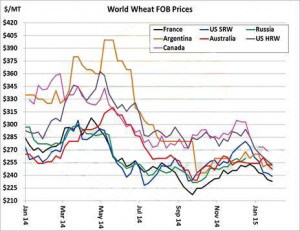


  • We have commented many times on the wheat vs. corn price spread, and attach a chart illustrating the recent correction, which again hopefully adds to our recent thoughts.


  • The USDA has today released its weekly export figures as detailed below:

Wheat: 565,400 mt, which is above estimates of 250,000-450,000 mt.
Corn: 1,084,200 mt, which is within estimates of 850,000-1,200,000 mt.
Soybeans: 909,000 mt, which is above estimates of 200,000-400,000 mt.
Soybean Meal: 297,500 mt, which is within estimates of 150,000-350,000 mt.
Soybean Oil: 10,600 mt which is below estimates of 15,000-30,000 mt.

  • Brussels issued weekly wheat export certificates totalling 672,392 mt, which brings the season total to 17,726,982 mt. This is 454,748 mt (2.5%) behind last year’s record pace.
  • US wheat sales were better than expected and have put a floor into todays market prices (despite the foregoing comments). EU cash wheat markets refused to move lower today, despite London and Paris futures drop this week, and the early weakness in Chicago saw new found competitiveness.
  • Our thoughts are that we will see additional weakness in corn and soybeans into the weekend as hedge related selling in ahead of the advancing Brazilian soybean harvest takes hold. Crude oil has seen light selling and is close to recent lows whilst gasoline and ethanol follow, the US$ is stronger, Rouble and €uro are weaker. Front month soybeans came close to testing support at $9.96, which if broken will see further declines.
  • Whilst we may have been looking for signs of a bottom in wheat, it has to be stated that right now there is no technical signal to confirm this, and as such why buck the trend? The old adage of “the trend is your friend” has to be borne in mind for now. In corn we have heard that Ukraine has approved 20.5 million mt of corn exports for the season, and is running about 3.5 million mt behind last year at this time. Our information is that importers should not bid for Ukrainian corn unless they truly want to own it – caveat emptor!

28 January 2015

  • Today has been a “down” day with markets both side of the pond shedding value (soybean meal as the exception actually gained) as soybean oil and wheat led the way pushing to new (recent) lows. End users have been scale down buyers and picking, what they believe to be, value. Funds have been exiting from long soybean oil/short soybean meal spreads, hence the oil decline and meal gains today. There is also an expectation that US weekly sales data will show large US soybean meal exports as crushers are attempting to lock in positive crush margins amid slowing domestic demand, consequently trying to attract export business.
  • US ethanol production data was in line with expectation and left corn grind also in line, maybe a little bullish as producers are still not cutting back production. However, US ethanol stocks rose 1.3% to 874 million gallons, as high as we have seen in recent years, and this is placing a strain on storage capacity. This will doubtless be a recurring theme in coming weeks and months. Negative US ethanol production margins have, at some time, to pressure production and relieve what will otherwise become historic stocks by early springtime.
  • In Brazil we continue to hear of early yields reaching record highs, some 5-7% above last year and the 2011 record. It is only in the dry areas of Bahia and Minas Gerias where limited harvesting has taken place that losses will be unavoidable. A Brazilian crop of around 95 million mt still looks to be feasible.
  • The decline in wheat values was clearly evident as funds continued to sell and French sellers attempted to offload stocks of old crop. There still appears to be demand from Asia for EU feed grade wheat and as stocks in France appear to now be of lower grade grain the reducing wheat/corn price spread is likely to attract greater prominence in feed rations. Consequently, this suggests to us that the downside in wheat has limits – assuming corn does not outpace wheat in a rush to lower levels. However, and there is always another side to the argument, EU new crop weather looks benign and with more snow forecast in the FSU with temperatures above normal there is no reason to suggest combined EU/FSU 2015/16 output should not be very similar to this year. That would lift end stocks to 50 million mt vs. the 25 million mt which is where we began the current year. Under these circumstances wheat looks set to vie with soybeans in the race lower!

27 January 2015

  • News today has come from in a variety of guises, US exporters reported further sales of 2014/15 soybeans to “undisclosed” destinations and at the same time China was reported to have cancelled another 120,000 mt of  soybeans for the same delivery period. Read into that what you will!
  • Ukraine’s AgMin has suggested that their grain exports for 2014/15 will reach 37 million mt, which is 4.2 million mt more than last year’s total and somewhat higher than may have been anticipated given geopolitical tensions and suggestions of export restrictions.
  • Markets in Chicago have seen soybeans trading lower as did the grains although as we approach the close (45 minutes to go) wheat is finding a touch of support and is just in positive territory. Soybeans have probably traded lower on fast declining US export sales and favourable weather forecasts into mid-February as well as reports that both harvest and safrinha corn plantings are proceeding well. Global soybean consumers are slap bang in the middle of a north to south hemisphere transition and even small price adjustments make a big difference.
  • The big picture remains pretty much unchanged; there is an ample supply of soybeans in the world although it seems farmers continue to display a reluctance to sell with all that brings with it. However, as prices remain elevated (relative to potential end stocks) we are facing additional encouragement to plant ever large areas and the consequences to S&D’s can only be viewed as longer term bearish – the question is one of timing, when are we going to see prices break lower? Forecast corn acres in the US and trend yields (8 bu/acre below this year) suggest a 2015 crop of around 13.3 billion bu vs. a demand of some 13.5 billion bu, clearly at these levels there is little to suggest any significant price upside at this time. In wheat there still remains too much supply chasing too little demand and the potential for Russian supplies to come back and overshadow the market is beginning to look very real.
  • Wheat markets in Europe led the way lower with London shedding £2.00 plus and Paris €2.50 in reasonable volume trade. The technical chart picture does not look bullish for either origin, and the Chicago chart looks even more vulnerable to lower prices despite being somewhat oversold right now. This could indicate that there is room for a bounce in the short term although the fundamentals do not support this greatly. Yesterday’s suggestion of a change to Egyptian moisture specifications appears to have unnerved the market, particularly the French!

26 January 2015

  • Chicago markets have been pretty lacklustre today, maybe they are anticipating the arrival of 3 feet of snow that is forecast to hit parts of eastern US in one of the worst storms in living memory. Aside from the snow in the US, global weather conditions remain benign and non-threatening, and “finishing rains” continue to remain in both the forecast and are materialising on the ground in S America.
  • US exports for the marketing year through to last Thursday show corn to be at 562 million bu (up 9 million year on year), wheat at 539 million bu (down a massive 260 million year on year) and soybeans at 1,312 million bu (up 197 million year on year). It should be noted we are fast approaching the US soybean export season end as S America takes up the volume in coming weeks.
  • Russian domestic wheat prices have declined from their early January peak and the government is failing (in spectacular fashion) to secure its 3 million mt of intervention purchases as domestic price levels remain higher than intervention price. At current exchange rates it seems Russian exporters can pass on the full export tariff at prices of $255/$260/mt, which translates to a cap of $5.60/bu basis CBOT contracts. The physical market seems undisturbed by controls on Russian (or Ukrainian) wheat exports.
  • Also noteworthy, in an otherwise lacklustre market, is the fact that ongoing warmth and above normal precipitation across Europe, Ukraine and Russia looks likely to leave wheat winterkill levels below average so far this season.
  • We continue to argue that it will take a significant weather disaster somewhere in the world to change what we believe to be a fundamentally bearish pattern right now. Lack of fresh market moving news or information is likely to see prices somewhat rangebound and any rally attempt struggling as we move deeper into S America’s harvest.
  • Oh, finally we nearly forgot the Greek election, which saw the anti-austerity vote win the day in Sunday’s election! The early decline in the €uro (150m points) was reversed into a 70 point gain on the day. The Ruble fell a further 3% and Russian debt was again downgraded by S&P in the face of further sanctions. Matif wheat declined but rumour that Egypt’s GASC may be about to return to a max 13% moisture level left cash premiums on the defensive. There is little to point towards higher cash wheat markets at this time.

22 January 2015

  • Key today was ECB President Mario Draghi’s announcement that €60 billion/month would be injected into the Eurozone economy in bond purchases in an attempt to kickstart growth. This level on injection was greater that initially anticipated by the market, which looked for €50 billion/month. Market reaction was mixed but when all said and done the US$ rally persisted with little, if any, sign of slowing as the US remained the “safe haven” given its relative economic stability.
  • Wheat markets received some support from agreement reached between the Ukrainian government and traders to limit exports to 1.2 million mt between now and the end of June. Whilst this is now agreed, the reality is that this volume is little different from the Jan/Jun export pace of recent years. Prior expectations were for exports to be in the region of 1.5-1.9 million mt. The key question that now remains is with shipments currently around 8.5 million mt, and feed wheat at least $40 over corn, where are they going to sell 3.1 million mt of wheat?
  • Matif wheat failed to make any significant gains despite a 200 point drop in the €uro and another big week of EU wheat exports in which Brussels granted licences totalling 815,246 mt bringing the season total to 17.05 million mt. This is close to ½ million mt (2.7%) behind last season’s pace.
  • CBOT markets were described a choppy with traders struggling to get to grips with the ECB announcement, strong US$ and crude oil, which continued what seems like its relentless decline dragging both gasoline and ethanol with it. The latest US update shows stocks of ethanol, crude and gasoline modestly increased week on week and the market is still looking for a price at which stock levels will begin to decline.
  • S American weather forecasts show little change and favourable; Argentina is forecast to get the dry conditions it needs and rains look likely to persist across C and N Brazil in the coming week.