
31 January 2013

  • Today’s figures from Brussels showed wheat export licences totalling another 489,000 mt for the week, bringing the total for the year up to 12.527 million mt, which compares with 9.958 million mt a year ago.
  • We have commented accordingly in previous weeks, and feel disinclined to repeat the same old……! Suffice to say the high rate of EU exports appear to be at the expense of US tonnage and current price differentials have led Strategie Grains to increase their forecast for EU exports and decrease US tonnages accordingly.
  • US weekly export data reported the following:

    Wheat: 387,900 mt, which was within estimates of 350 to 550,000 mt
    Corn: 253,400 mt, which was within estimates of 150 to 300,000 mt
    Soybeans: 1,253,000 mt, which was above estimates of 650 to 850,000 mt
    Soybean meal: 141,700 mt, which was below estimates of 150 to 200,000 mt
    Soybean oil: 20,100 mt, which was within estimates of 15 to 25,000 mt

  • The Russian debate continues with Reuters reporting that removing the 5% grain import duty is “possible” according to the Agriculture Minister; it was noted that the duty could possibly be reduced as opposed removed and the statement added it was not expected to materially affect the market. This begs the question as to why it exists in the first place if that is the case, however we await the outcome of deliberations.
  • In another statement from Russia it was noted that the traditional exporter will likely import in excess of 1.2 million mt of grain, having already come close to importing half a million mt in the season to December so far. Our own view is that the suggested 1.2 million mt is likely to be at the low end of the range given the volume of early season exports and the current pace of domestic demand.
  • Given the requirement to import into a traditional exporting market, the current size of managed fund net shorts and a general tightness of supplies in traditional exporting nations we could well foresee an explosive upside if, and when, the markets decide to take cover.
30 January 2013

  • Once again it seems that focus is falling on S America with suggestions of the Argentine soybean crop falling below 50 million mt and the corn output below 24 million mt. In Brazil harvest is underway, albeit with interruptions for rain, and early reports are pointing at lower yields in the key soybean growing state – talk is beginning to emerge of a sub 80 million mt crop. It is, of course, far too early for such discussions to be considered as hard fact but the market is trading upwards on the news.
  • To put some meat on the bones, private forecaster Lanworth estimates the Argentine soybean crop at 53.1 million mt, a reduction of 2.1 million mt from a month ago and their corn crop at 25.6 million mt, which is only 400,000 mt below last month’s figure. The Brazilian estimate from Lanworth stands at 80.9 million mt of soybeans, which is an increase from 79.4 million mt in December and corn also showing a 300,000 mt increase to 75.8 million mt.
  • Technical pictures on corn and soybeans are looking somewhat more bullish and it would appear that some buying has emerged as a result, adding to the strength of the picture. Cash prices in the US for both corn and soybeans remain firm as farmers retain stock in what can only be described as a tight old crop position.
  • The latest outlook for winter wheat in the US makes for poor reading with further deterioration as a result of continuing drought conditions. Top producer, Kansas, crop ratings of good to excellent dropped 4 points to 20% since December. Maximum moisture in the state was well below average at just one inch, and higher than average temperatures added to soil  moisture depletion. Nebraska fared no better with ¼ inch of moisture or less and little in the way of snow protection leaving the crop rated at just 8% good to excellent, down from 14% last month.
  • News from Canada of higher output as a result of greater plantings next year took eyes away from what we consider to be the main event, the forthcoming US crop! Potential abandonment rates, which we tentatively discussed as possibly reaching 25% some weeks ago, are now being put even higher, figures of 30% and higher are being quoted.
  • In another move, which we regard quite cynically as a diversionary tactic, the Russian Ag Minister is openly talking of enlarged crops and export capabilities. There is a far more pressing and immediate need, and that is their old crop tightness! We were always well drilled in our formative years that borrowing new crop stocks to relieve old crop stresses is not an easy task to accomplish with success; and we haven’t changed our opinion.

28 January 2013

  • Markets appear to be working hard to digest what is truly occurring weatherise in S America. It seems that conditions are not as favourable as would be desired given the tightness in global soybean and corn markets, which is placing pressure upon S American output.
  • In Russia we hear of continued discussion over the reduction, or complete removal, of the 5% grain import duty which was first raised (then denied) last week. Domestic prices have moved higher again and we appear to be approaching a political standoff with the Agricultural Minister not wishing to appear in the wrong by failing to curb exports earlier in the year; removing the import duty would be tantamount to such an admission and loss of face seems impossible to avoid right now. It would appear inevitable that a change of some sort in the import duty will take place before too long.
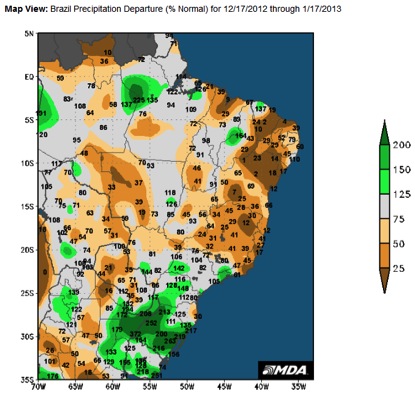
  • Argentine weather conditions continue to be less than ideal with heat and below ideal precipitation in the forecast. It appears that crop moisture requirements are unlikely to be met in coming days. S Brazil’s conditions are switching with rainfall required to rejuvenate both corn and soybeans, and to add to the stresses, temperatures are reportedly rising to higher than average.
  • In marked contrast, Matto Grosso, Brazil’s top soybean producer, has improved prospects as the weather conditions have turned wetter following extremely dry conditions in December and early January. The timing of these rains favours pod filling in advance of March harvest.

25 January 2013

  • Looking back over the last week leaves us with one overriding thought, and that is that it has been uninspiring one to say the least!
  • Probably the biggest news item, that turned out to be a non-item in the end, was talk of Russia lifting their 5% grain import duty in an effort to relieve the seemingly never-ending upward momentum in their domestic wheat and flour prices. The news was denied in quick time and markets gave back the gains made, and more, but the speed with which intervention grain sales are snapped up, despite hefty transport costs, and rumoured wheat sales into St Petersburg do tend to point in one direction. It would appear that the much-reported 2 million mt wheat import requirement to bolster the season is not a million miles away from the truth.
  • In a similar vein the on-going EU situation perhaps warrants closer inspection. This week, Brussels issued wheat export licences for 390,000 mt bringing the season to date total to 12.032 million mt, this compares with 9.749 million mt at the same time last year. The increase, 2.283 million mt, or 23.4%, when considered in the light of what else is available to compete can only be viewed as huge. The lack of Black Sea supplies as well as steady EU wheat demand would make the USDA’s latest projections on EU end stocks look far too tight. Their projection left the EU with some 24 days of stock, and we are significantly ahead of their export pace at this time.
  • The conclusion we draw therefore depends upon what happens in terms of exports moving forward. Maintaining the current pace of exports will reduce already uncomfortably tight end stocks, which will most likely need to be bolstered by feed grain imports to ensure adequacy of supply. A reduction in export pace would seem to be on the cards given the $25 to $30 per tonne discount which US wheat has over French at the moment, and Australian wheat is also competitive; the question remains though, will the reduced pace be sufficient?
  • There is evidence, in the UK at least, of some significant corn purchasing by consumers at prices below wheat levels adding some support to the argument above.
  • In the news, Ukraine domestic usage of corn seems to be smaller which should increase their potential supply to be exported, largely to the EU.
  • The other “elephant in the room” continues to be the S American weather which is giving rise to some concerns, in particular over fast drying Argentine topsoil levels, which would appear to be creating some stress levels in late planted and shallow rooted corn crops. This seems somewhat incongruous following the prolonged period of extreme wet weather endured by the region. However, it was the wet weather that delayed planting and has created the late crop and subsequent lack of root penetration, which would be evident under more normal climatic conditions.
  • In other news we continue to see extremely dry conditions in the US Mid West and Plains, which is impacting wheat crops and, unless we see significant replenishing precipitation (which appears unlikely right now) the prospects of a second consecutive dry season look to be on the cards. In addition the deep insulating snow layer has thawed leaving soils open to -21°C to -24°C (-7°F to -12°F) temperatures and deep penetrating frost which may well result in delayed spring plantings as more time will be required to allow the ground to warm up sufficiently.

24 January 2013

  • We have seen a second day of price decline in both London & Paris wheat markets, brought about by very little in the way of fact based or market derived data. Our assumption therefore is that the decline is “drift” rather than direction! Rumours of Baltic wheat being traded into the Russian port of St Petersburg remain just that, rumours, and we continue to await the outcome of Russian deliberations on the state of their tight wheat position, and, more importantly, how they manage the position going forward.
  • Brussels issued a further 390,000 mt of wheat export licences bringing the season total to 12.032 million mt, which compares with 9.749 million mt last year. This is 2.283 million mt more (23.4%) than a year ago. Clearly the USDA’s opinion on total EU exports for the season either needs to be revised, serious grain import volumes need to be addressed or the pace of exports to date needs to be curtailed – and soon. Given the non-availability of the usual Black Sea competition it would seem that the USDA’s figure is looking on the light side. Intra-EU grain movements make interesting data, feed demand, particularly in northern Europe, remains steady with poor quality and volume forage driving reasonably strong volumes.
  • We hear of milder weather conditions in southern Russia and Ukraine causing snow melt which has the potential to expose crops to freezing conditions, particularly at night time. The lack of a good blanket of insulating snow leaves crops susceptible to winter kill should temperatures drop sufficiently low, which would not be unusual in these regions.
  • We would remind that the southern Russian crop was planted in extremely dry conditions with some crops not even germinating, such was the effect of the drought. Soil moisture deficits have not yet been replenished and the crops will be in need of plentiful moisture in the immediate and critical emergence period following winter dormancy if potential is to be fulfilled.

22 January 2013

  • CBOT markets started the day on the offensive after the extended US weekend with support coming from talks of Russia lifting its grain import duty, which was later denied, dry conditions and winter kill across key global grain growing regions.
  • Once again we place a degree of focus on technical signals as the corn and soybean charts begin to build a degree of a “base” from which upward momentum may take  place. It is early days but, a close above last weeks highs would provide a solid signal to those of a bullish persuasion. Bullish enthusiasm has to be tempered following denials from Russia that they are about to lift their 5% grain import duty at this time. Some suggest that the real issue is one of time rather that whether it will or will not be lifted. We believe that the continued upward movement in their domestic grain and flour prices coupled with early export volumes, intervention sales, talk of physical grain imports and import duty suspension all conspire towards one conclusion – time will (as always) tell.
  • Current weather conditions in S America suggest that the southern regions of the continent are struggling due to a dominant high pressure ridge which is blocking rainfall and leaving atmospheric moisture levels extremely low. Soil moisture, particularly topsoil, levels are reducing rapidly at a time when crop demand is growing. Further north, the Matto Grosso region, which accounts for nearly one third of Brazil’s soybean output, is experiencing better rains after a very dry December and first half of January.
  • In contrast, Argentina has experienced planting delays as a result of prolonged rainfall, leaving many acres of both soybeans and corn to be planted late in December and January. These late planted crops are, understandably, shallow rooted, and appear to be succumbing to the rapidly drying soils in the second half of January. Forecasts remain drier that normal offering little immediate respite to crops.

21 January 2013

  • In a “gin and tonic fuelled frenzy” of report writing over the weekend it has become clear that a major typo crept into one paragraph – apologies! The corrected paragraph follows:

In summary, if a La Niña (as opposed El Niño as originally written) pattern becomes more established, and persists, the output of corn in Argentina is likely to be compromised and lower than either USDA or FAO figures suggest. This cannot be viewed as good news hot on the heels of the current extremely tight US corn position, which we continue to maintain is in need of elevated prices to instigate much needed demand rationing.

  • Tonight’s news will be limited as the US markets are closed in observance of Martin Luther King Day. This did not prevent some sharp upward price movement in London and Paris wheat markets, albeit in thin volume, which might not hold when the US returns tomorrow.
  • In a move most likely prompted by ongoing strong domestic flour and wheat prices, Russian government officials are discussing whether to lift their 5% grain import duty in an effort to ensure adequacy of supplies following their reduced harvest and heavy early export sales. It was reported that discussions are in preliminary stages and no decisions have been reached at this time. Ongoing intervention sales have done little to curb the sharp increase in prices which have been a feature this season. In later news we hear rumours (unconfirmed) that the potential for imports is being contemplated.
  • The Russian Institute for Agricultural Market Studies (IKAR) reported that wheat exports hit nearly 10  million mt by mid-January, with overall grain exports hitting 13.7 million mt. The inference is one of a slowdown in export activity as exportable supplies are well depleted and empirical evidence of both physical port activity and offers for sale support this. In a similar pattern it would appear that Ukrainian grain export levels will continue their downward trend with January unlikely to exceed 1.5 million mt, maize is likely to dominate this volume.

18 January 2013

  • We started the week playing “catch-up” to the US following the release on Friday of the January report at a time when Europe was shutting up shop for the weekend and Asia was already in the pub with a well-earned gin and tonic after another hard week! Timing of the release was truly wonderful, however, on reflection it probably dissipated reaction over a two-day period and whilst we saw gains they were not as dramatic as we anticipated.
  • Technical traders have seen some additional support as markets broke through 50 day moving averages for the first time since mid-December. Readers may well recall we have been looking for a “trigger” to stem the recent price decline and the report and subsequent price moves may well be what we have been looking for. Clearly time will tell.
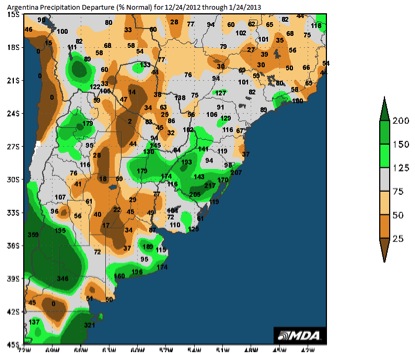
  • In terms of issues this week, probably the most discussed item has been S American weather conditions. Concerns have risen over dryness in Argentina, which probably comes as a surprise given the extreme wet conditions experienced through late 2012, which damaged wheat quality and quantity. However, January conditions have shown a marked reversal with hot and dry weather being the pattern and topsoils have dried out extremely fast as a result. Late planted corn is shallow rooted and appears to be struggling to access subsoil moisture leaving the crop in need of rainfall to rejuvenate it. Seemingly, the last significant rainfall was over three weeks ago and daytime temperatures have been hitting 32℃ (90℉).
  • These conditions, and the potential impact of output follow hot on the heels of the latest USDA prediction of 28 million mt output; the UN’s FAO (Food & Agriculture Organisation) figure is somewhat lower at 25.5 million mt.
  • The recent onset of dry and hot conditions may well add further credence to the prospect of a stronger La Niña signal. Pacific Ocean surface temperatures have been trending lower this month, a potential contributor to La Niña. Typically Argentina is extremely sensitive to La Niña and El Niño patterns, and corn output figures strongly correlate to these conditions; high yield and output in El Niño and low yield and output in La Niña conditions.
  • In summary, if a La Niña pattern becomes more established, and persists, the output of corn in Argentina is likely to be compromised and lower than either USDA or FAO figures suggest. This cannot be viewed as good news hot on the heels of the current extremely tight US corn position, which we continue to maintain is in need of elevated prices to instigate much needed demand rationing.
  • The current weather patterns are as important as ever with a strong need for good, early production as the current flow of new beans does not appear to be sufficient to satisfy export commitments booked for February. Vessels continue to line up at Brazilian ports to make sure they have a spot in line but there are building concerns that shipping delays could cause supply shortfalls.
  • Wheat markets received some further supportive news from the release this week by Strategie Grains of their latest forecast for 2013 EU output at 133.3 million mt, a reduction of 1.5 million mt from last month, but 17.5 million mt (8%) better than last year. The reduction from a month ago is attributed to reduced plantings as a consequence of wet weather conditions. Spring planting intentions still point towards an enlarged barley acreage and we are beginning to hear of some attractive discounts (to wheat) for barley prices next season, although we have not heard of any actual trades just yet!
  • Brussels issued a further 399,000 mt of wheat export licences this week bringing the total for the season to 11.642 million mt, which is an increase of 23% on the same time last year when export numbers were 9.465 million mt. Little wonder that EU offers have not featured competitively in recent tenders.
  • In summary, it feels as if we may have seen some seasonal price lows in Chicago and European markets, and we hope that the buying opportunities were grasped! Time will no doubt tell whether we are right or not.

17 January 2013

  • US weekly exports figures released today were reported as follows:

Wheat: 574,600 mt within estimates of 450-650,000 mt
Corn: 393,300 mt above estimates of 150-250,000 mt
Soybeans: 1,788,800 mt above estimates of 750-950,000 mt
Soybean meal: 245,000 mt above estimates of 100-150,000 mt
Beanoil: 12,900 mt below estimates of 15-25,000 mt

       Generally these figures appear to be bullish.

  • Further data releases include Strategie Grains 2013 EU grain outlook down 1.5 million mt mom but 17.5 million mt better yoy. Soft wheat numbers are estimated at 133.3 million mt, which is a reduction mom following reduced plantings, but an improvement of some 8% yoyI
  • IGC (International Grain Council) figures released today showed a reduction in 2012/13 corn end  stocks to 113 million mt, a nine year low principally as a result of higher consumption. The figure is a 3 million mt reduction mom and down from last year’s figure of 133 million mt.
  • The EU granted wheat export licences amounting to 399,000 mt bringing the year to date figure to 11.642 million mt, up from 9,465 million mt at the same time last year (23% increase).
  • In a change of weather fortunes Argentina is experiencing some crop moisture stresses, which may well come as a surprise following weeks of relentless rainfall which damaged their wheat crop quality and quantity. Topsoil moisture levels have reduced markedly as January conditions have been hot and dry. Late planted corn is shallow rooted and struggling to access the subsoil moisture and is in need of rainfall to rejuvenate it. Seemingly, the last significant rainfall was over three weeks ago and daytime temperatures have been hitting 32℃ (90℉).
  • These conditions, and the potential impact of output follow hot on the heels of the latest USDA prediction of 28 m ill ion mt output; the UN’s FAO (Food & Agriculture Organisation) figure is somewhat lower at 25.5 million mt.
  • The recent onset of dry and hot conditions may well add further credence to the prospect of a stronger La Niña signal. Pacific Ocean surface temperatures have been trending lower this month, a potential contributor to La Niña. Typically Argentina is extremely sensitive to La Niña and El Niño patterns, and corn output figures strongly correlate to these conditions; high yield and output in El Niño and low yield and output in La Niña conditions.
  • In summary, if an El Niño pattern becomes more established, and persists, the output of corn in Argentina is likely to be compromised and lower than either USDA or FAO figures suggest. This can not be viewed as good news hot on the heels of the current extremely tight US corn position which we continue to maintain is in need of elevated prices to instigate much needed demand rationing.

16 January 2013

  • It would appear that the gains in recent days have proved too much as some profit taking has capped gains in CBOT markets to some degree. Corn (at the time of writing) is all but unchanged whilst wheat is marginally positive and the soybean complex is showing a greater degree of positivity. Improved weekly sales and large domestic crush would seem to be the drivers.
  • This ongoing position is likely to produce one of two outcomes: either higher prices and the rationing we have been calling for over the last few weeks, or the US runs out of soybeans and products (meal and oil). Some suggest that S America will come to the rescue and fill in the hole which appears to be growing at a rapid pace, however the logistics of both loading and discharge present some significant physical issues which have to be addressed, leaving the simple solution as perhaps less simple than at first might appear to be the case.
  • S American weather is starting to become a significant determinant for price action; Argentine corn and soybean crops are fast approaching their (weather delayed) key development stages of pollination and bloom. Corn development was delayed as a result of excessive rains in the last three months of 2012 although we have seen dryer conditions in recent weeks.
  • There would appear to be some evidence of a developing La Niña pattern which would indicate warmer and more arid conditions similar to those which persisted in S American regions last year. N Brazil has experienced dry conditions, or drought, and increasing temperatures and significant rainfall, above average, is required to allow for a good soybean crop in the key Matto Grosso region. As temperatures rise and crops develop the water requirement grows from both crop demands and evaporation – hence growing soil moisture deficit unless rains arrive. Helpfully though, S Brazil has abundant soil moisture levels, for now, following the earlier heavy rains which plagued Argentina and southern Brazil.