- We have seen another positive day in the grains with both US and European markets putting in positive gains in the continuation of direction picked up from Friday’s USDA report. Soybean prices have traded either side of unchanged.
- In the UK the HGCA (Home Grown Cereal Authority) have confirmed that the long running spell of wet weather, which decimated the 2012 harvest, has not only severely disrupted autumn sowings, but in now also threatening spring planting. Waterlogged field conditions are keeping farmers and their machinery off the land as we approach the early spring planting window. Autumn wheat plantings only reached 80% of planned levels, some of which has been lost to flooding, and some to slug damage. Anecdotal evidence points to some rapeseed acres having been as much as 80% lost to slug damage. Key to next year’s harvest will be the choice of spring cropping, wheat or barley; much will be dictated by the availability of seed as well as grower preferences.
- In a departure from normal patterns (which seems to be the order of the day) the UK has seen a significant switch from wheat exports to wheat imports according to latest figures. The level of imports topped 1 million mt in the first five months of the season, which compares with 370,000 mt a year ago, as exports reached 480,000 mt, compared with 1.25 million mt a year on year. To put the volume of imports so far this season into perspective, they have exceeded the total for the whole of last year. The swing from net exporter to net imported has hit a massive 1.4 million mt.
- UK demand patterns appear little reduced as ethanol production at Ensus and the start up of the Vivergo plant continue to draw upon domestic grain despite corn top-ups being used by Ensus to boost grist starch levels. Feed production in the UK was higher than last year, which has supported grain consumption despite higher prices.
- According to officials from IKAR (Institute for Agricultural Market Studies) in Russia, the recent cold snap may well have damaged susceptible wheat which was not protected by snow cover. Estimates ranging from 5 to 25% of winter wheat may be at risk from winter kill. The recent warmer temperatures have allowed snow cover to thaw completely in some areas and the subsequent cold conditions (below 0℉) have created some lasting crop damage.
- Key southern Russian grain producing regions sowed crops in dry conditions and poor establishment has left crops weak. Rainfall levels below half of normal have added to stress levels, and the regions experiencing such conditions account for up to 60% of winter wheat production in Russia.
- The Russian situation appears to be similar to that of the US Plains, poor establishment in dry conditions followed by late dormancy extending the poor growing season adding to plant stress and the final straw being sudden onset of cold conditions bringing with it the risk of winter kill. On the back of the current season experienced in many wheat growing regions this is the last thing global wheat supplies need.
Monthly Archives: January 2013
11 January 2013
- Friday’s eagerly awaited USDA report left us with one clear message, and that is: “there is insufficient feed stock in the world right now”. How about that for a headline?
- US corn stocks, as of 1 December, fell to 8,030 million bu, down from 9,747 million bu at the same time last year. Demand rationing, through price hikes, is essential if minimum pipeline supplies are to be in place at the end of the season. The detail of the report included reference to forage stocks within the US being at record low levels (basis 1 December) due to the drought and depleted soil moisture levels in the Plains. With this in mind, feed demand for corn is likely to remain pressured until springtime and possibly longer if adequate rains and snow melt do not materialise.
- Harvested acres were reduced, as expected, but this was offset by another yield improvement; however, domestic feed and residual usage was reported as the highest since 2007, clear evidence that despite high cash basis prices we have seen little in the way of rationing to date. Corn exports from the US were forecast lower which we struggle with given latent demand from other regions including the EU (which was left unchanged) and S American exports were raised by 2.5 million mt to which we raised an eyebrow given weather conditions in Argentina.
- For corn, it is abundantly clear that the world is wholly reliant upon massive US plantings this year, and for those plantings to materialise into a massive crop. Given the soil moisture deficit from last year’s drought, which is still persisting in some areas, the desired outcome is far from a foregone conclusion. We look for prices to escalate into the remainder of the coming season.
- Wheat figures were more of a non-event aside from a slight reduction in US feed and end stocks (38 million bu), the main event being winter wheat acres less than trade expectations with hard red wheat some 1.2 million acres lower than average expectation although soft red was around half a million acres more than expected. Given (once again) the Plains drought and soil moisture deficit, the potential for abandonment is high and the potential for an incredibly tight US (and hence global) supply and demand picture is very real. The pace of US exports to date has been slow, but this picture is changing right now and we would expect to see a swift recovery in these numbers as long as US pricing remains were it is now in relation to its competitors – cheap!
- Soybean data saw an increase in both acres and yield as expected, giving a further 44 million bu to the supply side, but US exports were left unchanged much to our surprise. Overall, our impression is that the bad news is yet to come in beans. The potential overstatement of crop and understatement of exports points to extremely tight ending stocks, possibly below pipeline requirements. The implication being that higher prices will be required to force rationing, either of domestic crush, or exports, to permit sufficient year end stock for the US to keep working.
- Meanwhile, aside from the USDA’s report, the “normal working week” provided us with the following:
- US weekly exports continue to be disappointing in wheat and corn although Thursday’s Egyptian tender convincingly highlighted the competitive nature of US wheat. The US picked up 55,000 mt of soft red winter wheat business with Canada securing 60,000 mt. To further illustrate the point, the C&F prices attributed to the deal would appear to be lower than the French FOB levels! The competitive pricing potentially paves the way for a pick-up in export pace for US wheat from now on, as there are few offers around from the usual exporters.
- Soybean export numbers remain strong with China leading the way as buyers as their current crush margins are historically large. The Chinese crushers traditionally “lock in” such margins whilst they are available and this has led to their recent buying spree, which has seen them taking good cover through to Feb and March. We expect US stock forecasts to remain extremely tight, unless price hikes force the necessary demand rationing.
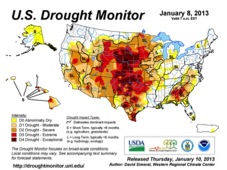 This week, US Agriculture Secretary Tom Vilsack designating 597 counties and 14 states as “primary natural disaster areas due to drought and heat.” The impact of this designation is to make farmers in these areas eligible for emergency loans at low interest rates. Last year some 2,245 counties and 39 states (71% of the US) qualified for this same status.
- The dry and unseasonably mild conditions persist leaving in question as much as 25% of the US wheat crop which may be subject to abandonment in the springtime. The choice of replacement cropping will be very much a reflection on the overwinter conditions and spring weather but we would consider it unlikely that significant acres were replaced with wheat. This would leave US wheat output for 2013 behind 2012 in a year when global supplies are far from bursting out of the barn.
- Australian weather conditions in key wheat growing states have been dry and hot to say the least. The intense drought and extreme heat of the last three months has worsened the outlook for the 2012/13 harvest. Current temperatures have topped 44 to 45℃ (112 to 114℉) in parts of New South Wales and South Australia (key wheat growing regions) and follow an intensely hot December. To put these temperatures into context, they are 8℃ (14℉) above normal. However, all is not lost. Western Australia received later and significant rainfall, which followed a dry beginning to the season, leading to a “reasonable” crop. Additionally, the region has not suffered the same intensity of heat as SA and NSW. There are, however, potential quality issues with late harvested grains sprouting due to wet harvest conditions. The dryer eastern regions have the potential to suffer from shriveled grains as a direct result of heat, which will compromise overall yield. All in all, the USDA’s 22 million mt estimate for Australian wheat output looks to be a high number right now, an output of closer to 20 million mt appears more likely in the light of the conditions.
- In summary, the USDA numbers and pretty much everything else we see in the world right now is pointing towards tightness and ultimately higher numbers.
10 January 2013
- CBOT markets have seen corn and wheat leading marginally to the upside and the soy complex around unchanged on the eve of what is probably the most significant USDA report of the season. Trade appears to be on the thin side as traders struggle to anticipate the contents of tomorrow’s release.
- US weekly export data was released as follows:
Wheat: 233,8000 mt, below estimates of 325-425,000 mt.
Corn: 1,000 mt, below estimates of 100-200,000 mt.
Soybeans: 406,8000 mt, above estimates of 200-400,000 mt.
Soymeal: 118,200 mt, within estimates of 75-175,000 mt.
Beanoil: 10,800 mt, below estimates of 35-65,000 mt.
- In the first release of figures this year Brussels wheat export data for the last three weeks amounted to 1.11 million mt bringing the season total to 11.243 million mt. This compares with 9.173 million mt last year and, in the light of limited competitive wheat from Black Sea or Argentina, to name but two, makes the task of rationing a difficult one to contemplate right now. If the current EU export pace is maintained we face the potential for huge feed grain import requirements to fill the gap.
- The latest Egyptian tender today awarded 55,000 mt of US soft red winter wheat and 60,000 mt of Canadian soft red winter wheat. Prices were reported to be significantly cheaper than the limited offers of French wheat which were put forward and confirming our earlier comments that US wheat is the most competitive at present.
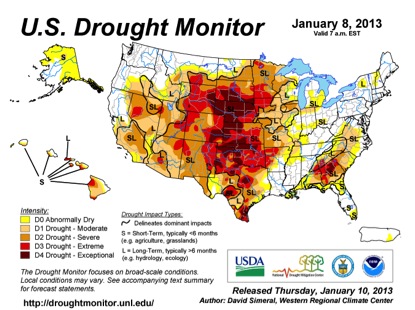 Yesterday we saw a statement from US Agriculture Secretary, Tom Vilsack, designating 597 counties and 14 states as “primary natural disaster areas due to drought and heat.” Th impact of this designation is to make farmers in these areas eligible for emergency loans at low interest rates. Last year some 2,245 counties and 39 states (71% of the US) qualified for this same status.
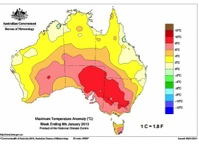 In Australia, one of the last potential global wheat “pressure relief valves”, recent weather conditions have been less than conducive to the ongoing crop development. Intense drought and extreme heat has worsened to outlook for the 2012/13 harvest. Current temperatures have topped 112 to 114℉ (44 to 45℃) in parts of New South Wales and South Australia (key wheat growing regions) and follow an intensely hot December. To put the temperatures into context, they are 14℉ (8℃) above normal.
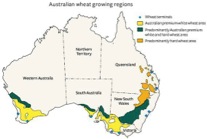 However, all is not lost, Western Australia received later and significant rainfall, which followed a dry beginning to the season, leading to a “reasonable” crop. Additionally, the region has not suffered the same intensity of heat as SA and NSW. There are, however, potential quality issues with late harvested grains sprouting due to wet harvest conditions. The dryer eastern regions have the potential to suffer from shrivelled grains as a direct result of heat which will compromise overall yield. All in all, the USDA’s 22 million mt estimate for Australian wheat output looks to be a high number right now, an output of closer to 20 million mt appears more likely in the light of the conditions.
- We look forward to tomorrow’s report with interest and hope that we see some clear market direction as a consequence. There are many who believe we will see “fireworks” potentially with limit moves (in corn), but in which direction?
9 January 2013
- Last night’s closing action in Chicago did provide some huge volume of trade as anticipated but despite that prices moved very little. Markets continue to trade in guarded fashion ahead of Friday’s key report which is likely to provide fireworks, the direction of these fireworks is less than certain at this time!
- We have seen some evidence of Chinese activity in the wheat market as they source better protein supplies from the US and Canada to bolster their own stocks amidst record domestic prices. It appears there is potential for some significant volume of imports by China if prices continue to remain depressed. Quality of the crop is also rumoured to be questionable, which would add credence to the requirement for higher quality wheats. It may not be generally reported, but China is suffering the coldest winter in 30 years, which is even affecting crops in the south.
- Conversely, the US climatologists reported that 2012 was the second warmest summer ever recorded. This comes as little surprise after all we have seen and reported over the last six or seven months although it is nice to have “official” confirmation, albeit after the event! The big question will be whether the drought will continue, some fear that the temperature trends in the two key oceans, Pacific and Atlantic, look to provide a repetition of the 2012 patterns. Only time will tell, but a second dry season in the US is the last thing global grain stocks need right now.
- France’s AgriMer reported their 2012 wheat output at 35.815 million mt, which is a little over 5% above the 2011 figure. At the same time they reported end stocks up over 300,000 mt at 2.293 million mt. Both corn and barley end stocks were also seen as higher than 2011 levels.
- Ukraine’s 2013 wheat crop is reported at 19 million mt by their AgMin and at 21 million mt by AgroConsult. Corn and barley output is also seen as increased in 2013. We see little in the way of surprise in these latest figures given last year’s crop stresses and the figures appear attainable provided the weather does not intervene as it did last year.
8 January 2013
- Today has not (as yet, with an hour to go in Chicago) shown any sign of the fabled “turnaround Tuesday” which so often plagues Monday direction. However, there is still time to go and with the start of fund rebalancing anticipated today we could well be in for a stormy close.
- We believe that markets right now are all about cash prices rather than their more frequently discussed cousins, the futures contracts. Clearly futures prices are much more public and transparent but we are seeing further clear evidence in many places (globally) that cash premiums are at elevated levels as buyers are struggling to get farmers and merchants to part with their physical crop.
- In the UK we hear wheat premiums for May-Jul delivery as much as £7 to £8 above “normal” and nearby supplies less than freely available. Despite the “abnormal” pricing of UK wheat in relation to French, by which we mean the premium as opposed to the historic discounts we have previously come to expect, we do not see a glut of sellers all rushing to take advantage of the “manna from heaven”.
- In other wheat exporting regions we hear of similar circumstances; Russian domestic premiums have been referred to here on more than one occasion, Argentine cash premiums are high, France is displaying strong cash levels as are US markets. This situation could well point to a change in the current downtrend before too long unless some new information comes to the fore.
- US export inspections released yesterday revealed soybean inspections close to 40 million bu with year to date numbers reaching 814 million bu, which is 36% higher than last year and a massive 61% of the USDA’s full year forecast. Seemingly US December soybean exports reached 190 million bu, the third largest figure on record.
- Corn inspections were somewhat less impressive at 8 million bu brining the year to date figure to just over 260 million bu down 55% on last year. US pricing would appear to be competitive and could well become the source of choice for new purchases – which still could include large volumes to the EU to replenish the export depleted feed grain stockpile.
- US wheat exports have reached nearly 530 million bu, which is 13% below last by year’s figure. We anticipate the pace to rise in coming weeks and months as US wheat remains extremely competitive in the global market – and traditional sources are either closed for business or extremely tight on stocks.
7 January 2013
- The week started on a slightly more positive note with CBOT grains all looking a touch firmer and that remains the situation as we enter the final hour of trading in Chicago. The technical picture in wheat looks extremely oversold with both RSI and Stochastic studies at or close to extreme levels. However, this does not constitute a buy signal on its own! We would reiterate the fund net short position in CBOT wheat, which was increased in the latest released data, is held in the cheapest wheat in the world right now. Call us cynical if you will, but one has to be extremely confident to hold such a position!
- The soybean technical picture looks to have found some degree of support with Friday’s (March ’13) low coinciding with the low of 16 November and also an old chart “gap” going back to 28 June last year, which is now filled. This could prove to be a pivotal time in soybean pricing if this level holds and provides support going forward.
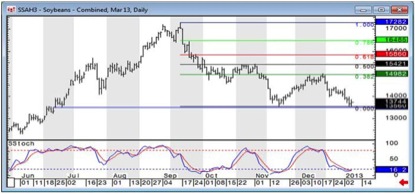
- The market has seen an improved interest from China, which has now returned from their extended New Year break, with soybean crush margins at relatively good levels and a keen interest to lock these in with purchases of now cheap US beans, The ebb and flow of Chinese margins is a good indicator of buying interest and we could see this adding to support right now.
- The trade continues to look forward to Friday’s production and stocks report. Average trade estimates are for a 75 million bu decline in 2012 US corn output and an increase of 22 million bu in soybean output. Dec 1 stocks are expected to show corn at 8.219 million bu and soybeans at 1.981 million bu; both these figures are well below stocks of 12 months ago.
- Given our outlook for US soybean and corn stocks at the end of the season, and the need to see strong demand rationing through price, we continue to look for upside in current pricing whilst continuing to acknowledge the current solid downtrend. We maintain a close watch out for any sign of price reversal signals such as the potential soybean support mentioned earlier.
- Latest EU weather conditions are starting to reflect a degree of concern over crops struggling to flourish in waterlogged ground. Ongoing heavy rain accompanied by warmer weather melting snow cover has the potential to leave poorly developed crops vulnerable to colder conditions in coming weeks.
4 January 2013
Happy New Year to all our readers and we wish everyone a successful and prosperous 2013.
The start to the year has reflected pretty much “more of the same”, fund selling particularly in soybeans, which has left the bean market firmly in a downtrend. The technical picture is bearish but looks very oversold right now and due for a correction but we would caution against stepping in right now, as the trend is still intact. The old adage about “catching a falling fridge” should not be forgotten at present.
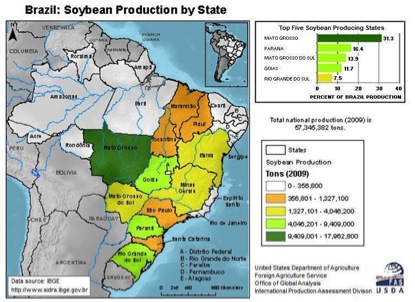
The on-going fund selling in soybeans has largely been brought about by S American crop prospects. Argentina’s Buenos Aires Grain Exchange (BAGE) reports their crop at 85% planted, which is up nearly 5% week on week and the USDA attaché sees the 2012/13 Brazilian soybean crop at 83 million mt, which is 2 million mt above the last USDA estimate.
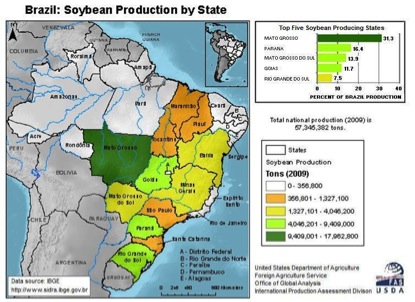 Weather conditions in Brazil are mixed, with Matto Grosso (the largest soybean producing state) showing early moisture stresses and deficit. December’s rainfall in the region has only amounted to 35 to 50% of normal and the deficit has grown to 100 to 150 millimeters in the key central region. However, the prospects in other states look better; Parana and Rio Grande do Sul both received good rains during last month. Matto Grosso do Sul needs further rainfall to achieve its potential. All in all, January and February will be key months for rainfall and its effect on the soybean crops.
Wheat markets have fared slightly better than soybeans, in other words they have not fallen as much! Globally we still see tightness in traditional sources of supply; Black Sea, Argentina and the EU. The US currently represents the cheapest source of wheat in the world and we are seeing an increase in the size of fund net short positions. We find this somewhat incongruous from a trade perspective and would not wish to be short of the cheapest global source of anything, let alone wheat!
The latest USDA crop condition report, issued on 2nd January, showed that wheat condition had deteriorated in December in both Kansas and Oklahoma. The expectation was for improved crop condition following increased precipitation.
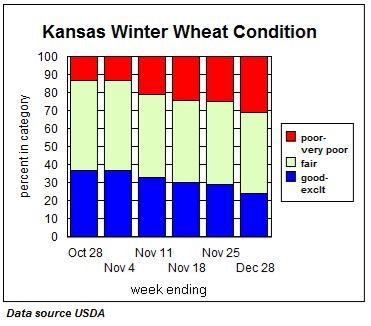
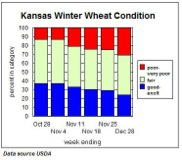 Kansas’s wheat rated as good to excellent fell to 24% from 46% a month ago, whilst the crop rated poor to very poor increased to 31% from 25%.
 The figures for Oklahoma over the same time frame were 11% good to excellent, down from 14% whilst poor to very poor increased to 61% from 44%.
The graphics show a clear trend of declining condition resulting from dry early conditions leaving the crop poorly developed, late going into dormancy thereby adding to stress levels by prolonging the very poor growing season, then being hit by cold winter conditions and freezing temperatures. The next USDA crop condition report is a month away and we will be looking closely to see if there is any sign of a reversal of the current trend.
In conclusion, we acknowledge the sizeable price declines but continue to view fundamentals as projecting a potentially bullish picture. However, until we see some clear sign of a change in the current downward trend, we have to sideline for now. The picture looks to be set for a potential “bear trap” hence our sideline rather than short stance.
3 January 2013
- We have seen further soybean liquidation today, which has naturally pressured prices further to the downside. The entire soybean complex is currently trading in negative territory once again. Technically, the charts present a bearish picture and until there are signs of the decline ending and reversing we must side with the trend. It has to be noted that volumes remain on the light side.
- Corn and wheat have not reacted in total sympathy with soybeans; corn is unchanged to slightly lower whilst wheat markets are currently displaying gains. Non US origin grains are displaying stronger signs amid continuing physical tightness. As we have previously reported Russian domestic prices have made record prices and are still close to their highs, Argentine wheat is difficult to source following their wet weather conditions, Black Sea grain has been finished for a while and EU levels remain relatively firm amid strong exports and consumer demand.
- The current wheat fund short position is to be watched closely given the fact that CBOT wheat is among the world’s cheapest. Should there be a change of heart and covering of shorts we could well see prices rebound significantly in a short period of time.
- The latest US wheat condition report was issued yesterday and showed Kansas and Oklahoma to be worse than a month ago. It was widely expected that condition would improve as a result of improved precipitation, but this has not been the case. Kansas winter wheat condition fell to 24% good to excellent from 29% whilst the proportion rated poor to very poor rose to 31% from 25% a month ago.
- Oklahoma conditions over the same time frame showed the crop rated good to excellent declined to 11% from 14% and poor to very poor rose to 61% against 44%.
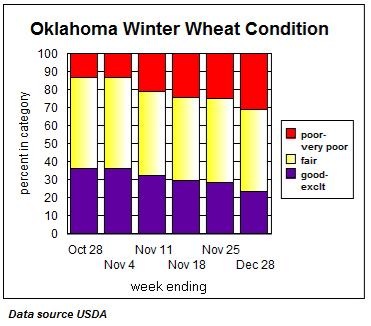
- The conclusion we draw from the decline in condition is that the onset of cold winter conditions and freezing temperatures is largely the culprit as the crop was in less than ideal shape and late entering dormancy. The next USDA crop condition report is a month away and we look forward to seeing if there will be any reversal of the current trend.
2 January 2013
- We hope you had a very happy Christmas and New Year and welcome to 2013!
- We rather expected a strong market this morning when we awoke to news that the US had actually fallen off the fiscal cliff but had been caught before hitting the bottom! In other words, the rescue was certainly last minute but rescue it was. Some 2% of the wealthiest US citizens will be hit directly by higher tax rates although it seems that most will be hit in some way, shape or form.
- We were not disappointed in our expectations, markets (particularly financials) jumped in response to the news and commodities reacted strongly in early trade. However, euphoria was short lived as fund selling resumed amid low volumes as many extended their holiday break and markets added to the declines which marked the last weeks of 2012.
- We are awaiting a degree of fund rebalancing and also the key January USDA report on Friday 11th, and it appears that many are sidelining until then. With the consequent reduction in volumes we see a degree of increased price volatility as a result.
- The anticipated relief to markets, from forthcoming S American crops, may well need to be more carefully considered in the light of current weather conditions experienced in the region. Brazil’s Matto Grosso, which is responsible for some 30 plus percent of the nation’s soybean production, has
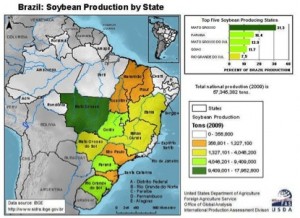 continued to suffer dry conditions – unusual for December which is normally one of the wettest summer months. Additionally, hot conditions have accompanied the dry weather. Other growing regions further south are also affected, albeit to differing degrees. The potential is for some 45% of the total soybean crop to be adversely affected, the crop should be flowering and pod setting this month, a time when yield is most susceptible to rainfall – or lack thereof.
- The latest weather forecasts show dry conditions for the next couple of weeks in Matto Grosso and better rains further south, an area which is also a significant soybean grower. The crop outlook is therefore mixed but certainly not all good – or all bad.
- Argentina continues to suffer with excess rain, which has been the trend since September. Wheat yields and quality continue to be reportedly suffering and the outlook for corn output is similarly declining.
- As we enter the New Year the news, regrettably, shows little in the way of improvement and crop prospects continue to be plagued with negative tones.