29 June 2015

  • Another day higher as the transfer of ownership continues from grower to funds. The fund appetite for the grains and less so for the soybean complex has continued again as the USDA report looms large. The S American farmer has been an active seller on the rally allowing him to reduce the size of his cash stocks, which he has been holding for many months. CBOT volumes have simply been huge.
  • US winter wheat condition is reported as 41% good/excellent, unchanged week on week, which surprised many who expected a decline due to the ongoing rains. The condition is better the last year’s 30% and the crop is 38% harvested well above estimates of 30% and up from 19% week on week but below last year’s 42%. US spring wheat is 72% good/excellent, up 1% week on week, again surprising many who were expecting a drop.
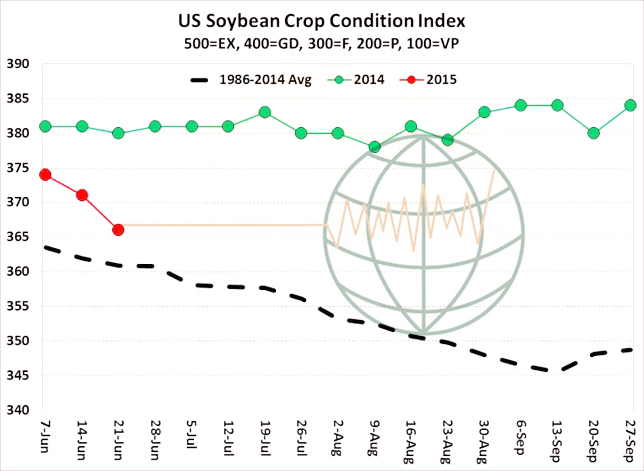
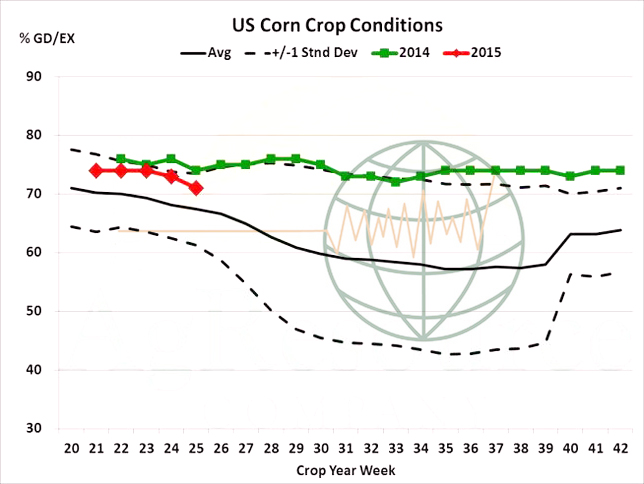
  • Corn condition dropped 3% good/excellent week on week to 68%, which is also down year on year from 75%, whilst soybeans saw a 2% week on week drop to 63%, which compares with 72% year on year. Both ratings reflect the recent rains. Soybeans are 94% planted, only a 4% gain in a week but only 1% behind last year.

25 June 2015

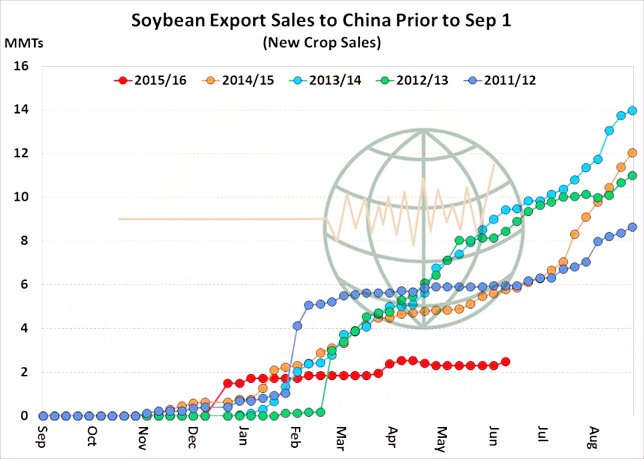
  • Another day of massive short covering saw soybean prices push to strong gains. Further rainfall in the forecast for the wettest parts of the Midwest and concerns over another drop in crop ratings were the fodder for the bulls. US export data  was uneventful, but what has been significant for some while now is that China has been absent from the US market for new crop soybeans. The chart below shows that China has secured only 2.5 million mt this year vs. 5.8 million mt a year ago and 8-10 million mt in the two preceding years. S America is a cheaper seller as far forward as the end of the year, pressuring further US sales at this time. Oct/Nov traditional US business is being picked up by both Brazil and Argentina as we have previously mentioned, and if the US is not to be left with massive unsold stocks, something has to give – prices maybe?

  • Crop ratings have dropped in a few states, but the majority of the US crop continues to hold up well above average right now. Currently, the US crop look on track to make 3.75 billion bu and with such a crop the US can ill afford to lose out on further export deals.
  • Corn rallied sharply with wheat and soybeans as 1-3” of rain appeared in the forecasts, which leaves the weekly gain around 24 cents so far and open interest in the market has declined significantly. The upcoming USDA report will have had a large degree of influence on this move as traders reposition and reduce risk but it feels like the move has been mostly weather related, in the context of a huge fund net short. There is talk of a sizeable increase to the Brazilian winter corn crop in coming days and S American corn remains some $2-6 below US Gulf into Aug/Sep whilst Ukrainian corn is offered $10 below US for Oct on an FOB basis. Additionally there is a good rain forecast for Ukraine in coming days which has the potential to boost their crop still further. Our view is that the weather has to remain significantly adverse in the US for this bullish move to persist.
  • Wheat traded in sympathy with its neighbours, as would be expected and talk of heat and dryness across the spring wheat regions of Kazakhstan and parts of the Russian Volga region as well as Canada lent some support. The Black Sea forecast contains beneficial rain. US exports for the week were nearly on the pace to match the USDA’s forecast, however total 2015/16 commitments rest at 201 million bu, down 65 million, or 25% from a year ago, whereas the USDA was forecasting an 8% increase! Ongoing price competitiveness of the US Gulf remains an issue, is there a theme going on here!!!
  • Brussels has issued weekly wheat export certificates amounting to  370,195 mt, which brings the season total to 32,851,776 mt. The season to date total is now 3.499 million mt (11.92%) ahead of last year.

24 June 2015

  • The US soybean weather outlook for July remains favourable and the bears are looking for a final bounce into the USDA report to allow what may well become the final big selling opportunity of the season although there is a suggestion that there could be an acreage re-survey by NASS on account of June rainfall which is adding to current uncertainty in the market.
  • In corn markets an improving US weather forecast (drier) and corn exports within expectations this week are the key elements to the market ahead of the USDA report next Tuesday. It feels that there are fewer concerns over a bullish surprise in the report than is the case for soybeans.
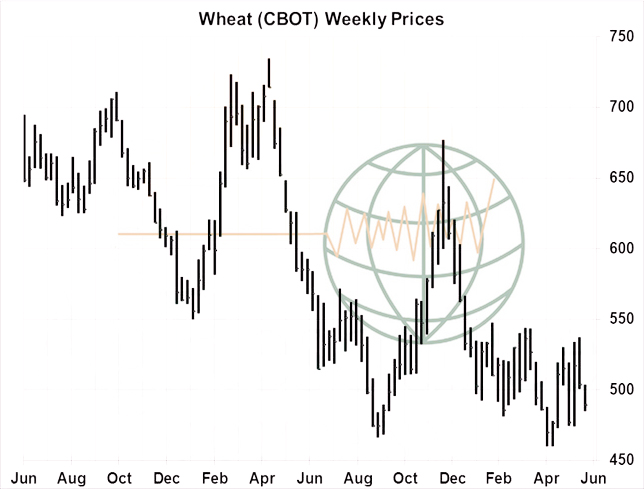
  • As far as wheat is concerned there are insufficient weather issues around to materially impact the cash market, particularly in the face of limited demand, and it is difficult to see the US futures market holding current levels given the prospect of end stocks pushing close to 1 billion bu.
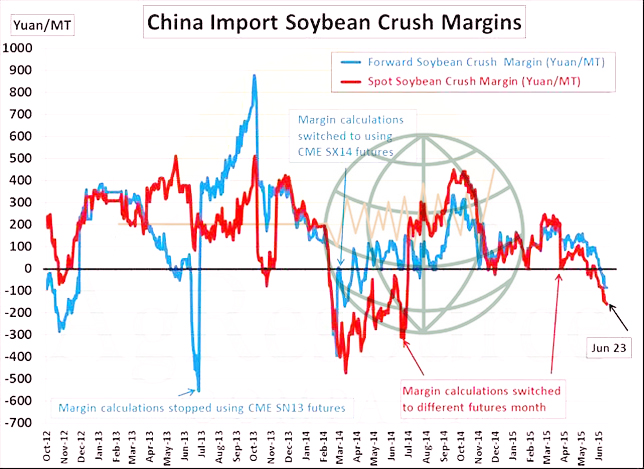
  • Chinese soybean crush margins have fallen to their lowest levels in a year with meal prices just off 8 year lows. Reduced Chinese pig numbers and an unprofitable broiler industry have curtailed domestic soybean meal use. What is different from 2014 is that new crop Chinese crush margins are also negative – which along with cheaper Latin American offers is slowing US new crop soybean sales to China. And Chinese crushers are opting for cheaper Argentine soybeans through October. US 2015/16 soybean exports appear likely to fall below that of 2014/15 in our opinion.


23 June 2015

  • Further fund short covering in corn and wheat offered support whilst a slowdown in fund demand across the soybean complex had the opposite effect. It appears the US farmer is a better seller of old crop corn and S America is active in October fob soybeans, effectively stealing the US “gut slot” of harvest. The record large S American soybean crop is narrowing the US window of opportunity to export. This could become a major issue following the June crop report.
  • The US$ surged again to sharp gains as the market continued to worry over another “let’s kick the tin along the road again”by Greece. The Greek deal (or no deal) and comments from the US Federal Reserve that two interest rate hikes are indeed possible in 2015 has set the stage well and truly for the US$ rally to persist – likely for the remainder of the year.
  • US weather patterns look more normal with another chance of C and E Midwest rain later in the week before a cooler and drier outlook develops. The outlook for rain moves south early next week which would be ideal. The critical corn pollination weather looks close to perfect, cool with showers, rather than any prolonged heat which is always so damaging to overall output.

22 June 2015

  • Some fund short covering was noted in Monday trade in wheat and soybeans. Corn appears to want to stay with recent lows and the market appears reluctant to cover those shorts – right now, suggesting that technical chart issues are more of a focus than fundamentals. It looks highly possible that we may, just may, be forming a chart “top” in soybeans and wheat, with a mid-week a likely time frame – if it occurs!
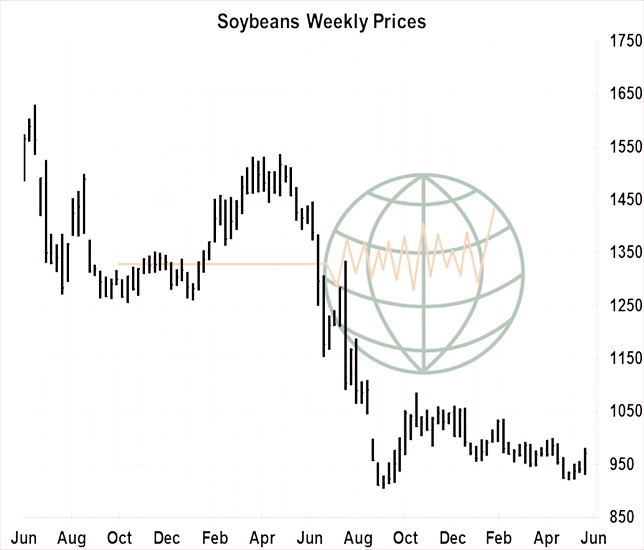
  • The soybean (July) chart looks to be testing the higher end of the downtrend channel, which has been in place since the season top formed last November. A close, basis the July contract, above $9.90 would break the downtrend. Our “top forming” comment above coincides with the spot soybean/corn ratio pushing out to 2.8:1 Monday, which is the same ratio at which the market topped in late February!
  • After the close, NASS reported that US soybean planting progress had advanced to 90% through Sunday. Crop condition ratings inched lower with good/excellent ratings at 65%. The index of all crop ratings was lower but, remained well above the long term historical average which would justify a 46 bu/acre yield. We see this recent rally as being largely technically driven as trader’s position ahead of major USDA reports next week, as well as the end of month/quarter. Technical rallies usually end once prices have reached key technical targets, which we see at $9.90-10 July and $9.60-9.70 November. We expect a summer high to be traded in coming days with prices to slide lower into the June 30th report.

  • Nationally, the US corn crop is rated as 71% good/excellent, down 2% points from last week and a year ago. As expected, substantial declines (11-19%) were recorded across IL, IN, OH and NC due to adverse weather. Partially offsetting this were moderate boosts in CO, SD and MN. Current conditions will not cause NASS to change their yield estimate in July. Early yield models suggests a national US yield of 165-168 bu/acre. Next week’s crop progress will include % silking. Corn in S IL will start pollinating next week.


20 June 2015


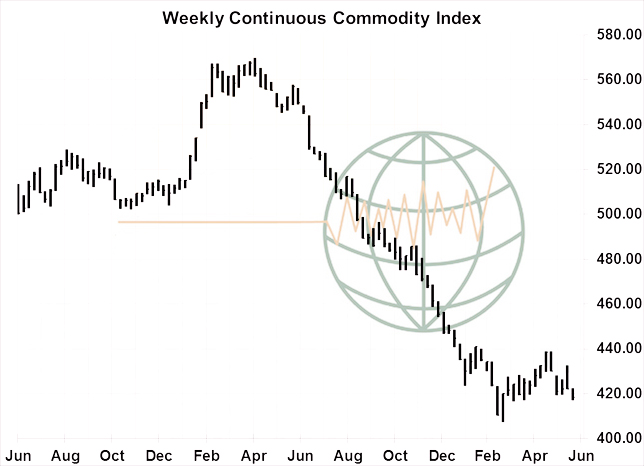
Weekly CCI Analysis:

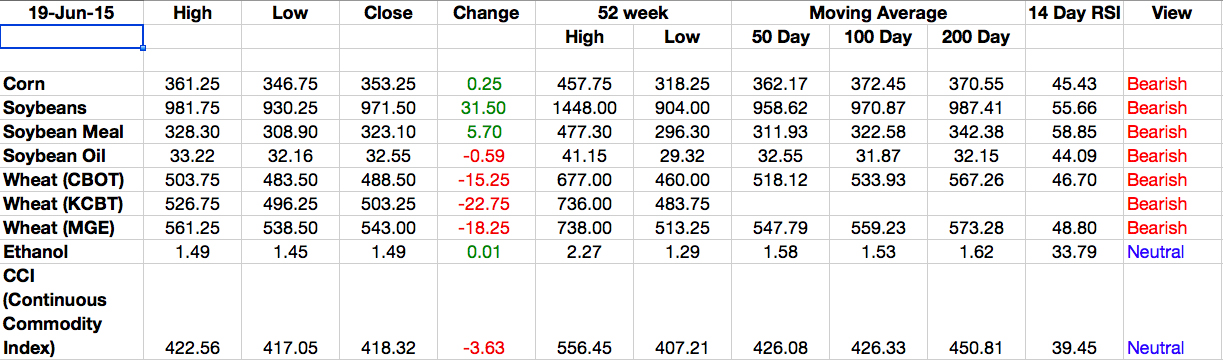
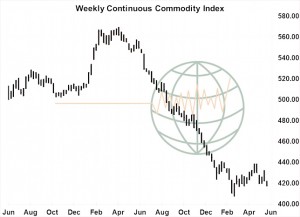
The CCI/CRB index finished the week lower even with a fall in the US$ on sliding grain and energy prices. The week ahead will be important as fund managers head into the end of the month and quarter. Amid US and Asian equity prices that are pushing to new record highs, commodities as an investment continue to fall out of favour. The recent rally in the CCI index appears to be corrective in nature and the US$ should rally regardless of the outcome of the Greek debt payment which is due on June 30th. At a minimum, the CCI index should retest contract lows by late summer or early autumn. Our view continues to remain bearish commodities. The world energy market should have scored its seasonal high with WTI crude above $62. A lower close in the week ahead would be deemed bearish heading into July.
Longer-term soybean analysis:

Soybean futures ended the week higher with fund short covering ahead of the end of month USDA reports being the main feature through the week. New crop soybeans fell to new contract lows which could not be sustained. This triggered short covering and a technical rally unfolded for the remainder of the week. The market is concerned that excessive rains in some areas of the country will reduce total acres. However, planting progress is expected to surpass 90% by Sunday, while crop condition ratings are expected to hold at a historically high level. Old crop June 1 stocks are projected at an 8 year high, and our view remains bearish. Saturday’s weather forecasts are much improved for the seeding states of KS and MO. A lower start is expected on Sunday with a resumption of the bear trend expected as US crushers added 2-3 weeks of cash inventory and have covered their crush needs into early to mid August. A cash lead decline is in the making.

Longer-term corn analysis:

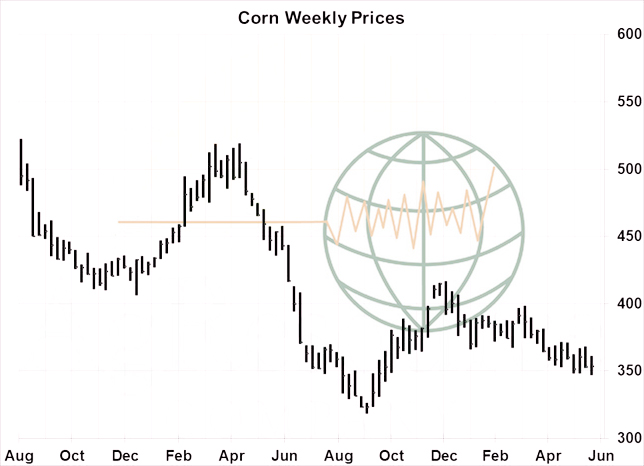
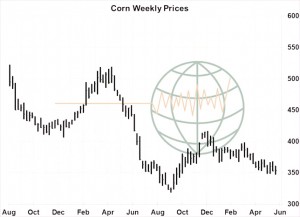
Corn futures this week ended unchanged. Strength was noted early, but US favourable longer term weather forecasts continue to trump uncertainty ahead of NASS’s Stocks and Seedings report. Heat/dryness is noted across the Delta/Southeast, with modest yield loss likely. But this will be offset by near record high crop ratings across the Central Corn Belt. NOAA projects July to be cool/wet across the whole of the Central US – driven by El Niño – and the trade is well aware of the positive effect cooler than normal temperatures have on Midwestern ear weights. Some weather premium was added early in the week, but potential for record/near record yields remain. Otherwise, little has changed. Gulf corn becomes uncompetitive beyond July. Black Sea weather is improving. June 1st stocks are projected some 850  larger million bu than last year. We maintain spot and new crop futures will drift slowly lower if favourable weather is confirmed beyond July 1.
Longer-term wheat analysis:

Wheat futures ended down 15-23 cents, with HRW contracts pacing the decline amid favorable S and C Plains harvest weather projected into the end of June. Much of Western and Central Europe has benefited from needed rainfall in the last 5-7 days, while Australia – despite El Niño – has seen soaking rainfall in the East, with similarly heavy rains offered to Western Australia in the coming days. With funds having liquidated a sizeable portion of their net short position in mid-June, it’s back to fine-tuning world production figures and determining just how much the Black Sea will export in the next 4- 5 months. World fob price spreads have narrowed, but a range of $4.50- 4.70, basis spot Chicago, is needed for Gulf SRW to compete against Russian and EU origins. US HRW is still a long ways off from finding any non-traditional business. Seasonal lows lie in the offing, but rallies will be hard-fought without extreme heat/dryness across Argentina and Australia in Aug/Sept. Rallies to $5.30-5.40, basis Chicago, are opportunities to catch up on 2015 and 2016 forward sales or to open/add to short positions.


18 June 2015

  • Chicago trade has been mixed with fund buyers once again evident on technical trade. Questions remain over whether or not the recent wet conditions will adversely impact acres or yields. Fund, who have been net short to a sizeable degree, have been buyers and this is countering cash selling by farmers. A weaker US$ has also added a touch of market support.
  • US weather looks as if the worst of the rains will end as tropical storm Bill passes through the Ohio Valley within the next 48 hours. Rains have reduced but already saturated soils has left some ponding and low level flooding. Will this be a serious negative to yield? Time, as always will tell, but the old adage of “rain makes grain” still sits in the forefront of our mind right now.
  • The USDA has today released its weekly export figures as detailed below:

Wheat: 315.900 mt, which is within estimates of 200,000-400,000 mt.
Corn: 827,600 mt, which is above estimates of 450,000-800,000 mt.
Soybeans: 664,900 mt, which is above estimates of 250,000-600,000 mt.
Soybean Meal: 176,300 mt, which is within estimates of 50,000-250,000 mt.
Soybean Oil: minus 100 mt, which is below estimates of zero-10,000 mt.

  • The above numbers were unsurprising given that US wheat and soybeans look uncompetitive into October! Brazil will doubtless be a massive exporter of corn for the coming six months, which will be a drag on further US corn sales.
  • Brussels has issued weekly wheat export certificates amounting to  385298 mt, which brings the season total to 32,481581 mt. The season to date total is now 3.355 million mt (11.52%) ahead of last year.
  • Our overall outlook suggests that as the N Hemisphere wheat harvest is almost here, despite some ongoing  issues,there is little to suggest that a major reversal of price trend is under way. In corn next week’s US weather forecast for warm and dry conditions will be very welcome, and needed. The cooler and wetter 8-15 day outlook should also be viewed as favourable as the crop moves into its pollination phase. The appears to be plentiful US stock and the recent rally in corn looks to be less solid than in soybeans. Each year, almost without exception, we see a market phenomenon known as a weather market, prices moving up and down on whatever the current forecasts bring – exacerbated by fund orders. Our view is to “sit it out” until after the June stocks report and possibly even two weeks into July. Remember last year’s 70 cent plunge in prices – and the regrets of those who jumped too soon!

18 June 2015

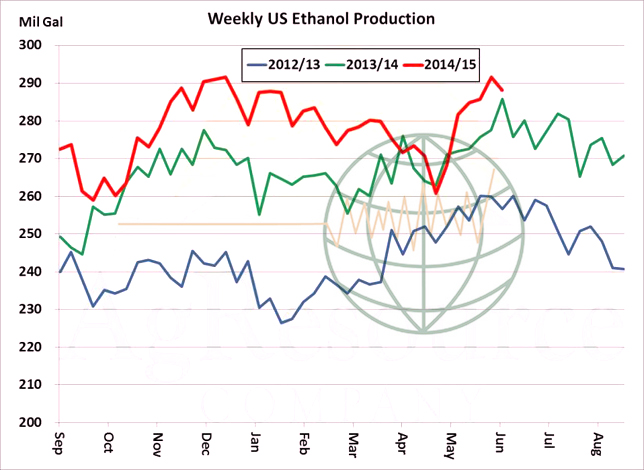
The weekly US ethanol grind continues slightly above pace needed to meet the USDA’s forecast. But stocks remain some 16% above last year, ethanol margins are in retreat amid sliding DDG and ethanol prices, and production seasonally peaks in mid to late June. A slow drift lower is expected in coming EIA reports, and the USDA was justified in lowering its projected corn used for ethanol production in its June WASDE.

A more in depth review of the US soybean stocks position follows:

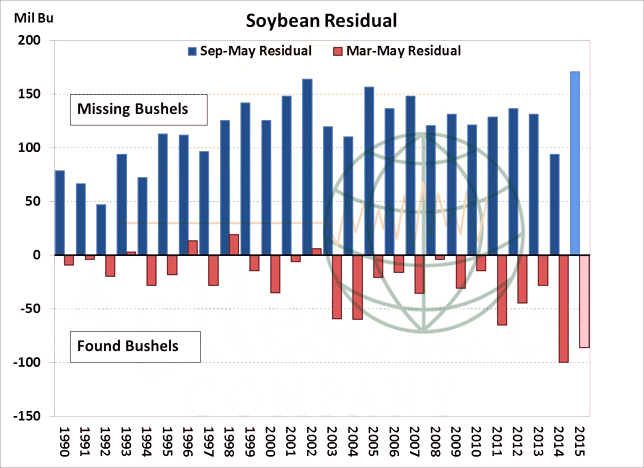
We estimate June 1st soybean stocks at 683 million bu, up 278 million bu or 69% from a year ago. If realised, US soybean stocks at the start of the 4th quarter will be at an 8 year high and at the largest level since 2006. Based on NOPA data, we estimate a quarterly crush rate of 483 million bu, while Mar-May exports are estimated at 180 million bu. The combined usage total of 663 million bu is up 6% from last year and largest since 2011. June 1 stocks as a ratio of Sep-May use is projected at 21% versus 13% a year ago and the 5 year average of 19%. Increased year on year supplies are reflected in both Midwest cash basis and flat prices. Basis across the Cornbelt is at 3-4 year lows, while flat price at mid-June is nearly $5/bu cheaper than a year ago. Exports will remain very slow through the summer, while crushers will be adequately supplied. Farmers are thought to be sitting on a huge amount of old crop bushels, which will likely cap summer rallies.

With crush, exports, and imports approximately known ahead of the report, the only variable left to estimate for the quarterly balance sheet is the quarterly residual use. It is the residual component that has produced such variability in quarterly stocks reports in recent years. The December and March reports collectively hinted that NASS had overestimated the 2014 soybean crop, and the Mar-May residual rate will offer more evidence as to whether this is true. Missing bushels in the first half of the year were record large at 257 million bu and we anticipate that the majority of those bushels (224 million) will be found in the last half of the year. The Mar-May residual rate is estimated at -86 million bu, with a near record low 4th quarter residual total of -138 million bu to be confirmed in the September stocks report.