6 June 2015

Weekly CCI Analysis:

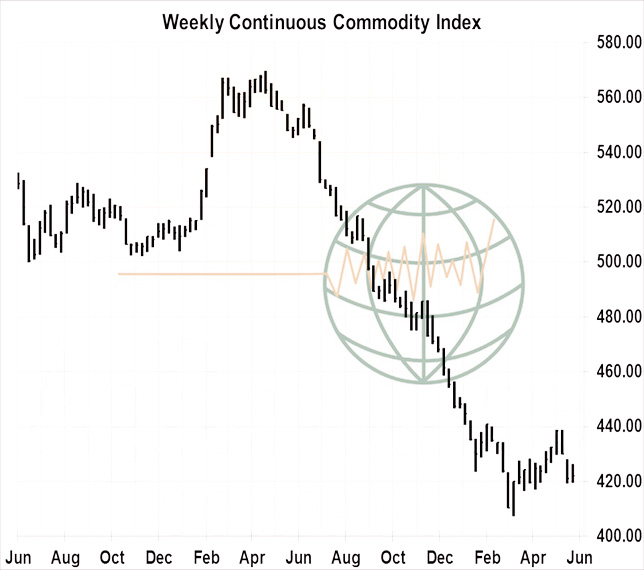
A sharp rally in the value of the US$ and weak economic data from China continues to weigh on world raw material values. The weekly CCI/CRB index finished little changed on the week amid a late week rally in crude oil bringing the CCI index to a slightly positive close. However, as the chart below reflects, the CCI is in a technical position of needing to rise above the late May highs for a new bullish trend to emerge. We expect that the Fed will raise US interest rates starting in September. This will help to spur further gains in the US$. Greece’s deferral on payment until June 30th only delays and potentially worsens their financial plight. Seems they have just “kicked the tin along the road” one more time! Our bullish view of the US$ is likely to keep pressure on commodity prices well into late 2015.
Longer-term soybean analysis:

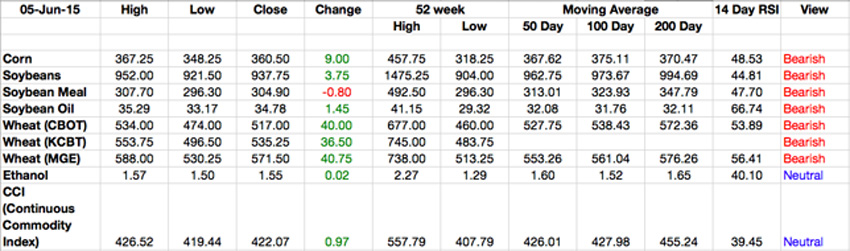
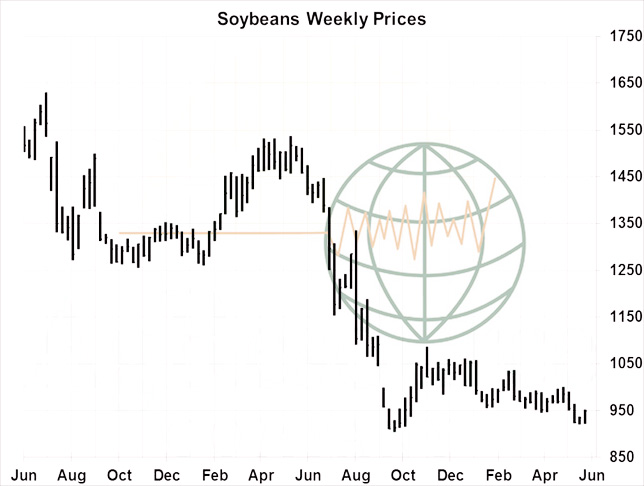
Soybean futures ended the week higher in both old and new crop contracts on short covering ahead of the June WASDE report. Cash prices also improved slightly through the week, but are more than $5 cheaper than a year ago with June 1st stocks estimated at multi-year highs. NASS will release its initial soybean crop conditions on Monday and good/excellent ratings are expected to be above 70%. Early growing conditions are favourable and the forecast offered into late June looks good. Trend or better yields look reasonable at this time, with many in the trade looking at yield potential of 46- 48 bu/acre. This along with expectations of larger US soy seeding in the June acreage report will produce a sizeable increase in the 2015 carryout. Our 2015/16 US end stock estimate is above 600 million bu. Our initial downside price target rests at $8.40-8.60 midsummer with the potential of sub $8 at harvest. Sell rallies above $9.30 November in coming weeks as $1.30-1.50 of weather risk does not seem needed or indeed justified at this time.
Longer-term corn analysis:

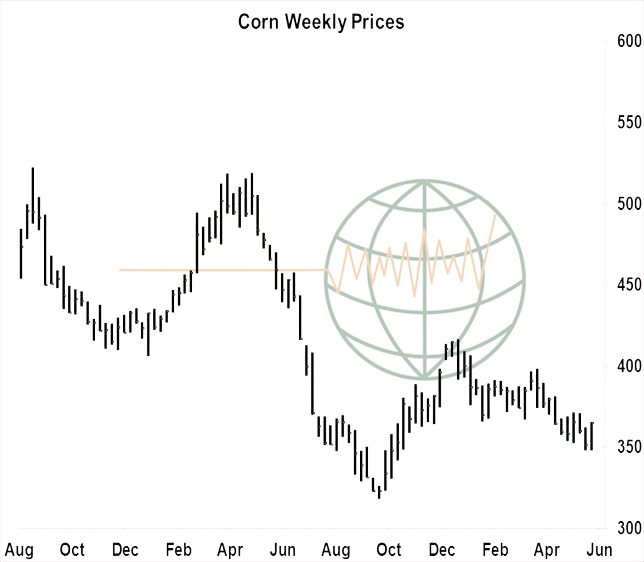
Corn futures bounced from contract lows and settled 9-10 cents higher. Slow planting is noted across parts of the SW Midwest, while short term weather concerns are cited in Western Europe. The longer term outlook, however, remains bearish. Lofty Gulf fob premiums are noticeably curtailing new crop US exports, and NOAA’s extended weather models now peak into the opening days of July, and normal precipitation and normal temperatures will be a feature over the next four weeks. China continues to have issues with its bulging feedgrain inventories. US corn is the world’s cheapest through the next 30 days, but South American fob offers plunge in July and beyond – and US new crop sales are down 24% from last year. A seasonal slowdown in ethanol production is expected beyond late June, and vegetation health maps indicate conditions much better than last year across the C Plains, Southeast, IA, MN, WI and IL. Summer rallies occur every year, but we expect this year’s bounce to be capped at $3.70, spot, and $3.90, Dec. Reward any short covering rally with sales.
Longer-term wheat analysis:

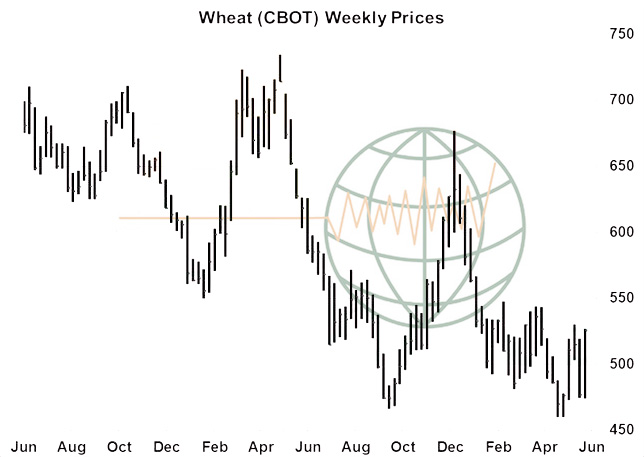
Wheat futures ended higher this week with Chicago contracts gaining 35-40 cents. The US$ spent much of the week lower, while short term dryness concerns linger in Canada and Western Europe. The funds have been swinging wildly between adding and covering short positions in Chicago. Extended forecasts maintain rain chances in Western Canada and Western Europe next week, along with favorably dry weather across the S Plains. If this forecast verifies, an intermediate high is being formed in US wheat. Our wheat outlook is little changed as bearish fundamentals remain intact. We’re unwilling to alter EU/Black Sea production estimates just yet, and uncompetitive fob offers (and another year lacking Brazilian and Chinese demand) is being felt in new crop US export sales. Our work suggests that the US$ remains longer term bullish as US job growth points toward a Fed rate hike sometime in late 2015. Critical N Hemisphere weather lies ahead, and so expect choppy trading into late June, but harvest progress and a surge in US end stocks will cap rallies at $5.40- 5.50, basis spot CME. Black Sea origin for Jul/Aug delivery is offered at prices equal to $4.60.
4 June 2015

  • We have seen another day of rallying prices as the US$ traded mostly weaker and funds have been actively covering short positions.There has been some optimism over Greece’s ability to stump up €310 million for the IMF tomorrow (Friday), but that pales into insignificance when compared with the €1.3 billion which falls due in the coming weeks. It is interesting to note that energies (crude, gasoline and ethanol) were al trading lower around midday.
  • The USDA has today released its weekly export figures as detailed below:

Wheat: 343,700 mt, which is above estimates of minus 75,000-plus 100,000 mt.
Corn: 410,100 mt, which is below estimates of 550,000-750,000 mt.
Soybeans: 477,300 mt, which is above estimates of 150,000-350,000 mt.
Soybean Meal: 50,900 mt, which is below estimates of 75,000-150,000 mt.
Soybean Oil: 32,700 mt which is above estimates of zero-12,000 mt.

  • The above requires little commentary other than to note that US corn sales have been declining in recent weeks as the US’s window of competition gets narrower. Net cancellations were recorded in new crop corn and soybean sales were at the higher end of expectations and wheat sales were a shade below the run rate required to hit the USDA’s last target figure. All in all an unexciting set of figures.
  • Brussels has issued an increased weekly volume of wheat export certificates with this week’s total reaching 502,147 mt, which brings the season total to 31,558,288 mt. The season to date total is now 3.263 million mt (11.53%) ahead of last year. At the same time we saw Brussels give 325,000 mt of Ukraine imports bringing the season to 778,000 mt out of a quota of 950,000 mt. What one hand gives, the other takes away springs to mind!
  • Weather forecast highlights include better rainfall in Canada and Europe beyond mid-June and the outlook has a distinct lack of threatening heat for the US as well as regular rains across the C Plains, Midwest and Delta into the third week of June.
  • In other news we have seen the Rouble fall around 3% today on renewed troubles in E Ukraine, a subject that has been on the back burner for some while now. Doubtless the lower crude oil prices and potential for an extension of EU sanctions has not helped the Rouble’s cause either! The potential issue going forward is the possibility of a “trigger” in the Russian export tax; today’s prices will not attract anything more than the minimum $1, but as we have seen a move in excess of 10% in the value of the Rouble it will not take much to change the picture significantly.

3 June 2015

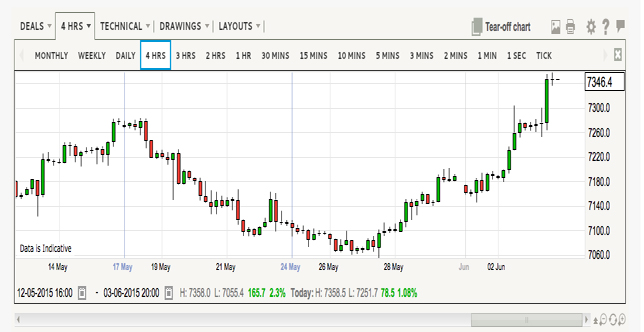
  • The ECB has indicated it is on hold despite uneasiness over the Greek situation and looming credit payment deadlines on Friday. It has suggested that QE is producing the desired results and the market responded in bullish fashion. As can be seen from the above chart the €uro has appreciated over 4% since the low set in late May. European stocks and equities rallied, and this has spilled over into raw materials and commodities, which has in turn prompted additional short covering as far afield as Chicago.
  • Additionally there is a slight raising of concerns over dryness in parts of Europe and increasing temperatures in the forecast is triggering some nervousness over wheat crops in particular. Much of the EU wheat crop is now in the grain filling stage but finishing rains are still desirable. Corn crops within the EU are more vulnerable and there is little doubt that rains will be required in coming weeks. It is somewhat comforting to note that European droughts are difficult to maintain with drought conditions only really impacting about every 20 years, half the frequency of the US. Regardless of today’s market reaction the 8-15 day weather forecasts include significant precipitation across the driest regions.
  • Dryness in W Canada is also being watched closely by the global wheat trade. Seeding is not currently an issue but the arid profile of W Canadian weather is in stark contrast to recent years.
  • On a less pessimistic note, US corn and S American soybean selling has been noted on the current rally as anticipated and this appears to be limiting gains. Record large US old crop corn stocks offer plentiful supplies and shortages are not a market moving issue.
  • Later trade saw early gains given back as news of Chinese soybean meal defaults were reported, which impacted not only soybeans and products but also the grains which closed on (or near) the session lows.
  • Informa Economics today reduced its forecast for US 2015 winter wheat to 1.481 billion bu from 1.486 billion previously. Their all wheat projection stands at 2.143 billion bu vs.the USDA’s latest figure of 2.087 billion, of which the winter wheat crop is 1.472 billion. The USDA’s figures are due for update on 10 June in their next release.
  • Argentine corn output for 2014/15 was projected 1 million mt higher than a month ago at 25 million mt, whilst soybean output was also increased by 1 million mt month on month to 60 million mt. The Brazilian soybean crop for 2014/15 was estimated 1 million mt higher month on month at 95.5 million mt. By way of comparison FC Stone left their soybean estimate for Brazil unchanged at 94 million mt whilst increasing their estimate for the corn crop by 2.15 million mt to 80.19 million mt.

3 June 2015

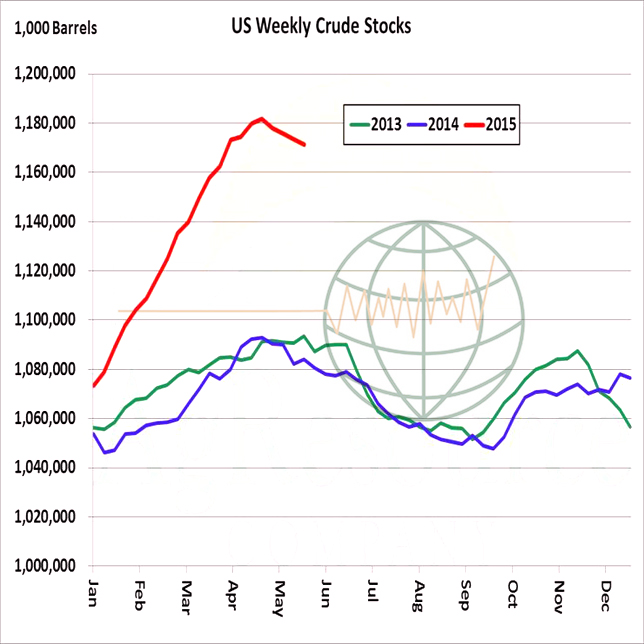
  • US weekly crude oil stocks have started a seasonal decline, but from a historically high level. The chart below highlights the problem facing OPEC members at this Friday’s meeting: the world is awash in energy and producers are still trying to maintain their market share. We look for OPEC to hold its production level at a record high and that WTI crude futures struggle against $62-65.00. Also, we sees no reason why the €uro should continue its rally (up 2% Tuesday) and that by late summer or early autumn, the €uro will fall to be priced at parity with the greenback.

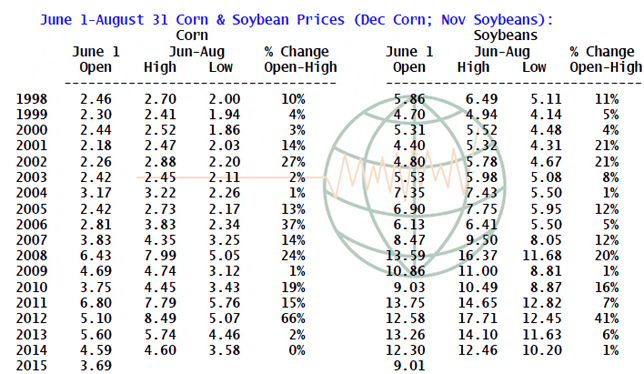
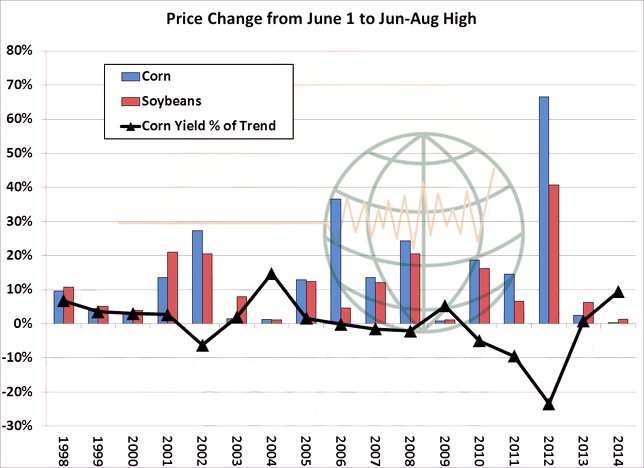
  • The table above lists corn and soybean settlements on June 1st and high and low prices during the Jun-August period. Rallies occur every summer, but the question is: just what kind of advance can be expected, and at what point should summer rallies be rewarded? We view this as a function of weather, and namely potential US corn/soy yields. This is displayed in the graphic below, which charts the % change in prices from June 1 to seasonal highs in June-August and compares them to corn yield’s performance against trend. The most substantial summer rallies have occurred during years that corn yields falls sharply below trend. Otherwise, in years in which yield has met or exceeded trend, the average rally in corn from June 1 to the Jun-Aug highs is 8% – which in 2015 equals just $.30/bu. The average rally in soybeans rests at 7%, which in 2015 is equal to $.60/bu – $.16 of which was scored Tuesday!

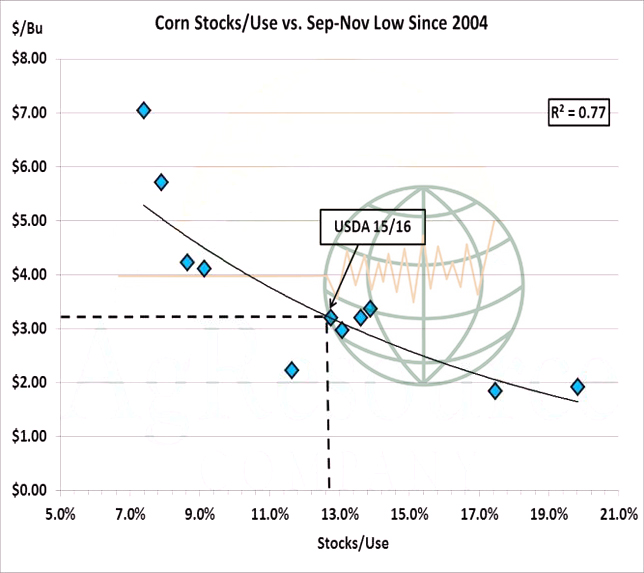
  • We should also be mindful that in years when yield is above trend (2004, 2009 and 2014) summer rallies in corn and soybeans managed meager 1% gains from their June 1 settlements. With two-week and longer term climate forecasts indicating normal precip and temps across the US Ag Belt, it’s important for growers to reward even modest CBOT rallies with sales. Any test of $3.95 Dec corn and $9.40 Nov beans are targeted unless a quick and rather dramatic weather pattern shift emerges. Heavy new and catch-up sales will be advised by many on such a normal price recovery. The  graphic below displays corn stocks/use vs. autumn lows, and assumes the USDA’s estimates in the May WASDE – which are a bit optimistic with respect to new crop consumption. This model suggests lows will be posted at $3.00-3.20, and indeed there’s a strong correlation that price corrects from summer highs with lows in August or at harvest. Finally, a 2% recovery was posted Tuesday in corn/soy futures which has met the minimum amount required in above trend yield years. Our bet is that December corn struggles above $3.85 and November soybeans above $9.25.

2 June 2015

  • The US$ fell sharply vs.the €uro this morning as consumer prices were reported to have risen 0.3% indicating that QE is working across the Eurozone to stabilise the currency. Additionally, Greece offered a financial package which it hopes will break the logjam and secure a deal that will avoid an IMF default. This news along with some short covering in advance of Friday’s US jobs report placed the greenback under pressure, which also sparked something of a rally in commodities.
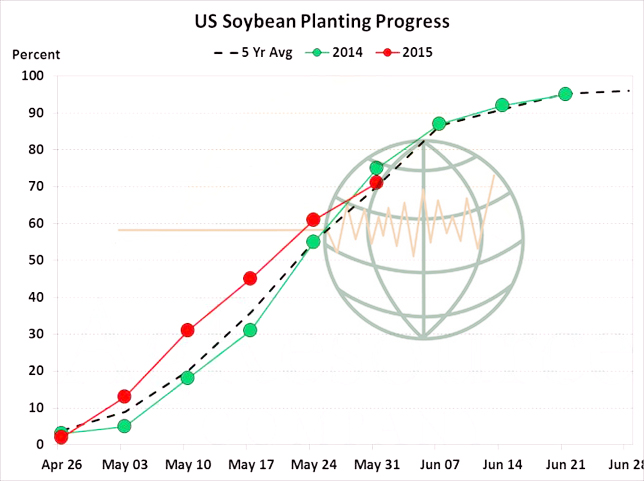
  • Soybeans were reported to be 71% planted, which was below the 75% level that was anticipated, and compares with 61% last week and the ten-year average of 74%. Corn plantings came in at 95% (1% behind expectation and behind last year’s 94%), whilst the proportion rated good/excellent was 74%, unchanged week on week and a touch behind last year’s 76% but ahead of the ten-year average of 70%. Winter wheat rated good/excellent slipped 1% week on week to 44%, which compares with 30% last year and the ten-year average of 43%.
  • From a general perspective, China remains a slow buyer of S American soybeans as their cash soybean meal market shows little, if any, signs of price uplift. Chinese meal markets appear to be languishing at a seven year price low and record soybean import volumes are likely to add further downward price pressure as stocks build in coming weeks.
  • Central US weather forecasts offer 0.5” to 1.75” of rain for the N Plains and NW Midwest this week with much needed dry conditions across the S Plains and the rest of the Midwest. As conditions warm up they will encourage crop growth, in summary the US weather is favourable.
  • As we move towards the end of the day it feels very much as if we have seen a “currency” dominated session as the US$ has slid to sharp losses vs. Not only the €uro, but also other currencies and funds have been in evidence covering short positions prompting commodity price gains. The large net short positions (as we have so often mentioned) in corn, wheat and soybeans has once again proved an “Achilles Heel” to the continuance of the longer term price downtrend. Some US$ slippage has been attributed to speculation that Greece could receive a financial “band-aid” from the ECB to avoid default. There is no indication as to whether, or not, Greece’s offer will find acceptance and we will doubtless continue to see volatile currencies heading into the remainder of the week and this will also have an impact upon commodities.
  • Yesterday’s market action in Chicago suggested that funds added over 8,600 short soybean meal contracts on the downside breakout and over 9,600 long soybean oil contracts as that market surged higher. The big increase in position size was probably a good pointer to some sort of turnaround today, which has indeed been the case
  • All in all, have we witnessed the seasonal market bottoms? Our inclination remains that the answer is, “Not yet.” Large fund shorts have left us vulnerable to spikes, as we have frequently suggested, and we do not yet see a fundamental shift in the “big picture”. Regrettably, it will likely take a while for the market to give back the recent gains but we still look for downside in what will undoubtedly remain choppy and volatile trade.

2 June 2015

  • Soybean planting progress was expectedly slow, but advanced to 71%, vs. the 5 yr average of 70%. Minimal work was done in the Delta due to heavy rains. Emergence was at 49% against the 5 year average of 45%. Initial crop ratings will be included next week, which should be historically strong.

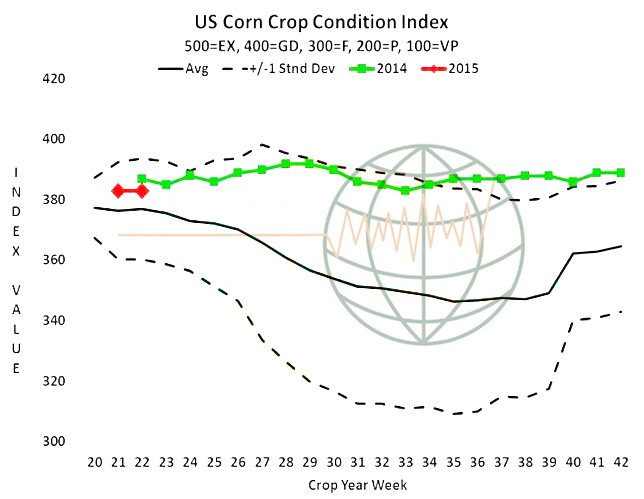
  • Corn crop ratings as of Sunday were unchanged at 74%, which the condition index pegged at 383, vs. 386 a year ago, which is a negligible difference. Ratings improved in MI, NE, PA and WI, and fell across KY, MO, NC and ND. All other states were little changed. As such, we maintain an initial yield projection of 167-169 BPA, though conditions will become more important in late June and beyond.

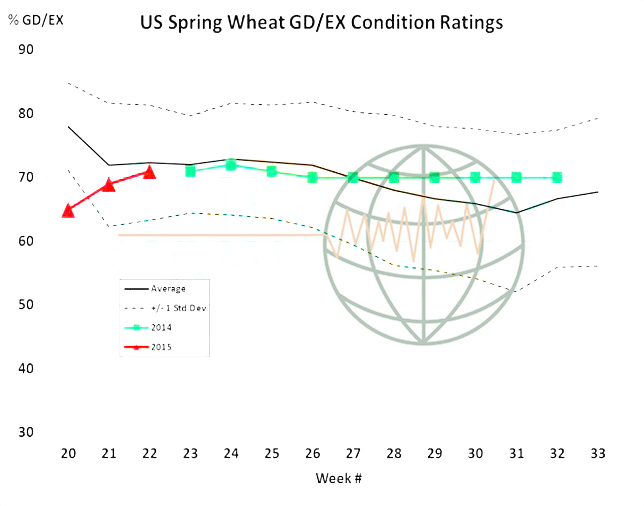
  • US spring wheat crop ratings were boosted another 2% points, with good/excellent as of Sunday at 71%. This is on par with initial ratings a year ago. Winter wheat good/excellent fell 1% point to 44%, vs. 30% last year. Winter ratings fell in IL, MO and TX, but are unchanged in KS, OK, and were up 1% in NE. Winter wheat harvest progress will reported in next week’s release.

1 June 2015

  • We have seen a mixed market today with soybean oil featuring heavily as funds pitch in and push prices higher in the wake of the US’s EPA biofuel revelation last Friday. Some short covering in wheat has been noted whilst corn has been lacklustre and soybeans and meal eased on the Argentinian strike resolution.
  • The new month, and the start of meteorological summer (not that summer is much in evidence here today) has seen a number of new inputs, which may prove to be market “triggers”.
  • The new Russian wheat tax appears to depend upon the Rouble/US$ exchange rate (although we believe it may well be more dependent upon Russian politics), which has been volatile to say the east since mid-2014. One commentator said, “wheat now has the element of Russian roulette”, which seems entirely appropriate right now. July 1 sees the introduction of the new export tax, which Russia suggested was intended to stop exports surging if the Rouble declined substantially. The 2014 decline in the value of the Rouble saw Russian export volumes grow sharply, and its value has not yet fully recovered. For the technically minded amongst us the new tax is set  at 50% of the customs price per tonne minus 5,500 Roubles ($105), but not less than 50 Roubles per tonne according to government information.
  • Egypt announced that it had purchased 5 million mt of local wheat so far this season, which began in mid-April, and is significantly above its 3.7 million mt target. Attractive prices offered by the government is cited as the reason for the increased volumes. Traditionally the government fixes a local procurement price, above global levels, in an attempt to encourage local production, and it seems to be working this season so far. Changes to the subsidised bread sales programme methodology are also encouraging farmer selling rather than holding onto their crop for personal consumption.
  • The Argentine strike appears to be resolved as a pay deal is agreed and sees the end to the three week long strike that has delayed some soy export shipments. Government approval is reported to have been granted, and as they act as mediator in such negotiations it seems that the strike action is now over. Chicago reacted accordingly as far as soybeans are concerned.
  • Closer to home the €uro tumbled after Greece missed a self-imposed deadline for reaching agreement with its lenders to unlock aid, and the fear of debt default remains very much alive as does the potential for a Greek exit from the Eurozone.
  • Southern Russia has received some welcome rains in the Krasnodar, Rostov and Vogograd regions over the weekend which will alleviate some of the concerns that have been raised over recent dryness within the region.
  • Finally, Reuters report that the risk of frost damage to the canola (rapeseed) crop in Manitoba is “severe” with significant acres in need of reseeding. Damage was reported to be worst in western Manitoba with many fields written off and in need of reseeding although it is too early to place an exact acreage on the damage. Canadian canola futures jumped on the news and Matif prices followed. Seed supplies are said to be tight which may well have added to market reaction.