27 January 2016

  • What markets take one day they give back another! Chicago wheat has led prices lower today as concerns over a Russian export duty fade. One Russian ag deputy countered talk from another (last week) in that Russia should cut wheat export duty in favour of new duties on barley and maize. Left hand, right hand and all that springs to mind! Basically it should not be forgotten that Russia has too much wheat/grain and needs to remain an exporter to the world’s market.
  • China appears to remain uninterested in US soybeans and is in preparation for their Lunar New Year holiday which is notorious for commodity inactivity and market lull. With recent purchases from S America (4-7 cargoes of Brazilian soybeans and cover through to May) there appears little reason for them to chase the market higher. In addition it looks likely that the Brazilian farmer will dig deeper into soybean harvest in the next couple of weeks, and will likely increase sales if prices move higher leading to price caps.
  • There is a continued absence of fresh input and with this as a backdrop we continue to focus upon lack of evidence of enlarged world or US grain export demand and the main fundamental factor, too much supply chasing after too little demand, as we head into spring. The US planting season, the weather and likely acres are the next items upon which we will have to focus. Globally, it seems that farmers are holding onto large stocks, either by design or by default, and this remains a potential price cap as we look forward.

26 January 2016

  • In another interesting turn we hear that Egypt has not yet made a final decision on the rejection of a cargo of French wheat that has tested positive for traces of ergot fungus. They recently decreed that “no wheat containing ergot fungus will be allowed into the country”, and the shipment, which arrived in December, is being retested.
  • Chicago markets have been mixed although it remains wheat that is displaying positive prices as we approach the close. The market today was described as dull with only short covering in wheat, which came close to testing the $5.00/bu level in the July ’16 contract. Slowing Chinese demand for US soybeans has left prices lacking support and this has being seen today as has the slowdown in US crush operations. Neither factor can be construed as bullish for soybeans or products and with crush margins at or near negative levels and US stocks of soybeans at decade highs we continue to struggle when we hear others peddling bullish stories.
  • Argentina continues to be an aggressive fob seller of corn through to April at levels reportedly some 15-20 cents below US Gulf, which will move buyers in their direction and remain away from the US. At the same time Ukraine is matching Argentina’s prices as they become more aggressive as farmers boost their sales. The result is that US corn exporters are struggling to find demand for their volume and to make matters worse global feed wheat is offered below the price of corn resulting in end users like S Korea to extend forward cover in wheat as far forward as June. There is too much feed grain in the world right now and price is the only means by which it can be moved – but it will have to be at lower levels that we are seeing right now!
  • If Russia was to place an additional export duty on wheat exports they would have to place an official public notice for 30 days in their federal register (assuming they follow the rules!) and if decided on Friday this would leave the door open to extremely aggressive export activity in the period up to implementation (early March). This would likely see French prices undercut, maybe substantially, in a drive to secure what little volume demand is around at present, leaving EU stocks unsold.

25 January 2016

  • European wheat prices rose on Monday as dealers covered short positions after reports Russia is considering increasing its grain export restrictions. Front month March wheat in Paris unofficially closed up €3.00  or 1.8% at €167.25/mt, the day’s high. Russia’s Agriculture Ministry is considering toughening grain export limits and imposing tougher restrictions until new crops arrive for sale this summer, the Interfax news agency reported on Monday. The aim is to cool Russian internal market prices. Reuters could not confirm the report. Russia already has an export tax on wheat but despite the duty, the country’s grain exports hit a record in December due to the weaker rouble.  The picture in Russia remained blurred, leading to a risk-off mood among market participants. However the report about possible additional restrictions on Russian exports prompted some dealers to cover short positions, traders said. “Export restrictions by Russia, which dominates the export market, would change the story but it has yet to be confirmed,” a trader said. Russia is a major rival to France in wheat export markets. The downward trend in Paris wheat prices since early November meant some export competitiveness had been regained but international demand is still weak, another trader said. German cash premiums in Hamburg were cut to compensate for the strength in Paris, with buyers declining to accept price rises. Standard wheat with 12% protein content for February delivery was offered for sale at €2.50 under the Paris March contract against €3.50 under on Friday. Bids were generally €3.00 under Paris futures.
  • Chicago markets were described as slow and two sided with rallies being capped by selling pressure. Favourable S America weather and ongoing lacklustre US demand, as well as the likelihood of growing US end stocks, look as if significant price gains remain unlikely. Wheat was higher on the latest Russian rumour. No confirmation on the rumour has been offered and differing opinions have been expressed by Russian ag deputies on the subject. A Russian economics ministry meeting will be held later this week. We have heard that wheat export duties could be on the agenda due to rising domestic food inflation rates. However, no outright ban on Russian wheat exports is being contemplated amid the abundance of Russian wheat/grain. We struggle to believe that any sizeable export duty will be placed and the wheat export duty rumours are tied to the falling Ruble and its impact on a host of consumer goods within Russia.
  • There has been considerable talk about rising domestic Brazilian corn prices and their record large corn export program. We have no hard evidence that Brazil is planning to shift or default on corn export commitments due to their short term rising prices. In fact, talk is ongoing that Brazil could release another package of government stored corn (they did 500,000 mt last week) to help their livestock producer. Moreover, their first corn harvest will start in just two or three weeks and this new supply will afford a fresh supply of corn as exporters shift their focus to soybeans. We don’t expect that Brazil will move to alter their corn export program with their cash corn market to likely to peak in the next 10 days.
  • US farmers are citing that grain and soybean prices are cheap. Yet, Russian, Brazilian and Canadian farmers would suggest that their domestic prices are high? It is the value of the US$ that continues to play a heightened role in stimulating world agriculture production. The 2016 grain markets are different insofar as the Black Sea is the world’s leading wheat exporter and S America is the world’s leading soybean exporter. This places huge pressure squarely back on the US and Chicago. As US export and crush demand estimates wilt, so will prices with time!

21 January 2016

  • Egypt’s GASC has once again tendered for wheat, on this occasion for 20 Feb-Mar 1 shipment, and has secured a total of 235,000 mt with Romania and France each picking up 60,000 mt and Russia the balance of 115,000 mt. Volume of offers appear to be down somewhat on uncertainty of payment date and also the reduction in ergot content levels to 0.05%.
  • Markets today have received something of a boost from crude and equity markets bouncing somewhat from extreme oversold positions.
  • Ethanol stocks in the US have risen again to a four year high of 21.94 million gallons, which is seen as “disappointing” and perhaps reflects the reduced economic incentive for blenders to utilise ethanol. Ethanol is priced well above unleaded gasoline and consequently the ethanol producer will have to either find export markets or face even greater stock build into early spring time. Surely ethanol production profitability will be limited in coming weeks/months!
  • EU wheat exports for the week were some 511,000 mt, which is below the pace required to hit the latest USDA forecast of 32.5 million mt. Current export pace suggests a more modest 28-28.5 million mt total, which would see further stock building. Russian fob offers continue to soften  and it feels as if we are on the brink of a fight to secure the few remaining spring and early summer demand requirements. The EU, Russia, Canada and US have to become more competitive if they are to reach their ultimate export targets, and it feels as if this is a tall order for them all to succeed.

20 January 2016

  • Crude oil posting new lows, below $27, which is the lowest since 2003, and the DOW Jones index some 500 points lower (and other indices correspondingly lower) did not add much in the way of support today. Weakness in global economies with energy producing nations struggling to raise sufficient cash for their own domestic economies is an ongoing issue.
  • One issue previously ignored is that some $730 billion exited the worlds emerging economies inn the last year. This record exodus leaves countries like Brazil, Egypt, China, Turkey and Russia with reduced funding ability going forward. Those who borrowed cheap US$ during the US QE programme may now be struggling to repay as the US$ rallies. This is introducing some concerns into European Banks as far as their non-performing loan portfolios are concerned! Watch this space!!!

19 January 2016

  • Informa Economics have today released their latest estimate on 2016 US corn and soybean planting acreages which shows a month on month reduction in corn to 88.869 million acres (from 88.926 in December) and an month on month increase in soybean acres to 85.23 million (from 84.537 in December). For comparison purposes the January USDA figures were corn at 88 million and soybeans at 82.7 million. It should be noted that Informa’s figures are based upon survey data, which (for this latest update) was collected in early January, they will resurvey ahead of the USDA’ March report and update planting prospects at that time.
  • Chinese economic growth has been pegged at 6.9%, the slowest since 1990, but generally in line with government expectations. Equity markets in Asia appear to have responded positively adding to a support for commodities in general today.
  • It seems that the return to work in Chicago is seeing fund short covering which is triggering something of a rally in prices, much of the buying has been associated with the large fund net short position and some reduction in exposure.
  • Currencies remain an issue with US$ strength showing again, the Brazilian Real has traded at 4.05:1 and the Russian Ruble at 78.6:1 and weakness in the “emerging” market currencies continues to limit import demand.
  • Argentina is continuing to offer discounted prices for wheat to importers, which is in turn triggering cheaper Ukrainian and Argentine corn offers. Global grain markets are not, at this time, responding to higher Chicago prices, which continue to highlight the US’s lack of competitiveness.
  • Soybean crush margins are barely profitable in China – and mostly negative across the remainder of the world. The world appears to be saturated in protein meals with cold weather not causing much of a bounce in the Midwest. The poor soy crush margins will likely cause further slowing of world soybean trade.
  • The latest long range forecasts has El Niño holding through the N Hemisphere summer as a warm phase of the Pacific Decadal Oscillation sits in a warm phase. This would reduce the chance of summer drought in the Central US  and we see no reason to bet against trendline US corn and soybean yields in 2016.
  • World feed wheat prices are struggling looking for demand and Egypt’s GASC is slow to book early February wheat milling needs as traders talk about a dollar shortage in Egypt. Our current view is that the current Chicago rally will end in the next few days with a new bearish trend to unfold heading into late March or April. We would place price objectives for spot Chicago corn to fall to $3.20, spot Chicago soybeans to $8.20 and spot Chicago wheat to $4.40 by spring.

14 January 2016

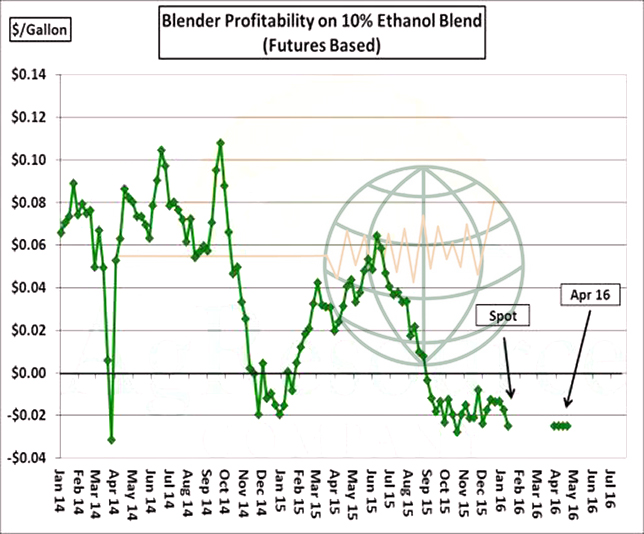
  • The graphic below charts futures-based ethanol blending margins, which are deeply negative into spring. Despite ongoing near record ethanol production, domestic blend demand has been a bit weak, and ethanol stocks continue to build. Eventually (when?), production margins will reduce to slow the US ethanol grind and, overall, ongoing weakness in energy markets will continue to weigh on major commodity indexes. For now the US corn balance sheet cannot afford to lose domestic use.
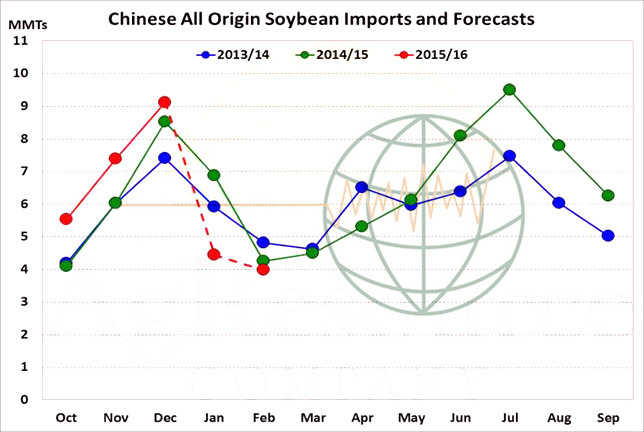
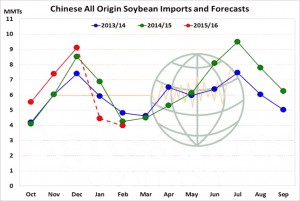
  • As of yesterday, Chinese Customs data showed December soybean imports of 9.1 million mt, a five month high and record large for December. Based on US/S American shipments, we estimate Jan imports of 4.4 million mt and Feb imports at 4 million. Despite slower imports in Jan-Feb, the pace of imports is still on track to hit the USDA annual forecast of 80.5 million mt.
  • The USDA reports this week were not bullish, but also did not offer any bearish surprises. Last week’s CFTC report showed funds with the largest net short position since June, and short covering appears to be the only supportive feature in the market. We continue to view price rallies as short lived and selling opportunities at this time, until such time as there is some fresh news with a bullish tone.
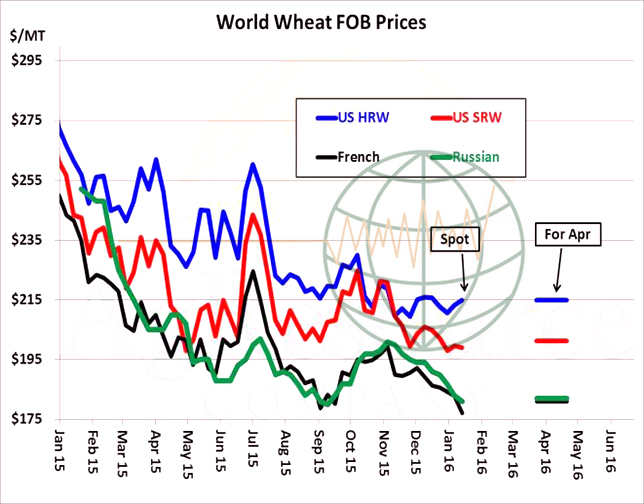
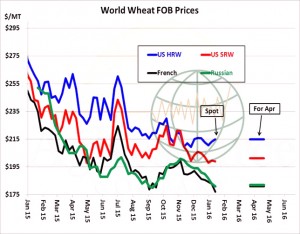
  • As mentioned previously, world wheat cash markets were unmoved by the USDA’s US winter wheat seedings number, and Russian offers actually ended weaker despite the report. The graphic below illustrates the recent widening of US premium to other origins, and US exports will be the market’s central focus in the near term. French fob offers have reached a season cash low, perhaps illustrating the stagnant export demand and trade. Snow cover has expanded as projected across C and E Europe and the Black Sea, which should add some insulating protection in advance of the forecast lower temperatures.
  • The USDA has today released its weekly export figures as detailed below:

Wheat: 290,600 mt, which is within estimates of 150,000-350,000 mt.
Corn: 669,300 mt, which is above estimates of 400,000-650,000 mt.
Soybeans: 1,127,400 mt, which is within estimates of 900,000-1,300,000 mt.
Soybean Meal: 64,700 mt, which is within estimates of 50,000-180,000 mt.
Soybean Oil: 41,200 mt, which is above estimates of 5,000-20,000 mt.

  • Our comment on this week’s US exports is that whilst corn and soybean volumes were at the higher end of trade expectation they are not market moving, and the trade now seems to appreciate that despite a cut in the US winter wheat seeding area world cash prices have continued to drift lower and US Gulf premiums to both Russian and EU origins are unsustainable. Consequently we are seeing US futures levels easing back following Russian and French cash levels.
  • Brussels has issued weekly wheat export certificates totalling 783,342 mt, which brings the season total to 14,762,856 mt. This is 900,626 mt (5.75%) behind last year.
  • There has been a suggestion that Chinese grain stocks (wheat, rice and corn) are now upwards of 500 million mt compared with the USDA’s figure of 250 million. Consequently the prospect of a curtailment in shipments, potentially to a substantial level and in the very near future, looks to be very real.
  • In conclusion, we remain of the view that ag markets require adverse weather, a significant boost in Chinese demand (preceded by economic stability – of course) and/or increased biofuel consumption in order to sustain any lasting rallies. At this time none of these are available and whilst we may see price hiccups or bounces along the way (as has been the case post USDA this week) it feels very much as if US export demand and overall global trade will remain the key price drivers for the time being.