13 February 2017

  • Early weakness in Chicago markets uncovered fresh fund demand with corn, soybean and wheat futures all rising into midday, and this would be the fourth day of active fund demand. Traders have suggested that fund purchasing in the ag space is expected to ease as the week advances. Funds placed ags on their inflationary purchase list, which is evident in the open interest totals from Friday. Remember that funds are still coming out of their net short wheat positions, while adding to their summer row crop longs. Strong morning volume in corn, wheat and soybeans indicates that funds are still buying, it’s just that the cash selling has increased in the rally to help as a buffer to limit the price rally. We would suggest that fund buyers have just entered these positions during the past week, and they are not expected to change their mind or exit these purchases until it is clear that another favorable N Hemisphere growing season is evident. As such, there will be corrections, but it is difficult to envision a lasting bear trend unless President Trump makes trade an issue.
  • S American sources indicate that cash soybean movement is slightly better to start the week as the harvest moves southward. However, the volumes of sales are not large as most hope for some weakening of the Brazilian Real and the Argentine Peso. We would maintain that it will take a push to higher price offers to get the Brazilian farmer to sell larger tonnages.
  • Fund managers have decided from a risk vs. reward perspective that that the grains are attractive. The funds are already long some reasonable volume of soybeans, which are showing a profit. Chinese demand is expected to slow into late week as their crush margins retreat. The close will be important today to gauge if the funds are willing to pile into additional length. Our bet is that the entire Chicago complex is getting pricey and that a correction looms. However, we doubt that the funds will want to give up on their recent net long position until corn seeds are planted in the Midwest. We would look for this week’s peak to be scored by Tuesday with prices retreating into Friday.§

9 February 2017

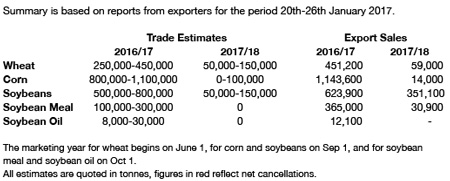
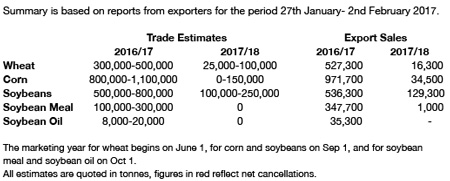
US weekly export data has been released as follows:
Brussels has issued weekly wheat export certificates totalling 482,594 mt, which brings the season total to 16.49 million mt. This is 1.15 million mt (6.54%) behind last year. Barley exports for the week reached 41,997 mt, which brings the season total to 2.76 million mt.

Today’s USDA report lived up to its “lacklustre” pre-release billing! Their US wheat export estimate has been increased to 1,025 million bu, which is a 50 million bu hike and dropped 2016.17 stock levels to 1,139 million bu. Corn ethanol production was increased by 25 million bu to 5,305 million bu, which reduced 2016/17 end stocks to 2,320 million bu. Soybean end stocks for 2016.17 were held at 420 million bu.

In world production the big surprise was 2016/17 Indian wheat output, which was reduced 3 million mt to 87 million mt. Brazilian and Argentine corn crops were left unchanged at 86.5 and 36.5 million mt respectively. Finally, the Brazilian soybean crop was left unchanged at 104 million mt whilst Argentina’s crop was cut 1.5 million mt to 55.5 million, which left global end stocks of 1.9 million mt at 80.4 million.

The market has initially viewed the reports as marginally positive for wheat, corn and soybeans, and whilst it is now done, dusted and history it seems that neither the bulls or the bears are going to rush into fresh new net positions on the back of the contents. However, it seems the Brazilian farmer remains reluctant to sell his new crop harvest due to currency, and this could force the Chinese buyers into staying with the US as supplier (for now) and potentially firm Chicago futures. Fresh highs in Chicago corn and soybeans could entice S American farmers into sales, but we will have to wait and see if this becomes the case.

8 February 2017

  • Interior US soybean cash  basis has been somewhat seasonal, and has been reluctant to follow rallies in Chicago futures, which is interesting. Changes in basis still hinge upon export potential in the final third of the marketing year, which in turn, still hinges upon S American crop size, but at some point bullish momentum will require better performance from the cash market. Recall a year ago that S American weather turned adverse in late Feb/early March, and so weather in the next 3-4 weeks is critical.
  • Market one liners:

Soybeans: Demand from China could very soon switch to Brazil.
Corn: We are at the top of the October-February range and require bullish supply news for a breakout higher.
Wheat: Spread trade unwinding and a large fund net short position support a bounce in prices.

  • Today has seen Chicago soybean prices maintain their rally whilst the grains are modestly unchanged to either side of unchanged as we approach the close. Rising S American fob basis and active Chinese demand post Lunar New Year holiday have supported the soybean complex today whilst slowing US export demand has seen the grains languish, particularly as corn bumps its head on key chart price resistance levels. Markets are awaiting Thursday’s USDA report and unlikely to swing wildly in the absence of fresh news input.
  • It is interesting to note the discount of US fob soybeans to Brazilian prices through to April. Normally, Brazilian soybeans hold a 10-15 cent/bu quality premium for their extra oil content, so this does not mean that China will move their demand northward. However, the fact that the US is in the hunt for world soybean trade has underpinned Chicago futures with US soybean export sales already reaching 91% of the USDA’s annual forecast with nearly 6½  months remaining in the crop year.
  • China has been an active Brazilian soybean buyer taking some 12 to15 cargoes (according to our information) in the past few days. This has rallied Brazilian export premiums and allowed the US Gulf to become competitive again. Funds are likely to be big buyers (again) at the close in corn if March is above its 200 day moving average of $3.68. Wheat will likely be in tow. Funds continue to secure the entire Chicago market, even in the face of bearish fundamentals. It is possible that spot Chicago soybeans could retest $10.80-11.00 resistance with March corn targeting $3.75-3.80.
  • We cannot help but notice that Russia’s forward wheat market is offered below spot, and we maintain our view that Russian exporters have work to do to alleviate current massive stock levels. Snow cover in key areas of S Russia continues to ebb and flow, with pockets of the region now bare. Europe since Jan 1 has been much drier than normal, and of course moderate drought lingers, and will continue to linger, across the W US Plains. Crop conditions in TX, which will be published weekly from here forward, were pegged at 31% good/excellent, vs. 29% a week ago but vs. 44% a year ago. Wheat will be increasingly exiting dormancy in TX and parts of OK amid abnormal warmth, and the point is that a new N Hemisphere growing season lies just ahead. Structurally, rallies above $4.50 (basis spot Chicago futures) will be difficult without widespread confirmed crop loss, (which is not on the cards today) and consequently we remain sellers of rallies.

7 February 2017

  • We saw a mixed start to trade in Chicago, which has trended towards marginally higher levels across the board with an hour to go until the close tonight. There is little, if anything,in the way of fresh news today and traders have little to cling onto and determine a clear direction (nothing new there then!). Traders are awaiting the latest reports from CONAB and USDA, both scheduled for release on Thursday.
  • Crude oil has eased and the US$ remains firm. Brazilian cash soybean offers are firmer today as close to record exports appear to be able to cope with early harvest supplies. US Gulf soybeans continue to be the world’s cheapest, and this looks to be the case through until April, and until such time as we see declining basis prices in Brazil it is hard to imagine price breaks lasting. This scenario also plays out in wheat where Black Sea cash prices remain strong offering support to the rest of the world in the short term. That said, S American cash corn prices have eased a touch this week and Argentine corn is now offered at parity with the US for March availability, and is a slight discount for April/May.
  • The key going forward is the size of the S American crop and it seems the market is anticipating a modest revision higher in  Brazilian corn and soybean output by CONAB later in the week.
  • The ongoing transition to S American soybean exports and cheap Gulf corn for spot delivery will offer support on price breaks. However, recent improvement in Argentine precipitation will keep buying limited at, or near to, technical resistance, and so we maintain a neutral outlook into March. The longer term outlook remains a function of S American crop size, and thus April to August US export demand, which will be better known in the next 30 days. If we recall correctly it was early March when soybeans surged to near $12 a year ago. So far, there is no indication of lasting excessive rain in Argentina and soil moisture in N Brazil is much improved from last year.

6 February 2017

  • If there was any doubt that fund managers want to be on the long side of the soybean market, today’s price action in Chicago should provide clear notice. Funds have been buyers of the soybean complex from the get go with the grains trading either side of unchanged. March soybean futures has taken back all of Friday’s decline which was based on growing Brazilian soybean crop estimates. The ship line up for Brazilian soybeans is record large at the same time that the US is still shipping out 60 million bu per week. The message is that world soybean demand is robust which for now is countering the supply rise in the Brazilian harvest. Corn and wheat are following, but the recent moisture across the EU and price pressures on the ASW eastern Australian wheat is causing pressure on Chicago. The world wheat market is oversupplied, and without a new crop weather problem, rallies will be difficult to sustain. It feels, for now, as if the Chicago soybean complex is happy to maintain strength.
  • Brazil is said to be opening negotiations with Mexico over soybeans and meat according to Brazil’s ag minister Maggi. Mexico is looking for alternatives to US grain, soybean and meat based on the US Trump Administration’s posturing over NAFTA. Brazil is said to be open to selling/exporting more food products to Mexico if the US alters trade policy.
  • China’s return was felt overnight as their Central Bank did not raise interest rates. This “no move” sparked a fresh push of investment in commodities. We would note that seasonal corn/soybean price trends turn higher next week and a record large Brazilian soybean crop is being buffered by record large world oilseed demand. With the USDA report anticipated to be neutral/supportive on Thursday, we would caution against turning overly bearish with US and S American farmers remaining tight fisted with stored supplies. CONAB is scheduled to release their updates on Thursday morning.

2 February 2017

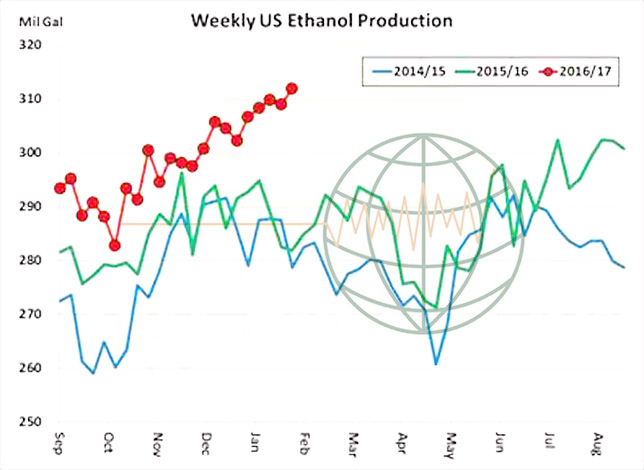
  • US ethanol production continues to rise to record levels which is indicated in the chart below. This week’s ethanol production of 312 million gallons sets a new record high. WASDE appears to be running too low in its annual ethanol production estimate by at least 25-50 million gallons, and if this trend persists, it could be too low by 75 million. The US domestic demand for corn remains record large.

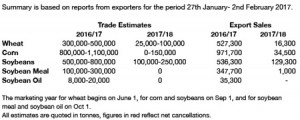
  • Weekly US export data has been released as follows:

  • Brussels has issued weekly wheat export certificates totalling 816,936 mt, which brings the season total to 16.01 million mt. This is 1.01 million mt (5.93%) behind last year. Barley exports for the week reached 192.559 mt, which brings the season total to 2.72 million mt.
  • An uninspiring day in Chicago in what seems like a “rest” in the wake of yesterday’s strong rally where corn spread trade and reports of dryness in the Plains added support. It should not be forgotten that the US farmer has sold most of his old crop soybeans and adds cash corn sales on rallies. However neither the US or S American farmer is showing much desire to make new crop sales at current price levels.
  • It seems that the funds will not let go of the reflation trade and see commodities as cheap on price breaks, and it is hard to argue this scenario. It seems almost impossible to get a fund manager to sell sub $3.50 corn or sub $4.15 wheat ahead of the new N Hemisphere growing season. The US has sold 91% of its expected annual US soybean export package with seven months remaining in the crop year. China will return slowly from its week long holiday, and we would probably bet it will be with their buying shoes on starting early next week!

1 February 2017

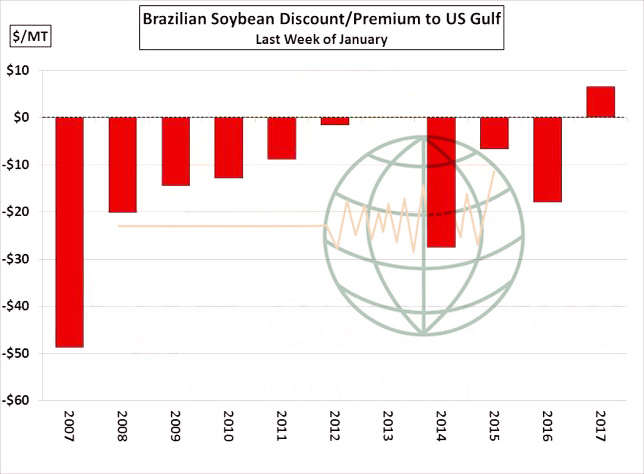
  • Brazil is on track to harvest a potentially record soybean crop, and export commitments so far in January are higher than expectations. The global cash market, however, is not yet providing incentive for a wholesale switch to S America. The graphic below shows Brazilian soybean’s discount to US Gulf, or in the case of this year, Brazil’s premium to US Gulf. Weaker basis is therefore likely to be forthcoming, but in the meantime we would expect solid US soybean sales and shipments through the month of February.

  • Chicago markets started trading weaker but quickly rallied into positive territory on the back of fund buying and rumours of fresh Chinese demand. Some Chinese traders are returning from their New Year break and have positions to cover it seems. There is also something of a traditional post New Year seasonal bullishness. It is noteworthy that cash soybean meal is weakening and this is acting as a drag upon futures prices. Finally, there is the issue of fresh Russian/Ukraine military clashes in E Ukraine, which will doubtless put some further strain on the Trump administration. Support for Ukraine will likely come from a financial or trade perspective and global grain traders are watching this closely.
  • S American farmers are noting that the Brazilian Real has rallied and that Chicago prices have fallen this week and consequently are not cash related sellers. The lack of cash selling allows for market corrections, but most S American sources argue that it would require new highs for any large scale Brazilian farmer selling. Our bet is farmers will now wait for yield results before selling much in the way of additional cash soybeans.
  • This remains a “big crop” vs. “big demand” marketplace and chasing breaks or rallies is still not our recommendation. Corn and wheat are in position to test their recent highs while the weakness in cash soybean meal markets argue that rallies in soybeans will fail. The grains should gain on soybeans, and also soybean oil on soybean meal. Our view remains one of selling strong rallies near their recent highs in the grains.