28 September 2017

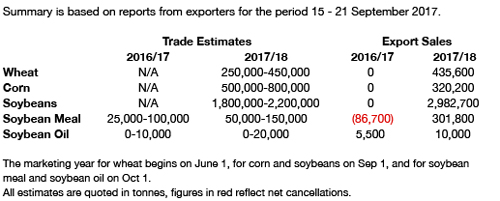
  • US export data has been released as follows:
  • Today’s action in Chicago (so far) has been largely lower and also somewhat dull with corn, wheat and soybeans all 1-5 cents lower at the time of writing. Grain export data was close to market anticipation, and even record weekly soybean demand could not spark anything meaningful, including fund buying. Key US data is out tomorrow, and our guess is that there is simply a lack of enthusiasm for new positions ahead of the release.
  • Whilst it might be that corn export numbers were a touch disappointing, it should be noted that ongoing S American corn export volumes are at record levels. Soybean figures clearly reflect Chinese appetite for beans, from all origins, particularly at current (relatively low) price levels. It would seem prudent for both old and new crop Chinese soybean import volume figures to be increased somewhat.
  • Corn demand shows little hope of improvement in the short to medium term, and it may just be that the USDA’s current US export estimate is too currently high. US wheat export prospects will only show signs of improvement once Black Sea export volumes start to reduce, potentially in December or January.
  • The Australian weather forecast has added some rainfall for Queensland, but turned drier in NSW, which accounts for a much larger share of Australia’s total grain crop. Very heavy rain, 3 to 4 inches, is offered for Queensland this weekend, and will doubtless be welcomed, but other key wheat growing regions look set to remain dry into the first week of October. Aussie cash wheat continues to firm in price, particularly for higher grades.
  • Demand for US soybeans is massive, but just how this impacts the balance hinges upon old crop carryover stocks, and whether yield is 50 bushels/acre or closer to 48, both of which will be determined in the next two weeks. Neutral prices trends are most likely into mid-autumn.

27 September 2017

  • Russia’s SovEcon has suggested that the 2017 record wheat harvest may well be a precursor to a second “bumper” crop in 2018 as a consequence of fast paced early plantings this autumn. A slow start to planting has been replaced with a much better pace, with 11.2 million ha planted as of Tuesday, which compares with 10.8 million has a year ago. SovEcon  intimated that as much as a record 18.1 million ha could be planted this season. Clearly such an area could well weigh heavily upon prices, both locally and globally, assuming average weather conditions. The strong Russian planting area is driven largely by lower production costs, which in turn leaves growers in profit despite current low prices. SovEcon’s final word was  that costs of production in Russia were “substantially lower than the rest of the world”, which should resonate loud in the ears of growers elsewhere.
  • Early selling in November soybeans found good demand under the 100 day moving average, and soybeans traded up into late in the day to close two cents higher. In the soy product markets, meal end firm while liquidation kept soybean oil prices lower. US soybean cash basis has collapsed in the last week as harvest gains pace, with IL river bids up and down the state quoted as much as $.60/bu under. The Delta harvest is running well ahead of normal and good yields have kept the Gulf well supplied. Additionally, limited August rains have lowered river depths, restricting the tonnage that barges can haul and thus raising barge freight rates. Spot freight rates typically spike in late September as the harvest gets underway, and we note that forward offers are significantly cheaper. Exporters have noted exceptionally strong Chinese demand, and expect they will ship out a record number of beans in the first quarter. Our bet is for an early seasonal low in basis, with strong export demand to support Chicago soybean futures on breaks.
  • Corn bucked off a stronger US$ and unchanged S American cash markets, and settled 1-2 cents higher. US yield data so far suggest NASS’s September estimate is relatively accurate, or at least within 1-3 bu of final. Export sales on Thursday will no doubt be unexcited. However, we have in recent days has mentioned that the US ethanol market is strong, and with wheat values rising, the burden on the global corn market to find demand is less intense than it was a year ago. Black Sea feed wheat this evening is up another $2/mt to $178 (vs. Gulf corn at $157), and note also that feed wheat’s seasonal trends points higher through Nov/Dec. S America will dominate world corn trade through late year, but it is becoming likely that the USDA is underestimating total corn trade. US ethanol production last week totalled 293 million gallons, down 11 million from the prior week but up 2 million on the same week in 2016. Ethanol stocks fell and, importantly, it appears that non-domestic ethanol disappearance remains strong. There is still no compelling argument for a major price move in either direction.
  • Chicago wheat hit new six week highs amid positive technical considerations, and as world cash prices continue to inch higher. There’s also growing concern over SRW establishment in the US, particularly as short and long term outlooks trend drier across the C and E Midwest. Managed funds in Chicago are still short an estimated 70,000 contracts. Russian wheat offers rest at $191-193/mt into November, vs. $180/mt in late August. In the last six weeks Russian prices have rallied 6%; French & German offers in the same period are up 2-4%, and as demand is found in the Black Sea prices there are rising to match other world origins. Further upside exists into mid/late November. Do to overlook Australia’s massive premium to all other markets, and that a full 3-4 million mt of demand previously filled by Australia will be forced elsewhere, and, recall, Russian exports will be capped by logistical constraints. An overly bullish outlook requires adverse weather, but over time a test of $4.80, basis December Chicago, is projected barring major surprises in coming USDA reports.

26 September 2017

  • US crop condition data has been released as follows:
  • Following lower overnight trade, the soybean market continued lower in a mix of technical trading and selling in the soybean oil market. The EPA on Tuesday said that it will seek comments on potential reductions to both biodiesel and the advanced biofuel RFS targets for 2018, as well as biodiesel targets for 2019. Comments will be accepted for 15 days, with the 2019 targets to be announced on November 30th. While the impacts of such a decision are more months/years away, soybean oil futures sank as the news moved through the trade. The impact of reduced biodiesel imports has yet to be realised in either B100 prices or producer margins. In fact, since the Commerce Dept. implemented taxes on Argentine biodiesel, both B100 price and production margins have turned lower as the spread between soybean oil and B100 has narrowed. Nearby support ahead of Friday’s stocks report is expected under $9.60, while strong rallies will struggle against harvest pressure.

NOTE - Biodiesel is diesel fuel made from vegetable oils, animal fats, or recycled restaurant greases. It’s safe, biodegradable, and produces less air pollutants than petroleum-based diesel. Biodiesel can be used in its pure form (B100) or blended with petroleum diesel. Common blends include B2 (2% biodiesel), B5, and B20.

  • The EU and GFS weather models continue to pull a Brazilian pattern change further into the nearby time period, and confidence is rising with respect to soil moisture being replenished in Central Brazil over the next ten days. The US$ has recovered well from early September’s low, and we would mention that US interior basis has been in retreat as bins are cleared ahead of harvest. Fresh yield data this week has not been overly shocking, and so NASS’s September yield figure is likely within 1-3 bushels/acre of final. The trade’s average guess on Sep 1 stocks rests at 2,350 million bu, exactly what the USDA printed in the last WASDE. Fireworks are not anticipated on Friday. The EPA announced today it is seeking comments on a potential cut to the RFS mandate in 2017 and beyond. This mostly affects biodiesel, as ethanol is left more to the free market, and we would also note that gasoline’s premium to ethanol is again rising, and production margins remain stout. Note, too, that Brazilian ethanol’s premium to US origin is rising, and this week nearly matches the 20% tariff put on imports of US ethanol this summer. We expect the US ethanol market to remain strong. Otherwise there is just not a lot of fresh input. Chart-based support rests at $3.45.
  • US wheat futures ended marginally lower, EU and Black Sea cash prices are unchanged, overall the wheat market was rather listless today. We do highlight the recent bounce in spring wheat’s premium to other classes this week. NASS’s final wheat production estimate is due on Friday, and though yield was stabilised during the final throes of summer, it is abandonment that will push US HRS production 15-25 million bu lower, thereby pushing HRS end stocks closer to 120-125 million bu. We doubt much downside risk is left in the spring wheat market, as there is little doubt hefty premiums are needed to ration supply. World wheat price trends are noticeably positive in the Sep-Nov quarter, made evident by the recent rally in Black Sea fob offers, and so spot Minneapolis should find lasting fair value at $6.30-6.80, basis December. Australian forecasts lack any substantial moisture relief into Oct 5th, and a close eye wil needl be kept on continued rainfall in Argentina.

25 September 2017

  • Following lower trade overnight, selling continued in the soy markets through Monday. The soymeal market paced last week’s late rally, and also led the way lower on Monday’s correction. Early week news was limited to export inspections that were at expectations, but still above a year ago at 38 million bu. After the close NASS reported national harvest progress had advanced to 10% complete through Sunday vs. the 5 year average of 12%. The Delta states are all well ahead of normal with LA at 75%, MS at 50%, and AR at 35%. Harvest across the Cornbelt states is just getting underway, and generally in line with average. The hot/dry weather in the last week has advance crop maturity, and harvest will accelerate into October. Near term support was established last week under $9.60 and resistance this week above $9.80, which looks to contain the soybean market into Friday’s quarterly Grain Stocks report. Old crop stocks are already expected well over a year ago, and it will be the October Crop Report yield that will have “significance”.
  • Corn futures ended marginally higher, as both the bulls and bears lack leverage. Crude hit new 5-month highs. Next week’s arrival of moisture in Brazil will more directly impact Brazil’s soybean balance sheet, while NASS’s Stocks report on Friday won’t include any statistical fireworks for corn. Overall, the market lacks direction, and will likely trade sideways until more is known about S American weather patterns in November/December. The US corn harvest through Sunday reached 11%, vs. 14% last year and 17% on average. Maturity continues to lag year-ago levels, particularly across the N Plains & Upper Midwest, maturity is some 18-25% behind normal in SD, ND, MN and WI. Key USDA data lies ahead, but more important than US balance sheet changes in the next three weeks is strength in other feed grain markets. A range of $3.30-3.80 December is projected through early winter without major surprises in combine yield data in the next few weeks.
  • Wheat futures at all US exchanges ended higher, led by spring wheat in Minneapolis ahead of NASS’s Small Grains Summary on Friday. We also note how drought in the C and E Midwest has yet to be solved, and in fact looks to worsen over the next 10 days, and there is concern about early SRW establishment. US winter wheat planting through the week ending Sunday reached 24%, vs. 28% last year. Unlike corn, a supply-driven story is developing in wheat, one that looks to further shuffle the world trade matrix. The Australian forecast has again trended drier in NSW and Queensland, and this week we have opted to reduce our estimate of Australia’s 2017/18 crop to 18 million mt. Compared to last year, this suggests that some 9-10 million mt of demand will shift from Australia to other origins, which amid current price relationships look to favuor US HRW longer term. Russian fob offers are up another $1/Mmt to $191/mt, a 6-week high, and we look for a test of $196-198/mt in Russia by December.  This in turn suggests a seasonal top in December Kansas/Chicago futures at $4.75- 4.90.

21 September 2017

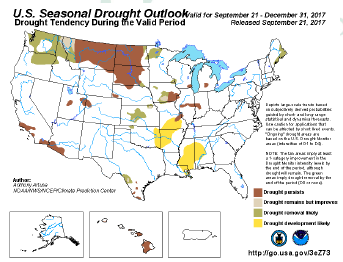
  • NOAA’s updated climate forecasts today included ongoing normal/above normal temperatures through December, and mostly dry weather across the Central US over the next 45 days. The odds of La Niña developing in late autumn/winter were boosted noticeably (62%, vs. just 26% last month), and overall drought is expected to persist/expand across the Plains. The US drought monitor this week featured class reductions in MT, ND and MN, but an expansion in abnormal dryness in MO, IA, IL, IN and MI, which provides evidence that NASS’s yield estimates are overstated. Heavy rains lie in the offing Sunday to Tuesday across the Plains, but no precipitation of note is forecast east of the MS River. Temperatures into the weekend will reach as high as the upper 80s and 90s. The return of a broad NW upper air flow will allow dry weather to return to the whole of the Central US Sep 28-Oct 5, accelerating crop maturity and harvesting.

  • Soybeans closed firm on Thursday while soy products were sharply mixed. Soymeal led the Chicago soybean markets higher and finished back above both the 50 and 100 day moving averages, supporting the soybean trade while soybean oil marked the lowest close in nearly a month. US soybean export sales were well above expectations at just over 2.3 million mt, the largest since last October. Soybean oil sales remained light in both old and new crop positions. The soybean oil market bottomed in early June and has trended higher since, as the market anticipated that the government would intervene to slow foreign biodiesel imports, and export sales have slowed since the Commerce Dept’s announcement in August. New crop sales sit at a decade long low, while outstanding old crop sales are the lowest since 2012/13. With domestic biofuel demand to increase nearly 1billion lbs (16%) to 7 billion lbs in the year ahead, US exports are seen sliding to a three year low. Firm trade is expected ahead of the weekend, with a close over $9.80 to spark a round of technical buying.
  • Chicago corn futures again did very little, and enthusiasm is lacking with the harvest quickening. Soaking rains will impact a majority of the Plains and NW Midwest early next week, but otherwise the 30-day outlook features warm/dry weather. A flood of combine data is becoming available. Early yield data has been highly variable. US export sales through the week ending Sep 14th totalled 21 million bu and featured moderate sales to Japan and Mexico, but no other surprising destinations. Total 2017/18 commitments rest at 434 million, and an average weekly pace of 28 million bu is needed to hit the USDA’s annual target. Export demand certainly won’t be a major factor into early 2018, and work suggests the USDA’s forecast is 50-100 million bu too high. Otherwise, fresh news is lacking. Whether December can find support above $3.55 will be important in the near term. There is fundamental support in wheat (rising world cash markets, less than ideal weather) and in soybeans (demand/Midwest yield), but corn lacks much excitement. Brazil remains abnormally dry, but it’s far too early to be too pessimistic on the first crop.
  • US wheat futures rallied slightly for a third consecutive session, and December Chicago settled above major technical resistance at $4.52, albeit very slightly. Russian fob offers are unchanged, EU offers are noticeably higher though, and with managed funds still short an estimated 85,000 contracts in Chicago, downside risk requires an improvement in world weather. Western Australia will benefit from moderate rainfall in the next ten days, but elsewhere only spotty precipitation is forecast into early October, certainly not enough to reverse the trend of declining soil moisture. There is also more attention being paid to recent and upcoming dryness in E Ukraine and Russia, assuming the current two-week outlook verifies, September rainfall in the Black Sea will rest at just 20-70% of normal, and large pockets of Ukraine and S Russia will see just 20-30% of normal rain in September. US weekly export sales were a meagre 11 million bu, unchanged from last week and some two million shy of what is needed to meet the USDA’s annual forecast. The US’s share of world trade is suffering as record shipments leave Russia, but US exporters have much better export opportunities beyond Nov/Dec.

20 September 2017

  • Following firm trading overnight, soybeans extended gains on improved export demand. Ahead of the morning open, the USDA announced old crop export sales totaling 132,000 mt to China and another 960,000 mt to unknown, with another 120,000 mt of new crop soybeans also to unknown. Note that announcements have accelerated since Aug 1, with a total of 27 transactions for new crops soybeans, totalling 4.75 million mt. Tuesday’s combined total of 1.21 million mt was the largest since July, which was directly following a Chinese (ceremonial?) frame contract signing ceremony in Des Moines. World demand remains strong, with summer demand figures up 10% over last year. We caution against turning bearish amid US yield uncertainty and the drier start to the S American planting season.
  • December corn traded in another 4-cent range, ended modestly higher, and whether the contract can trade through $3.55, and thus break through its 20-day moving average for the first time mid-July, will be watched closely. We note that both chart-based support and resistance levels continue to narrow. Otherwise, the weekly ethanol report was in line with analyst estimates, though amid further losses in US gasoline stocks crude rallied $1/barrel, settling above $50 for the first time in four months. US ethanol production and blending margins remain elevated. Ethanol production last week totalled 304 million gallons, down slightly on the week, but up a hefty 15 million from this week a year ago. More importantly, non-domestic disappearance continues at a record level, in spite of Brazil’s recently passed tariff on imports. Official exports in July totalled 117 million gallons, the second largest on record. What little Midwest harvest data is available has been mixed, the real yield story seems to be in disappointing beans, and moving forward our focus is on rising milling/feed wheat prices and this year’s rather late start to Brazil’s wet season.
  • US wheat futures rallied 4-7 cents, with December Chicago posting newer multi-week highs. Limited fresh news is available, but Australia’s crop potential continues to decline and the Black Sea cash market continues to move higher (record demand is found here). Australia’s share of world trade is in retreat, which will bode well for the US market over time. Literally zero rain has fallen across much of New South Wales, Queensland and even pockets of W Australia so far in September. Spotty showers are possible in NSW next week, but needed soaking rain is not indicated over the next two weeks, and a final Aussie crop of 19-20 million mt (vs. the USDA’s 22.5) is most likely. US export sales on Thursday are expected in an uneventful range of 300-450,000 mt, but we maintain that the USDA is too low with its forecast. Gulf wheat is only just more expensive than Russian origin, and Black Sea prices are expected to inch higher into Nov/Dec. Also note that managed funds this evening in Chicago are net short an estimated 86,000 contracts.

19 September 2017

  • Early selling in November soybeans found support at the 100 day moving average that pared back losses and left November 2.25 lower for the day, but 7 over the early morning low. Soybean oil had support under the 50 day moving average, and meal was lower on meal/oil spreading. Early Brazilian soybean planting is now underway, though producers across the country will likely wait for better rains to develop over the next several weeks. The question for this year is the extent that Brazilian producers will expand soybean acreage. Soybean area has increased every year for the last decade, and the USDA estimates another 2% expansion this year. In US$ Chicago is 1% higher, but 2% lower in Reais. CONAB’s initial estimate for soybean area is still a month away, but at the start of the year, producers are facing below normal soil moisture and lower prices.
  • December corn fell another 3 cents as ongoing Central US warmth should accelerate crop maturity, and as there are signs of better rain chances in Southern and Central Brazil beyond the next 10 days. We view the recent break as mostly chart-driven, and major technical support and resistance lies at $3.45 and $3.55, respectively. The EIA’s weekly energy report, due Wednesday morning, should include steady (and record large for the week) ethanol production, but key will be the pace of non-domestic ethanol disappearance. So far, non-domestic use has shown no signs of slowing despite Brazil’s approved tariff on imports from the US. Brazil’s ethanol market continues to rally, and US production and blending margins remain elevated. S America’s cash corn market has been stale in recent weeks. Argentina is still the world’s low cost origin,  and by $.20/bu. However, feed wheat does not look to displace as much total corn demand this year. It may be premature to lower US corn exports below the USDA’s projected 1,850 million bu. We would note that downside risk in S American corn, and world feed/milling wheat prices, is limited.
  • Wheat futures worldwide did very little today, but cash markets are noticeably firmer following Egypt’s latest tender result. Egypt secured 175,000 mt of wheat from Russia, which is not surprising, but at an average fob price of $197/mt, a full $10/mt higher than its last purchase in late August. The Russian market continues to find demand, and amid limited export capacity fob prices there continue to rise. Russian wheat, again, the world’s driver of price in August to November, is still offered well below comparable EU origin, and so a collapse in value is not imminent, and Russian wheat is competitive up to $196-198/mt, vs. quotes this evening of $188 (note that Egypt again is paying a steep premium amid phytosanitary issues). The point is we doubt much downside risk exists in even US futures. Rain is needed in Australia, E Ukraine and S Russia.

18 September 2017

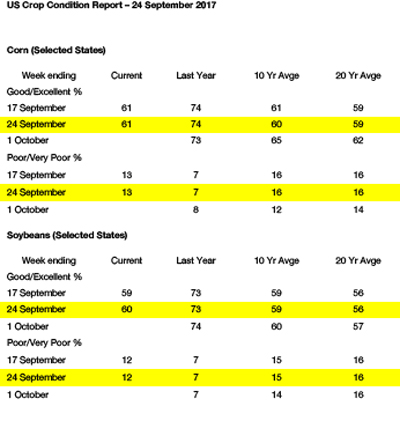
  • US crop condition data has been released as follows:

  • Soybeans rallied from the morning opening on export sales announcements that totalled 387,000 mt. However, November soybeans found resistance back above the contract’s 50 day moving average. The soy product markets finished sharply mixed, with meal leading the complex higher, while soybean oil followed Malaysian palm oil lower. NASS reported national good/excellent soybean crop ratings at 59%, down 1% from last week, while national harvest was 4% complete. (IA good/excellent ratings declined 3% for the week to 58%). While late season rains in W Iowa offered late summer relief, crop ratings remain well under the long term average and well below a year ago. We note that NASS’s implied pod weight for IA was 8% over last year and record large, while the September pod count was at a four year low. Nearby support was established last week under $9.50 basis November futures, while the market awaits more harvest data to determine a yield trend. Our view is for lower yields in October, when actual harvest data can be incorporated into NASS’s projection.
  • December corn has been unable to exceed its 20-day moving average since early summer, and again failed to do so today. Otherwise, it was a rather slow day, news wise, and crop maturity should at least catch up with average in the next two weeks as abnormally warm temps are sustained. We would also mention that EU/Black Sea feed wheat prices continues to move higher, which should allow for better corn demand into East Asia from all origins. Maturity as of Sunday reached 34%, vs. 50% on this week a year ago and a longer term average of 45%. No frost is indicated, and in fact abnormally warm temps will stick around for another 6 to 7 days, but with maturity well behind normal in ND, SD, MN and IA, US temperatures will be worth monitoring into the first week of October. good/excellent ratings are unchanged at 61%; harvest is 4% complete, vs. 11% on average.
  • Another round of sub-freezing temperatures were recorded across much of New South Wales over the weekend, but US wheat futures instead failed at tech resistance, and also extracted some premium amid a rather wet pattern forecast next week across the HRW Belt. Winter wheat planting through to Sunday reached 13% complete, vs. 15% a year ago. Egypt’s GASC is once again seeking optional origin supply for late October shipment, which again we would expect be filled by Ukrainian/Russian origin. The Black Sea will dominate world wheat trade into late autumn. However, as that market finds demand, prices continue to rise. Russian wheat for spot arrival is offered at $188/mt, vs. $180 just weeks ago, and Russia’s discount to other origins is narrowing. Do not ignore this year’s loss of S Hemisphere wheat, and as such the US market will be well positioned to capture world demand beginning in winter. Other than periodic short covering, rallies will be tough over the next 6-8 weeks, but we maintain seasonal lows were scored in late August.