31 January 2018

  • It has been a corrective morning in Chicago as corn, soybean and wheat futures decline following days of rally. The market had become technically overbought with the RSI (Relative Strength Index) in soybeans reached 62%, the highest since July. The market needed a rest and a correction which is occurring this morning. We note that some argue that Argentina received rain overnight, and it did in the far NW provinces that produce less than 4% of their corn/soybean crop. This rain will have virtually no impact on 2018 Argentine soy/corn production. If a soaking rain DOES NOT appear by February 10, a host of private Argentine soy production estimates will slip to 48-51 million mt. Most Argentine crop sources are pegging their current corn crop at 36.5 million mt with a lack of rain in the first ten days of February pushing that 34-35 million mt. The USDA pegged the Argentine soybean crop at 56 million mt and corn crop at 42 million mt back in early January. Those crop estimates will likely be revised lower in February. We see the morning Chicago lower price action as corrective, not a new bear trend.
  • Chicago floor brokers report that funds have sold 6,300 contracts of soybeans, 2,500 contracts of corn, and 5,700 contracts of wheat. In soy products, funds have sold 4,500 contracts of soymeal and 500 contracts of soyoil.
  • The EIA weekly report showed that US ethanol production fell to 1,040 barrels/day from 1,062 last week. The grind consumed 306 million bu of corn for the week compared to 312 million bu in the week prior. US ethanol stocks fell to 968 million gallons, up 5% from last year. The ethanol data was seen as neutral to slightly bearish amid the decline from last week.
  • World wheat fob offers vary more widely depening on the producer wheat sales. To the surprise of many in the EU, Frech farmers are still clutching onto their wheat store based upon an €8 premium offered by the March-September Paris wheat futures spread. Also, Argentine wheat offers are nearly exhausted by strong exports which has underpinned Russian wheat amid the rally to $196-197. US wheat fob prices will not attract demand due to their stiff premiums.
  • The fund short covering has paused with new selling evident overnight. However, US nor S American farmers are selling cash corn or soybeans on the break. Argentine farmers are outright bulls as they watch crop prospects wither. It is the end of the month and short funds are being protective of their profits. Yet, monthly gains are being notched in Chicago corn, soybeans and wheat futures.

31 January 2018

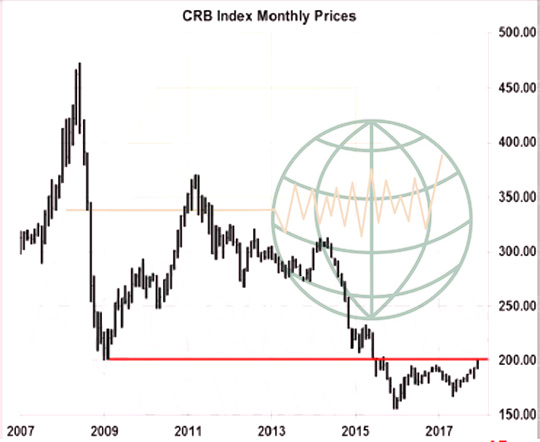
  • In early 2015, the CRB Index fell below the low that was set back in 2009. A major low was set the following year in 2016, and a secondary low was again set last summer. Since then the commodity index has rallied back through the 2015 breakout. With the US economy growing, many commodity traders are discussing the potential of rising US inflation and the impact that could be felt in commodity markets. Markets will be closely listening to the State Of The Union address, and then again for Janet Yellen’s final FOMC Meeting announcement.

  • The EU and GFS weather models are in agreement on a split S American weather pattern for at least the next two weeks. Dryness prevails across Argentina and looks to be sustained into the 15th. The lack of topsoil moisture in Argentina will maintain high temps in the 90s, and at times lower 100’s. The heat and dryness will produce acute stress on Argentine corn and soybean crops. The forecast is warm to hot amid drying topsoil. Highs will reach the mid 90’s to lower 100’s. The excessive heat will prevail into mid February. Additionally, daily heavy rains are ahead for much of N Brazil. This shouldn’t affect later developing bean fields, but weekly totals upwards of 7-12” will slow early bean harvesting, and thus raise questions about safrinha corn acreage in pockets of Mato Grosso and Goias. Also, enduring mud could slow truck traffic northward to export ports. This is a stable summer weather pattern that is concerning for a deepening Argentine drought. We see no indication of a pattern change. The strength of the jet stream amid La Niña looks to maintain parched weather with above normal temperatures.
  • The 14 day US weather forecast is unchanged and maintains dry weather into the middle of February. Trace amounts of rain/snow are possible in the Dakotas, but otherwise a pattern of complete dryness and cold temperatures will prevail for the next two weeks. The jet stream will lift northward in the last half of February. Whether moisture falls with this northern migration of the jet stream will be key for spring soil moisture. Starting in early March, the dryness across the Central US will become more concerning for 2018 US spring and summer row crops. A high pressure ridge looks to hold across the SW US with the upper air flow coming out of the Pacific Northwest. Snow totals across the Rockies will be extremely limited and the drought looks to worsen. The dryness is worrisome as sub soil moisture reserves are in fast retreat. The middle of February is highly important for a wetter pattern to develop. 
  • Soybean and meal futures continued higher through Tuesday as funds continued to cover their short soybean position and add to their long meal position. The Argentine forecast offered hardly any changes, with very little rain and well above normal temperatures lasting into mid February. Commodity fund traders were estimated buyers of 11,000 soybean, 5,500 soymeal, and 3,000 soyoil contracts.The EIA will release the January Biodiesel Production report on Wednesday, with data for November. Total soyoil use and substitution of other products will be just as important as the actual biodiesel numbers. Corn oil prices have been in decline for over a year, as most ethanol plants have invested in technology and equipment to extract oil from DDG’s. Biodiesel plants prefer soyoil, but have been steadily increased use of alternatives, including corn oil in the last year as the corn/soy spread has slipped to a three year low. Spot futures close through the first of several a major weekly trend lines, and without a change in the Argentine forecast, we expect that breaks continue to find demand from short funds and end users.
  • A dire Argentine weather forecast mixed with still heavily short commodity funds continued to support Chicago corn trade through Tuesday. Spot corn was back over $3.60 for the first time since August, while most new crop contracts were back $4. Both weekly and monthly ethanol data will be out on Wednesday. The monthly data for November is approximately known, and expected to be slightly better than the October figures, while nearby output is expected to stay firm. Ethanol plant margins for IL and NW IA, have largely stayed profitable over the last year. IA margins spiked lower at the start of the year, but are estimated this week at $.04/gal, with IL plants estimated to be making close to $.13/gal. Our price targets are coming into view, though a much stronger rally could unfold if much needed rains do not soon fall in Argentina. The outlook stays bullish corn.
  • Kansas March wheat futures gapped higher today. Yesterday, the USDA released winter wheat crop conditions, that for some states, showed ratings that were the lowest since Jan condition reports first began to be released (e.g. 2006 for KS, 2010 for OK). Funds were thought to have bought 6,500 contracts of Chicago wheat contracts. Yesterday, funds were estimated to be short 112,000 contracts. The Kansas March futures contract closed at $4.70. That is up 17 cents and was the high of the day. SRW futures rose nearly 9 cents, while the Minneapolis Mar contract only managed to eke out a 3 cent gain. On the Kansas nearby futures chart $4.80 is resistance. If the contract closes above that level, the next target would be $5.00 then $5.50. SRW Mar futures closed at $4.58, just shy of our upside target of $4.60- $4.65.

30 January 2018

  • Chicago corn, soybean and wheat futures have rallied heading into the midday hour with cash connected selling noted on the morning rally. Cash corn movement has been active in the past few days as bids have reached their best levels in months. However, US soybean sales have been waning as producers have likely marketed more than 70% of their 2017 soybean harvest. Funds and speculators have been on the other side of the producer selling based on their continued exodus of short positions. We estimate that funds are still short 175,000 contracts of corn, 76,000 contracts of soybeans, and 112,000 contracts of wheat. Funds may have to get to a flat position heading into spring before the market reaches a seasonal high. We are looking for a higher close, but based the producer sales of corn and soybeans, this is a market that takes two steps forward and one back. A close above $3.605 in March corn and $9.95 in March soybeans will confirm the next bullish chart signals. Our upside price target for March Chicago wheat rests at $4.60-4.65.
  • The USDA announced the sale of 132,000 mt of corn to Spain. The sale helps confirm that Latin America has run out of corn and that the US will have the market to itself in coming months. Key will be the Brazilian winter corn crop amid the decline in Argentine production. Everyone is trying to guess if Chinese soybean importers are going to extend their forward coverage ahead their Lunar New Year holiday. In recent years, Chinese soybean buyers have been covering their needs prior to the holiday. However, this year it appears that Chinese buyers have missed the rally and are wating for a correction. Amid the big interior cash meal trade of recent days, crushers are getting short of stock. The pressures are building for China to make new purchases, but few want to chase Chicago. We suspect that most may wait until after the holiday hoping for improved S American weather. However, if the weather does not improve with either too much rain for N Brazil or too little for Argentina in the weeks that follow, these importers may be forced into coverage for March and April. Chinese importers are much closer bought than prior years do to the rising value of the Yuan.
  • Russian wheat fob offers have stopped rallying ($193/mt) as producer sales have starting to increase. The world has an abundance of old crop wheat left to sell as the US market sees a sharp rally in prices. The goal of the US market is to price out its wheat due to potential new crop problems. A long lived bull rally is not expected without new crop Black Sea weather adversity.
  • Crop loss will accelerate across Argentina in the next two weeks due to hot/dry weather and a high pressure ridge aloft. One needs to remember that Argentina plants two summer row crops, the first being in October/November and the second in December and January. Both crops are suffering under acute dryness, but it is corn that could endure a 20% yield loss or an Argentine crop if 31-33 million mt (vs USDA estimate of 42 million).

29 January 2018

  • Chicago grain and oilseed futures have been back and forth through the morning, but have stayed higher through the latter part of the day. The overnight trade was accompanied with sharply higher volume, though trading through the day has not found the aggressive follow through buying, though price breaks continue to find end user demand, which has offered support. The midday weather forecast little change to the Argentine forecast out to mid-February. Chicago brokers estimate that commodity funds have been net buyers of 4,000 contracts in corn and have been flat for the morning in the wheat market. Funds were big buyers in soybeans overnight, but sellers of near 5,000 contracts through the morning. In soybean product markets, funds were also similarly large overnight buyers, but turned net sellers of 3,500 contracts through the day, and also sellers of 2,500 soyoil contracts. Despite funds selling through the day prices have managed to hold higher.
  • Chinese buyers will go on holiday in 2 weeks, and the US$ index has bounced to start the week, and the dollar is also higher against key S American currencies. However, longer term bearish dollar trends are still in place, both on the index and against the Brazilian Real. For the Brazilian farmer, the rally in prices in Chicago has been bitter sweet, as those gains have been more than offset by changes in currency over the last several weeks.
  • Crop loss will likely accelerate across Argentina in the next two weeks due to hot/dry weather and a high pressure ridge aloft. We have lowered our estimate of the Argentine soybean crop to 52 million mt with corn at 36.0 million mt. It is the availability of soybeans for processing/export which is our biggest concern should the Argentine soy crop be less than 49 million mt. Corn prices should follow soymeal upwards.

26 January 2018

  • Chicago is mixed at noon with soybean/soymeal under pressure with the grains firmer. The meal market is sliding after a nearly nonstop rally over the past nine trading sessions. It appears that funds managers want to bank some profits before the weekend following their recent heady gains. Soybeans have followed the meal market, which has been the case all week long. March soymeal has encountered resistance near $350.00/ton once again. Spot soymeal did score a new rally high at $348.50/ton, but to reach above this level requires the confirmation of an Argentine soybean crop below 50 million mt. Argentine soymeal exports would be constrained on a production level below 50 million, which is a level that world crushers have been monitoring. Corn and wheat prices have been largely supported by rising crude oil prices, improved Brazilian ethanol demand, and the falling US$. Grain/soy spreading has also offered a bullish tailwind. We doubt that a new bearish price trend can emerge in the grains with the specs acting as buyers of breaks.
  • CBOT floor brokers estimate that funds are net sellers of 4,200 contracts of soybeans and buyers of 4,100 contracts of corn and 2,900 contracts of wheat. In soy products, funds have bought 2,600 contracts of soyoil while selling 4,600 contracts of soymeal.
  • US Gulf corn is priced at $163.50 this morning against $167/mt out of Argentina and $173/mt from the Ukraine. It is very difficult to find a Brazilian corn offer from February through May. We don’t expect that Brazil will return as a large corn exporter until July. US Gulf corn is cheaper than Argentine offers through June as a result of their declining corn crop prospect. IMEA estimated Mato Grosso soybean harvest progress at 12.3% vs 16.2% last week. The warm and dry weather pattern allowed for farmers to push ahead with harvest. The current pace is right at the 5 year average.
  • Every market needs a rest and such is the case for soybeans/meal this morning. However, we see nothing that would alter the prevailing Chicago uptrend with S American weather too dry for Argentina and too wet for N Brazil amid a falling US$. The weekly CoT report needs to show a big decline in fund net shorts or additional covering will be witnessed next week. Higher prices likely lie ahead.

To download our weekly update as a PDF file please click on the link below:

Weekend summary 26 January 2018

Our weekly fund position charts can be downloaded by clicking on the link below:

Fund positions disaggregated data

25 January 2018

  • Currencies and energy markets have become major drivers of US and world grain prices. The US$ has plunged to new lows for the move, and overall we view strength in other major exporter currencies as fundamentally supportive. US energy stocks continue to erode, counter seasonally, and until there are signs of massive upticks in production we expect crude to range from $55-70/barrel, which will further support economic growth in places like Russia, Canada, the Middle East and N Africa. The macro landscape is much different this year compared with last year.
  • It has been a strong morning in Chicago as the US$ falls, S American weather is concerning, and funds are covering a large net short position. Cash related selling is noted from US farmers, but S American farmers are not big sellers on the fall in the value of the Real and Peso. March soybeans have pushed above the weekly downtrend line at $9.95 while March corn is holding above $3.55. Traders are selling corn, soy and even wheat against the upside resistance, but amid the sharp fall in the value of the US$, we have concerns that funds will have to liquidate much of their net short position. It took weeks to get into net Chicago grain shorts and it will take weeks to get out. The longer term structural bearish outlook for Chicago has not changed, but that does not mean markets cannot enjoy a meaningful bounce.
  • Chicago floor brokers estimate that funds are net buyers of 2,200 contracts of corn, 1,800 contracts of wheat, and 4,100 contracts of soybeans. In soy products, funds have bought 4,100 contracts of soymeal and 1,600 soyoil.
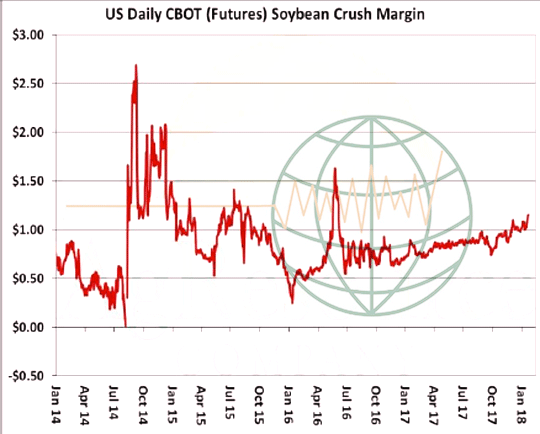
  • Chicago prices are pulling back and correcting at midday on the slight increase in rainfall in the 9-15 day period for Argentina. Rainfall totals were bumped up 0.1-0.5” in this timeframe, but our confidence that far out is low. Temperatures are also 4-6 degrees cooler, still above normal, but cooler. The Chicago soybean market has had a nice rally and some profit taking against resistance is normal. However, we do not see any big change in the S American weather forecast, the value of the US$ or fund willingness to exit short positions. We doubt that this Chicago break can be sustained. US crush margins surged this morning to over $1.20/bu on the rally. This is causing US and S American crushers to seek additional soybean supply. The US farmer has been a willing seller on the rally, but S American farmers are not. Brazilian farmers have seen a rally in the Real from 3.30 to 3.13 at midday while Argentine farmers see a black market for the peso above 20.00:1. There is no compelling reason for S American farmers to sell with exceptionally wet weather to limit Brazilian soybean harvest and causing difficulty for transportation. Somehow Chicago will have to coax additional cash movement of soybeans in S America. US farmers historically have sold 70% of their prior harvest by the end of the January.
  • A falling US$ along with funds being heavily short is likely to lift Chicago prices in coming weeks. The Argentine weather forecast is slightly wetter in the 9-15 day period (low confidence) which is causing the midday correction. There is not enough rain in the Argentine forecast to solve prior months of dryness.

24 January 2018

  • Chicago corn and wheat have traded to solid daily gains while the soybean market trades both sides of unchanged. The volume of Chicago trade has expanded on the rally and the sharply lower US$ is providing a bullish backdrop. Corn is catching a bid on declining Argentine and S African production along with the pop above key resistance at $3.55 basis March. The charts are turning bullish of corn with spot futures trading above the 50 and 100 day moving averages, and soybeans look to test their weekly downtrend line at $9.95 basis March. A close above this level would fuel additional fund short covering. We estimate that funds are still sitting on a record large net short corn and wheat position, while being net short 80,000 contracts of soybeans. Chicago floor brokers estimate that funds are net buyers of 7,300 contracts of corn, 3,800 contracts of wheat, and sellers of 2,000 contracts of soybeans. In soy products, funds have bought 1,200 soymeal and 2,000 soyoil.
  • Former Brazilian President Lula was convicted of corruption and appears to be going to jail. Supporters are still arguing that a pardon could free him to run for the 2018 presidential election. The news caused the Brazilian Real to rally to 3.18;1 which sparked the Chicago soybean rally as farmers halt sales. The Real could push higher vs. the US$ now that the Lula trial has passed.
  • Argentine corn and soybean crop estimates are in decline amid warm and dry weather, and the forecast of additional dryness. We have lowered our Argentine corn crop estimate to 36.5 million mt (compared to USDA estimate of 42.0 MMTs) with a soy crop estimate now at 52 million mt. There are private estimates in Argentina of a soy crop of 48-50 million mt (due to an even farther fall in yield and planted area). Argentina is the world’s largest soymeal exporter with annual crush rate at just under 45.0 million mt. If the Argentine crush rate is confined by a smaller crop, that export demand would likely be pushed to the US. This is the reason for the ongoing rise in US and world soybean crush margins.
  • Argentine soybeans have reached 5,000 Pesos/mt today, which has not produced much increase in cash related selling. Spot Argentine corn has reached 3,000 pesos/mt, a new historic high. Argentine farmers are becoming bullish on ongoing hot/dry weather and inflation that is running at over 30%.
  • A falling US$ along with fresh fund short covering is lifting Chicago corn, soybean and wheat futures. Key is the weekly downtrend line at $9.95 basis March futures. A close above $3.55 March corn should push values up to $3.65-3.70. The US wheat rally will be constrained by slowing US wheat export demand. We hold to a short term bullish outlook.

23 January 2018

  • Cash and Chicago soybean crush margins have reached their best levels in nearly two years. Soymeal end users around the world are caught with limited forward coverage as Argentina is within the throes of a developing drought. Rain is badly needed and the forecasts are not offering a change in the arid weather pattern into mid- February. As long as US and world soymeal values rise, firming crush margins are forecast. We note that the Brazilian soybean crop could rise to 112-113 million mt, but this will not be enough to offset the Argentine losses. Fund managers are taking note. 

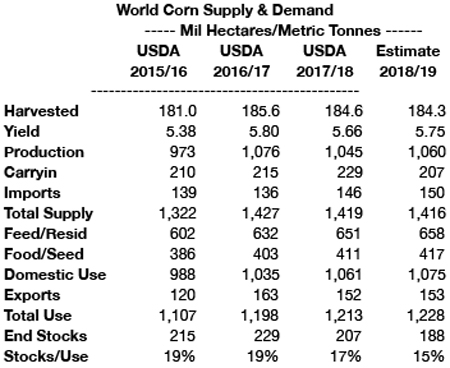
  • World corn acreage surged from 2009 to 2013, which was a function of price/profit. More acres were added in 2016, which was a function of non-US dollar currencies. However, as producer balance sheets change via Chicago prices and relative strength, even mild demand growth looks to cut world corn ending stocks. We fully expect corn seeding to expand another 1 million ha in Argentina in 2018, but decline in Russia, the US and China. The net is a slight reduction in total world corn area. Assuming trend yield and trend (and even somewhat weak) consumption growth, using acreage of 184.3 million ha results in a 19 million mt (9%) decline in global corn stocks. Note that world animal numbers are expanding following contraction in 2015 and 2016, world meat consumption growth is accelerating, and Chinese meat consumption is rising for the first time since 2014. 

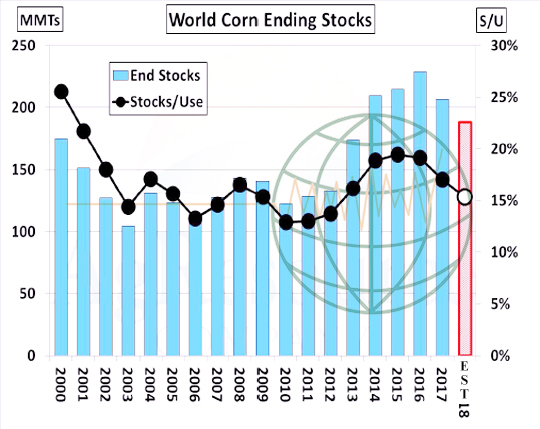
  • Global corn stocks/use at 15% will be the lowest since 2012, and while not overly bullish, it does suggest fair value in the next 12 months lies between $3.40-3.85 basis spot Chicago. Of course, a US yield of 176-180 bushels/acre would alter this outlook, but the most probable scenario features trend yield in the US and elsewhere. Importantly, following five years of depressed prices, the market has worked to elevate consumption, making weather issues a bit more interesting in 2018/19. Moreover, China has signalled it plans to embark on a comprehensive biofuel program and biofuels in general will be attractive until world crude producers respond with higher production. We maintain a broadly neutral corn outlook, but wishes to point out that the recent bear market has likely run its course. In recent years adverse weather was needed for rallies; in coming years very good weather is needed for a further break.

  • Soy prices finished higher on Tuesday, with soyoil following palm oil prices higher, but also pacing the day’s advance in Chicago. The palm oil market found demand on Tuesday from deeply oversold conditions and slow production figures for the first half of January. Commodity funds traders were estimated buyers of 3,000 soybean contracts, and 4,000 contracts each in the soymeal and soyoil markets. After declining for three weeks, estimated Chinese soybean crush rates turned up last week to a 3 week high of 1.9 million mt. The current pace remains record large, however, soymeal stocks have also been moving higher since mid-November. There is a loose (and inverse) relationship between soymeal stocks and estimated crush margins. However, there is no statistical relationship between estimated margins and Chinese imports, and based on US and S American export to China in December, we expect that January imports will be at or near a record large figure of 6-7 million mt. The big event for Wednesday will be the trial of former Brazilian president Lula, and the impact that the results have on the Brazilian Real. Elsewhere in S America, Argentine crops have very little rain in the forecast.
  • March corn fell slightly, and still appears bound to a range of $3.45-3.55 in the near term. We continue to caution against turning bearish at the lower end of this range amid ongoing, and accelerating, dryness in Argentina and as the US$ forged new lows for its recent move. US weekly export sales through the balance of winter should also be well above the pace needed to meet the USDA’s forecast. Without perfect weather, the most probable scenario includes further cuts to global stocks amid a lack of acreage expansion. The market in recent years has very slowly worked to build a rather sizeable demand pillar, and so work continues to suggest that multi-year lows were posted in 2016. Notice that ethanol’s discount to gasoline is testing the levels established during Hurricane Harvey. The EIA’s weekly ethanol report on Wednesday should be supportive. Funds have done little to change their massive net short position.
  • Better than expected snow fell across N KS and NE in the last 24 hours, but, such totals will do little to curb drought expansion. Work suggests there is adequate snow cover given no extreme cold is expected across TX & OK in the next two weeks. Choppy trade will continue, and breaks look to be supported amid weakness in the US$, firm world cash markets and as funds maintain a net short position in Chicago worth 140,000 contracts. US wheat futures since early autumn have struggled at major moving averages, and the market awaits pronounced weather adversity or a demand driver to trade above $4.40, basis spot Chicago. This is logical as Black Sea stocks and export remain elevated. However, unlike recent years, major exporter currencies are strengthening, which is working to support world cash prices, Russian fob offers today sit at a season-high $194/mt, and still the market must reconcile widespread drought in the US, which according to climate work isn’t going away through the balance of winter.

23 January 2018

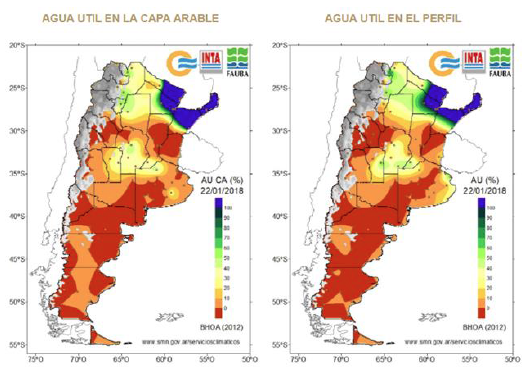
  • The map (below) to the left is topsoil and the chart on the right is subsoil moisture as of today. The only location where there is plenty of soil moisture is far NE Argentina, where few crops are grown. The Argentine dryness stretches all the way back to October, and although there have been promises of drought ending soakers, the rains have all been localised. Much of Argentina is dry and the forecasts are arid into early February.

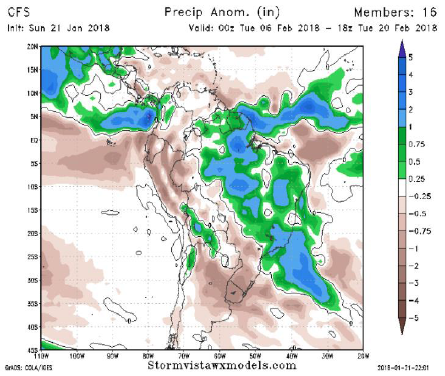
  • Improved rainfall returns to Central Brazil by late week, but the CFS weather model in recent releases has trended noticeably drier across Argentina. Very little rain is forecast in the next two weeks, and the latest guidance on 16-30 day rainfall is below average. 56% of Argentina’s early planted crop is in the silking phase, and the need for rain is immediate. Unfortunately a major pattern change is unlikely between now and early February. Dryness and above normal temperatures will linger across Brazil through the balance of the week. Thereafter, a high pressure ridge wanes which allows normal tropical shower activity to resume in Mato Grosso, Goias and Minas Gerais. It is still important that this shift materialises as pockets of Central Brazil are starting to experience crop stress. In Argentina, no meaningful rain of note is offered to the primary ag belt into Feb 1, and the graphic below suggests La Niña  based dryness likely continues to mid-February. Time is running out to salvage trend Argentine corn yield potential.

  • The Argentine 2018 corn crop is going backwards, and rather quickly. One-off rain events since October have done little to curb the ongoing decline in soil moisture and without a major pattern change in the next 3-4 weeks, LLa Niña looks to negatively impact summer row crop production. Cumulative rains in Argentina since Dec 1 across the primary Corn Belt (Buenos Aires, Cordoba & Santa Fe) are just 60% of last year. Assuming the 7-day forecast is correct rainfall will exist at just 66% of normal and 58% of last year. Cumulative Dec-Jan rainfall of less than 8” is very often associated with La Niña establishment, and also indicates corn and soy yields well below trend. Such would appear to be the case in 2017/18.
  • Dec-Jan cumulative rainfall correlates decently with final corn yield in Argentina. Typically it is December and February rainfall that most impact crop potential, but following this year’s delayed seeding, we suspect that the need for rain is immediate for both early and later planted crops. The Buenos Aires Grain Exchange last week reported that 45% of early planted corn is rated poor/very poor; 53% of later planted corn is poor/very poor. A majority of the crop will be in its silking phase by late month, and so the current dryness is indeed impacting yield. Using Dec-Jan precipitation to date, work indicates a final Argentine corn yield 15- 18% below trend. Though the model isn’t perfect, it is clear that rainfall of 10” plus  is needed for corn yield to reach trend or above. Precipitation of 5” in Feb would be helpful, but the forecast models want to maintain the arid trend.
  • What is important about the lack of rainfall in January is that the production loss is beginning to cross the threshold where it does impact the global corn trade matrix. Assuming an Argentine corn yield 15% below trend (6.75 mt/ha), production comes in at 33.8 million mt. Even with record large carryin stocks such production will allow for an exportable surplus of just 24-25 million mt, vs. actual exports of 25 million mt last year and the USDA’s forecast for the coming year of 29 million mt, thus 185 million bu will be switched to other origins. Given the recent surge in Black Sea corn basis, and the uncertainty over safrinha production in Brazil, the US will be the primary beneficiary. There is no shortage of corn in the world, but as the market begins to question US acreage in 2018, We seriously doubt that spot futures can fall much farther. Argentine losses may well spark fund covering.
  • It was a higher start to the week as the trade resumed concern for the Argentine crop. Old crop soymeal led the day’s rally and and finished up $7/ton. Funds were estimated buyers through the day of 7,000 soybean and 6,000 soymeal contracts while selling 1,000 soyoil. Soy markets appear largely focused on Argentine weather and the potential impact on crop size/meal exports. Soyoil was thought to be the story of the year on expanding biofuel demand, but is marking new lows this week and down 9% for the year, while soymeal has marked new highs and is up 15%. The largest notable change has been in the spot soybean crush spread which has now gained 25% from the start of the year and 52% over the September low. Chicago is offering processors an average margins of $1.11/bu to the end of the year versus $.83 last year and the 5 year average of $.68. Limited rains look to fall across Argentina over the next two weeks. Our next target for March beans is at $10.10. Remember that funds are short close to 90,000 contract of soybeans.
  • March corn moved very little, and aside from ongoing dryness in Argentina, fresh news was absent. However, We view the coming weather pattern in Argentina and far S Brazil as highly important, as now production losses look to shift export demand in 2018 to other origins. This along with uncertainty over US corn seeding this spring, and as US domestic corn use has ballooned to a record 12.5 billion bu, will keep spot futures well supported above $3.45. Funds sold a net 5,000 contracts today, and thus maintain a short position worth 215-217,000 contracts. Argentine dryness is priority number one, but in the meantime the market continues to work to boost overall consumption. Brazilian ethanol’s premium to US origin has widened further to $.92/gallon (40%), and ongoing ethanol exports are attracting market attention. Gulf corn is offered below all other origins through May. A close above $3.55, March, is needed to attract fund short covering.
  • Wheat futures continue to recover post-USDA report losses, albeit very slowly. However, the lack of any demand driver is working to limit any meaningful fund short covering. World cash fob offers are moving higher, but not at the speed of those in the US, and so Gulf HRW is again positioned rather poorly in the world market. Export sales in the next 1-2 weeks will stay uneventful. However, the downside risk is lacking. The market’s goal in the coming weeks and months is to reconcile weak export demand with low winter wheat area as well as an expanding Plains drought. Still no meaningful precipitation is included in the Plains’ 2- week forecast, and climate guidance maintains ongoing below normal precipitation into April. This is mostly a function of the duration of La Niña. More pronounced short covering requires adverse weather in one more major exporting country; Russia, the EU or the Ukraine.

22 January 2018

  • A higher morning Chicago trade uncovered some modest cash related selling in US corn which pressured the grains into the midday hour. Soybean futures have held strong on concerning Argentine weather. The Argentine forecast can change, but limited rainfall totals over the next few weeks is likely to cause stress to developing summer row crops. Argentine temperature are seasonal for this week, but look to warm next week and into early February. Corn is being the crop that is being impacted and yield estimates are in decline. Research argues that for a 2018 Argentine corn harvest of 36.5 million mt (and in decline) vs. the January USDA forecast of 42.0 million mt. Soymeal is the commodity being most impacted by drought like weather, but we would remind that corn is the crop that could see the steepest yield/production losses. Argentine nearby fob corn is offered at $165/mt today, the highest fob price offer in nearly a year. New crop Argentine corn offers have risen to $163/mt. This is no place to sell corn or indulge in bearish fantasies!
  • Chicago brokers report that funds have sold 4,400 contracts of corn and 2,300 contracts of wheat, while buying 4,100 contracts of soybeans. In soybean products, funds have sold 3,200 contracts of soymeal and sold 1,800 soyoil.
  • The US Senate is likely to approve a two week stopgap measure to re-open the US Government and the flow of ag information. The US$ has started to rally back with the Brazilian Real and the Russian Ruble gaining. The Argentine Peso has been weaker at 19.1:1, but farm sales have not been large as inflation is starting to become more engrained in the mind of the Argentine farmer. In Peso terms, their corn prices are at an all-time record high today.
  • Seasonal price trends are up and funds are too short of corn, wheat and soybeans amid concerning S American weather. Our hope is that NAFTA negotiations can make progress this week. The Argentine corn crop is in fast retreat and crop condition reports are not good. The S American weather pattern looks to be static with concern growing for Argentine crops in February. Funds are too short of Chicago corn/soybeans and the risk vs the reward is tilted to the bulls.