
19 January 2018

  • The Chicago morning started off with fresh fund buying on bullish technical considerations in corn and soybeans. Stronger than expected weekly US corn and soybean export sales added to the tailwind of support. The wheat market declined on slow US sales amid the sinking EU wheat market. The EU is trying hard to boost its wheat export pace amid large stocks. We look for a mixed Chicago close with March wheat to find resistance above $4.30 with March soybeans uncovering selling above $9.835, the 50 day moving average, with S American weather forecasts being closely followed. A close today above $3.52 March corn (50 day moving average) or $9.79 in March soybeans (200 day moving average) would be deemed as bullish. The wheat market looks to hold in a broad range amid large world exporter stocks.
  • Chicago brokers report that funds have bought 3,500 contracts of corn and 4,300 contracts of soybeans. In soy products, funds have sold 3,700 contracts of soyoil while buying 2,900 soymeal. Funds have sold 3,200 contracts of wheat.
  • There is optimism that next week’s NAFTA negotiations will yield positive results, and that at a minimum, kicks the negotiating can down the road with future negotiations. The NAFTA trade talks look to be starting two days early amid the expectation that Canada will bring a new plan to the US and Mexico. The market could see this as being supportive next week.
  • Seasonal price trends are up and funds are too short of corn, wheat and soybeans amid concerning S American weather. Our hope is that NAFTA negotiations can make progress next week that will help US corn values. China should be a larger buyer of soybeans ahead of their Lunar New Year.

To download our weekly update as a PDF file please click on the link below:

Weekend summary 19 January 2018

Our weekly fund position charts can be downloaded by clicking on the link below:

Fund positions disaggregated data

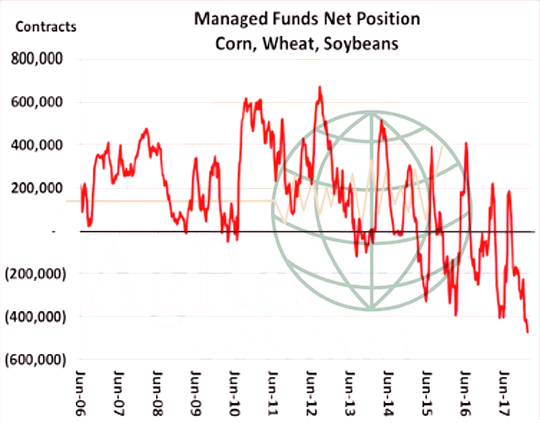
  • Funds have entered into a new record short ag futures position of -473,000 contracts, an increase of 29,000 contracts in the holiday shortened week. The net short in US soybeans surged to -103,400 contracts with the combined grain (Chicago corn and wheat) at -370,000 contracts. The hefty fund short opens upside price risk should any bullish supply shock develop. World farmers have to be sellers of supply if Chicago prices are to be pressured substantially in the weeks ahead.
  • Following higher overnight trade, soybeans and meal extended the week’s gains through Friday, with soymeal again pacing the rally. The Argentine weather forecast shows limited rainfall over the next 10 days which is likely to keep planting progress to a minimum and stress growing crops. Commodity funds were estimated buyers of; 5,000 soybean and 3,500 soymeal contracts, while selling 2,600 contracts of soyoil. IMEA, an agriculture economic institute in Brazil, estimated that soybean harvest progress in Mato Grosso had reached 3% this week versus 12% last year and the 5 year average of 7%. Planting this year was later due to dry October conditions, which has also pushed the harvest backwards. Of note is that the export lineup update shows 1.8 million mt of beans scheduled to sail in January versus 1.2 million a year ago. We expect Chicago meal and soybeans to add premium until there is a change in Argentine weather forecast.
  • March corn ended marginally higher and thus settled above its 50-day moving average. Argentina has been dry all season, but increasingly the establishment of La Niña looks to maintain dryness and mild heat through pollination. The two-week forecast lacks meaningful rain, and climate work suggests coming dryness is likely to extend into early February. Early planted corn in Argentina is rated at just 11% good/excellent. Even later planted corn is pegged at a disappointing 12% good/excellent. Yield loss is near certain as the crop pushes through reproduction. World grain prices also continue to move upwards; Black Sea feed wheat is offered at a new seasonal high $184/mt. In addition, somewhat surprising is the recent surge in Black Sea corn basis, from $.65 over futures to $.85 at the close of the week. US Gulf corn is still the world’s cheapest origin, and amid delayed crop development in Argentina should remain so into the middle part of spring. New bearish news is needed to push March below $3.45.
  • Weekly US export sales of everything but wheat were at or above expectations, and through the week ending January 11 the US sold a meager 6 million bu. This is double the previous week, but still well short of the pace needed to hit the USDA’s annual export target. Sales have failed to meet the pace required for three consecutive weeks. EU prices have also declined in an effort to find better export demand and rid the market of excess stocks. Competition for world market share remains steep, and will likely remain so into the middle part of 2018. However, Russian fob offers have rallied to $194/mt, vs. $192/mt a week ago, and so further downside risk in EU cash prices appears limited. As the world’s wheat benchmark price rises, and as minor feedgrain prices remain lofty, the US too will find better consumption on breaks. Longer term, the next major driver of price will hinge upon whether N Hemisphere exportable surpluses rise or fall. In the near term, it is key that the US$ holds at 90 points on the Index; otherwise additional short covering is expected.
17 January 2018

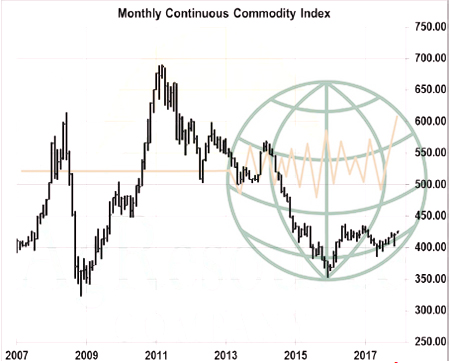
  • The monthly chart of the CCI/CRB Index is turning upwards, and would confirm a bull market with a close above $443.00. A broad swathe of commodity markets are bottoming due to a falling US$, strong world demand, and stagnating supplies. By most measures, a longer term bottom in the broad commodity market is forming. However, this does not mean that a new lasting ag bull market is ready to emerge. Notice that the CRB Index peaked in 2011 and the ag markets peaked in 2012 amid a major Midwest drought. Our point is that its become late to be bearish of ag commodities.

  • Reversing the trends of recent days, the grains (corn/wheat) have caught a bid with soybeans and soymeal weaker in moderate volume. Corn is once again bouncing off of $3.45 support as the market continues to build a base against ever rising open interest (likely new fund shorts). We estimate that funds are now short a record 235-240,000 contracts of corn. The soybean market has rallied sharply for several days, but an attempt to fill an open chart gap at $9.62 has occurred. Wheat futures appear to be caught in between the pull of corn and the push of soybeans this morning.
  • Chicago brokers report that funds have bought 5,500 contracts of corn and 2,800 contracts of wheat, while selling 4,300 contracts of soybeans. In soy products, funds have sold 2,700 contracts of meal and 2,100 soyoil.
  • US farmers indicate that they will look to plant more cotton, sorghum and barley based on current prices and the outlook for their future profitability. US cotton acres could rise by 800,000-1.0 million acres to 13.5 million acres, sorghum acres back to 6.3-6.6 million acres (up 600-700,000 acres), and barley to 3.1-3.3 million acres (up 500-700,000 acres). The point is that minor crop acres including cotton could expand by 1.9-2.4 million acres which will come out of corn/soybean seeding with total US cropped acres unlikely to expand. This may cause a 500,000 acre decline in 2018 US soybean acres and 1-1.5 million acre drop in corn. This compares to the November Baseline report forecasting 2018 US corn and soybean acres both expanding to 91.0 million acres.
  • US corn futures are rising as traders ponder reduced 2018 US corn seedings and a tightening balance sheet assuming a trend yield of 173 bushels/acre. Soybean futures are weaker on spreading against the grains and the retesting of support in March soyoil futures below $.325. Our view is that soyoil values are near long term support with limited downside risk as demand for US biodiesel increases. Amid funds that are holding a record large net short grain position, we continue to advise against any substantial downside expectations.

16 January 2018

  • It has been a widely mixed morning in Chicago with soybeans leading an upwards charge while wheat futures sink following the wake of bearish data from the USDA January report. Long wheat/short soy spread unwinding has been active with funds wanting to be on the long side of the complex via less than perfect S American weather. We look for a mixed close with a firm cash HRW wheat market offering support while the $9.72 area offers resistance to March soybeans on rallies. The market is still looking for a more bullish fundamental catalyst amid funds holding record or near record net short grain positions. Chicago floor brokers estimate that funds have bought 2,800 contracts of soybeans and 3,100 contracts of soymeal, while selling 3,600 contracts of corn and 4,200 contracts of wheat. In soyoil, funds have sold 2,200 contracts with March looking to test key support at 32.50.
  • Brazil is considering lifting its duty on US ethanol if the US would lift its objection to the import of Brazilian fresh beef. No one knows for sure whether Brazil or the US will ever reach an agreement, but the stage is favorably set for a positive decision. The US blocked Brazilian beef in 2017 following the Brazilian scandal on food safety concerns. Brazil has already resubmitted all of the material required by the US to restart beef trade. Brazilian cash ethanol prices have been rising sharply and we are sure that the US ethanol will pressure the administration to advance the proposed deal.
  • The trade is questioning on how much faith to place in extended US or EU weather forecasts beyond the next 10 days. The reason is that the extended forecast offers rain chances for S Brazil and Argentina beyond the next 12 days. However, the track record of the extended 10-15 day models has been poor, and in some cases, no better than a coin flip. As such, research argues that we place their attention in the 10 day forecast and see of the rain in the extended range is pulled forward.
  • Egypt’s GASC secured 295,000 mt of Russian wheat in an overnight snap tender. The average price was $211.92/mt basis CIF, or some $4/mt more than their last tender. The purchase confirmed a rising trend of Russian wheat prices.
  • A 50% correction of Kansas March wheat comes in at $4.185 with key support noted below $4.20. Corn prices appear trapped as Friday’s large fund selling could not push prices lower. S American weather will gain in importance, but the extra US 2018 winter wheat seedings will likely curtail 2018 US soy seeding. Don’t turn bearish as values appear to bottom.

12 January 2018

  • Friday is report day!
  • Today has seen Chicago markets trade in what has been described as a wildly mixed session with corn steady, soybeans higher and wheat sharply lower in a somewhat more exaggerated repeat of Thursday trade patterns. USDA data had few surprises. Wheat markets reacted most violently to higher than anticipated US seedings, 32.6 million acres vs. 31.4 million expected and 32.7 million last year but the changes were minimal and in line with expectations.
  • Final US corn yield was pegged at 176.6 bushels/acre, a 1.2 bushels/acre increase from November although harvested area was reduced some 400,000 acres, largely offsetting yield in overall output. December 1 corn stocks of 12.5 billion bu were a touch above expectation forced a reduction in feed and residual numbers by 25 million bu. US 2017/18 corn end stocks increased 40 million bu month on month to 2,477 million bu. S American corn production was left unchanged.
  • US soybean production was cut 33 million bu via reduced yield (49.1 vs. 49.5 previously). Exports were cut 60 million bu to account for the pace of sales and shipments to date. Quarterly stocks totalled 3.16 billion bu, right at trade guesses, and which confirmed a slightly higher pace of domestic disappearance. Crush was raised 10 million bu to 1,950 million. End stocks were raised 25 million to 470, which on paper is not bullish but funds’ massive short position is being pared back. Soy oil stocks were cut 80 million lbs to 1,536, a new five-year low. This morning’s soy complex data just isn’t bearish enough to push the market below major chart-based support.
  • US wheat stocks were raised 29 million bu amid reduced feed and seed use. Wheat exports were left alone. HRW stocks were lifted 14 million, SRW 11 million, SRW 1 million, durum 7 million, while white wheat stocks were lowered 4 million. New crop winter wheat seedings were put at 32.6 million, vs. 32.7 a year ago. HRW acreage is estimated at 23.1 million, vs. 23.8 million last year; SRW is estimated at 6.0 million, vs. 5.6 last year. Even by-state changes were minimal. While higher than expected this does exacerbate the battle for acreage across the Plains and Delta. With more land than expected dedicated to wheat production, and with sorghum, cotton and soybean markets performing much better than corn, corn area next year could be lower than expected. In its world numbers, Russian wheat production was raised 2 million mt, but this is more than offset by higher domestic/export demand.
  • Black Sea wheat stocks are actually down 500,00 mt from the December’s WASDE. Aussie stocks, too, are down 1 million mt to a new nine-year low 3.2 million mt. Aussie wheat exports were lowered 1.5 million mt. Brazilian soybean production raised from 108 to 110 million mt following a lack of threatening weather so far. Argentine production was lowered 1 million mt. Including Paraguay total S American soybean production is now projected at 175.4 million mt, up 1 million from December but down 7 million mt from last year. No changes were made to China’s soy balance sheet.
  • The highly anticipated January reports have now come and gone. Higher than expected wheat acres are noted, but today’s data doesn’t change the overall structure of ag markets. Currencies (the dollar is testing 2017’s low) and S American weather are most important moving forward.

11 January 2018

  • US crude stocks have fallen now for eight consecutive weeks, and since the middle of November have declined 42 million barrels, or some 4%. Until the market confirms enlarged production, and there is a sign that stocks are building, we look for crude to trade in a range of $55-65/barrel. This is of course an input cost, but should also on the margin strengthen major exporter currencies and work to curtail acreage expansion outside the US.
  • It has been another mixed session, with corn, wheat and beans all pretty much unchanged as the market digests CONAB’s latest report, another round of weak US export sales, and preparations for tomorrow’s stocks and seedings numbers. The soy complex has extracted premium from price amid ideas that the USDA will raise Brazilian production, lower US exports and find new land available for soybean seedings via reduced winter wheat acreage. The break from recent highs is understandable, but work suggests the market is fairly valued at $9.45-9.75, basis March, until more is known about S American production, particularly as Central and Northern Brazil will be drier in the second half of January.
  • Through the week ending January 4, US exporters sold a net 17 million bu of corn, 3 million bu of wheat and 22 million bu of soybeans, all of which are considered disappointing. For their respective crop years to date the US has sold 1,067 million bu of corn, down 25% from last year; 1,523 million bu of soybeans, down 14%; and 715 million bu of wheat, down 8% from a year ago. Much better demand is needed to hit the USDA’s forecasts, and though late season corn/soy sales are a function of S American production, US exporters must now sell 700 million bu of beans from now until Aug 31, vs. 400 million a year ago.
  • We would mention that there are suggestions that China still needs to cover its spring soybean needs, but does not seem to be in a rush to do so. Two cargoes were sold to unknown destinations this morning. Funds net short in soybeans has become rather large, and as of this morning we estimate managed funds’ short at a net 100,000 contracts. This is the shortest such position on record ahead of a S American growing season, and is just 18,000 shy of the all-time record posted last June. The US soybean balance sheet is no doubt comfortable, but the short side of the market is getting crowded.
  • Soybeans in the last two weeks have digested incremental boosts in Brazilian soybean production estimates, as well as a string of disappointing US weekly export sales. Downside risk is viewed as limited ahead of pod fill in S America, which will take place over the next 2-5 weeks.

10 January 2018

  • Gulf US soybean basis levels appear to be closely following last year’s pattern with gains since early December. The rally in Gulf soybean basis was occurring long before the onset of arctic cold, and we are told that there has been a modest increase in Midwest soybean origination, but that supplies are less than crushers and exporters desire. This means that US cash soybean basis could stay strong in coming weeks. US nor S American farmers are making cash soy sales in a declining marketplace. The marketplace will have to encourage additional sales post the USDA January report.
  • Virtually no precipitation has fallen across the US Southern Plains, including KS and pockets of NE since the middle of autumn, and another two weeks of complete dryness is likely. This, along with bitterly cold temperatures, has put a bid under HRW wheat prices in recent weeks. We would note that winterkill will likely never be fully quantified, but dryness is always more of a concern. NOAA’s drought forecast released in December, which leaned heavily on La Niña’s arrival, has so far proven correct. While current weather is not impacting wheat yield directly, there does appear to be a correlation between winter and spring precipitation. Assuming latest model runs verify, KS precipitation in Dec-Jan this year will be 60% below normal. The odds that drought continues into spring have been elevated. Dryness also appears to a bit more structural in nature amid the development and deepening of La Niña. Latest ENSO model forecasts suggests that a weak to moderate La Niña will persist into the later part of spring, thereby including a majority of winter wheat’s critical growing stage. Wheat yield in KS has been below trend in 7 of the last 10 La Niña springs, and yield exceeded trend significantly in only two of those years. It is far too early to bet on drought, but measuring probabilities 45-60 days ahead of the end of dormancy is important.
  • Low volume and slow has been Chicago this morning with the grain markets slightly higher with soybeans/soy products slightly lower. Traders continue to await Thursday’s Brazilian crop estimates from CONAB and the USDA January Crop Report. Soybean futures have retested prior lows with March taking aim at $9.5475 with funds still exiting long soymeal positions. We estimate that funds are now short around 97-99,000 contracts of soybeans as they add to their net short position. Funds have been modest buyers of wheat. Chicago brokers estimate that funds have sold 4,300 contracts of soybeans, 2,900 contracts of soymeal, and 1,200 contracts of soyoil. In the grains, funds have bought 2,000 contracts of corn and 1,600 contracts of wheat. The funds continue to add to net short soybean position, while covering a modest portion of their grain short.
  • The expectation of a bearish USDA January report is pulling the soy complex back to its prior lows as traders discuss a sizeable drop in US soybean exports. Corn and wheat are trying to hold near unchanged amid the soybean downdraft. China is seeking world soybeans on the break, but fund selling is keeping Chicago values under pressure.

9 January 2018

  • In a general sense, world raw material prices are rising, to the exclusion of the ag commodity sector. Funds are holding a near record short position in agricultural futures as general ag prices slump. For some reason, food prices are not participating in the world economic growth cycle. Historically, it is food that leads as emerging nation wealth leads to enlarged spending on calories. Some argue that it is abundant world grain supplies and the prospect that NAFTA could be dismantled to the detriment of US trade. One could argue that US ag should be participating in the commodity reflation.
  • It feels like Chicago fund traders have hit the “pause button” with corn, soybean and wheat futures trading mixed at midday. The volume of trade is far less than Monday’s fund inspired selling spree. That selling was met with strong end user pricing as evident by the 40,000 contract rise in Chicago corn open interest. March corn is back hugging $3.50, March Chicago wheat back to $4.30, while the soybeans languish on intra-market spreading. March soybeans are holding their prior lows against $9.55. We would point out that funds fired considerable bearishness at corn, soybeans and even wheat with large sales on Monday. The market absorbed the selling and is recovering this morning. This tells us that there is scale down pricing from end users, and that even if Friday’s USDA report is bearish, the downside risk appears limited, this is no place to side with the bears. Chicago floor brokers estimate that funds have sold 3,000 contracts of soymeal, while buying 2,400 contracts of wheat and 4,500 contracts of corn. Funds have also bought 1,000 contracts of soyoil and sold 3,000 contracts of soybeans.
  • Egypt’s GASC received seven offers for wheat with one offer seeming very cheap at just above $192/mt. The offers came once the Government offered assurances that demurrage would not be an issue with any new sales. World exporters object to paying demurrage on any wheat that is sold as fob. Egypt secured 115,000 mt of Russian wheat in the tender.
  • Australian Statistical Bureau estimated the 2016/17 wheat crop at 30.4 million mt vs ABARES estimate of 35.0 million million mt, previously. We note that WASDE pegged the 2016/17 Aussie wheat crop at 33.5 million mt, so the difference between the Australian Stats agency and its own estimate is only 3.1 million. We would note that WASDE does not have to follow the Aussie Stats Bureau and can maintain their own estimate of 33.5 million mt. Nonetheless, Research argues that WASDE should lower 2017/18 Aussie wheat exports by 2 million mt to 15.5 million due to its high fob prices amid static world wheat demand. Unfortunately, the loss or gain of 2-3 million mt of Aussie wheat from more than a year ago does alter the bearish outlook for world wheat prices going forward. The world is still awash in wheat with Russia continuing to be aggressive on offers.
  • Soybean rust concern is increasing across Central Brazil amid all of the recent rains. The rust is causing producers to reduce their soy yield estimates.
  • Chicago is likely to keep chopping sideways into Friday’s report. Brazil’s CONAB will be out with their crop estimates on Thursday followed by the USDA on Friday. We look for a Brazilian soy crop of 111-111.75 million mt from CONAB, up 3-3.75 million from the USDA’s December forecast. Chinese December trade data will also be out overnight along with the Index rebalance at the close in Chicago.

8 January 2018

  • The fear of a bearish USDA January Crop report returned this morning with the report release being just four trading sessions away. The chant of a “big crop” always gets bigger could be heard across the Chicago trading floor as traders fear a new record yield in corn and a bump higher in US soybean yields. Funds came out of the box with new sales while end users are loath to take coverage unless prices are back near last week lows. Chicago continues to trade in a range. The big question for the bears is whether funds return with additional selling from Friday’s USDA data. Our leaning is not to join the record fund short position, but a bullish catalyst is certainly lacking at the moment to change direction in Chicago futures. Chicago floor brokers report that funds have sold 14,000 contracts of corn, 6,500 contracts of soybeans, and 500 contracts of wheat. In soy products, funds have sold 5,000 contracts of soyoil and 3,100 soymeal.
  • The Index Fund roll/rebalance starts at the close today. Funds will be buyers of wheat which has helped that market partially recover.
  • China has announced that it has cut its poor population by two thirds over the past five years. There were just 30 million of China’s population living below the poverty line in 2017, compared to 99 million in 2012 (according to the Chinese media release). China hopes to bring this total down under 20 million by 2020 and the Government eventually hopes to eradicate poverty. The Chinese expansion of income will boost demand for food and industrial metals. Aquaculture has exploded within China and now produces 2/3’s of the world’s farmed fish. The expansion of food demand is noteworthy and is one reason why the CRB index has turned upwards.
  • The USDA January report is just four trading sessions away and fund managers appears intent on “piling on” in their growing net short position. Our concern is that if USDA does not offer any bearish surprises, who is going sell the market lower. Farmers in the US and S America are not willing to sell cash grain on a break.