
4 January 2018

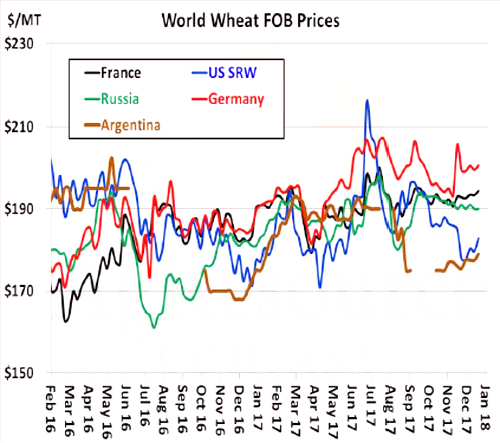
  • Argentine FOB wheat prices are once again the cheapest in the world as the US market has turned higher following the current arctic chill and potential freeze damage that may have harmed the Plains HRW crop. Notice in the graphic below, US SRW wheat prices are still well below all other world exporters, which offers the potential for additional gains. We would note that European wheat exports to date are exceptionally slow, and at some point when French farmers start to unload their stored cash wheat, the EU will become a more aggressive world wheat exporter. US cold weather cannot bull the world wheat market it seems.
  • It seems that several days of gains are unwinding in Chicago as corn, wheat and soybeans all sag this morning. Traders are debating sluggish US corn, wheat and soybean export volumes and whether 2018’s S American corn and soybean output will reach last year’s volumes – or not. The USDA’s last WASDE put 2018 Brazilian soybean output at 108 million mt and Argentina at 57 million mt. The trade consensus appears that the Brazilian crop will be 2-3 million above the USDA’s last and that Argentina will be below by 1-2 million. The net result being a combined harvest in the order of 165-167 million mt, which is below last year’s 172 million result. In a market enlarged by greater global demand a crop of this size would put support into market prices, and we would estimate that level at $89.50/bu basis spot Chicago futures.
  • In corn the argument is even stronger with Argentina’s crop seen at 39-40 million mt, some 2-3 million below the latest  WASDE, and many doubtful that Brazil will produce 92 million mt. Combined corn output of 129-131 million mt would be some 8-10 million below last year.
  • Hedge fund managers see Chicago grains as a cheap play and they could become larger investors following the Jan 12 USDA Crop Report. The macros are bullish for raw material prices. The Baltic’s main ocean freight index surged 6.25% today to $1,341.00. 2018 World freight rates/indexes have been rising amid strong demand for raw materials from emerging nations. The trend is likely to persist into Q2.

3 January 2018

  • Managed funds are holding their largest net short ag position at year end on record, and the 5th largest net short for any week on record. This heady fund net short ag position started in June, and accelerated into the end of the year. The fund short itself is not bullish, but it will add to upside market velocity if a fundamental trigger point such as adverse S American weather were to develop. The market is set up a little like late June if the January WASDE report does not hold any surprises.
  • Morning trade in Chicago has been mixed with corn, wheat and soybeans all trading either side of unchanged. Crude oil pushed above $61/barrel for the first time since June 2015with the CRB Index testing its prior monthly high. The next target for March WTI crude oil futures is $62.58 the early May 2015 top. If this resistance level is reached, and breached, the next upside target would be $75-$80/barrel. Inflationary talk is rife in Chicago and the question of what it means for the grains is, as of today, unresolved. Next week’s January WASE report may offer some clues although it seems the majority are anticipating a bearish report for corn and soybeans. Maybe a neutral or positive report would be construed as bullish.
  • First fields of soybeans are being harvested in N Brazil with producers in Mato Grosso reporting yield levels of 55 bags/ha, around two bags below last year. The harvest will be slow to move south based upon planting dates. China appears keen to receive soybean offers for Feb/Mar shipment with some new demand being met by the US. Brazil is slow to offer based upon late planting and a relatively depleted old crop “pipeline”.
  • There is a bull story developing in soyoil amid lower yield and a sharp rise in biodiesel demand. Soyoil should gain on soymeal with normal Argentine weather. However, the forecast looks more concerning and drought issues are likely to emerge by mid January. We anticipate hard wheat gaining on soft in the weeks ahead on winterkill concerns and historically low seeded acres. This is no time to be overly bearish corn, soybeans or wheat.

2 January 2018

  • To kick off our 2018 reports we have spent the break looking at a number of somewhat controversial topics that might (or might not) impact agricultural crops, commodities and prices in the future.
  • Sunspot activity has reached close to zero in December 2017, and when this occurs there is typically a significant change in weather patterns thereafter. Thee first major weather event will likely be a major El Niño, amplified during minimal sunspot activity. Our current La Niña in not (yet?) a major weather event, and looks as if it could well dissipate before the winter is over. However, the La Niña pattern can, and is, producing  record cold temperatures and snowfall in many areas, typical of zero sunspot activity .
  • The 2020/2021 season has the potential for a major La Niña event, which could leave us all wishing for a return to mild conditions as record low temperatures and snowfall hit the northern hemisphere. This is leaving the spring and summer of this year, 2018, as a transition from minor La Niña to major El Niño, which (if correct) will set off major weather events in Asia towards the end of the year and into 2019.
  • The transition period has potential to create a very warm, hot and dry spring in the US and a very hot and dry early part of the 2018 summer. This will be a period of irreversible crop damage, particularly as we enter the period with very low subsoil moisture levels. With an empty water tank, the negative effects will be amplified. The last three seasons have seen ample ground water allowing the crops to better handle and periods off adverse and dry conditions. This luxury will not be available in the coming year.
  • That said, the big upcoming issue will be a severe drought in Asia, particularly China in late 2018 and 2019, leading to severe negative crop production impact, which could lead to something of a famine in Asia.
  • Grain markets will continue to build their lengthy base into the spring, assuming S American weather remains favourable, which will likely be a last chance opportunity for consumers to take cover prior to “lift off”. The difference from current conditions to the volatile and severe weather events and approaching El Niño pattern will have to be seen to be believed.
  • Afterwards, the most likely pattern is for a “slingshot” reversal from El Niño to a major La Niña in the 2020/2021 timeframe setting off the largest freeze and severe conditions seen in a lifetime. Current crop genetics have limited ability to withstand such conditions. All of the above elates to the current reduction in sunspot activity and its impact upon the weather on our planet.
  • Aside from weather, we saw the US$ bear waking up as 2017 ended leaving a very bearish monthly and yearly close. The potential downside in the US$ Index is to target 85 from the current 91-92 level, and we see this spring as the likely timeframe. This will introduce inflationary expectations back into the commodity space for the first time since around 2010. There are trillions of dollars underexposed in the commodity space, and when the bull trend is eventually recognised we could well be in for an explosive move. If we look at how some 500 million dollars has been willing to follow the bitcoin spree, possibly just to avoid the current monetary system, any food shortage fears could well produce a huge rush to own the ultimate life sustaining asset – food. The bitcoin volume will seem small in comparison.
  • Algorithms and high frequency traders have pressed the current be a market to extremes, they will do just the same to the upside when momentum swings. They have no regard for bull or bear, just the prevailing trend, until such time as it either fails or becomes not worthwhile.
  • 2017 has been a year of no major volatility in any meaningful way, we see 2018 as changing this, and we see this volatility attracting much attention.