2 June 2015

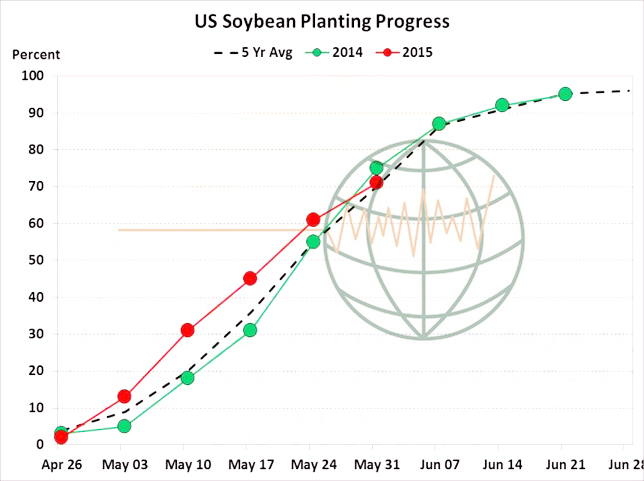
  • Soybean planting progress was expectedly slow, but advanced to 71%, vs. the 5 yr average of 70%. Minimal work was done in the Delta due to heavy rains. Emergence was at 49% against the 5 year average of 45%. Initial crop ratings will be included next week, which should be historically strong.

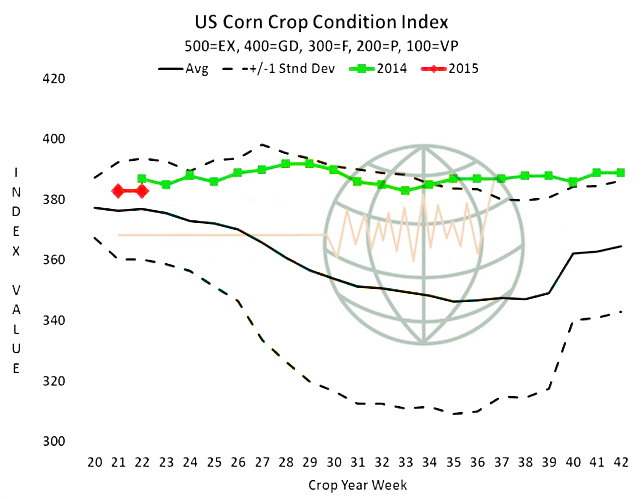
  • Corn crop ratings as of Sunday were unchanged at 74%, which the condition index pegged at 383, vs. 386 a year ago, which is a negligible difference. Ratings improved in MI, NE, PA and WI, and fell across KY, MO, NC and ND. All other states were little changed. As such, we maintain an initial yield projection of 167-169 BPA, though conditions will become more important in late June and beyond.

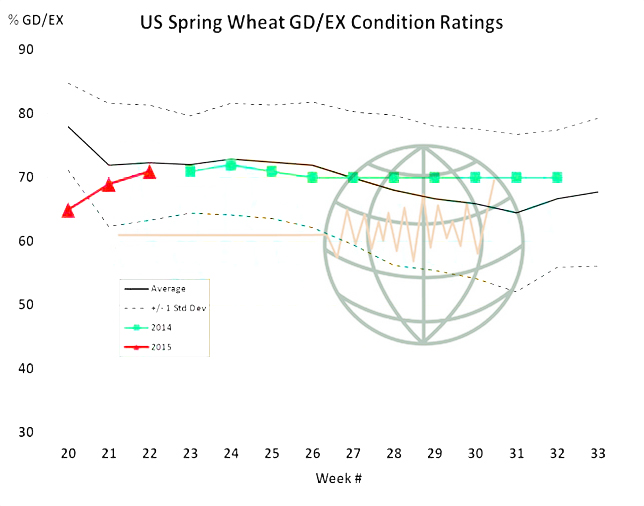
  • US spring wheat crop ratings were boosted another 2% points, with good/excellent as of Sunday at 71%. This is on par with initial ratings a year ago. Winter wheat good/excellent fell 1% point to 44%, vs. 30% last year. Winter ratings fell in IL, MO and TX, but are unchanged in KS, OK, and were up 1% in NE. Winter wheat harvest progress will reported in next week’s release.

1 June 2015

  • We have seen a mixed market today with soybean oil featuring heavily as funds pitch in and push prices higher in the wake of the US’s EPA biofuel revelation last Friday. Some short covering in wheat has been noted whilst corn has been lacklustre and soybeans and meal eased on the Argentinian strike resolution.
  • The new month, and the start of meteorological summer (not that summer is much in evidence here today) has seen a number of new inputs, which may prove to be market “triggers”.
  • The new Russian wheat tax appears to depend upon the Rouble/US$ exchange rate (although we believe it may well be more dependent upon Russian politics), which has been volatile to say the east since mid-2014. One commentator said, “wheat now has the element of Russian roulette”, which seems entirely appropriate right now. July 1 sees the introduction of the new export tax, which Russia suggested was intended to stop exports surging if the Rouble declined substantially. The 2014 decline in the value of the Rouble saw Russian export volumes grow sharply, and its value has not yet fully recovered. For the technically minded amongst us the new tax is set  at 50% of the customs price per tonne minus 5,500 Roubles ($105), but not less than 50 Roubles per tonne according to government information.
  • Egypt announced that it had purchased 5 million mt of local wheat so far this season, which began in mid-April, and is significantly above its 3.7 million mt target. Attractive prices offered by the government is cited as the reason for the increased volumes. Traditionally the government fixes a local procurement price, above global levels, in an attempt to encourage local production, and it seems to be working this season so far. Changes to the subsidised bread sales programme methodology are also encouraging farmer selling rather than holding onto their crop for personal consumption.
  • The Argentine strike appears to be resolved as a pay deal is agreed and sees the end to the three week long strike that has delayed some soy export shipments. Government approval is reported to have been granted, and as they act as mediator in such negotiations it seems that the strike action is now over. Chicago reacted accordingly as far as soybeans are concerned.
  • Closer to home the €uro tumbled after Greece missed a self-imposed deadline for reaching agreement with its lenders to unlock aid, and the fear of debt default remains very much alive as does the potential for a Greek exit from the Eurozone.
  • Southern Russia has received some welcome rains in the Krasnodar, Rostov and Vogograd regions over the weekend which will alleviate some of the concerns that have been raised over recent dryness within the region.
  • Finally, Reuters report that the risk of frost damage to the canola (rapeseed) crop in Manitoba is “severe” with significant acres in need of reseeding. Damage was reported to be worst in western Manitoba with many fields written off and in need of reseeding although it is too early to place an exact acreage on the damage. Canadian canola futures jumped on the news and Matif prices followed. Seed supplies are said to be tight which may well have added to market reaction.

31 May 2015

Weekly CCI Analysis:

The CCI/CRB stabilised on the week with the US$ rising to a 13 year high against the Japanese Yen, while trading broadly sideways against the €uro and most other currencies. US Central Bank officials hinted at US rate normalisation later this year while the EU struggles to get a new Greece accord that would prevent default and their potential exodus from the community. If the US economy continues to gain traction, the US dollar/interest rates will both likely rise into yearend. The US June jobs report and China’s monthly PMI reading will hold great interest to traders this week. There are clear signs that the US economy is accelerating its growth rate while China’s economic outlook is slowing. Chinese real estate values are trying to stabilise, but future strong raw material demand is not foreseen. Our view on the CCI/CRB index remains bearish with intermediate lows expected by late summer/autumn.

Longer-term soybean analysis:

CBOT soybean futures marked meager gains at the end of the holiday shortened trading week with support coming from a strong late week rally in soybean oil. The EPA released its proposal for the US biofuel mandates which triggered fund buying of soybean oil which pushed spot futures back towards the top of the recent trading range. Ultimately, the updated EPA requirements were a disappointment and came in below what many biofuel analysts had expected. Lawsuits could delay the implementation and palmoil producers are trying to have their vegoil become an advanced US biofuel participant. Late Friday, the Argentine oil workers union settled their strike and blockades at crush plants were removed. The port workers union is likely to do the same on Monday with a 27.8% wage increase. The majority of the US soybean crop is now seeded and the weather outlook into mid-June is favourable with regular rains/warmth. We hold to an outlook for steady/lower price trends into the summer, with November to test $8.40-8.60 for an intermediate low. Any rally to $9.20-9.30 basis November should be sold.

Longer-term corn analysis:

Corn futures ended down 9 cents, with July sitting just above its contract low posted during the 2014 harvest. NASS revealed the crop is rated at 74% good/excellent, a touch below trade expectations, but which our work suggests points toward excellent yield potential amid normal summer weather. Conditions are likely to improve in the coming weeks, as a warmer temperature pattern is established through the first half of June. Otherwise, as expected, the EPA has proposed substantially reducing mandated volumes for ethanol production/consumption. Nothing changes in the short run with ethanol supply/demand subject to market economics, but that the EPA has acknowledged the blend wall at 14.0 Bil Gal. New crop export interest remains meager. A more sideways pattern is expected in the next 3-4 weeks as the trade better assesses crop conditions and June/July weather forecasts, but should yield match last year harvest lows are pegged at $3.00- 3.20 basis Dec. We continue to be willing sellers of short covering rallies. More and more of the climate forecasting community are buying into a cool/wet Jun/Jul/August across the Midwest.

Longer-term wheat analysis:

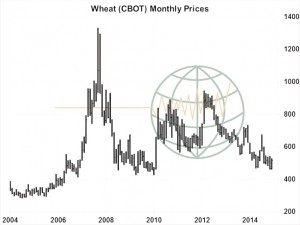
World wheat futures ended sharply lower this week. Concerns over dryness in Russia and Canada have been mostly removed as rains have begun to fall across SE Russia and as forecasts into mid-June maintain near normal precipitation and temperatures. Egypt’s first purchases of the new international marketing year also validated Black Sea/E European cash prices at $190/MT, which is well below US Gulf offers. With forecasts improving, it’s back to attempting to boost US exports though Gulf premiums remain much too expensive. Our outlook is little changed, and ultimately world cash offers are projected to reach $170-175/MT by July. Russia looks to have a very marginal export tax beyond July 1 ($1/MT, with higher levels kicking in if world prices exceed $220). This is not expected to materially affect trade flows. We remain bearish and spot futures will likely range from $4.25-5.25 through the next six-nine months. How low prices reach depends on the value of the Ruble relative to the US dollar in July/August.

28 May 2015

  • Reports last night suggested yesterday’s meeting in Argentina had brought agreement between unions and industry, but so far the required green light from the Government appeared to be lacking. Clearly for the market this issue is now about how long it goes on and the opposing near term/long term consequences: the nearby will see further strength in spreads and basis, but the longer Argentine beans stay off the market, the more negative the eventual impact when the problem is resolved. In a separate move yesterday, and one which may or may not be linked to the strike issue and the attendant revenue losses, Argentina retro-actively raised the April export tax on bio-fuels to 13.2%, from 5% in March and 8.9% in February. We should not forget the ostensible reason for lowering the tax in March, which was to give support to the industry following the loss of the EU export markets!
  • News today suggests that a compromise deal has been agreed but it is still not yet officially confirmed that the Government has committed to the deal – so the debacle continues. There appears to be a general acceptance in S America that a return to normal working will be seen by early next week with many striking workers resuming their jobs tomorrow. The danger of one union negotiating a sizeable settlement is that it encourages members of other unions to follow suit in the hope that they too will make gains. The Chicago soybean and meal markets eased back from earlier highs on the back of the news.
  • For varying reasons, the world soybean market has been trading near-term logistics issues against longer term negative fundamentals for the last five months, and despite all the complications, it’s the long term that continues to win out with Nov beans down $1.25 since the start of 2015 and down 50¢ during the month of May. For now it’s the Argentine strike which is causing the near term problems, but Chinese demand is slow as evidenced by open export slots in Brazil in June, and we are now just one month from the USDA’s June plantings report where the trade expects NASS to find additional acres (the NASS survey for the report begins next week).
  • Two weeks ago, the Algerian wheat tender looked cheap as we reported, but now looks like it was a good sale. The first new crop wheat tender by Egypt’s GASC saw a total of 240,000 mt awarded for shipment 1-10 July with Romania picking up one cargo and Russia the other three. Prices on a C&F basis equated to an average of $199.28/mt, which is just over $5.00/mt below the prices paid on 18 April. Limited volume was offered by France and Poland, and was not competitively priced on this occasion.
  • Brussels has issued a reduced volume of weekly wheat exports presumably due to the recent holiday breaks. This week’s tonnage reached 253,455 mt, which brings the season total to 31,056,141 mt. The season to date total is now 3.066 million mt (10.95%) ahead of last year.
  • Finally, the IGC today raised their forecast 2015/16 global wheat output figure by 10 million mt to 715 million mt. They also added 10 million mt to 2015/16 global corn output with their latest figure standing at 961 million mt. Whilst both crop forecast  figures were a reasonable increase they remain below last season’s bumper levels (wheat 721 million mt, corn 997 million mt).

28 May 2015

  • When you look back in time, most blame the gasoline blend wall for US ethanol demand as being the primary reason why US/world grain prices have slumped to their lowest levels for late May since the mid 2000’s. Yet, we all need to remember that an unusual 4 years of below trend US corn yields helped maintain bullish expectations far longer than they should have. Those poor yield years of 2010-2011- 2012-2013 contributed to tight US stocks and encouraged more acres to be brought under cultivation especially in the Black Sea and Latin America. Now that US corn yields appear to be returning to normal where will this take price?


27 May 2015

  • Yesterday’s US condition and planting report showed soybean planting to be 61% complete compared to 45% last week and 55% last year while the 10-year average for this time of year is 58%.

  • Corn planting was 92% complete compared to 85% last week and 86% last year while the 10-year average for this time of year is 88%. Traders were looking for the weekly crop condition update to show 75% of the crop in good to excellent condition, and the report showed 74% was rated good/excellent. The 10-year average for this time of year is 71%. The highest percent rated good/excellent was 78% in 2007 while the lowest was 63% in 2005.

  • Winter wheat rated as good/excellent stood at 45% unchanged on last week and compared to 30% last year while the 10-year average for this time of year is 45%. The weekly spring wheat planting report showed the crop to be 96% complete compared to 94% last week and 70% last year while the 10-year average for this time of year is 83%. The conditions report showed 69% was rated good/excellent compared to 65% last week and the 10-year average for this time of year at 78%.

  • The market may well have been expecting a reversal of yesterday’s decline on profit taking but favourable central US and world weather has put paid to that – today as grain markets closed lower once again. July ’15 corn has moved closer to the $3.50 support level whilst July ’15 wheat clearly has its eye on the early May lows once again. Soybeans and meal found a degree of support on the Argentine strike and associated cash firmness which is evident particularly in EU soybean meal premiums – but the market is lacking any convincing demand as Chinese demand slows as evidenced by lack of new purchases and open export slots in Brazil through late May and June (which is historically unusual).
  • Matif wheat again closed lower with the Sep ‘15 displaying a drop of up to €8 from last Friday’s high. This, coupled with a slump of some 5% in the €uro has seen FOB values in France drop by a staggering €15 in under a week.
  • All in all, we are asking the question, “How low is low when it comes to prices?” Buyers are not showing their hand, when they do there is a rush of sellers (trade not farm) and it feels very much as if the buyer has, and will retain, the upper hand for the time being.

26 May 2015

  • It has been an “interesting” Tuesday with the macro picture coming to the fore. We have seen some sharp losses in the value of crude oil and the US stock market whilst the US$ soared higher. In a move which took many by surprise we have seen the value of US wheat fall, sharply, as S Plains weather improves and funds queued up to make sales ahead of harvest. It is also interesting to note that global wheat prices have not fully followed the Chicago rally underlining its fragility, and as last week’s low was penetrated volume selling returned once again.
  • Support in July CBOT wheat this morning stood at $4.95½, which was broken today, and the next level looks to be $4.87¼, tomorrow’s trade will be interesting. This morning’s support for December corn stood at $3.72¼, which was breached but the market closed a whisker above this level, the next level of support sits at $3.65¾. The trend appears lower with no weather issue to reverse it at present. In soybeans the market is clearly oversold at present but there is again no weather issue to reverse this right now. Support sits at $8.73½, some way below current closing levels but given everything we see right now this looks vulnerable as does the potential for growth in the fund net short, which may, just may, post a significant new record before too long.
  • In Argentina strike action is providing some support to the front month soybean meal contract. It appears that the Oil Worker’s Union and crush/export industries agreed to a 36% wage increase (that included a bonus above the 27% wage increase) this morning, which was promptly vetoed by the Argentine Government. The reason is that other Government affiliated unions agreed last week to a 27% wage increase and the non-affiliated Government Oil workers Union cannot be seen as getting more from its employers. As such, the parties don’t know what to do next as the negotiated deal cannot be blessed by the Government. New meetings are being set for Wednesday for all involved – including the Argentine Labour Division. The hope is that some sort of work around can be found.
  • In Europe Matif markets were open Monday but traded volume was very thin and prices pretty much unchanged whilst losses kicked in today on the back of the slump in Chicago levels. The Senalia silo has announced a back to normal status on intake, which should help matters somewhat although timing, as they say, is everything! The €uro dipped 150 points on the prospect of an impending Greek default to the IMF. The Brussels crop unit, MARS, upped its 2015 EU wheat yield to 5.93 mt/ha (from 5.89 a month ago) which compares with 6.07 mt/ha last year. Given the lack of area estimates from MARS it is impossible to calculate an overall production making the figure a bit pointless – but gives a sense of direction.

23 May 2015

Weekly CCI Analysis:

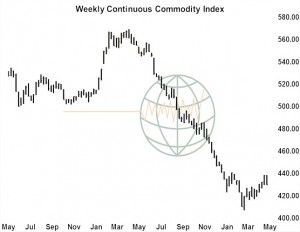
The CCI/CRB fell sharply on the week with the US$ rising following a 2 month correction. Ags, energy and metal markets all closed lower and seasonal price trends in the ags now point decidedly downwards. If the energy markets are unable to push to new highs in the week ahead, a test of the March CCI lows is expected by late July. US Fed Chairman Yellen indicated that the US Central Bank would raise interest rates by year end and that 1st quarter GDP weakness would not hinder US rate normalisation. If the US economy continues to gain traction, the US$/interest rates will both rise. Greece is still trying to negotiate a credit deal with the IMF and the EU Central Bank to avoid default. There are fears that Greece will have to default at some point amid building loan repayments. We maintain a bearish view on US and world commodity markets on oversupply and stagnant demand. A mid to late 2016 low is expected.
Longer-term soybean analysis:

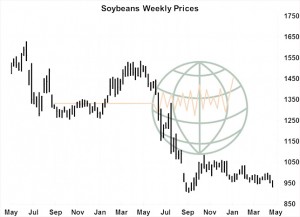
Soybean futures broke out to the downside and finished the week lower with both old and new crop soybean futures marking new contract lows. Chinese demand for old crop S American and new crop US soybeans has clearly slowed, and basis in S America continues to work lower. China has clearly overbought on S American old crop beans with meal and crush margins both moving lower. Purchases of US new crop soybeans are off 53% from a year ago and are sitting at a six year low. Larger private estimates for S American production were also introduced to the market this week that suggest the USDA’s current estimates could be as much as 3-5 million mt too low. Our price models suggest that July soybeans could drop another $1/Bu ahead of expiration. With November to fall under $8.00 with good Central US weather.
Longer-term corn analysis:

Corn futures ended the week weaker following a lack of market-specific news. The Central US weather pattern is favourable, and of note, NOAA on Thursday projected cooler than normal temperatures and above average US rainfall into August – driven by El Niño. US crop conditions on Tuesday are expected to be at or above initial ratings in 2014 – and just below the record. The US corn market needs to stimulate export demand with domestic use stagnant. We have no problem with the USDA’s old crop forecast, as strikes in Argentina and rising fob premiums in Ukraine have made Gulf corn just competitive for export during June and July. However, steep discounts are noted in South America for August and beyond, and S American corn crops are getting bigger – most notably in Brazil where a record large harvest is possible. It’s early, but early US weather conditions have been favourable and the 2015 US corn yield is likely to exceed trend – it’s just a question of July weather and degree. We maintain that periodic short covering offers selling opportunities. Our downside price target for December corn is $3.00-3.20 with normal Midwest summer weather.

Longer-term wheat analysis:

Wheat futures rallied 8-15 cents on the week, led by higher protein contracts amid minor weather issues. Too much rain has fallen across TX, OK and S KS, warm/dry weather will impact Russia’s SE winter wheat crop, and longer term dryness is being watched in Canada. None of these is yet impacting world production or ending stocks just yet, but in the context of funds’ sizeable short position and minimal other news, the rally is understandable. Note that a wetter pattern is offered to Russia in the 8-15 day period, dry weather so far has triggered speedy planting in Canada, and quality issues in the S Plains will be only be determined at harvest. Note that Gulf SRW and HRW are not priced competitively, and the recent rally has only worsened the US’s position in the world export market. Another 10-20,000 contracts of fund shorts could be covered in the coming weeks, but lasting heat/dryness in Russia is needed to create a more bullish landscape. There’s no shortage of global wheat supplies in the near term. N Hemisphere harvest pressure will begin in mid/late June, and sub- $4.50 wheat is projected during mid to late summer months.