
7 December 2012

Sometimes it is difficult to pull significant events out of what has happened over a period, and this is one of those weeks. A number of relevant and newsworthy issues have come to the surface, BUT none of them seem to hit us between the eyes at terminal velocity!

UK farmers who have been pressured by excessive rainfall received a period of respite in a cold snap which allowed a brief period in which it was possible to get machinery onto the land – and combines were seen rolling once again, in December, gathering a very late harvest. However, the weather window has not added significantly to the autumn wheat sowings, which remain behind expectations at around 80% leaving the very real prospect of another sub 14 million mt harvest in the UK next year.

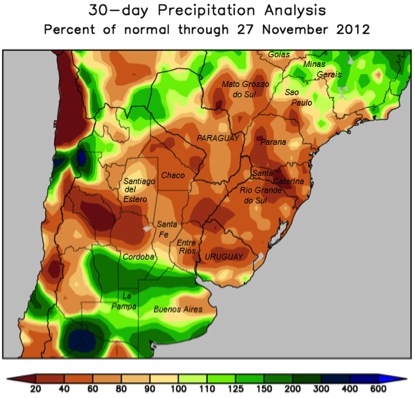
In S America reports of barley harvests bring little to raise a smile, the early reported yields are running nearly 40% behind expectation in northern regions which, if representative of the country as a whole, could take up to two million mt off the national crop and pressure already tight exportable volumes As with wheat the outlook for the crop is already blighted by the on-going wet weather and not only yield reductions are hitting the headlines but quality fears are already well reported. The key outcome remains to drive buyers to alternative origins to source material but, as we have previously reported, many traditional sources are already tight on stocks.

As if this was not bad enough, we picked up on reports that some Argentine wheat exports are blocked due to a “lack of export permits”. The AgMin have denied that there is any export suspension, but we did hear that the Argentine government “may” be about to apply some form of pro-rata to existing export licences as they are struggling to find the necessary volumes of wheat. We stress that this is, as yet, unconfirmed, however the wet conditions experienced over recent weeks and months does give a degree of credibility to the rumour.

Further north, in the USA it has been estimated that the winter wheat abandonment rate may reach as much as 25% as continued warm weather and lack of rainfall continue to stress the crop. Clearly the decision to plough up the crop and re-seed will wait until spring but the crop outlook has continued to decline beyond the last released USDA condition report as temperatures have remained higher than that required to allow the crop to enter winter dormancy; thus prolonging the period of drought induced stress. This level of abandonment has only been seen twice in the last 50 or 60 years, 1988/9 and 2001/2. The decision on what to plant instead will only be made when conditions in the spring are known.

CBOT prices, despite the potentially bullish news, remain stuck in a broad range downtrend that has plagued the market since late July price peak. Even the news last weekend that Egypt, in their first tender since October, had awarded 280,000 mt (out of a total 400,000 mt shopping spree) to the US failed to give the market the shot in the arm it is looking for. The next tender, the date of which is unknown, may well reinforce the message that US wheat is now competitive in the global arena, and highlight that the rest of the world is struggling with tight supplies.

Thursday’s US export figures contained one figure to grab attention, and that was the soybean export number at 1.14 million mt which was above the estimated 500-700,000 mt. The total soybean export commitments this season now stand at 28.4 million mt, which is nearly 6.4 million mt (or 29%) ahead of the position a year ago. Little wonder that we have remained friendly to the market, despite the significant price drop since early September. From a technical perspective we appear to be close to testing the $15/bu mark as we approach the week-end, a break through this level could well see the bulls take charge once again although we don’t believe that the funds have a great appetite for significant participation this side of New Year as they appear to be protecting profits and performance levels achieved in 2012. Maybe the dawn of 2013 will be the “trigger” for fresh upside momentum.

To conclude, in the “unremarkable news week”, we remain friendly to the fundamentals of the global soy complex and grains markets and urge consumers to remain well covered for the current season.

6 December 2012

US weekly export figures released today were as follows:

Wheat: 353,100 mt, which was within estimates of 350-500,000 mt.
Corn: 47,400t, which was below estimates of 350-550,000 mt.
Soybeans: 1.14 million mt, which was above estimates of 500-700,000 mt.
Soymeal: 464,800 mt, which was above estimates of 150-300,000 mt.
Bean oil: 19,000 mt, which was below estimates of 50-100,000 mt.

The effect on the market close was corn settling 4 to 5 cents lower, wheat gaining a couple of cents and the soy complex finishing in positive territory.

In S America we heard reports that Argentinian some wheat exports are blocked due to a “lack of export permits”. The AgMin have denied that there is any export suspension, we picked up that the Argentine government “may” be about to apply some form of pro-rata to existing export licences as they are struggling to find the necessary volume of wheat. We stress that this is, as yet, unconfirmed, however the wet conditions experienced over recent weeks and months does give a degree of credibility to the rumour.

Staying with news from Argentina, the reported barley yields in the north are way below expectation, as much as 38% down, and if representative of the total crop, could take 2 million mt off the crop. The news has taken many by surprise and buyers are looking for alternate sources, without a huge degree os success right now.

According to Reuters the US winter wheat abandonment rate may reach as much as 25% as continued warm weather and lack of rainfall continue to stress the crop. Clearly the decision to plough up the crop and re-seed will wait until spring but the crop outlook has continued to decline beyond the last released USDA condition report as temperatures have remained higher than that required to allow the crop to enter winter dormancy; thus prolonging the period of drought induced stress. This level of abandonment has only been seen twice in the last 50 or 60 years,1988/9 and 2001/2. The decision on what to plant instead will only be made when conditions in the spring are known.

On a happier note, Brazil’s CONAB, the government food agency, forecast a 2012/13 soybean crop of 82.6 million mt, a figure greater than expected from the US crop this year. They also predicted their corn crop to be 71.9 million mt.

Weekly EU wheat export licences were issued for 746,000 mt bringing the season to date to 8.923 million mt, up from 7.966 million mt a year ago. Barley exports licences were 118,000 mt with the season at 2.581 million mt compared to 1.972 million mt last year. The combined additional exports close to 1.5 million mt so far this season; we continue to question how long this can continue and how big a “hole” is going to be left which will require imported feed grain to fill it!


4 December 2012

Today’s news includes the latest forecast from private analyst Informa Economics who reduced the Argentine 2012/13 soybean crop to 58.4 million mt from 59.5 million mt last and the corn crop was cut to 27 million mt from 28 million mt last reported. At the same time Brazilian soybean output was increased slightly to 81.4 million mt from 81.25 million mt whilst corn numbers were cut slightly to 66.2 million mt from 66.8 last estimated.

The Argentine cuts were attributed to a drop in harvested acres and lower yields, the region has been suffering from excessive rainfall and flooding.

Interestingly, in the same report China’s 2012/13 corn crop was projected at 7.1 million mt higher at 208.1 million mt, the same as forecast by Chinese officials.

Australia’s ABARES has provided an upbeat report on their wheat prospects stating that crops were not a badly affected as many believed.Their estimate of the 2012 wheat crop was 22 million mt, down a million from their previous forecast but still 26% behind last year. Their outlook for exports was stronger than the USDA’s forecast, a figure of 20.9 million mt was quoted which would put them only second to the US in the league of global exporters with Canada and the EU following behind.

Closer to home in a move away from the usual “flooding and rainfall” stories we hear that combines are rolling in the UK once again! The recent freeze has firmed ground sufficiently in some areas to permit travel on previously waterlogged ground.

Given all the “good news” today it is little wonder we have seen markets ease a touch! However, we continue to maintain our view on the overall tightness of global stocks and caution against complacency.

3 December 2012

A brief commentary will be the order of the week as I am travelling. However, I will happily respond to specific points which may arise, email will be the best way to achieve this.

Markets started off higher this morning making positive noises with reports that the funds were, once again, buyers. However, reported US corn and wheat exports were disappointing and capped gains and markets are currently trading below the highs of the day. Clearly, markets are nervous and appear to be searching a more definite “signal” before trading higher in strong fashion.

US Export data
                  W/E 29 Nov ’12         Year to date           Last year
Wheat        14.19 million bu         461 million bu        533.6 mil bu (-13%)
Corn           9.63 million bu          208.3 million bu     401.0 mil bu (-58%)
Soybeans   51.08 million bu         600.3 million bu    429.1 mil bu (+40%)

Saturday saw Egyptian wheat tenders awarded, and as expected, the US was the recipient of 280,000 mt. Additional tonnages went to Romania and France (60,000 each). The next question is, “when will Egypt be back to the table for more?” Our guess is that it will be the New Year but only time will tell.

The tender award probably marks the necessary slowdown in EU exports and the start of a stronger emphasis upon US origin material as we have been suggesting in recent weeks. The outlook for other regions remains bleak to say the least; Argentina has stopped issuing wheat export licences, their crop being described as “disastrous”, as much as 50% of the Uruguayan crop could be downgraded to feed grade and some Brazilian milling wheat sales are either being washed out or converted to feed grade. This leads us to assume that the S American balance sheet will need some revisions before too long!

The wheat outlook is not improving in our opinion.

30 November 2012

Markets have all trended lower today in a follow through coupled with week-end, month-end and pre-Christmas profit taking whichever you wish to choose!

That said, the fundamentals are pretty much unchanged. There is little in the way of fresh news…… apart from China’s recent statistics reported on Reuters; a record 2012 grain harvest for a ninth straight year with total output up 3.2% at 589.57 million mt according to the Chinese National Bureau of Statistics. Corn reached a record 208.12 million mt (up 15.34 million mt), rice a record 204.29 million mt (up 3.28 million mt) and wheat at 120.58 million mt, the second highest ever. Good weather and better yields were cited as being responsible for the improved output, seemingly government subsidy and incentives also added some encouragement! (Writer’s cynical note – hmmmmm are they potential buyers?).

29 November 2012

CBOT markets showed an inclination to trade higher this morning until we saw the publication of weekly export figures which continued to show disappointing figures for wheat and corn. The market sold off to lower levels in the afternoon and latter hours of the session. Soymeal sales were above expectation and beanoil was in the expected range leaving the soy complex to trade either side of unchanged.

In S America we have continued to see wet conditions persist and, according to Buenos Aires Grain Exchange (BAGE), both soybean and corn plantings behind normal for this time of year. In stark contrast, the dry conditions in S Brazil appear to be worsening with soil moisture reported to be displaying a four to five week moisture deficit equivalent to 2.5 to 3 inches. The crop moisture requirement for both soybeans and corn rises significantly when grown in this region compared with the US for example.

It is too early to assess the impact on output in either Argentina or Brazil right now, suffice to say the effect is not favourable and a change in weather conditions is necessary if crops are to fulfil their potential this season and provide relief to tightening global supplies.

EU wheat exports licenses were granted for 454,000 mt bringing the season to 8.177 million mt, this compares to 7.724 million my last year. We continue to maintain that this pace is not sustainable and the emphasis on global wheat trade must move away from the EU (probably to the US) in the very near future if acceptable year end stocks are to remain.

28 November 2012

CBOT markets gave back some of yesterday’s gains in early trade but as the day progressed we saw prices, particularly in wheat and corn, edge back into “green”, or positive territory once again. The soybean complex however (at the time of writing) has continued to post slight losses on the day.

Oil World has today reported that soybean prices are too low and do not fully reflect the risk associated with S American output as weather related setbacks and a potential return of La Niña conditions are contemplated by observers. The statement by the respected analysts continued by referring to  “the unusually small world stocks available at the beginning of 2013.”

Conditions in S America, particularly dryness in Southern Brazil, have raised concern over output which is almost being considered a necessity to restore a more balanced equilibrium to the much reported tight global supply situation. Typically, La Niña conditions are less than favourable for S American soybean output as was seen last season.

Australian based Macquarie Bank have suggested that we are about to see a rebound in US wheat exports which have been “terrible” so far this season. The change in export fortunes is attributed to rainfall derived quality issues in S American supplies, limited available supplies from Russia and Ukraine as well as pressured EU supplies. The outcome of the next tender from Egypt, who have been absent from the market this month, may well add some credibility to their view if the US is awarded contracts. We will watch with interest.

Wheat prices in both London and Paris moved higher again today with London reaching new contract highs in both old and new crop positions. Prospects for new crop supply are, as previously mentioned, pressured due to the extreme wet weather and flooding being experienced in the UK, which has restricted autumn sown acreage to well below “normal” levels. One UK consumer, referring to new crop wheat today said, “it looks as if we have missed the boat!” Given the level to which new crop prices have risen and the prospects for crops around the world, he may well be correct.

27 November 2012

CBOT markets opened higher this morning with wheat gaining ground after the US winter wheat crop condition declined another one percentage point to 33% good/excellent and the poor/very poor rating increased two percentage points to 26%. Albeit these moves were pretty much expected but the market took the news to heart and rallied strongly.

The ongoing dry conditions in the US Plains coupled with above average temperatures are preventing the crop entering into dormancy and consequently prolonging and exacerbating the crop’s stressed status. We are picking up on reports of wheat crops turning brown and displaying signs of dying off. Whilst this is an early indication of the crop (and unlikely to be representative of the whole crop), some commentators are already raising their estimate of abandoned acres and trimming yield forecasts.

The prolonged “bearish” view on US wheat, which has predominantly emanated from the lack of sizeable exports so far this season, could well be about to be tested. The remainder of the week will be very interesting to  monitor.

Today the HGCA’s UK supply and demand report confirmed what we have been discussing for a while; that is that the UK will be a much larger wheat importer than in previous seasons, potentially topping 2 million mt as a result of the well documented poor harvest which impacted both yield and quality. In addition there are further wheat tenders in coming days by Jordan, Iraq and Algeria, which will add pressure (particularly to EU prices) at a time when we hear that, at long last, EU feed producers (notably French) are coming to the market to take cover. Both Paris and London markets rallied strongly with Paris volumes reaching a huge (for Paris) 37,458 lots.

Elsewhere in the world the pattern on wheat markets remains pretty much unchanged; in other words there is little in the way of good news to offset what the trade has reacted to today.

We believe that he soy complex is one to watch in coming days and weeks; beanoil export volumes continue to run at levels ahead of expectation with the implication that stocks will decline by as much as 50% to one of their lowest levels since the late 1990′s. Fund short positions, which are large, if they chooses to cover and go long, could well prove the catalyst for the “explosive” price moves we have been highlighting for some while. Caution is the watchword right now!

26 November 2012

We return to a new week, after the US’s Thanksgiving break, to markets which have attempted (with little vigour) to rally; but; have managed to stay in positive territory throughout the session. Some technical levels (corn in particular) have provided support via 50 day moving averages and medium term downtrends which are now acting as supportive price levels at which traders are happy to go long in search of higher numbers. Will they hold? Will prices advance throughout the remainder of the week? Key questions which remain to be answered.

The spillover from last week’s export figures (corn and soy in particular) helped the day get off to a positive start, and the news from Australia of poor protein levels in recently harvested wheat assisted the tone. To this we can add the poor prospects for Argentine output and the ongoing dry US Plains issues which make wheat look less than exciting. All in all, the prognosis going forward does not look fantastic.

At home in the UK we are being bombarded with news (as well as the physical symptoms) of extreme wet weather which adds to saturated ground creating floods in many areas and making field work impossible. For the record we are looking at over 200 flood warnings and 300 flood alerts in existence right now, rainfall in excess of two inches in 24 hours being common across much of the country and many communities suffering as a consequence. It appears that only around 70% of planned winter crops are in the ground right now, in a “normal” year this would be 100%.

The upshot of these circumstances are that we will either see an extremely late winter planting or a change to spring sown crops. Either way, the effect will be reduced output in an already pressured supply situation. The early setback to 2013 UK harvest prospects is pushing some consumers into “buy” mode with mainland EU supplies once again looking competitive and potentially filling the gap.

There appears to be little, if anything, on the horizon which could be labelled “good news” in the grain and feed markets right now.

23 November 2012

It has been an interesting, if shortened, week with the US’s Thanksgiving celebrations extending into a reduced Friday trading session. That said, we have had a few snippets of non US news which might just make interesting Friday evening bedtime reading!

Egypt has indicated that it is holding around six months stock of wheat which may take away some pressure from its potential in coming tenders. We view this as potentially bearish in the marketplace which has bullish tendencies. That said, Egypt will still have to return to the market in the current (tight) crop year which negates some of the bearishness.

In the UK we hear news of the delayed Vivergo plant coming to an opening in 2012 placing additional pressure on an already strained marketplace. The original plan was to open in the 2010/11 crop year but construction and other delays have deferred this – until now it seems. The potential for the plant is in excess of one million mt wheat, over 400 million litres of bio-ethanol and around half a million mt DDG/moist feed. It appears that the business is gearing up its grain purchasing and intake albeit it is not clear right now to what level of capacity.

Whether or not the plant will emulate the Ensus plan by utilising corn is unclear; the Ensus plan to utilise some 20%  of French corn, possibly increasing to 50%, would appear to be dictated by the depleted starch levels in domestic wheat crops this season. Some commentators suggest that an increase to 50% corn inclusion would not be beyond the bounds of possibility, we have had no confirmation of these figures.

Confirmation of wheat sales (50,000 mt) by Germany to Brazil come as something of a shock to the marketplace today. The implication is probably more for Argentine quality and the potential implication in coming weeks/months for the sales already on the books by Argentina. These sales were made at substantially lower levels ($40/$50) than current replacement and indicate the pressure which exists on those shippers to ensure contractual fulfilment. We are clearly going to experience an interesting few weeks as harvest unfolds.

Next week, as the US returns to “normal” will also be interesting to observe.