We would like to wish all our subscribers a very Happy Thanksgiving.


We would like to wish all our subscribers a very Happy Thanksgiving.
Last night the USDA issued the latest crop condition report which, unsurprisingly, saw a further reduction in US winter wheat rated as good/excellent from 36% to 34%. The poor/very poor proportion increased from 22% to 24%. The good/excellent figure is a record low and attributable to the persistent drought conditions experienced in the Plains. It would appear that the US soil moisture profile is the seventh lowest since the turn of the LAST century and the Plains are the driest EVER recorded. These conditions are elevating concern levels not only for grain production, but also for consumers and graziers alike.
We hear that it is the percentage of the crop recorded in the poor/very poor category that provides a better correlation to yield rather than the correlation with good/excellent, and, given the dry outlook over the next couple of weeks, we are already picking up on discussions of reduced US wheat output. Clearly, how the crop overwinters and the amount of moisture which the soils can accumulate over the winter will be crucial to 2013 output.
Closer to home, we have looked at EU grain end stocks previously, and reported on the extreme tightness of supply, currently estimated at some three weeks usage. The ongoing pace of grain exports shows little, if any, sign of letting up, and with cumulative grain shipments hitting 9.6 million mt (wheat and barley combined) we are more than 10% ahead of the same time last year and well ahead of USDA forecasts. We either need to reduce the pace of exports or increase imports of grains to restore the balance sheet to manageable levels.
The likely grain of choice for importation will be corn, and reports circulating at present estimate that some 12 million mt will be required to balance the books. “Where from?” is the question. Brazil is not offering into next year as supplies appear to be well committed and the tight US position would seem unlikely to provide the necessary volume.
The requisite action is for EU grain prices to rise, and do so soon, to limit further exports by becoming uncompetitive in the global market place; thereby driving the US into the supply role (at last). When the world wakes up to this pattern we expect to see explosive price action (to the upside) unfold.
Monday started with CBOT markets showing some sign of recovery, possibly even strength, on a slightly lower US$ and hope that the US will not drop, lemming like, off the much discussed fiscal cliff at the end of the year. Equity markets around the world have found comfort in the news and posted gains throughout the day which has added to positive tone. At the same time, energy markets found renewed strength on the increased tension in the middle east, Palestine and Israel, and this has spilled over into agri markets.
Funds are reported to have been buyers today as have consumers which has helped push markets higher into the later stages of the session. Cash basis has continued to stay strong in the US grains as farmer selling is limited and consumers as well as exporters remain buyers.
EU grain markets took 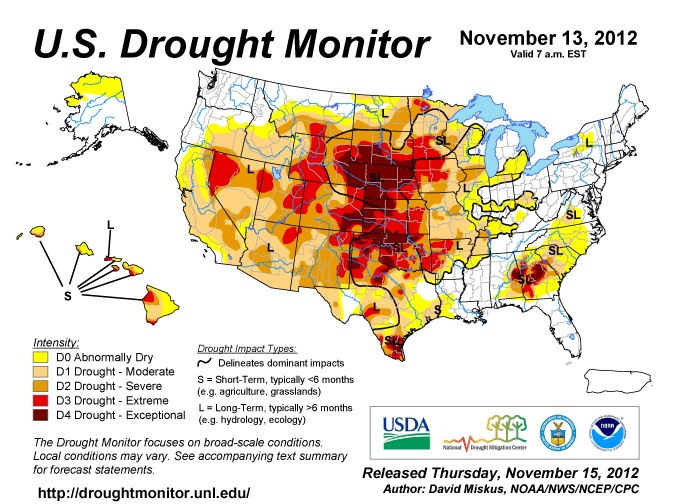 comfort from the US gains and rallied in sympathy making gains on the day. The parched US Plains continue to receive little in the way of rain and the outlook for the winter wheat crop does not improve right now. Similarly, the Russian wheat growing regions remain dry with little in the way of rain in the forecast. In contrast UK and northern European wheat growing regions are suffering from too much moisture and consequent delays; it seems that global wheat prospects for the 2013 harvest are on the back foot right from the outset.
It has been yet another intriguing week following last Friday’s USDA report. We thought we would look at some of the seeming anomalies arising from the detail and see where they pointed us.

We would not wish to be considered arrogant in our opinion, preferring the title of “challenging” in our interpretation of the reported data. Clearly, time will tell if our thought process is on the right track or not.
Aside from the review of last week’s report we have had “confirmation” (once again) of Ukraine’s cessation of exports effective 1st December. Where this will leave those who have shipments scheduled after that date is anyone’s guess right now but we would not wish to be holders of such contracts today. As we write this, it appears that wheat exports from the region are getting priority and corn shipments are dangerously close to going into default as a consequence.
This week’s EU total wheat export licenses reached a whopping 750,000 mt, the largest figure since the Russian export embargo in September 2010 when the figure hit 1 million mt. The cumulative figure now stands at 7.3 million mt a full 6.5% greater than the same time last year. Pressure is clearly in place for this export pace to continue due to limited supplies from elsewhere, we suspect this week’s “optional origin” purchase of 400,000 mt by Algeria is likely coming from France. Hopefully this adds credibility to our earlier comment on the need for greater corn imports to fill the growing gap in feed requirements.
One further point for consideration was the news on Wednesday that the US Army Corps of Engineers are about to proceed with plans to reduce the flow of water from the upper reaches of the Missouri river reservoirs in an effort to preserve water stocks in a drought related conservation measure. The impact of this measure is to potentially lower the water levels in the Mississippi between St Louis and Cairo, Illinois at a time when water levels are already low following the summer long drought. The prospect of barge traffic being halted as a result is believed to be very real and the stranglehold this will place upon grain exports is not to be underestimated. Measures to keep the waterway open for longer, such as dredging and removal of obstructions, are being discussed but concerns are rising. There are on-going discussions as to the legality of the measure, which we will watch with interest.
Once again we have had a week where we have seen a decline in prices, which we find hard to justify based upon fundamental news and information. Under the circumstances we continue to recommend keeping cover at high levels and using dips to top up as necessary.
CBOT markets settled lower as fund selling capped soybean rallies and capping corn prices leaving wheat to trade in a narrow range. Support from outside markets was lacking and resulted in a dull day!
The EU granted 750,000 mt wheat export licenses bringing the total to 7.3 million mt or 6.5% more than the same time last year. The weekly total is the highest since the 1 million mt granted in the last week of September 2010 after the Russian export embargo came into force. We see the pace of exports continuing to remain brisk based on reduced available supplies elsewhere; which can only continue to exacerbate and heighten the critical end stock position we are facing. Algeria’s 400,000 mt “optional origin” wheat purchase is thought to be French illustrating the point. On the back of this information it would seem unlikely that any fall in EU wheat futures prices will be long lasting and should help to support non EU origins as well.
The Ukrainian position on wheat exports continues to fascinate, seemingly the Ukraine government has advised Egypt (and others) that it will no longer export wheat after the year end. This, it would seem, will lead to cancellations of shipments in the new year. Additionally, this is placing more emphasis upon wheat exports from the region, at the expense of corn shipments which face potential defaults as a consequence.
The US drought monitor continues to display “exceptional drought” across the US Plains leaving the recently sown winter wheat crop struggling in the dry conditions.
In the southern hemisphere we continue to watch the Australian and Argentine crops with a degree of despondency. Not only is output under pressure but quality, too, is suffering. Without doubt the ability of the southern hemisphere to export at last year’s levels is behind us and the question now is, “what will they be able to provide.”
The upshot of all of this, with six months remaining in the northern hemisphere marketing year, is that demand will likely switch to the US in quick time, and we expect Egypt to return to the market very soon; the awards made will be watched closely to see the direction.
Today heralds a “new” item of news with reports that the US Army Corps of Engineers are about to proceed with plans to reduce the flow of water from the upper reaches of the Missouri river reservoirs in an effort to preserve water stocks in a drought related conservation measure. The impact of this measure is to potentially lower the water levels in the Mississippi between St Louis and Cairo, Illinois at a time when water levels are already low following the summer long drought.
The prospect of barge traffic being halted as a result is believed to be very real and the strangle-hold this will place upon grain exports is not to be underestimated. Measures to keep the waterway open for longer, such as dredging and removal of obstructions, are being discussed but concerns are rising. There are ongoing discussions as to the legality of the measure which we will watch with interest.
The USDA’s crop progress report, issued yesterday, is highlighted below:
US SOYBEANS – 96 PCT HARVESTED VS 93 PCT WK AGO VS 93 PCT 5-YR AVG
US WINTER WHEAT CONDITION- 36 PCT GOOD/EXCELLENT, 39 PCT WK AGO, 50 PCT YR AGO
US WINTER WHEAT – 95 PCT PLANTED VS 92 PCT WK AGO VS 94 PCT 5-YR AVG
US WINTER WHEAT – 79 PCT EMERGED VS 73 PCT WK AGO VS 81 PCT 5-YR AVG
The key statistic, to our mind, is the ongoing reduction in wheat condition, good/excellent classification down by 3% wow; at the same time the poor to very poor rating increased to 22%, up from 19% a week ago. We need not remind anyone of the need for global wheat crops to perform in the coming year to make up for this year’s poor showing.
Soybeans have gained ground today following the higher than expected US crush figures for October; these came in at 153.5 million bu well above trade estimates and 12.4 million bu above the same period last year. It is also the third highest October figure on record. The combined Sep/Oct figure is 9% higher than last year which flies in the face of the USDA’s forecast decline this year. Clearly the price rationing needed to allow the crop to last is not yet underway. The potential for explosive upside in prices remains high on our agenda.
We received news today of New Energy Corp, US based ethanol producer of nearly 30 years standing with a capacity of 100 million gallons of ethanol per year, filing for Chapter 11 bankruptcy. Their president blamed drought, poor corn harvest, higher corn prices, high ethanol supply, low ethanol pricing and low gasoline demand for their demise. He added that they were not the only producer facing tough times and a challenging industry situation.
In terms of good news, Strategie Grains estimate the EU 2013 soft wheat crop at 136 million mt, an increase of 10.6% over weather reduced 2012. The increase is attributed to an increased area of 23.6 million ha (up 3.5%), and based upon yields at 5.7 mt/ha compared to 2012 yield which stands at 5.4 mt/ha. Clearly the UK and northern French crops have to be planted, conditions continue to be challenging due to waterlogged fields in many places.
The morning started in fine “turnaround” style with higher levels seen from the outset on a technical bounce from Friday and Monday losses, but this was not maintained as fund liquidation of soybeans resumed and dragged wheat and corn lower.
Soybeans broke below the $14 mark as prices search for a base and the technical sell stops were hit. Corn, on the other hand, found some price support from October lows which lifted values somewhat; whether they are robust enough to last remains to be seen.
We have had confirmation that bio-ethanol producer, Ensus, is utilising corn to boost starch levels in an effort to restore yields to more realistic levels. This follows hot on the heels of new year corn purchases by feed manufacturers who are finding better nutritional value in the imported grain.
UK wheat trade statistics show larger than expected September exports although these are likely to be “old business” committed well before harvest issues intervened. Spain appear to be the largest recipient of the UK shipments. However, it would seem unlikely that the situation will continue with imports expected to rise significantly from previous years.
CBOT markets all started lower today following Friday’s USDA report induced selling. The pace of selling picked up and spilled over into Europe as MATIF dropped €7 in the largest single day loss since late last July. Buyers ran away, preferring to find better value another day.
We rarely mention MATIF corn; however, following Paris wheat losses and CBOT corn declines it was little wonder that Paris corn prices followed lower, albeit in limited volume. Cash demand from consumers in deferred positions was lively but sellers ideas remained firm on limited offers. The EU physical tightness is starting to become much more evident and with no volume offers from S America it looks as if European buyers are going to struggle to fulfil their needs.
Fundamentally, the markets should be trading higher but fund sellers have turned tail and are exiting positions which is causing “contagion” selling at present dragging prices lower. The market does feel oversold right now and we look for a “trigger” to reverse the current downward momentum.
London wheat closed higher again, albeit off the highs, but the May ’13 contract managed to set another record high earlier in the session; this being the fourth day in a row this has happened. The May contract has risen by over £20.00/mt within a four week time frame and new crop prices approach the £200.00/mt mark as UK and northern France experience delays in sowing due to wet conditions in the fields.
The surge in EU prices is a reflection of tight global supplies, not only wheat but all feed grains, as we have reported here in recent weeks. EU corn import licenses have reached 2.1 million mt, well above USDA forecasts, and more than double last year’s level. This comes as no surprise given the pace of grain exports and paves the way for ongoing strong import volumes over the remainder of the season, potentially pressuring Ukraine, US and S American supplies and pushing prices higher still.
It would appear that there is still a significant amount of physical cover to be taken by UK consumers in the New Year, albeit many have futures hedges in place to limit upside risks.
Friday’s USDA report, to be issued at 13:30 UK time, left US markets in a reflective state on Thursday with little in the way of direction as market participants awaited fresh news and possibly direction.
Once again the market is very much wheat focussed with Paris hitting new highs as technical chart based buying from funds was evident along with decent cash demand from non EU buyers and a drop in the Euro as Greece passed its austerity measures.
The EU has to begin the job of rationing; either domestic prices have to rise to close the export channel or the export price has to rise to switch demand away from EU origin. Neither of these scenarios are playing out right now! The upshot of this means that significant corn imports will be required to meet demand (which will be enlarged as a result of growing wheat exports) later this season, and EU buyers would seem to have “missed the boat” as both Ukraine and S American premiums have risen on limited EU buying. When the buying kicks in, (notice we didn’t say “if the buying kicks in”) the impact on prices is likely to be significant.
Friday’s USDA report looms large, and we (alongside many others) do not expect the figures to reflect our view on corn yield or carryout stock. Our views on the Argentine crop, Ukraine exports and potential EU imports which we have reported here in recent weeks point towards a changing global corn perspective which will drive prices higher and demand towards an already tight US.